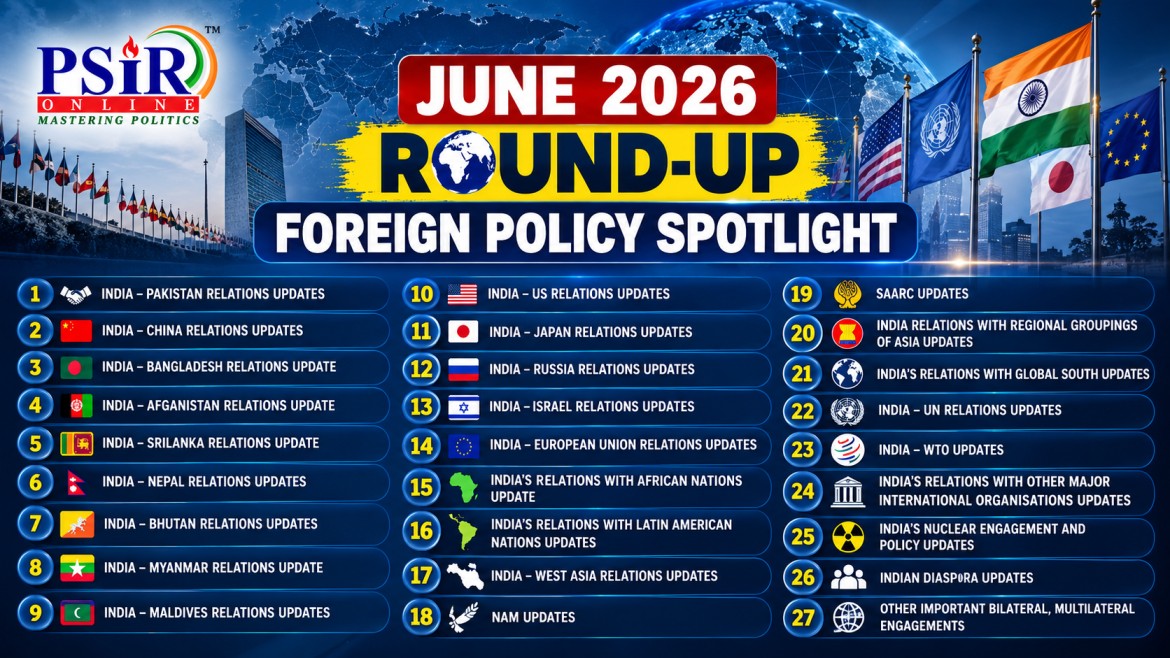
1. INDIA – PAKISTAN RELATIONS UPDATES
Key Developments in June 2026
1. Indus Waters dispute intensifies: On 11 June, Union Water Resources Minister C.R. Patil said India was working to ensure that “not a single drop” of water would flow to Pakistan in the coming years. Pakistan strongly rejected the statement and warned that any attempt to block water could have serious consequences.
2. India advances water-diversion planning: India had moved ahead with planning for a tunnel project to transfer Chenab water towards the Beas basin, alongside work on existing hydropower infrastructure following the suspension of the Indus Waters Treaty.
3. Limited Track-II engagement: Indian and Pakistani representatives participated in unofficial Track-II discussions in Colombo and Bangkok in late June, focusing on crisis-management mechanisms, terrorism and water issues. However, India's Foreign Secretary clarified that these meetings did not represent the Government of India.
Overall Situation
India–Pakistan relations remained strained and without formal bilateral dialogue. The Indus Waters issue emerged as an increasingly prominent source of tension, while unofficial Track-II contacts provided a limited channel for discussing crisis management.
Bottom line:
No major breakthrough. June saw continued diplomatic and strategic deadlock, with the Indus Waters dispute becoming the principal bilateral flashpoint, while limited unofficial contacts indicated an effort to preserve channels for crisis management.
2. INDIA – CHINA RELATIONS UPDATES
June 2026 witnessed further movement towards gradual normalisation in India–China relations, particularly through the resumption of border trade and the Kailash Mansarovar pilgrimage. However, the underlying boundary question remained unresolved.
Key Developments in June 2026
1. Resumption of India–China border trade:
Border trade through Lipulekh Pass resumed on 26 June 2026 after a six-year interruption. The first group of Indian traders crossed into the Tibet Autonomous Region, marking an important practical step in restoring border economic activity.
2. Kailash Mansarovar Yatra resumes through Nathu La:
The first batch of Indian pilgrims crossed into China through Nathu La on 20 June, marking the resumption of the pilgrimage route and adding a people-to-people dimension to the improving bilateral relationship.
3. Progress towards normalisation:
These developments followed the May 2026 WMCC discussions, where both sides had noted that peace and tranquillity along the border was enabling gradual normalisation and had discussed border management, delimitation and cross-border cooperation.
Overall Situation
The relationship showed incremental improvement in practical engagement, particularly in trade and pilgrimage. However, this should not be interpreted as a settlement of the boundary dispute; the LAC and broader boundary question remained unresolved.
Bottom line:
June witnessed further practical normalisation, but not a breakthrough on the core boundary dispute. Border trade and pilgrimage resumed, providing confidence-building signals in India–China relations.
3. INDIA – BANGLADESH RELATIONS UPDATE
June 2026 saw some movement towards practical engagement, particularly on border management and consular/travel issues, but no major political breakthrough. At the same time, border-management disputes and mistrust remained important constraints.
Key Developments in June 2026
1. High-level India–Bangladesh border talks:
The 57th BSF–BGB Director General-level conference (8–11 June) in New Delhi reviewed border deaths, illegal/forcible crossings, smuggling and human trafficking. Both sides agreed to strengthen coordinated patrols, real-time information sharing and joint action against trans-border crime. A Joint Record of Discussions was signed.
2. Diplomatic friction over cross-border movements:
Concerns over alleged “push-ins”/forcible crossings remained a sensitive issue. Bangladesh raised objections and sought adherence to existing bilateral mechanisms for the repatriation of persons identified as Bangladeshi nationals.
3. India moves towards restoring regular visa services:
India announced the resumption of regular travel-visa services for Bangladeshi nationals from 28 June, signalling an effort to restore people-to-people connectivity after restrictions during the period of strained bilateral relations.
Overall Situation
June reflected a cautious recalibration rather than a full reset. Security agencies demonstrated willingness to cooperate on border management, while visa normalisation provided a modest opening for broader bilateral engagement. However, migration-related disputes and continuing political mistrust remained unresolved.
Bottom line:
No major breakthrough, but practical engagement improved modestly. Border-security cooperation and the restoration of visa services were positive steps, while migration and trust-related issues continued to constrain the relationship.
4. INDIA – AFGANISTAN RELATIONS UPDATE
No major diplomatic breakthrough occurred in June 2026. However, India continued to deepen its engagement with Afghanistan through humanitarian assistance, healthcare support and diplomatic coordination, reaffirming its policy of supporting the Afghan people and regional stability.
Key Developments in June 2026
1. India strengthens humanitarian and healthcare assistance:
India supplied 5 tonnes of essential medicines to Kabul on 17 June, while also providing medical equipment including neonatal and paediatric-care devices, ventilators, patient monitors and specialised medical kits to Afghan health authorities.
2. India reiterates its Afghanistan policy at the UN:
At the UN Security Council briefing on Afghanistan on 8 June, India reaffirmed its support for Afghanistan's peace, stability and development, highlighting its humanitarian assistance and development partnership. India also stressed the importance of Afghanistan's sovereignty and regional stability.
Overall Situation
India's engagement with Afghanistan in June remained centred on humanitarian assistance, development cooperation and calibrated diplomatic engagement, rather than formal political recognition or a major new strategic agreement.
Bottom line:
No major breakthrough, but India's humanitarian and development-oriented engagement with Afghanistan remained active and consistent.
5. INDIA – SRILANKA RELATIONS UPDATE
June 2026 witnessed continued strengthening of India–Sri Lanka maritime, defence and economic cooperation, with no major political breakthrough but several practical initiatives reinforcing the bilateral partnership.
Key Developments in June 2026
1. INS Sharda strengthens maritime cooperation:
Indian Navy ship INS Sharda visited Colombo from 10–13 June, conducting professional exchanges and capacity-building activities with the Sri Lankan Navy, including training in firefighting, first aid and rescue procedures. The visit reinforced maritime security and interoperability under the MAHASAGAR vision.
2. India provides military assistance to Sri Lanka:
On 16 June, India handed over military stores and a trauma-care system worth over US$5 million to the Sri Lankan Army under India's grant assistance programme. The equipment was transported aboard INS Sharda.
3. Push for greater use of local currencies in bilateral trade:
The Indian High Commission in Colombo organised a “Rupee to Rupee” roundtable on 15 June, bringing Indian and Sri Lankan policymakers, banks and businesses together to discuss expanding INR–LKR trade settlement and strengthening the bilateral commercial corridor.
Overall Situation
India–Sri Lanka ties continued to deepen through maritime security cooperation, defence assistance and economic integration. June's developments were largely practical rather than political, building on the high-level engagement earlier in 2026.
Bottom line:
No major breakthrough, but the partnership continued to consolidate, particularly in maritime security, defence capacity-building and economic connectivity.
6. INDIA – NEPAL RELATIONS UPDATES
June 2026 witnessed a clear diplomatic reset and renewed high-level engagement between India and Nepal following Nepal’s new government taking office. The month saw senior political and foreign-ministerial contacts, along with concrete progress in digital payments, legal cooperation and development partnership.
Key Developments in June 2026
1. High-level political engagement with Nepal’s new government:
Rastriya Swatantra Party chairman Rabi Lamichhane met Prime Minister Narendra Modi on 3 June, with India expressing its readiness to work with Nepal’s new government to strengthen the multifaceted relationship.
2. Nepal Foreign Minister’s visit and new agreements:
Nepalese Foreign Minister Shisir Khanal visited India from 5–7 June and held talks with EAM S. Jaishankar. Both sides reviewed connectivity, trade and transit, energy, development cooperation and people-to-people ties. India and Nepal also completed internal procedures for the Mutual Legal Assistance Agreement in Criminal Matters.
3. UPI–NPI linkage launched:
India and Nepal launched a peer-to-peer linkage between India's UPI and Nepal's National Payments Interface (NPI) to facilitate cross-border personal remittances. An MoU was also signed between Digital India Bhashini and Kathmandu University for a voice-first language translation platform.
4. Cross-border connectivity reviewed:
India and Nepal reviewed progress on major cross-border railway projects, including the Raxaul–Kathmandu railway link, during meetings in Kathmandu on 11–12 June.
Overall Situation
June marked a renewed phase of high-level engagement after Nepal's political transition. The relationship moved beyond routine diplomatic contacts towards practical cooperation in digital payments, legal assistance, connectivity, energy and development. At the same time, longstanding issues such as the boundary question remained unresolved.
Bottom line:
June witnessed a significant positive reset in India–Nepal engagement, with the new government in Kathmandu signalling closer cooperation and several concrete initiatives giving the relationship a practical dimension.
7. INDIA – BHUTAN RELATIONS UPDATES
No major breakthrough occurred in June 2026. However, India–Bhutan cooperation continued to deepen through education, digital connectivity and development cooperation, reflecting the steady institutional character of the bilateral relationship.
Key Developments in June 2026
1. Education and institutional engagement:
Bhutan's Minister of Education and Skills Development, Lyonpo Yeezang De Thapa, visited India in June for bilateral discussions and visits to Indian educational institutions. The visit reinforced cooperation in education, skills and capacity building.
2. India–Bhutan people-to-people cooperation:
The India–Bhutan Foundation held its 24th Board meeting in Leh in May and approved activities for 2026–27, including educational, cultural, scientific and technical exchanges. Although the meeting itself was in May, its programme continues into the June period; therefore, I would not make this a major June entry.
3. Digital and development connectivity:
India–Bhutan cooperation continued in areas such as digital connectivity, education and development projects, building on the extensive project pipeline under Bhutan's 13th Five-Year Plan.
Overall Situation
The relationship remained stable, close and development-oriented. June did not produce a major new strategic agreement or political shift; cooperation remained concentrated on practical sectors such as education, skills, connectivity and development partnership.
Bottom line:
No major breakthrough. India–Bhutan relations remained steady and cooperative, with June marked primarily by sectoral and institutional engagement rather than a major diplomatic development.
8. INDIA – MYANMAR RELATIONS UPDATE
June witnessed a significant strengthening of high-level India–Myanmar engagement. Myanmar President U Min Aung Hlaing made his first official visit to India from 30 May to 3 June 2026, with substantive talks held on 1 June. The visit produced concrete cooperation in connectivity, trade, scholarships and security.
Key Developments in June 2026
1. First official visit of Myanmar President to India:
Prime Minister Narendra Modi and President U Min Aung Hlaing reviewed the entire bilateral relationship, including trade, rare earths, healthcare, connectivity, heritage restoration, capacity building, maritime security and cyber security. India reiterated support for Myanmar-led efforts towards peace, stability and national reconciliation.
2. Connectivity and economic cooperation:
Both sides agreed to work towards completing the Kaladan Multi-Modal Transit Transport Project and India–Myanmar–Thailand Trilateral Highway. They also agreed to facilitate bilateral trade through the Rupee–Kyat settlement mechanism.
3. Expansion of educational cooperation:
India announced that Mekong–Ganga Cooperation scholarships for Myanmar students would increase from 36 to 100 annually from 2026.
Overall Situation
The visit gave India–Myanmar relations fresh political momentum, combining connectivity, economic cooperation, security and capacity building. For India, Myanmar remains strategically important as a bridge to Southeast Asia under Neighbourhood First, Act East and MAHASAGAR.
Bottom line:
June marked a significant strengthening of India–Myanmar engagement, with the Myanmar President's first official India visit producing concrete initiatives in connectivity, trade, education and security.
9. INDIA – MALDIVES RELATIONS UPDATES
June 2026 saw continued diplomatic and economic engagement, but no major strategic breakthrough. The most important development was the Maldivian Foreign Minister’s visit to India, which focused on giving renewed momentum to bilateral ties.
Key Developments in June 2026
1. Maldivian Foreign Minister’s visit to India:
Foreign Minister Iruthisham Adam visited India from 2–4 June and held talks with EAM S. Jaishankar. The two sides reviewed the full range of bilateral relations and discussed giving renewed dynamism to the partnership, including expanded economic and trade cooperation.
2. India–Maldives economic engagement:
The visit provided momentum to ongoing efforts to deepen trade and investment cooperation, including the proposed India–Maldives Free Trade Agreement. Formal FTA negotiations subsequently began on 29 June, continuing into July.
Overall Situation
The relationship remained on a cooperative and steadily improving trajectory, with both sides seeking greater economic engagement alongside the existing strategic and maritime partnership.
Bottom line:
No major breakthrough, but June reinforced the ongoing India–Maldives rapprochement, particularly through high-level diplomacy and the move towards deeper economic integration.
10. INDIA – US RELATIONS UPDATES
June 2026 witnessed significant movement in India–US economic and strategic engagement, particularly on the proposed Bilateral Trade Agreement. The month also saw the first meeting between Prime Minister Narendra Modi and President Donald Trump in more than a year, against the backdrop of trade tensions and the West Asia conflict.
Key Developments in June 2026
1. US–India trade negotiations intensify:
A US negotiating team visited New Delhi from 1–4 June for discussions on the proposed Bilateral Trade Agreement (BTA), covering market access, non-tariff measures, customs and trade facilitation and economic-security alignment.
2. Section 301 tariff issue:
On 3 June, India said it was engaging with the US over proposed additional tariffs arising from Section 301 investigations, while continuing parallel negotiations for the trade framework.
3. Modi–Trump meeting at the G7 Summit:
Prime Minister Modi met President Trump on 17 June in Evian. The leaders reviewed cooperation in trade, defence, strategic technologies and energy, while discussing the West Asia situation and the importance of freedom of navigation and safe shipping through the Strait of Hormuz. They also noted significant progress towards an interim trade agreement.
4. US Trade Representative visits India:
US Trade Representative Jamieson Greer visited New Delhi on 22–24 June, holding further discussions with Commerce Minister Piyush Goyal. Talks covered market access, digital trade, supply-chain resilience, non-tariff barriers and strategic sectors, with both sides reporting substantial progress.
Overall Situation
June showed intensive economic diplomacy alongside continuing strategic cooperation. The trade agreement became the central bilateral issue, while defence, technology, energy and Indo-Pacific cooperation continued. However, the agreement was not yet finalised, so the month represented significant negotiating progress rather than a completed trade breakthrough.
Bottom line:
Significant progress, but no final trade breakthrough. June was marked by intensive BTA negotiations and renewed high-level political engagement, with both sides seeking to move the relationship beyond the recent period of trade-related tensions.
11. INDIA – JAPAN RELATIONS UPDATES
No major strategic breakthrough occurred in June 2026, but India–Japan cooperation advanced in the area of climate finance, low-carbon technology and economic resilience.
Key Developments in June 2026
1. Joint Crediting Mechanism moves forward:
India and Japan adopted the Rules of Implementation for the Joint Crediting Mechanism (JCM) on 8 June 2026 under Article 6.2 of the Paris Agreement. The mechanism establishes procedures for approving projects, verifying emission reductions and transferring carbon credits, encouraging Japanese investment and technology transfer for low-carbon projects in India.
2. High-level strategic engagement:
Japanese Foreign Minister Toshimitsu Motegi met Prime Minister Narendra Modi on 26 May, just before the June period. Since this was a May event, I would not count it as a June development; it is already relevant to our May coverage.
Overall Situation
India–Japan relations remained stable and strategically important, with June's most concrete progress coming through climate and economic cooperation rather than a major political or defence initiative.
Bottom line:
No major breakthrough in June. The adoption of the JCM implementation rules strengthened India–Japan cooperation on carbon markets, clean technology and climate-related investment.
12. INDIA – RUSSIA RELATIONS UPDATES
No major breakthrough occurred in June 2026. India–Russia relations remained steady, with the partnership continuing across defence, energy, trade and multilateral platforms. The most relevant June development was the continued institutional engagement supporting this broad partnership.
Key Developments in June 2026
1. Continued economic and strategic engagement:
India–Russia cooperation remained focused on diversifying bilateral trade, strengthening investment and connectivity, and expanding cooperation beyond the traditional defence and energy sectors. India and Russia continued to work through established institutional mechanisms, including the India–Russia Inter-Governmental Commission.
2. Russia remains an important energy and defence partner:
Energy cooperation, particularly crude-oil supplies, and longstanding defence-industrial cooperation continued to remain central pillars of the relationship. India’s broader approach remained one of maintaining its strategic partnership with Russia while pursuing an independent foreign policy amid geopolitical tensions.
Overall Situation
June was essentially a continuity month rather than a breakthrough month. The relationship remained resilient, but there was no major new summit, agreement or strategic shift comparable to the high-level engagements covered in earlier months.
Bottom line:
No major breakthrough. India–Russia ties remained stable and strategically important, with defence, energy and economic cooperation continuing as the principal pillars.
13. INDIA – ISRAEL RELATIONS UPDATES
June 2026 was a highly sensitive month for India–Israel relations because of the wider war in West Asia. India maintained communication with Israel while simultaneously pursuing diplomacy with other regional actors and prioritising the safety of Indian nationals and freedom of navigation.
Key Developments in June 2026
1. India–Israel engagement amid the West Asia conflict:
As the conflict involving Israel and Iran escalated in June, India closely monitored the situation and maintained diplomatic engagement with both sides. India's approach emphasised de-escalation, dialogue and diplomacy, while protecting Indian citizens and economic interests in the region.
2. Protection and evacuation of Indian nationals:
The conflict created serious concerns for Indian nationals in the region, particularly those in Israel and Iran. India undertook measures to facilitate the movement of Indians from affected areas, making diaspora protection and crisis diplomacy an important component of its foreign-policy response.
3. Bilateral strategic cooperation continued:
Despite the regional conflict, India–Israel ties continued under the Special Strategic Partnership for Peace, Innovation and Prosperity established during PM Modi's February visit. Cooperation continued across defence, technology, agriculture, innovation and security.
Overall Situation
June was not a month of a new bilateral agreement or major economic breakthrough. Instead, the relationship was shaped primarily by the regional war and India's effort to balance its strategic partnership with Israel with its wider interests in Iran, the Gulf and the broader West Asian region.
Bottom line:
No major bilateral breakthrough. June's significance lay in crisis diplomacy, protection of Indian nationals and managing India's strategic partnership with Israel amid the wider West Asian conflict.
14. INDIA – EUROPEAN UNION RELATIONS UPDATES
June 2026 witnessed significant momentum in India’s European engagement. At the EU level, India and the EU reaffirmed the importance of quickly moving towards the signing and implementation of their recently concluded FTA. At the bilateral level, France, the UK and Germany recorded important developments in strategic, economic and technological cooperation.
Key Developments in June 2026
1. India–EU FTA: push towards implementation
Prime Minister Narendra Modi met the Presidents of the European Council and European Commission on 17 June on the sidelines of the G7 Summit. Both sides welcomed the conclusion of the India–EU FTA negotiations and stressed its early signing and implementation, particularly for expanding trade and investment and strengthening supply-chain diversification.
2. India–France: major strategic and technology outcomes
During PM Modi's 14 June visit to France, India and France adopted the India–France Innovation Roadmap 2030 and agreed to establish a Joint AI Working Group. Other outcomes included cooperation on digital science, UPI expansion in France, railways, economic security, space, health and a mechanism aimed at doubling bilateral trade over five years.
3. India–UK: CETA moves towards implementation
On 17 June, India and the UK announced that their Comprehensive Economic and Trade Agreement (CETA) would enter into force on 15 July 2026. The agreement is accompanied by the Agreement on Social Security Contributions (DCC). India subsequently undertook preparations with UK counterparts for implementation.
4. India–Germany: strategic partnership strengthened
PM Modi met German Chancellor Friedrich Merz on 17 June at the G7 Summit. The leaders reviewed the renewed India–Germany Strategic Partnership, with cooperation covering trade and investment, defence and security, green development, technology, innovation, education and mobility.
Overall Situation
June marked a substantial strengthening of India's engagement with Europe, combining the EU-level FTA with deeper bilateral partnerships. France emerged strongly in technology, AI, space and economic security; the UK in trade and social-security arrangements; and Germany in strategic and economic cooperation.
Bottom line:
June witnessed significant progress in India's European diplomacy. The India–EU FTA, India–France strategic/technology cooperation and India–UK CETA implementation preparations were the month's most important developments, while India–Germany ties also gained momentum.
15. INDIA’S RELATIONS WITH AFRICAN NATIONS UPDATE
June 2026 witnessed continued high-level India–Africa engagement, particularly with South Africa, while India also maintained its humanitarian partnership with the African Union. However, the major India–Africa Forum Summit remained postponed from May.
Key Developments in June 2026
1. INDIA–SOUTH AFRICA: HIGH-LEVEL VISIT AND TECHNOLOGY COOPERATION
South African Deputy President Paul Mashatile's visit to India, which concluded on 3 June, provided momentum to bilateral cooperation in trade, investment, defence, skills and emerging technologies. India and South Africa agreed to scale up cooperation in AI, digital infrastructure, advanced manufacturing, quantum technologies, biotechnology and hydrogen energy.
2. INDIA SUPPORTS AFRICA'S EBOLA RESPONSE
India announced support for the Africa-led response to the Ebola outbreak, including assistance to the Africa CDC, reflecting India's continued humanitarian and public-health partnership with African countries.
Overall Situation
India's engagement with Africa in June remained focused on South–South cooperation, technology partnerships, economic engagement and health diplomacy. South Africa remained an especially important partner because of its role in the Global South, BRICS and other multilateral platforms.
Bottom line:
No single continent-wide breakthrough occurred in June, but India–South Africa ties gained fresh momentum, particularly in emerging technologies, while India's health partnership with Africa remained active.
16. INDIA’S RELATIONS WITH LATIN AMERICAN NATIONS UPDATES
No major region-wide breakthrough occurred in June 2026, but India–Chile relations saw meaningful progress, particularly in critical minerals, mining technology and economic cooperation. This is directly relevant to India's efforts to diversify strategic supply chains.
Key Developments in June 2026
1. INDIA–CHILE: CRITICAL MINERALS COOPERATION
On 2 June, a senior Coal India Limited delegation met Chile's Ministry of Mining, with discussions focusing on lithium and other critical minerals, investment opportunities and cooperation in strategic resource sectors.
2. INDIA–CHILE: MINING TECHNOLOGY AND INDUSTRIAL COOPERATION
During EXPONOR 2026 in Antofagasta (8–11 June), India engaged with Chilean mining and industrial stakeholders, including discussions on sustainable mining, technology, Indian expertise and critical-mineral supply chains.
3. BROADER INDIA–CHILE ECONOMIC ENGAGEMENT
On 16 June, India and Chile discussed cooperation in financial markets, sustainable finance, investment promotion and regulatory exchanges, including possibilities for greater financial connectivity through GIFT City.
Overall Situation
June reinforced the economic and strategic-resource dimension of India–Latin America relations. Chile is particularly relevant because of its importance in lithium, critical minerals and mining, areas central to India's clean-energy and supply-chain diversification objectives.
Bottom line:
No major region-wide breakthrough. However, India–Chile cooperation on critical minerals and mining emerged as the most significant Latin American development for India in June 2026.
17. INDIA – WEST ASIA RELATIONS UPDATES
June 2026 was dominated by the West Asia war and its direct consequences for India's energy security, shipping, diaspora and regional diplomacy. India welcomed the US–Iran understanding reached on 15 June and emphasised peace, stability, freedom of navigation and uninterrupted commerce.
Key Developments in June 2026
1. India welcomes US–Iran understanding:
On 15 June, Prime Minister Narendra Modi welcomed the understanding between the US and Iran to end the conflict, stressing the need for lasting peace and stability and the restoration of freedom of navigation and commerce.
2. Strait of Hormuz and India's energy security:
The conflict severely affected shipping through the Strait of Hormuz, a vital route for India's energy supplies. India closely monitored maritime traffic and coordinated with shipping companies and Indian missions. On 15 June, the LNG carrier DISHA, carrying around 62,370 tonnes of LNG for India, safely crossed the Strait of Hormuz.
3. Protection of Indian seafarers:
India intensified measures to protect its citizens working on vessels in the Gulf region. By mid-June, more than 3,600 Indian seafarers had been safely repatriated from various locations in the Gulf.
Overall Situation
India's West Asia policy in June was shaped by crisis management and strategic balancing. New Delhi had to simultaneously protect its relations with Iran and the Gulf countries, safeguard Indian nationals and seafarers, maintain energy supplies and advocate de-escalation and freedom of navigation.
Bottom line:
June was a crisis-management month rather than a period of new bilateral breakthroughs. The West Asia war elevated energy security, maritime security, diaspora protection and strategic autonomy to the centre of India's regional diplomacy.
18. NAM UPDATES
There was no major NAM summit, ministerial meeting or India-specific NAM initiative in June 2026 that warrants separate coverage. The movement remained focused on its established agenda of sovereignty, multilateralism, development and Global South cooperation.
Key Developments in June 2026
1. NAM remained relevant amid global conflicts:
The continuing conflicts in West Asia and other regions kept NAM's traditional emphasis on sovereignty, non-use of force, peaceful settlement of disputes and multilateral diplomacy relevant. However, there was no major June institutional development requiring detailed coverage.
Overall Situation
June was essentially a low-activity month for NAM. The more significant NAM developments came earlier in 2026, while the next major India-related NAM event was scheduled for 31 August–1 September 2026 in Belgrade, marking the 65th anniversary of the first NAM summit.
Bottom line:
No major NAM development in June 2026.
19. SAARC UPDATES
June 2026 saw limited but continued functional cooperation within SAARC, particularly in energy and cultural cooperation. There was no major political initiative or breakthrough on reviving high-level SAARC processes.
Key Developments in June 2026
1. SAARC–IRENA cooperation on renewable energy:
On 1 June, the SAARC Energy Centre and the International Renewable Energy Agency (IRENA) held a virtual meeting to discuss implementation of their cooperation plan. The two sides focused on regional energy security, knowledge-sharing, capacity-building and renewable-energy cooperation.
Overall Situation
SAARC remained institutionally active at the functional level, but June did not witness a significant political development towards the organisation's broader regional revival.
Bottom line:
Limited functional cooperation continued, particularly in renewable energy and culture, but there was no major political breakthrough in SAARC during June 2026.
20. INDIA RELATIONS WITH REGIONAL GROUPINGS OF ASIA UPDATES
June 2026 saw continued Indian engagement with Asian regional institutions, particularly through SCO and IORA, while ASEAN-led mechanisms also moved forward ahead of their July ministerial meetings.
Key Developments in June 2026
1. India participates actively in SCO meetings:
India participated in several SCO ministerial-level processes in June, including the SCO Industry Ministers’ Meeting on 5 June, the Internal Affairs and Public Security Ministers’ Meeting during 4–6 June, and the SCO Conference on “Central Asia – The Core of SCO” on 12–13 June. These engagements covered regional security, economic cooperation and Central Asian connectivity.
2. India hosts IORA senior officials meeting:
India hosted the 28th Meeting of the IORA Committee of Senior Officials in New Delhi on 15–16 June under its current IORA chairship. Discussions included the organisation's future roadmap and cooperation for a peaceful, stable and prosperous Indian Ocean Region.
3. India and ASEAN-led mechanisms continued preparations:
The East Asia Summit Senior Officials’ Meeting on 9 June in Manila reviewed implementation of the EAS Plan of Action 2024–28 and discussed regional and international developments, with preparations for the July Foreign Ministers’ Meeting and November Summit. India is an EAS participating country.
Overall Situation
India's regional-grouping diplomacy in June remained focused on strategic engagement, regional security, connectivity and the Indo-Pacific/Indian Ocean architecture. The IORA chairship and SCO participation were the most substantive developments for India's foreign-policy positioning.
Bottom line:
India's engagement with Asian regional groupings remained active in June 2026, but the month did not witness a major institutional breakthrough or a significant restructuring of India's regional-grouping diplomacy.
21. INDIA’S RELATIONS WITH GLOBAL SOUTH UPDATES
June 2026 saw India continue its effort to position the Global South as a priority in global governance, particularly through its BRICS Chairship, G7 outreach and cooperation with African partners.
Key Developments in June 2026
1. India highlights Global South priorities at the G7:
At the G7 Summit in Évian on 16–17 June, Prime Minister Narendra Modi participated in the outreach sessions and said India would give voice to the aspirations of the Global South. India raised issues including inclusive and sustainable growth, energy security and the impact of geopolitical conflicts on developing countries.
2. Global South cooperation through India's BRICS Chairship:
On 23 June, while meeting National Security Advisers and senior security officials of BRICS countries, PM Modi stated that India's BRICS Chairship would focus on practical cooperation and the priorities of the Global South, including terrorism, cybersecurity and emerging technologies.
3. India supports Africa-led health response:
India announced support for the Africa-led response to Ebola, reinforcing its development-partnership approach towards African countries and its broader engagement with Global South health challenges. The initiative was listed by the MEA among its June 2 developments.
Overall Situation
India's Global South diplomacy in June combined multilateral advocacy with practical cooperation. The G7 outreach provided a platform for India to articulate developing-country concerns, while the BRICS Chairship offered an institutional mechanism for advancing cooperation among emerging and developing economies.
Bottom line:
June 2026 reinforced India's role as a voice for Global South concerns, particularly through the G7 outreach and India's BRICS Chairship.
22. INDIA – UN RELATIONS UPDATES
India's engagement with the United Nations in June 2026 was particularly visible through UN peacekeeping, the Women, Peace and Security agenda and India's continued contribution to UN peace operations.
Key Developments in June 2026
1. Indian Army officer receives UN Military Gender Advocate of the Year Award:
On 5 June, Major Abhilasha Barak was named the 2025 UN Military Gender Advocate of the Year for her work with the United Nations Interim Force in Lebanon (UNIFIL), including promoting gender-responsive peacekeeping and the Women, Peace and Security agenda. The award highlighted India's contribution to UN peacekeeping.
2. India remains a major contributor to UN peacekeeping:
As of June 2026, India was contributing 4,254 uniformed personnel to UN peacekeeping operations. Indian personnel continued to serve in missions including UNISFA in Abyei, where Indian peacekeepers were involved in civilian protection and community engagement.
Overall Situation
India's UN engagement in June 2026 continued to centre on peacekeeping, international peace and security, gender-responsive peace operations and multilateral diplomacy. The month did not bring a major breakthrough on long-standing issues such as UN Security Council reform, but India's substantial peacekeeping contribution remained an important component of its UN engagement.
Bottom line:
June 2026 reflected continuity in India's active engagement with the United Nations, particularly through peacekeeping and multilateral security diplomacy.
23. INDIA – WTO UPDATES
June 2026 witnessed a significant development in India's WTO dispute-settlement engagement, with a WTO panel being established to examine China's challenge to India's measures concerning solar cells, solar modules and certain information technology goods.
Key Developments in June 2026
1. WTO panel established on China's challenge to India's solar and IT measures:
On 23 June, the WTO Dispute Settlement Body agreed to China's second request for the establishment of a panel concerning India's measures affecting solar cells, solar modules and certain information technology goods. China alleges that some of India's tariff measures and domestic-content-related incentives are inconsistent with WTO rules. India stated that it had already demonstrated the WTO compatibility of the measures during consultations and regretted China's decision to proceed with the panel request. Several WTO members reserved their rights to participate as third parties.
2. WTO dispute-settlement reform remained under discussion:
The 23 June DSB meeting also included discussions on reform of the WTO dispute-settlement system, including the continuing vacancy of the Appellate Body. India participated in the wider WTO process concerning restoration of a functioning dispute-settlement mechanism.
Overall Situation
June 2026 brought India's WTO engagement into sharper focus through the China–India dispute over solar and IT measures, alongside the broader debate over reform of the WTO dispute-settlement system.
Bottom line:
The establishment of a WTO panel on China's challenge to India's solar and IT measures was the principal India–WTO development in June 2026.
24. INDIA’S RELATIONS WITH OTHER MAJOR INTERNATIONAL ORGANISATIONS UPDATES
June 2026 saw India deepen its engagement with major international institutions, particularly through World Bank financing for India's reform and job-creation agenda and India's participation in the International Labour Organization's 114th International Labour Conference.
Key Developments in June 2026
1. World Bank approves $1.5 billion financing for India:
On 18 June, the World Bank approved $1.5 billion in financing to support India's structural reforms aimed at strengthening the business environment, expanding trade and investment openness, mobilising private capital and promoting private-sector-led job creation. The operation forms part of the World Bank Group's Country Partnership Framework for India for FY2026–31.
2. India engages with the ILO on labour reforms and social protection:
India participated in the 114th International Labour Conference in Geneva in June. India's delegation highlighted the country's labour reforms, social protection expansion, digital public infrastructure and future-oriented skilling. India also discussed strengthening cooperation with the ILO on decent work, social justice and international labour mobility.
3. India takes part in the Global Coalition for Social Justice:
During the ILO conference, India reaffirmed its commitment to the Global Coalition for Social Justice, an ILO-established multistakeholder platform aimed at strengthening international cooperation on social protection, inclusive growth and equitable labour markets.
Overall Situation
India's engagement with major international organisations in June 2026 centred on development financing, labour reforms, social protection and inclusive growth. The engagements also reflected India's effort to connect domestic reform priorities with wider international cooperation.
Bottom line:
June 2026 witnessed substantive engagement between India and major development and labour institutions, particularly the World Bank and ILO, without a major institutional shift in India's multilateral approach.
25. INDIA’S NUCLEAR ENGAGEMENT AND POLICY UPDATES
June 2026 saw India continue to strengthen its indigenous nuclear-energy programme, while maintaining its established position in favour of the peaceful use of nuclear energy and responsible non-proliferation.
Key Developments in June 2026
1. Expansion of India's fast breeder reactor programme:
On 19 June, BHAVINI organised an Industry Partnership Conclave in Mahabalipuram to develop partnerships for the expansion of India's Fast Breeder Reactor (FBR) programme. The development followed the achievement of criticality by the Prototype Fast Breeder Reactor (PFBR) at Kalpakkam, marking an important stage in India's three-stage nuclear-energy programme.
2. India continues to emphasise peaceful nuclear cooperation:
India's nuclear policy continued to emphasise the peaceful applications of nuclear technology, nuclear safety and international cooperation, including through its 2026 chairmanship of the IAEA's Regional Cooperative Agreement (RCA). India assumed the RCA chairmanship earlier in 2026, with the arrangement promoting peaceful nuclear applications for development across the Asia-Pacific region.
3. West Asia nuclear crisis reinforces India's non-proliferation concerns:
The June conflict involving Iran and the wider West Asian region brought nuclear non-proliferation back into India's strategic environment. On 15 June, India welcomed the US–Iran understanding aimed at ending the conflict and emphasised peace, stability and freedom of navigation.
Overall Situation
India's nuclear policy in June 2026 reflected two parallel priorities: expansion of domestic nuclear-energy capacity through indigenous technologies, particularly fast breeder reactors, and continued engagement with international mechanisms concerned with the peaceful use and responsible management of nuclear technology.
Bottom line:
June 2026 reinforced India's emphasis on nuclear-energy expansion, technological self-reliance and peaceful nuclear cooperation, while developments in West Asia kept nuclear non-proliferation an important part of India's strategic environment.
26. INDIAN DIASPORA UPDATES
June 2026 saw direct high-level engagement between the Indian government and the Indian diaspora, particularly during Prime Minister Narendra Modi's visit to France, where the diaspora was discussed as an important component of India–France people-to-people relations.
Key Developments in June 2026
1. Prime Minister addresses Indian community in Paris:
On 18 June, Prime Minister Narendra Modi addressed the Indian community in Paris during his visit to France. He highlighted the contribution of the Indian community to France and its role in strengthening India–France relations, particularly through students, professionals, tourism, innovation and economic connections. He also invited the diaspora to contribute to India's development and noted measures to facilitate greater mobility between the two countries.
2. Indian diaspora in Kuwait during the West Asia crisis:
On 9 June, during his conversation with the Amir of Kuwait amid the escalating West Asia crisis, Prime Minister Modi specifically thanked the Kuwaiti leadership for its attention to the safety and well-being of the large Indian community in Kuwait. This reflected India's diplomatic focus on protecting its diaspora during the regional crisis.
Overall Situation
June 2026 highlighted two dimensions of India's diaspora policy: diaspora engagement as a component of bilateral relations and protection of Indian citizens abroad during regional crises. The Paris interaction provided a direct example of community diplomacy, while the Kuwait engagement demonstrated the importance of diaspora protection in India's foreign-policy response to the West Asia crisis.
Bottom line:
India's official diaspora engagement in June 2026 combined community outreach with protection of Indian citizens abroad, reflecting the diaspora's growing role in India's diplomatic and people-to-people relations.
27. OTHER IMPORTANT BILATERAL, MULTILATERAL ENGAGEMENTS
June 2026 saw India pursue important bilateral engagements beyond the major relationship-specific and regional-grouping sections, particularly with Australia, Canada and the United Kingdom.
Key Developments in June 2026
1. India–Australia defence cooperation gains further momentum:
On 1 June, Defence Minister Rajnath Singh and Australian Deputy Prime Minister and Defence Minister Richard Marles co-chaired the second India–Australia Defence Ministers’ Dialogue in New Delhi. The two sides discussed strengthening defence-industrial cooperation, collaboration in futuristic technologies and greater cooperation for a free, peaceful and prosperous Indo-Pacific.
2. India–Canada strategic partnership receives fresh momentum:
Prime Minister Narendra Modi and Canadian Prime Minister Mark Carney met on 16 June on the sidelines of the G7 Summit. They welcomed the positive momentum in bilateral relations and reviewed economic cooperation, including commercial arrangements involving LNG, LPG and metallurgical coal, as well as resilient supply chains and energy and food security.
3. India–UK economic partnership moves towards implementation:
India's Commerce and Industry Minister Piyush Goyal visited the UK from 25–27 June, including discussions with UK Business and Trade Secretary Peter Kyle. The visit took place ahead of the scheduled 15 July 2026 entry into force of the India–UK Comprehensive Economic and Trade Agreement (CETA) and the accompanying Double Contribution Convention.
Overall Situation
June 2026 witnessed continued expansion of India's bilateral engagement beyond its major strategic relationships, with defence cooperation with Australia, economic and strategic engagement with Canada, and preparations for implementation of the India–UK trade agreement forming notable developments.
Bottom line:
India's June 2026 foreign-policy engagement included renewed bilateral activity with Australia, Canada and the UK, particularly in defence, economic cooperation and strategic partnerships.
