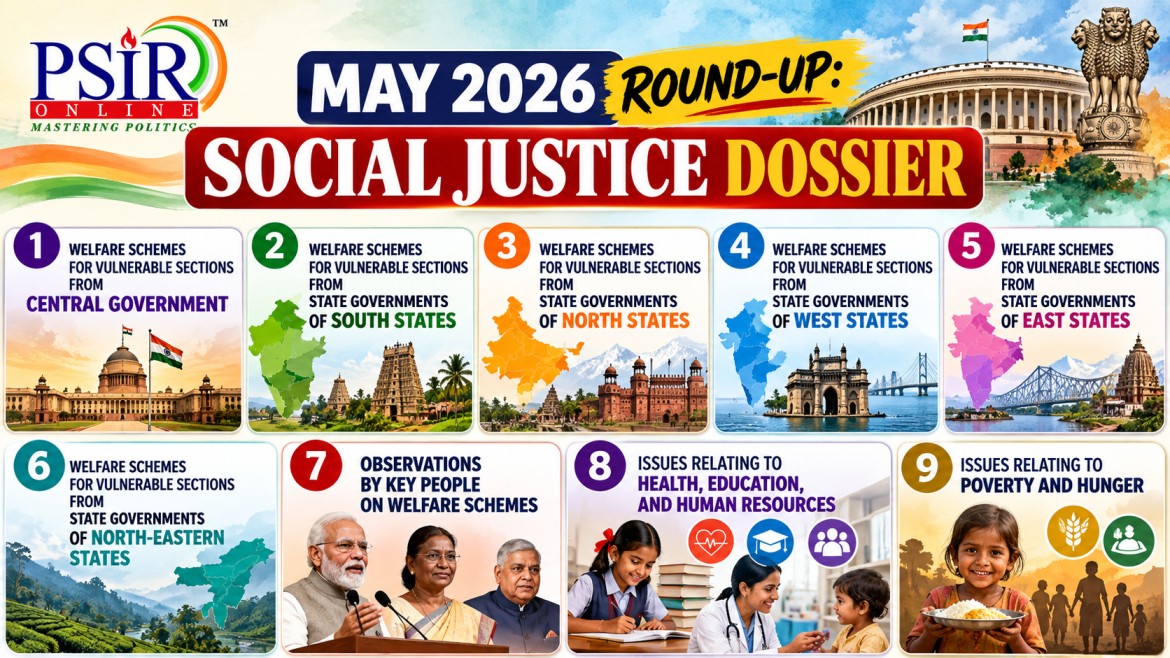
1. WELFARE SCHEMES FOR VULNERABLE SECTIONS FROM CENTRAL GOVERNMENT
A. JEEVAN APP FOR SENIOR CITIZENS — MAY 2026
The Ministry of Social Justice and Empowerment launched JEEVAN (Joint Elderly Empowerment & Virtual Assistance Network) on 22 May 2026.
It is a digital platform designed specifically for senior citizens. It provides information about government welfare schemes, welfare programmes, emergency assistance and support services, and senior citizen homes supported by the Department of Social Justice and Empowerment.
Along with JEEVAN, the government also launched SHATAYU (Senior Holistic Care Assistance and Training For Your Utility), a dashboard intended to strengthen the geriatric caregiving ecosystem. It provides information about the availability of trained geriatric caregivers across districts and States.
Why it matters for UPSC:
India's ageing population is creating a growing need for elderly healthcare, social security, assisted living and caregiving services. JEEVAN and SHATAYU represent a shift towards using technology to improve access to welfare and elder-care services.
B. PM-AJAY PORTAL AND AJAY MOBILE APP — MAY 2026
On 26 May 2026, the Ministry of Social Justice and Empowerment launched the PM-AJAY Portal and AJAY Mobile App for better implementation of the Pradhan Mantri Anusuchit Jaati Abhyuday Yojana (PM-AJAY).
PM-AJAY is aimed at improving the socio-economic conditions of Scheduled Castes. Its major components include Adarsh Gram, grants-in-aid for skilling and employment, and hostels in educational institutions.
The new digital system is intended to move implementation from paper-based processes to end-to-end digital processing, with real-time monitoring, transparent governance and milestone-linked fund flow.
Important clarification for students:
The PM-AJAY scheme itself is not new in May 2026. What is new is the PM-AJAY Portal and AJAY App, which seek to improve implementation and monitoring of the existing SC welfare programme.
C. VB–G RAM G — NEW RURAL EMPLOYMENT FRAMEWORK
On 11 May 2026, the Central Government notified the implementation of the Viksit Bharat – Guarantee for Rozgar and Ajeevika Mission (Gramin) — VB–G RAM G Act, 2025, with nationwide implementation scheduled from 1 July 2026.
It provides a statutory employment guarantee of 125 days, compared with the earlier 100-day guarantee under MGNREGA, and seeks to strengthen rural employment, livelihoods and rural infrastructure.
Why it matters for Social Justice:
Rural households dependent on wage employment are among the economically vulnerable sections. The new framework links employment security, income support and rural development.
Important: This is a new rural employment framework/law, rather than a conventional welfare scheme. So I would include it in the dossier, but clearly identify it as a major social-protection development, not call it simply a newly launched scheme.
D. ANNUAL HEALTH CHECK-UP FOR ESIC WORKERS
On 7 May 2026, the Government launched a Pan-India Annual Health Check-up Programme for insured workers aged 40 years and above under the Employees' State Insurance Corporation (ESIC).
This is particularly relevant to workers in the organised sector covered by ESIC, with a focus on preventive healthcare and early detection of health problems.
UPSC angle:
It reflects the movement from merely providing treatment towards preventive and occupational healthcare as part of social security.
E. PMGSY-IV — RURAL CONNECTIVITY FOR VULNERABLE/RURAL COMMUNITIES
On 10 May 2026, the Union Government launched PMGSY-IV in Madhya Pradesh as part of the next phase of the Pradhan Mantri Gram Sadak Yojana.
Although it is primarily an infrastructure programme, it has a strong social-justice dimension because rural roads improve access to schools, healthcare, markets, employment and government services, particularly for remote and disadvantaged communities.
2. WELFARE SCHEMES FOR VULNERABLE SECTIONS FROM STATE GOVERNMENTS OF SOUTH STATES
A. KERALA — FREE KSRTC BUS TRAVEL FOR WOMEN
The newly formed Kerala Government announced in May 2026 that women would be allowed free travel on Kerala State Road Transport Corporation (KSRTC) buses from 15 June 2026. The decision was taken at the first Cabinet meeting of the new government on 18 May.
The measure is aimed at reducing the transport burden on women and improving their access to education, employment, healthcare and other public services.
Why it matters for UPSC:
Affordable and accessible public transport is an important part of women's economic and social empowerment. Free public transport can particularly benefit women from low-income households.
Social Justice angle:
The measure seeks to reduce a practical barrier to women's mobility and participation in public life.
B. KERALA — ENHANCED HONORARIUM FOR ASHA WORKERS
In May 2026, the new Kerala Government announced an increase in the monthly honorarium of ASHA workers by ₹3,000. The decision was part of the first set of welfare measures announced by the government.
ASHA workers are community-level health workers who act as an important link between rural and vulnerable households and the public health system.
Why it matters for UPSC:
ASHA workers contribute to maternal health, child health, immunisation, disease awareness and access to healthcare.
The decision also highlights an important issue in social justice — the working conditions and remuneration of frontline care workers.
C. KERALA — DEDICATED INSTITUTIONAL FOCUS ON ELDERLY WELFARE
The Kerala Government announced in May 2026 that it would work towards establishing a dedicated ministry/departmental framework for elderly welfare, in view of the State's ageing population. The government stated that it would study international models, including Japan's experience.
Why it matters for UPSC:
Kerala has a relatively ageing population, creating increasing demand for elderly healthcare, social security, caregiving and assisted living.
This development reflects a shift from treating elderly welfare only as a pension issue towards a broader approach involving healthcare, social protection and care services.
D. ANDHRA PRADESH — INCENTIVE FOR THIRD AND FOURTH CHILD
In May 2026, Andhra Pradesh Chief Minister N. Chandrababu Naidu announced financial incentives of ₹30,000 for the birth of a third child and ₹40,000 for a fourth child. The announcement was made as part of the State's response to concerns over declining population growth and ageing.
The government also indicated that a broader “Children Are Wealth” programme would be introduced.
Why it matters for UPSC:
This represents an emerging policy shift from traditional population-control approaches towards addressing low fertility and population ageing.
Important: This was an announcement in May, so we should not present it as a fully implemented scheme unless subsequent government orders establish implementation.
E. TELANGANA — WELFARE SUPPORT FOR PERSONS WITH DISABILITIES
In May 2026, Telangana conducted a major welfare drive for persons with disabilities under its Praja Palana 99 Days Action Plan. Assistive devices included retrofitted vehicles, battery-operated tricycles, laptops and hearing aids.
The initiative focused on improving the mobility, education and economic independence of persons with disabilities.
Why it matters for UPSC:
Welfare for persons with disabilities is increasingly moving beyond financial assistance towards assistive technology, accessibility and independent living.
3. WELFARE SCHEMES FOR VULNERABLE SECTIONS FROM STATE GOVERNMENTS OF NORTH STATES
A. HIMACHAL PRADESH — INDIRA GANDHI PYARI BEHNA SUKH SAMMAN NIDHI
In May 2026, the Himachal Pradesh Government approved a monthly financial assistance of ₹1,500 for eligible women under the Indira Gandhi Pyari Behna Sukh Samman Nidhi Yojana.
Women aged 18–59 years from families with an annual income below ₹2 lakh are eligible. The first phase was expected to cover around 2 lakh women.
Why it matters for UPSC:
The scheme provides direct income support to women from economically weaker households. It can be linked with women's economic security, gender equality and social protection.
Social Justice angle:
Direct cash transfers can provide women with greater control over household resources and help reduce economic vulnerability.
B. DELHI — EXPANSION OF RATION CARD COVERAGE
In May 2026, the Delhi Government reopened applications for new ration cards after a long gap and increased the annual family-income eligibility limit to ₹2.5 lakh. Applications began from 15 May 2026.
The move is intended to bring more low-income families under the Public Distribution System (PDS) and improve access to subsidised food.
The government also undertook a verification exercise to remove invalid, duplicate and otherwise ineligible beneficiaries from the database.
Why it matters for UPSC:
This is directly connected with food security and targeted welfare delivery.
Social Justice angle:
The case highlights the challenge of balancing wider coverage with accurate beneficiary identification.
C. HARYANA — PROACTIVE DELIVERY OF SOCIAL SECURITY BENEFITS
On 8 May 2026, Haryana transferred more than ₹2,115 crore directly to the accounts of nearly 58.87 lakh beneficiaries under various welfare programmes.
The beneficiaries included recipients of old-age assistance, disability pensions and other social-security pensions, along with women beneficiaries under the Deen Dayal Lado Lakshmi Yojana.
Important: This is not a new scheme. It is a significant welfare-delivery reform/implementation development.
The State described this approach as a “Pro-Active Model”, using digital systems and DBT to deliver benefits directly to beneficiaries.
Why it matters for UPSC:
It illustrates how DBT and digital governance can reduce delays and improve welfare delivery.
D. HARYANA — DEEN DAYAL LADO LAKSHMI YOJANA: CONTINUED IMPLEMENTATION
On 8 May 2026, Haryana released the seventh instalment of the Deen Dayal Lado Lakshmi Yojana, transferring about ₹205 crore to 9.76 lakh women beneficiaries.
The scheme provides ₹2,100 per month to eligible women and is aimed at strengthening women's economic and social security.
Important for students:
The scheme itself was launched in September 2025, so it should not be presented as a new May 2026 scheme. The May development is its continued implementation and large-scale DBT delivery.
E. RAJASTHAN — DIGITAL ACCESS TO WELFARE FOR WIDOWED AND ECONOMICALLY WEAKER WOMEN
Rajasthan's Collaboration and Gift Scheme was made available through the National Government Services Portal in May 2026. The scheme integrates the Sahayog Yojana and assistance for the marriage of daughters of widowed women, providing financial support to economically weaker sections and widowed women.
Important: This should be treated as a digital service/administrative development, rather than a newly launched welfare scheme in May.
Why it matters for UPSC:
It demonstrates the increasing use of digital platforms for welfare access, particularly for vulnerable women.
F. PUNJAB — MERI RASOI YOJANA: NUTRITION SUPPORT
In May 2026, Punjab distributed ration kits under the Meri Rasoi Yojana to around 40 lakh families covered under the National Food Security Act. The kits contained items such as chana dal, mustard oil, sugar, salt and turmeric.
Important: This is a welfare implementation development, not a newly launched May scheme.
Why it matters for UPSC:
It is relevant to food security, nutrition and protection of poor households from rising household expenditure.
4. WELFARE SCHEMES FOR VULNERABLE SECTIONS FROM STATE GOVERNMENTS OF WEST STATES
A. GOA — MAHILA DIGITAL SASHAKTIKARAN YOJANA
In May 2026, the Goa Government issued a notification concerning the Mahila Digital Sashaktikaran Yojana, aimed at improving the digital skills and opportunities of women, particularly women from economically weaker and rural sections. The scheme provides free IT training and digital-awareness programmes to eligible Goan women.
Women aged 18 years and above, who have been residents of Goa for at least 15 years, can apply. Training is provided through empanelled IT Knowledge Centres and Citizen Service Centres.
Why it matters for UPSC:
Digital literacy is increasingly becoming a part of social and economic empowerment. Lack of digital skills can restrict women's access to employment, entrepreneurship and government services.
Social Justice angle:
The scheme addresses the digital divide among women and attempts to connect digital empowerment with economic opportunities.
Important: The scheme was actually notified in August 2025.
B. GUJARAT — SANKAT SAKHI DIGITAL APPLICATION FOR WOMEN
Gujarat's Department of Women and Child Development has introduced the Sankat Sakhi application to make information on women-oriented welfare and protection mechanisms easier to access. The application brings information about women-centric schemes, support centres, nearby police stations, relevant laws and safety measures into one platform. The application was updated in May 2026.
Why it matters for UPSC:
The initiative illustrates how digital governance can improve access to welfare and protection services.
Social Justice angle:
For vulnerable women, lack of awareness about available schemes and institutional support can itself become a barrier to accessing justice and welfare.
Important: This is a digital service initiative, not a new cash-transfer or conventional welfare scheme.
C. MAHARASHTRA — LADKI BAHIN: BENEFICIARY VERIFICATION AND TARGETING
Maharashtra's Mukhyamantri Majhi Ladki Bahin Yojana underwent extensive beneficiary verification through e-KYC. By May 2026, the beneficiary base had fallen substantially after verification of eligibility, including income criteria and other exclusion conditions.
Important: This is not a new scheme. The scheme was launched earlier. The May 2026 development is significant because it demonstrates the use of e-KYC and beneficiary verification to improve targeting of welfare benefits.
Why it matters for UPSC:
It raises an important social-justice question: how can governments balance inclusion of genuine beneficiaries with prevention of leakages and exclusion errors?
5. WELFARE SCHEMES FOR VULNERABLE SECTIONS FROM STATE GOVERNMENTS OF EAST STATES
A. WEST BENGAL — ANNAPURNA YOJANA: MONTHLY FINANCIAL ASSISTANCE FOR WOMEN
The West Bengal Government introduced the Annapurna Yojana in May 2026 to promote the economic empowerment and socio-economic upliftment of women. The scheme was officially notified on 20 May 2026 by the Department of Women and Child Development and Social Welfare.
Under the scheme, eligible women residents of West Bengal between 25 and 60 years of age are entitled to receive ₹3,000 per month as financial assistance. Women in permanent government employment, income-tax payers and illegal immigrants are excluded from the scheme.
The scheme is designed to provide direct income support to women, particularly those who face economic vulnerability.
Why is it important?
Direct financial assistance can strengthen women's economic security and provide them with greater control over household resources. However, long-term women's empowerment also requires access to education, employment, healthcare, skills and financial opportunities.
UPSC Mains relevance:
The scheme can be linked with women's empowerment, social protection, gender equality, direct benefit transfers and inclusive development.
B. WEST BENGAL — FREE BUS TRAVEL FOR WOMEN
The West Bengal Government announced free travel for women in all State-run buses across the State. The Transport Department issued the notification on 21 May 2026, with the scheme coming into effect from 1 June 2026.
The facility covers both short-distance and long-distance State-run buses. Women beneficiaries can obtain a Smart Card containing their photograph and a QR code. Until Smart Cards are issued, travel can be provided after verification of an eligible photo identity document.
Why is it important?
Transport costs can act as a barrier to women's participation in education, employment, healthcare and other economic and social activities. Making public transport free can therefore improve women's mobility and access to opportunities.
UPSC Mains relevance:
The measure can be linked with women's empowerment, accessibility, social inclusion, public transport and gender-sensitive welfare policies.
6. WELFARE SCHEMES FOR VULNERABLE SECTIONS FROM STATE GOVERNMENTS OF NORTH-EASTERN STATES
A. MANIPUR — RECRUITMENT OF ANGANWADI WORKERS AND HELPERS
The Manipur Government invited applications in May 2026 for the recruitment of Anganwadi Workers and Anganwadi Helpers for Anganwadi Centres across the State. The recruitment was notified on 8 May 2026 under the Integrated Child Development Services (ICDS).
Anganwadi Centres play an important role in providing supplementary nutrition, health services, preschool education and support to mothers and children.
The recruitment is significant because strengthening the Anganwadi workforce directly affects the delivery of nutrition and early-childhood services to vulnerable communities.
Why is it important?
Children from economically disadvantaged households are particularly dependent on public nutrition and early-childhood services. Adequate staffing of Anganwadi Centres can improve the reach and quality of these services.
UPSC Mains relevance:
The issue can be linked with child nutrition, maternal and child health, early childhood care, human capital formation and the role of frontline workers in welfare delivery.
B. NAGALAND — PM JANMAN AND DA-JGUA WELFARE SATURATION CAMPAIGN FOR TRIBAL COMMUNITIES
Nagaland launched an Information, Education and Communication (IEC) campaign in May 2026 under PM-JANMAN and Dharti Aaba Janjatiya Gram Utkarsh Abhiyan (DA-JGUA).
The campaign was aimed at reaching tribal communities and Particularly Vulnerable Tribal Groups (PVTGs) in remote areas and improving their access to government welfare schemes. It included village-level awareness programmes, beneficiary saturation drives, health camps, Aadhaar enrolment, welfare facilitation and grievance redressal.
The campaign was conducted in districts including Zunheboto, Longleng and Phek, with an emphasis on taking welfare services closer to remote tribal communities.
Why is it important?
The existence of a welfare scheme does not automatically ensure that vulnerable communities receive its benefits. Remote tribal populations may face barriers such as geographical isolation, lack of documentation, limited awareness and weak access to government institutions.
Therefore, saturation campaigns can help bridge the gap between welfare provision and actual welfare access.
UPSC Mains relevance:
The issue can be linked with tribal development, PVTGs, last-mile delivery, inclusive governance, social exclusion and access to public services.
C. MEGHALAYA — CM LEAD FELLOWSHIP AND DIGITAL EDUCATION INITIATIVES
Meghalaya launched the CM LEAD Fellowship and strengthened digital systems of the Meghalaya Board of School Education (MBOSE) in May 2026. The initiatives were launched in Tura on 23 May 2026.
The fellowship is aimed at strengthening educational leadership and improving the quality of school education.
Why is it important?
Improving the quality of education is particularly important for students from disadvantaged communities because public schools are often the primary route through which such students access formal education.
UPSC Mains relevance:
The initiative can be linked with quality education, human capital formation, educational inequality, teacher capacity and inclusive development.
D. MEGHALAYA — SUPPORT FOR RURAL LIVELIHOODS UNDER FOCUS+
Meghalaya continued strengthening its FOCUS+ programme, which provides direct financial assistance to farming households and supports rural livelihoods.
The programme provides an annual untied grant of ₹5,000 per farming household, credited directly to beneficiaries in two instalments. The assistance can be used for farming and production-related activities such as seeds, feed, planting material and equipment. The programme particularly supports rural households dependent on agriculture.
Why is it important?
Small and marginal farming households often face unstable incomes and limited access to productive assets. Direct livelihood support can help households invest in agricultural activities and strengthen their income base.
UPSC Mains relevance:
The programme can be connected with rural livelihoods, poverty reduction, small farmers, direct benefit transfer and inclusive growth.
7. OBSERVATIONS BY KEY PEOPLE ON WELFARE SCHEMES
A. PMEGP — STRONG PERFORMANCE IN EMPLOYMENT AND ENTREPRENEURSHIP FOR VULNERABLE GROUPS
The Prime Minister’s Employment Generation Programme (PMEGP) recorded strong performance during the 15th Finance Commission period. By May 2026, the scheme had generated 36.33 lakh employment opportunities and utilised its allocated budget of ₹13,554 crore.
The scheme has a strong social-justice dimension because women, SC, ST and OBC entrepreneurs have been among its major beneficiaries. Around 80% of PMEGP-supported units were established in rural areas, strengthening rural entrepreneurship and employment.
Why is it important?
PMEGP shows how welfare policy can move beyond direct financial assistance towards self-employment and livelihood creation. For vulnerable sections, access to credit and entrepreneurship opportunities can reduce dependence on purely consumption-oriented welfare.
UPSC Mains relevance:
It can be used to discuss employment generation, rural entrepreneurship, women's economic empowerment, inclusive growth and the shift from welfare to livelihood-based empowerment.
B. NATIONAL SOCIAL ASSISTANCE PROGRAMME — EXPANDING SOCIAL PENSION COVERAGE
A May 2026 assessment of India's pension landscape highlighted the continuing role of the National Social Assistance Programme (NSAP) in providing financial assistance to economically vulnerable sections.
As of April 2026, the Central social-pension component under NSAP covered more than 2.92 crore beneficiaries, while State Governments covered over 1.41 crore beneficiaries through their own social-pension systems and supplementary assistance. NSAP primarily supports elderly persons, widows and persons with disabilities.
The assessment also highlighted the importance of State-level top-ups because the Centre encourages States and Union Territories to supplement the central assistance.
Why is it important?
The figures demonstrate the continuing importance of social pensions as a basic social-security floor for vulnerable populations who may have limited or no regular income.
UPSC Mains relevance:
This can be used in answers on social security, ageing, disability, widowhood, poverty and the limitations of contributory pension systems for economically vulnerable citizens.
C. ONE NATION ONE RATION CARD — EXPERT OBSERVATION ON PORTABLE SOCIAL PROTECTION
The National Human Rights Commission (NHRC) organised a core-group meeting on 13 May 2026 on protecting the rights of migrant workers.
NHRC Chairperson Justice V. Ramasubramanian stressed the need for systemic reforms, inter-State coordination, portable social protection and stronger implementation of labour laws. NHRC Secretary General Bharat Lal specifically highlighted the One Nation One Ration Card (ONORC) and emphasised the need to bridge the gap between legislation and actual implementation.
The discussion also highlighted the importance of timely payment of wages so that migrant workers can access essential services such as healthcare, sanitation, housing, education for children and social-security benefits.
Why is it important?
Migrant workers frequently move across State boundaries. A welfare system that is tied to a particular place of residence can therefore exclude people who are among the most vulnerable.
UPSC Mains relevance:
This is useful for questions on migrant workers, portability of welfare benefits, One Nation One Ration Card, cooperative federalism, social security and last-mile delivery.
8. ISSUES RELATING TO HEALTH, EDUCATION, AND HUMAN RESOURCES.
A. SUPREME COURT — MENSTRUAL HYGIENE MANAGEMENT IN SCHOOLS
The Supreme Court continued its monitoring of Menstrual Hygiene Management (MHM) in schools in May 2026. On 25 May 2026, the Court considered the compliance report submitted by the Union Government and States/UTs following its earlier directions.
The report showed that States and Union Territories had taken steps to provide separate toilets for girls, sanitary napkins, disposal facilities, menstrual-health awareness and menstrual-hygiene education in schools. The Court also noted that areas such as anonymous student feedback, accessibility for children with disabilities and structured monitoring mechanisms were still under progressive implementation.
Why is it important?
Menstrual hygiene is not merely a health issue. Lack of sanitation facilities, menstrual products and awareness can affect girls' attendance, dignity, health and continuation in education.
UPSC Mains relevance:
The issue can be linked with gender equality, right to education, public health, WASH facilities, dignity and inclusive education.
B. SUPREME COURT — TET REQUIREMENT FOR SCHOOL TEACHERS
On 29 May 2026, the Supreme Court modified the timeline relating to the Teacher Eligibility Test (TET) requirement for teachers covered by the Right to Education framework.
The Court extended the deadline for acquisition of TET qualification from 31 August 2027 to 31 August 2028. It also observed that authorities should endeavour to conduct TET preferably twice a year, with approximately six months between examinations, so that teachers get reasonable opportunities to qualify.
The Court also provided protection to certain in-service teachers with less than five years of service remaining as of its earlier 2025 judgment: they may continue until superannuation without acquiring TET qualification, but they cannot receive promotion unless they obtain the prescribed qualification.
Why is it important? The judgment attempts to balance two objectives: Teacher quality through minimum professional qualifications, and continuity of service for teachers who were appointed before the RTE Act's requirements became applicable.
UPSC Mains relevance:
It can be used in answers on quality of education, teacher accountability, RTE Act, human-resource development and the tension between minimum standards and administrative practicality.
C. SUPREME COURT — MOTHER TONGUE AND THE RIGHT TO EDUCATION
In a judgment dated 12 May 2026, the Supreme Court examined the importance of mother tongue/regional language in education while considering issues connected with the Right of Children to Free and Compulsory Education Act, 2009.
The Court referred to the constitutional and policy emphasis on the use of regional languages as a medium of education and the importance of language in facilitating meaningful learning.
Why is it important?
Language can influence a child's comprehension, participation and learning outcomes. This is particularly important for children from disadvantaged backgrounds who may face additional barriers when the language of instruction is unfamiliar.
UPSC Mains relevance:
The judgment can be connected with NEP 2020, mother-tongue education, inclusive education, educational inequality and preservation of linguistic diversity.
D. RBSK 2.0 — NEW FRAMEWORK FOR CHILD HEALTH SCREENING
The Ministry of Health and Family Welfare released the Rashtriya Bal Swasthya Karyakram (RBSK) 2.0 Guidelines on 3 May 2026.
RBSK 2.0 expands the existing 4Ds approach — Defects at Birth, Diseases, Deficiencies and Developmental Delays — and introduces a broader continuum of care for children from birth to 18 years. It also gives greater importance to digitalisation and strengthened programme-delivery systems.
Why is it important?
Early identification of health problems can prevent minor conditions from becoming serious disabilities or long-term health problems.
UPSC Mains relevance:
It can be used under child health, preventive healthcare, human capital formation, early intervention and universal healthcare.
E. SEHAT — AGRICULTURE, NUTRITION AND HEALTH CONVERGENCE
The ICMR and ICAR launched SEHAT on 11 May 2026 to strengthen the connection between agriculture, nutrition and public health.
The programme focuses on areas such as biofortified crops, integrated farming systems, occupational health, prevention of non-communicable diseases and One Health preparedness.
Union Health Minister J.P. Nadda described SEHAT as reflecting a shift from a predominantly curative approach towards preventive healthcare.
Why is it important?
Health outcomes are strongly influenced by food systems, nutrition, livelihoods and the environment. Therefore, health policy cannot operate in isolation from agriculture and nutrition policy.
UPSC Mains relevance:
Useful for preventive healthcare, malnutrition, lifestyle diseases, One Health, food security and inter-sectoral convergence.
F. INTEGRATED TRAINING FOR PRIMARY HEALTHCARE TEAMS
On 8 May 2026, the Union Health Ministry launched an Integrated Training Programme for Primary Healthcare Teams under a unified, competency-driven framework.
The initiative aims to improve the capacity of frontline healthcare workers to provide people-centred and high-quality primary healthcare. The programme particularly recognises the role of ASHAs, ANMs and Community Health Officers, who together form a predominantly female frontline workforce.
Why is it important?
India's primary healthcare system depends heavily on frontline workers. Improving their skills can strengthen last-mile healthcare delivery, especially in rural and underserved communities.
UPSC Mains relevance:
The initiative can be used under primary healthcare, women workers, human resources in health, rural healthcare and capacity building.
G. VICE PRESIDENT — AIIMS AND THE IMPORTANCE OF AFFORDABLE, EMPATHETIC HEALTHCARE
At the 51st Convocation of AIIMS New Delhi on 12 May 2026, Vice President C. P. Radhakrishnan praised AIIMS for combining medical excellence with affordability and highlighted its contribution to rural healthcare outreach and medical innovation.
He also stressed that AI cannot replace the presence of a doctor at a patient's bedside and called upon medical graduates to provide healthcare with empathy and integrity.
Why is it important?
The observation highlights an important issue in the age of digital healthcare and AI: technological innovation should strengthen healthcare delivery without eliminating the human relationship between doctor and patient.
UPSC Mains relevance:
Useful for questions on AI in healthcare, medical ethics, affordability of healthcare, human resources in health and technology-human interface.
H. AI IN HEALTHCARE — EQUITY AND ETHICAL OVERSIGHT
At the 79th World Health Assembly in May 2026, Health Minister J.P. Nadda emphasised that the use of Artificial Intelligence in healthcare must be accompanied by regulation, research, ethical oversight and equity so that technological benefits reach all sections of society.
He stressed that technological advancement should remain anchored in ethics, trust and public good.
Why is it important?
AI can improve diagnosis, health records and service delivery, but unequal access to technology can create a new digital health divide.
UPSC Mains relevance:
This can be used for AI and healthcare, digital divide, ethical governance, universal health coverage and equitable access to technology.
I. UMMID — GENOMIC AND PRECISION MEDICINE FOR RARE DISEASES
On 21 May 2026, the Union Government dedicated the UMMID (Unique Methods of Management of Inherited Disorders) Programme to the nation.
The programme focuses on early diagnosis, genetic counselling and affordable healthcare for families affected by rare genetic disorders. Union Minister Jitendra Singh highlighted the growing importance of genomic and precision medicine in India's healthcare system.
Why is it important?
Rare genetic disorders often involve high diagnostic and treatment costs. Early diagnosis can help families access appropriate medical advice and reduce avoidable suffering.
UPSC Mains relevance:
Useful for rare diseases, affordable healthcare, genetic medicine, public health research and health equity.
9. ISSUES RELATING TO POVERTY AND HUNGER.
A. SARTHAK-PDS: ₹25,530 CRORE FOR STRENGTHENING FOOD SECURITY DELIVERY
On 27 May 2026, the Union Cabinet approved the continuation and integration of two major food-distribution components under an umbrella scheme called SARTHAK-PDS — the Scheme for Assistance in Ration Transport and Handling-Income with Automation in PDS. The Centre approved an outlay of ₹25,530 crore for the next five years.
The scheme brings together support for intra-State movement of foodgrains and Fair Price Shop (FPS) dealers' margins, along with technology-driven reforms under SMART-PDS.
The objective is to improve the last-mile delivery of foodgrains, strengthen Fair Price Shops and make the Public Distribution System more transparent, efficient and technology-driven.
Why is it important?
Food security does not depend only on procuring adequate foodgrains. It also depends on whether food actually reaches the intended beneficiary. Weak transportation, inadequate margins for FPS dealers and poor delivery systems can affect the effectiveness of welfare programmes.
SARTHAK-PDS therefore focuses on strengthening the delivery side of food security.
UPSC Mains relevance:
The development can be linked with food security, PDS reforms, last-mile delivery, digital governance, leakages, transparency and welfare delivery to vulnerable sections.
B. MISSION FOR ATMANIRBHARTA IN PULSES — LINKING FOOD PRODUCTION WITH NUTRITIONAL SECURITY
The Government's Mission for Aatmanirbharta in Pulses (2025–31) continued to be an important part of India's food-security strategy in May 2026. The Mission seeks to substantially increase domestic production of pulses and reduce India's dependence on imports.
Pulses are particularly important for India's nutritional security because they are an important source of protein and other nutrients, especially for households that may not be able to afford expensive sources of protein.
The Mission therefore links agricultural production, farmer income and nutritional security.
Why is it important?
Food security is not simply about the availability of calories. It also involves access to a balanced and nutritious diet. Increasing domestic pulse production can contribute to both food availability and nutritional security.
UPSC Mains relevance:
Useful for hunger, malnutrition, nutritional security, agricultural policy, food inflation, farmer welfare and sustainable food systems.
C. NATIONAL FOOD SECURITY ARCHITECTURE — FOCUS ON PORTABILITY AND LAST-MILE DELIVERY
In May 2026, the Government's food-security framework continued to emphasise portability of food entitlements and technology-based delivery through the One Nation One Ration Card (ONORC) system.
ONORC enables beneficiaries to obtain their entitled foodgrains from Fair Price Shops anywhere in the country using their existing ration card/Aadhaar authentication. This is particularly important for migrant workers, who may otherwise lose access to food entitlements when they move between States.
The system has therefore expanded the concept of food security from location-based entitlement to portable entitlement.
Why is it important?
Migrant workers are among the groups most vulnerable to interruptions in access to food and social-security benefits. Portability allows them to continue accessing food entitlements even after migration.
UPSC Mains relevance:
This can be used in answers on migrant workers, urban poverty, portability of welfare benefits, cooperative federalism, PDS reforms and inclusive social protection.
D. PM POSHAN — LINKING FOOD SECURITY WITH EDUCATION
The PM POSHAN Scheme continued to play an important role in addressing child hunger and improving educational outcomes. The programme provides nutritious cooked meals to children in Government and Government-aided schools and aims to improve their nutritional status while encouraging regular school attendance.
The scheme demonstrates that hunger and education are closely interconnected. A child facing food insecurity may also face difficulties in school attendance, concentration and learning.
Why is it important?
School feeding programmes can simultaneously address hunger, nutrition, education and social equity.
UPSC Mains relevance:
Useful for child malnutrition, hunger, human capital formation, school attendance, social justice and the interrelationship between nutrition and education.
E. FOOD SECURITY AS A SOCIAL PROTECTION FLOOR
India's food-security framework under the National Food Security Act (NFSA), 2013 continues to cover up to 75% of the rural population and 50% of the urban population. Under the framework, Antyodaya Anna Yojana households are entitled to 35 kg of foodgrains per household per month, while Priority Households receive 5 kg per person per month.
The continuing emphasis on PDS modernisation, portability and last-mile delivery in 2026 highlights an important principle of social justice: food security requires both legal entitlement and effective delivery mechanisms.
UPSC Mains relevance:
This can be used to discuss right to food, hunger, poverty, social protection, welfare delivery and the role of the State in ensuring basic human needs.
