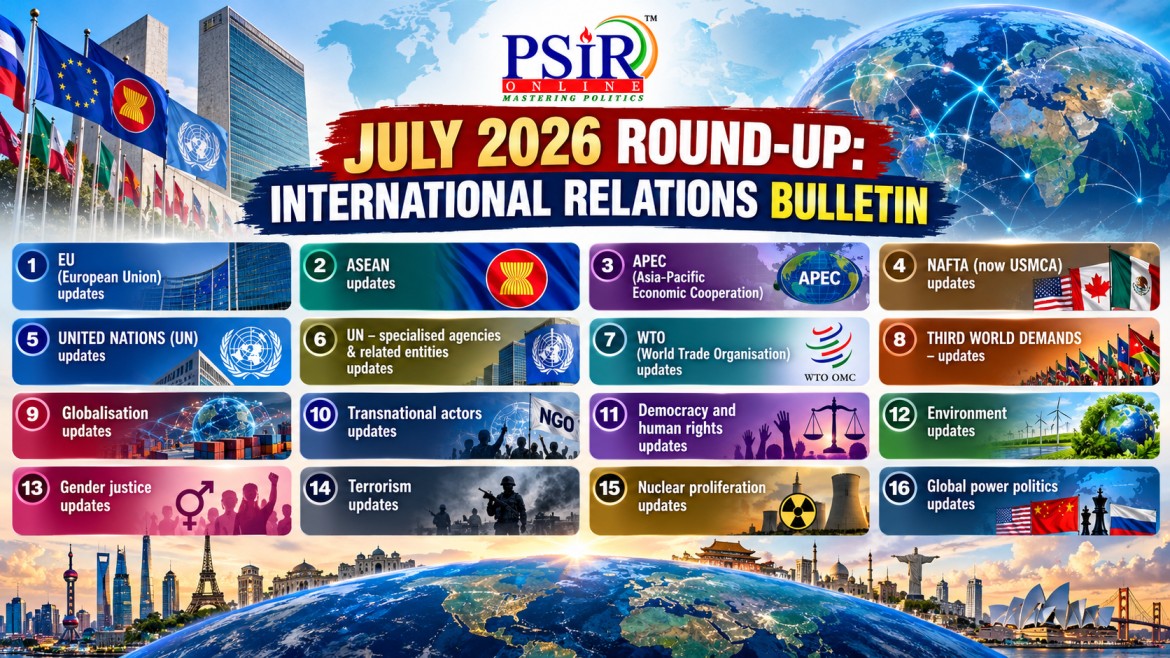
1. EU (EUROPEAN UNION) UPDATES
A. EU–INDIA TRADE AND TECHNOLOGY COUNCIL DEEPENS STRATEGIC PARTNERSHIP
The third EU–India Trade and Technology Council (TTC) met in Brussels on 15 July 2026, strengthening cooperation on trade, technology and security. The two sides agreed to begin formal negotiations on India’s association with Horizon Europe, establish an EU–India Innovation Hub on electric-vehicle charging technologies, launch an EU–India Startup Partnership, and deepen cooperation in semiconductors, AI, quantum technologies, high-performance computing and 6G. They also agreed to strengthen resilient supply chains in areas such as pharmaceuticals, agri-food and clean-energy technologies.
PSIR significance: Important for India–EU strategic relations, strategic autonomy, technology diplomacy, economic security and resilient supply chains. It also reflects the emergence of technology and economic security as major dimensions of contemporary international relations.
B. EU OPENS A NEW CLUSTER OF UKRAINE'S EU ACCESSION NEGOTIATIONS
On 14 July 2026, the EU opened negotiations with Ukraine on Cluster 6 — External Relations, covering external relations as well as foreign, security and defence policy. This marked another significant step in Ukraine's EU accession process and linked enlargement directly with the European security order.
PSIR significance: Relevant to EU enlargement, European security, Russia–EU relations, regional integration and the EU's evolution as a geopolitical actor.
C. EU ADOPTS 21ST PACKAGE OF SANCTIONS AGAINST RUSSIA
On 23 July 2026, the EU adopted its 21st package of sanctions against Russia, targeting Russian energy, financial services, crypto-related platforms and entities linked to the military-industrial complex. The package also tightened export restrictions on dual-use goods and technologies, including measures concerning entities in several third countries.
PSIR significance: The measures demonstrate the EU's use of economic sanctions as an instrument of foreign policy and strategic power, while highlighting the growing importance of economic security and geoeconomics in global power politics.
2. ASEAN UPDATES
A. ASEAN REAFFIRMS CENTRALITY AMID INTENSIFYING MAJOR-POWER COMPETITION
At the 59th ASEAN Foreign Ministers’ Meeting and related meetings in Manila from 21–24 July 2026, ASEAN reaffirmed ASEAN unity and centrality in shaping the regional order. The ASEAN Post-Ministerial Conferences brought together ASEAN and its major dialogue partners, including China, India, Japan, Russia, the EU and the United States. ASEAN stressed the importance of ASEAN-led mechanisms such as the East Asia Summit, ASEAN Regional Forum and ASEAN Defence Ministers’ Meeting-Plus for maintaining an open, inclusive and rules-based regional architecture.
The meetings are significant because ASEAN is attempting to preserve its strategic space and centrality while major-power competition increasingly shapes the Indo-Pacific.
PSIR significance: Important for ASEAN centrality, Indo-Pacific geopolitics, regionalism, strategic autonomy and balance of power. It is also directly relevant to India’s Act East policy and its engagement with ASEAN-led regional institutions.
3. APEC (ASIA-PACIFIC ECONOMIC COOPERATION) UPDATES
A. APEC MEMBERS SEEK COMMON APPROACH ON ARTIFICIAL INTELLIGENCE
At the APEC Digital and AI Ministerial Meeting in Chengdu, China, on 23 July 2026, ministers from APEC economies discussed cooperation on artificial intelligence, digital technologies, data governance and digital connectivity. The meeting adopted the APEC Digital and AI Ministerial Statement, supporting the APEC AI Initiative (2026–2030) and calling for cooperation to ensure that AI development is open, safe, inclusive and people-centred.
PSIR significance: Important for the emerging geopolitics of technology, digital governance and the growing role of AI in international economic relations. It also reflects the Asia-Pacific's attempt to develop common norms for emerging technologies amid increasing global technological competition.
4. NAFTA (NOW USMCA) UPDATES
A. USMCA JOINT REVIEW OPENS NEW PHASE OF NORTH AMERICAN TRADE NEGOTIATIONS
On 1 July 2026, the United States, Mexico and Canada conducted the first USMCA Joint Review, as required under the agreement. Mexico and Canada supported renewal of the agreement, while the United States did not agree to renew it in its existing form and called for further negotiations. The agreement nevertheless remains in force.
The subsequent third round of US–Mexico negotiations on 21–23 July focused on automobiles, steel and aluminium, agriculture, labour, electronic payments and economic security, with the two countries agreeing to continue negotiations.
PSIR significance: Important for understanding the shift from conventional free trade towards economic security, strategic supply chains and managed regionalisation. The USMCA review also demonstrates how major-power trade policy can reshape regional economic integration and North American geopolitics.
5. UNITED NATIONS (UN) UPDATES
A. UN GENERAL ASSEMBLY ADVANCES SECURITY COUNCIL REFORM AND SOUTH–SOUTH COOPERATION
On 28 July 2026, the UN General Assembly took up the question of equitable representation and increasing the membership of the Security Council, alongside a resolution on the intergovernmental review of South–South cooperation. The same sitting also considered the comprehensive review of UN peacekeeping operations and implementation of the Durban Declaration.
PSIR significance: The developments are directly relevant to UN reform, Security Council representation, Global South demands, South–South cooperation and the changing structure of multilateral governance. For India, Security Council reform remains an important dimension of its engagement with the UN.
B. UN GENERAL ASSEMBLY OPENS PROCESS FOR SELECTING THE NEXT SECRETARY-GENERAL
On 22 July 2026, the President of the General Assembly announced a new public-facing phase in the process of selecting the next UN Secretary-General, including the first UN Town Hall in a decade. The initiative is intended to make the selection process more visible and accessible to the wider international community.
PSIR significance: The process is relevant to debates on UN institutional reform, transparency, accountability and the role of the General Assembly in global governance.
6. UN - SPECIALIZED AGENCIES & RELATED ENTITIES- UPDATES
A. WHO STRENGTHENS GLOBAL RESPONSE TO THE EBOLA OUTBREAK
On 2 July 2026, the World Health Organization (WHO) added the first diagnostic test for Bundibugyo virus disease to its Emergency Use Listing and supported the launch of clinical trials to identify effective treatments. The measures were part of the international response to the ongoing Ebola outbreak in the Democratic Republic of the Congo and Uganda. WHO subsequently continued coordinating surveillance and epidemic intelligence across affected countries.
PSIR significance: The development highlights global health governance, human security and international cooperation against transnational health threats, while demonstrating the importance of specialised UN agencies in coordinating responses that individual states cannot manage alone.
B. WMO WARNS OF A RAPIDLY INTENSIFYING EL NIÑO
On 3 July 2026, the World Meteorological Organization (WMO) reported that El Niño had developed in the tropical Pacific and was expected to strengthen rapidly during July–September. WMO warned of increased risks of heatwaves, droughts, heavy rainfall and other extreme weather events, and mobilised climate-information and early-warning systems to support vulnerable countries and communities.
PSIR significance: Important for global environmental governance, climate security, disaster preparedness and international cooperation, particularly because climate-related risks disproportionately affect vulnerable developing countries.
7. WTO (WORLD TRADE ORGANISATION) UPDATES
A. WTO CONDUCTS INDIA’S EIGHTH TRADE POLICY REVIEW
The WTO conducted India’s Eighth Trade Policy Review on 21 and 23 July 2026, examining India’s trade policies and practices. WTO members reviewed issues including tariffs, trade facilitation, services, investment and India’s integration into the multilateral trading system. The review provides a forum for members to question and assess India’s trade policies under the WTO’s transparency mechanism.
PSIR significance: Important for India’s role in the WTO, trade policy and national policy space, and the continuing tension between domestic development priorities and commitments under the multilateral trading system.
B. WTO PUSHES REFORM OF THE MULTILATERAL TRADING SYSTEM
At its 14–15 July 2026 General Council meeting, the WTO pressed ahead with discussions on institutional reform and unresolved negotiations following the MC14. Director-General Ngozi Okonjo-Iweala called for simultaneous progress on reform and outstanding negotiations, while members also adopted measures benefiting developing and least-developed countries, including further work on TRIPS implementation and the Enhanced Integrated Framework.
PSIR significance: Relevant to the crisis and reform of global economic governance, the concerns of developing countries and the future of multilateralism and the rules-based trading order.
8. THIRD WORLD DEMANDS – UPDATES
A. G77 DEMANDS REFORM OF GLOBAL FINANCIAL ARCHITECTURE
At the 2026 High-Level Political Forum on Sustainable Development in July, the G77 and China called for stronger international action to address the financing gap, rising debt burdens, climate challenges and structural inequalities affecting developing countries. The Group stressed the need for greater access to development finance and a more equitable global economic system.
The issue gained further importance with the UN Secretary-General’s July report on external debt, which noted that developing countries’ external debt had reached $12.3 trillion in 2025 and called for expanded concessional finance and improved debt-restructuring mechanisms.
PSIR significance: The development directly reflects the Global South’s continuing demand for a more equitable international economic order, particularly through reform of international financial institutions, debt justice, development finance and greater voice for developing countries in global economic governance.
9. GLOBALISATION UPDATES
A. GLOBAL VALUE CHAINS ARE BEING RECONFIGURED, NOT ABANDONED
An OECD report released on 9 July 2026 found that global value chains remain deeply integrated despite geopolitical tensions, trade restrictions and supply-chain disruptions. Rather than a broad retreat from globalisation, firms are increasingly diversifying suppliers, restructuring sourcing networks and building resilience, while services and multinational investment remain central to international production.
PSIR significance: The development challenges the simple “deglobalisation” narrative and points towards an emerging model of resilient and reconfigured globalisation, where economic interdependence continues but is increasingly shaped by geopolitics, economic security and supply-chain diversification.
10. TRANSNATIONAL ACTORS UPDATES
A. ICRC CALLS FOR INTERNATIONAL HUMANITARIAN LAW TO GOVERN THE USE OF UNMANNED SYSTEMS
On 3 July 2026, the International Committee of the Red Cross (ICRC) convened a major discussion at the World Peace Forum in Beijing on the growing use of drones and other unmanned systems in armed conflicts. The ICRC stressed that these technologies must comply with international humanitarian law, while participants examined questions of legal responsibility, human judgment and the risks created by increasingly autonomous warfare.
PSIR significance: Important for understanding the changing role of transnational humanitarian actors in global security governance, particularly their efforts to shape norms concerning emerging military technologies, international humanitarian law and autonomous weapons.
11. DEMOCRACY AND HUMAN RIGHTS UPDATES
A. UN HUMAN RIGHTS COUNCIL TAKES ACTION ON MAJOR HUMAN-RIGHTS CRISES
The UN Human Rights Council concluded its 62nd session on 8 July 2026, adopting 28 resolutions. It responded to escalating violence in Sudan, calling for an urgent investigation into alleged violations around El Obeid, while also addressing serious human-rights situations in Myanmar, Nicaragua, Venezuela and Ukraine. The Council additionally strengthened protections relating to judicial independence and the rights of women and girls.
PSIR significance: The development highlights the role and limitations of international human-rights institutions, accountability mechanisms and multilateral action in addressing violations. It is relevant to universal human rights, humanitarian intervention, international law and the effectiveness of global governance.
12. ENVIRONMENT UPDATES
A. EXTREME CLIMATE EVENTS INTENSIFY AS EL NIÑO DEVELOPS
In July 2026, the World Meteorological Organization (WMO) warned of increasingly severe climate impacts as El Niño developed in the tropical Pacific. The month saw record-breaking heat and major wildfires across parts of Europe, while the UN climate chief warned that climate-driven disasters were imposing growing human and economic costs.
The developing El Niño also raised concerns for Asia, including India, through its potential effects on rainfall, agriculture and food security.
PSIR significance: The development highlights climate security, environmental governance, food security and the vulnerability of developing countries to global climate change. It also reinforces the need for international cooperation on adaptation, mitigation and climate finance.
13. GENDER JUSTICE UPDATES
A. GLOBAL AID CUTS THREATEN WOMEN’S RIGHTS AND HUMANITARIAN SUPPORT
A UN Women report released on 10 July 2026 warned that cuts in international development assistance were severely affecting women’s rights organisations working in conflict and humanitarian settings. The report found that at least one million women and girls had lost access to critical support since January 2025, while 84% of women’s organisations surveyed reported increased demand for their services.
The impact was particularly significant in conflict-affected countries, where women-led organisations provide services relating to protection, gender-based violence, livelihoods and humanitarian assistance.
PSIR significance: The development connects gender justice with international development finance, human security and global inequality. It also demonstrates how reductions in international assistance can disproportionately affect women in conflict-affected societies and weaken the global Women, Peace and Security agenda.
14. TERRORISM UPDATES
A. UN ADOPTS NINTH REVIEW OF GLOBAL COUNTER-TERRORISM STRATEGY
On 1 July 2026, the UN General Assembly adopted Resolution 80/286, completing the ninth review of the UN Global Counter-Terrorism Strategy on its 20th anniversary. Member states reaffirmed the Strategy’s four-pillar approach, covering prevention of conditions conducive to terrorism, combating terrorism, strengthening state capacity, and protecting human rights and the rule of law. The review also addressed emerging threats, including the use of new technologies and unmanned aircraft systems by terrorist actors.
PSIR significance: Important for understanding the evolution of global counter-terrorism governance, the tension between security and human rights, and the need for multilateral cooperation against increasingly technology-enabled terrorism.
15. NUCLEAR PROLIFERATION UPDATES
A. IAEA STRENGTHENS INTERNATIONAL SAFETY AND SECURITY OF RADIOACTIVE SOURCES
From 6–10 July 2026, the IAEA convened its seventh Open-ended Meeting of Technical and Legal Experts in Vienna to review implementation of its Code of Conduct on the Safety and Security of Radioactive Sources. Representatives from 115 Member States and four international organisations participated, focusing on strengthening national measures to prevent radioactive sources from being misused or falling into unsafe hands.
PSIR significance: The development highlights the continuing importance of international nuclear security cooperation, non-proliferation and multilateral verification, particularly in preventing the misuse of radioactive materials and strengthening global nuclear governance.
16. GLOBAL POWER POLITICS UPDATES
A. US–CHINA–RUSSIA RIVALRY SHARPENS AROUND THE IRAN CONFLICT
The US–Iran conflict continued to draw the strategic interests of China and Russia into the wider geopolitical contest during July. On 24 July, US President Donald Trump said that Chinese President Xi Jinping and Russian President Vladimir Putin had assured him that they would not provide weapons to Iran, while Washington simultaneously warned both countries against deeper involvement. The episode demonstrated how the Iran conflict had become connected to wider US–China–Russia strategic competition.
PSIR significance: The development is important for understanding great-power competition, strategic balancing, the geopolitics of West Asia and the emerging multipolar order, where regional conflicts increasingly intersect with the interests of major powers.
B. CHINA–RUSSIA STRATEGIC COORDINATION CONTINUES TO CHALLENGE US PRIMACY
During July, China–Russia strategic coordination remained an important feature of global power politics. Their May summit had produced a joint declaration advocating a multipolar world and a new type of international relations, while analysts continued to identify their cooperation as an important mechanism for countering US strategic pressure.
PSIR significance: Relevant to multipolarity, balance of power, strategic partnerships and the transformation of the US-led international order.
