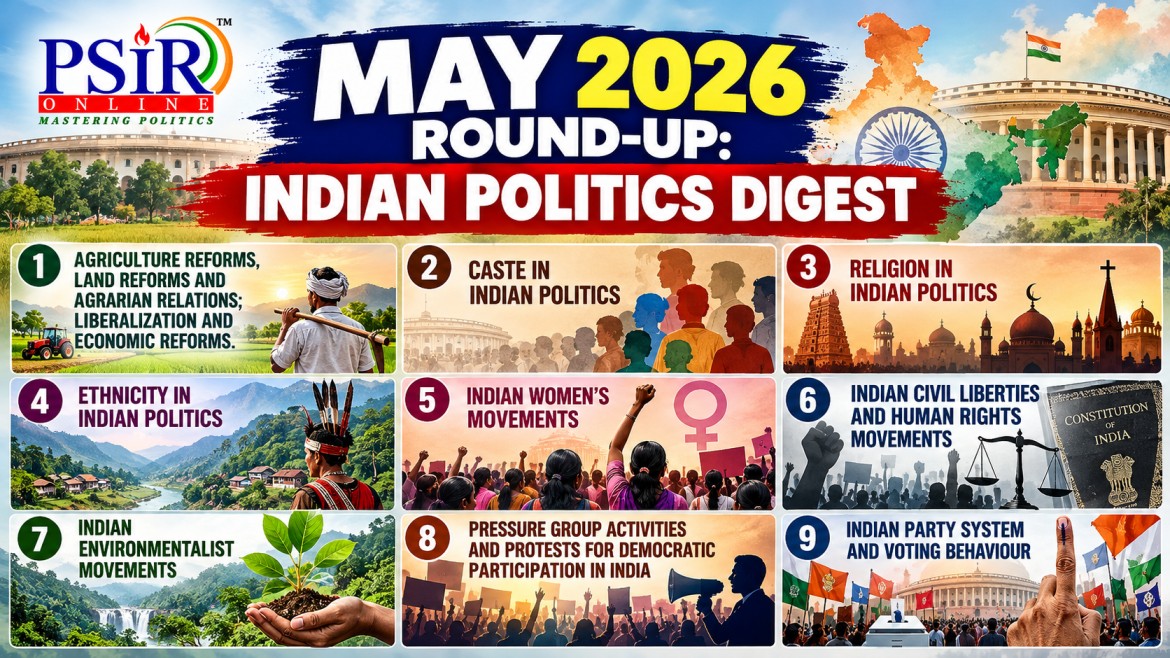
1. AGRICULTURE REFORMS, LAND REFORMS AND AGRARIAN RELATIONS; LIBERALIZATION AND ECONOMIC REFORMS.
A. MSP AND THE POLITICS OF AGRICULTURAL PRICE SUPPORT
In May 2026, the Union Cabinet approved Minimum Support Prices (MSP) for Kharif Marketing Season 2026–27. MSP for paddy was raised by 3%, while relatively higher increases were announced for jowar (9%), sunflower (8%), soybean (7%) and cotton (7%). The decision continued the state's role in providing price assurance to farmers, even as agricultural policy increasingly seeks greater market orientation and diversification.
PSIR Link: Agrarian relations; state intervention in agriculture; MSP politics; farmers' interests; agricultural market reforms.
B. GOVERNMENT INTERVENTION TO PREVENT DISTRESS SALE
On 5 May 2026, the Union government approved procurement of 9,023 metric tonnes of sunflower at MSP in Karnataka and increased the procurement limit for gram in Maharashtra to 8.19 lakh tonnes. The measures were explicitly aimed at protecting farmers from distress sales and ensuring remunerative prices.
PSIR Link: Farmers' mobilisation; agrarian interests; state-market relationship; price support as an instrument of agricultural policy.
C. NEW AGRICULTURAL REFORM PUSH — SIMPLIFICATION AND DIGITAL GOVERNANCE
On 18 May 2026, the Agriculture Ministry announced a series of measures under its “Reform Express”, including simplification of licensing for the sale and storage of household pesticides, easier registration of new fertilisers and digital integration of all 649 customs ports to facilitate agricultural commodity imports. The stated objective was to make agricultural governance more transparent, technology-driven and efficient.
PSIR Link: Agricultural liberalisation; deregulation; technology-driven governance; integration of agriculture with national and global markets.
D. EASTERN INDIA: MARKET-ORIENTED AGRICULTURAL TRANSFORMATION
The Eastern Regional Agriculture Conference held in Bhubaneswar on 19 May 2026 brought together the Centre and eastern states to develop region-specific agricultural strategies. Discussions focused on pulses and oilseeds, crop diversification, agricultural credit, marketing reforms, natural farming, farmer registries and protection against fake agricultural inputs.
The emphasis on region-specific agricultural strategies is significant for understanding the continuing importance of state-level variations in India's agrarian structure.
PSIR Link: Agrarian diversity; Centre–State relations in agricultural policy; regionalisation of agricultural development; market reforms.
E. AGRICULTURAL REFORMS AND CENTRE–STATE COORDINATION
The National Kharif Conference held on 28–29 May 2026 brought Agriculture Ministers from 22 states together with central officials, scientists and other stakeholders. The conference focused on coordinated implementation relating to seeds, fertilisers, crop insurance, agricultural credit, natural farming and state-specific agricultural roadmaps.
The development illustrates the increasingly cooperative and coordinated approach to agricultural policymaking, where implementation depends heavily on Centre–State collaboration.
PSIR Link: Agrarian policy; cooperative federalism; agricultural governance; role of stakeholders in policy implementation.
F. 100% FDI IN INSURANCE — DEEPENING ECONOMIC LIBERALISATION
In May 2026, the government amended the foreign-investment rules to operationalise 100% FDI in insurance companies through the automatic route, replacing the earlier 74% ceiling. Residency requirements relating to the management of insurance companies with foreign investment were also relaxed. LIC, however, remains subject to a separate 20% foreign-investment ceiling.
This represents a further step in India's post-1991 trajectory of economic liberalisation, deregulation and greater integration with global capital.
PSIR Link: Liberalisation; globalisation; changing role of the state; FDI; economic reforms.
G. INVESTMENT PROMOTION AND CONTINUED LIBERALISATION
The government extended the Scheme for Investment Promotion up to 2030–31 in May 2026. The scheme provides investor facilitation, regulatory support, investment promotion and assistance in attracting investment into India.
The continuation reflects the state's attempt to combine market-oriented economic policy with an active developmental role, rather than simply withdrawing from economic activity.
PSIR Link: Liberalisation and economic reforms; developmental state; investment-led growth; state–market relationship.
H. LABOUR REFORMS AND THE CHANGING STATE–MARKET RELATIONSHIP
May 2026 also saw the notification of rules under India's new labour codes, covering working conditions, social security, minimum wages and recognition of trade unions.
For PSIR, this is relevant because labour reform represents an important dimension of India's post-liberalisation debate: how to reconcile economic competitiveness and labour-market flexibility with workers' rights and social security.
PSIR Link: Liberalisation; labour politics; working-class interests; trade unions; state–market relations.
I. BHAVYA AND PRIVATE PARTICIPATION IN INDUSTRIAL DEVELOPMENT
In May 2026, guidelines were released for the Bharat Audyogik Vikas Yojana (BHAVYA), which aims to develop 100 industrial parks. The framework provides for private participation and allows a private developer that is a major investor to allot up to 25% of the developed land to itself, subject to the scheme's conditions.
The initiative reflects the broader shift towards public–private participation and private investment in industrial development.
PSIR Link: Economic reforms; privatisation/PPP; role of private capital; changing nature of the developmental state.
2. CASTE IN INDIAN POLITICS
A. SUPREME COURT CLEARS THE WAY FOR CASTE ENUMERATION
On 20 May 2026, the Supreme Court dismissed a petition challenging the Union government's decision to include caste enumeration in the forthcoming Census. The Court treated the decision as falling within the government's policy domain and observed that information on the number of people belonging to backward classes can assist in framing welfare measures.
The development is significant because caste data has become central to debates over reservation, representation, affirmative action and distribution of welfare benefits. It also highlights the continuing political importance of caste as an organising principle in Indian democracy.
PSIR Link: Caste and politics; affirmative action; social justice; political representation; state policy.
B. KARNATAKA ACCEPTS BACKWARD CLASSES COMMISSION'S CASTE SURVEY REPORT
On 27 May 2026, Karnataka Chief Minister Siddaramaiah accepted the report of the Karnataka State Backward Classes Commission containing the findings of the state's caste survey. The report's acceptance has political significance because its findings could influence debates over reservation and representation among different caste groups in the state.
The episode illustrates how caste enumeration can become politically consequential when demographic information is translated into claims for representation and redistribution.
PSIR Link: Caste census; reservation politics; backward-class mobilisation; identity and representation.
C. MARATHA RESERVATION MOVEMENT RE-EMERGES
In late May, Maratha reservation activist Manoj Jarange Patil announced an indefinite fast over outstanding demands concerning Maratha reservation. On 29 May, Maharashtra BJP leaders appealed to him to withdraw the proposed protest, demonstrating the political pressure generated by the movement.
The development demonstrates the continuing role of caste-based movements as pressure groups, using protests and mobilisation to influence government policy on reservation and representation.
PSIR Link: Caste mobilisation; pressure-group politics; reservation movements; social movements.
D. RESERVATION AND OBC–SC POLITICS IN UTTAR PRADESH
In May, the Samajwadi Party launched its “PDA Aarakshan Audit” campaign amid protests by OBC and SC aspirants over recruitment and reservation-related issues in Uttar Pradesh. The campaign linked reservation rights with questions of employment and political representation, while the party sought to broaden its social base among non-Yadav OBC communities.
This illustrates how political parties increasingly use reservation, representation and caste-based social coalitions to construct electoral alliances.
PSIR Link: Caste-based political mobilisation; party system; social coalitions; OBC politics.
E. RESERVATION DEMANDS AS PRESSURE-GROUP POLITICS
May also witnessed continued mobilisation by caste organisations around reservation. The Maratha movement in Maharashtra, together with wider debates following the decision to conduct caste enumeration, demonstrates how caste associations can function as pressure groups, articulating community interests and negotiating with the state.
This is important for understanding the transformation of caste from a primarily social institution into an instrument of political mobilisation and bargaining.
PSIR Link: Pressure groups; caste associations; interest articulation; democratic participation.
3. RELIGION IN INDIAN POLITICS
A. MANDATORY RECITATION OF VANDE MATARAM IN WEST BENGAL SCHOOLS AND MADRASAS
In May 2026, the West Bengal government made the singing of all six stanzas of Vande Mataram mandatory during morning assemblies in schools under the School Education Department. Subsequently, on 19 May, a separate order made its singing mandatory in recognised madrasas under the Minority Affairs and Madrasah Education Department as well. The move generated debate over the relationship between nationalism, religious identity, minority institutions and the state's role in regulating educational practices.
PSIR Link: Religion and nationalism; secularism; minority rights; identity politics; state–religion relationship.
B. DURGADI FORT: RELIGIOUS SITE BECOMES A FOCUS OF HINDU–MUSLIM POLITICS
In May 2026, the long-standing dispute over Durgadi Fort in Kalyan, Maharashtra again became politically active. Hindu groups and rival Shiv Sena factions protested over restrictions on Hindu devotees' access to the site during Bakrid prayers, leading to clashes with police. The dispute has historically been associated with competing claims over worship rights and has featured in Maharashtra's Hindutva politics.
The episode demonstrates how religious sites can become arenas for political mobilisation and competitive identity politics.
PSIR Link: Religion and politics; communal mobilisation; Hindutva politics; pressure groups; identity-based political mobilisation.
C. BHOJSHALA DISPUTE: RELIGIOUS IDENTITY AND POLITICAL MOBILISATION
The Bhojshala–Kamal Maula complex in Dhar, Madhya Pradesh remained a major religious-political issue in May following the Madhya Pradesh High Court's ruling concerning the religious character of the site. On the first Friday after the ruling, Hindu groups conducted a maha aarti, while Muslim petitioners offered namaz at home as a symbolic protest. Heavy security was deployed in the area.
The development illustrates how disputes over historical religious sites can generate competing community mobilisation and become intertwined with contemporary identity politics.
PSIR Link: Communalism; religious identity; social movements; mobilisation; politics of religious sites.
D. SABARIMALA REFERENCE: RELIGIOUS FREEDOM VS CONSTITUTIONAL REFORM
The Supreme Court's nine-judge Constitution Bench reserved its judgment on 14 May 2026 after 16 days of hearings in the Sabarimala reference. The proceedings examined the relationship between Articles 25 and 26, religious freedom, denominational rights, essential religious practices and the constitutional power to reform religious practices.
During the hearings, the Court also examined whether the Essential Religious Practices doctrine is appropriate for determining the constitutional protection of diverse religious practices.
This is highly relevant to PSIR because it raises a fundamental question: How should a secular democratic state balance freedom of religion with equality and constitutional reform?
PSIR Link: Secularism; Articles 25–28; religious freedom; constitutionalism; judicial intervention; reform of religious practices.
E. PERSIANS/PARSIS, INTERFAITH MARRIAGE AND RELIGIOUS AUTONOMY
During the Sabarimala hearings in May, the Supreme Court also examined the issue of Parsi women marrying outside the faith and the consequences for their access to Zoroastrian places of worship. The Court questioned whether exclusion following interfaith marriage could be reconciled with the right to conscience and individual autonomy.
The issue provides a useful example of the tension between religious community autonomy and individual rights, particularly women's rights and freedom of conscience.
PSIR Link: Religious freedom; individual rights; community rights; gender and religion; secularism.
4. ETHNICITY IN INDIAN POLITICS
A. RENEWED NAGA–KUKI ETHNIC TENSIONS IN MANIPUR
In May 2026, Manipur witnessed a fresh escalation of tensions between Naga and Kuki-Zo communities in the hill districts. Following the killing of three Kuki church leaders in an ambush on 13 May, retaliatory abductions occurred on both sides in Kangpokpi and Senapati. Reports indicated that members of the two communities were being held by groups from the opposing community.
The episode is significant because it shows how the prolonged Meitei–Kuki conflict has acquired an additional Naga–Kuki dimension, with territorial claims, community boundaries, political interests and historical grievances interacting with each other. By 23 May, the situation was being described as a widening Naga–Kuki confrontation in Manipur.
PSIR Link: Ethnic identity; sub-nationalism; ethnic conflict; territoriality; political mobilisation; Northeast politics.
B. ETHNIC IDENTITY AND POLITICAL REPRESENTATION IN ASSAM
The 2026 Assam Assembly election results, declared in early May, demonstrated the continuing importance of ethnic and community-based political alignments. The NDA secured a strong majority, while the Bodoland People's Front (BPF) won seats in areas with substantial tribal populations. The election also showed distinct political patterns across Assamese, tribal, Bengali Hindu and minority-dominated regions.
The results provide a contemporary example of how ethnic and linguistic identities intersect with electoral competition and party strategies in Assam.
PSIR Link: Ethnicity and electoral politics; sub-nationalism; regional parties; identity-based political mobilisation; voting behaviour.
C. ETHNICITY, TERRITORIAL CONTROL AND POLITICAL FRAGMENTATION IN MANIPUR
The May developments also highlight a deeper feature of ethnic politics in the Northeast: ethnic identity is closely connected with territory and political representation. The Naga–Kuki tensions unfolded particularly across districts and areas where different communities constitute local majorities. The conflict therefore involves not merely cultural identity but competing perceptions of territorial security, community autonomy and political control.
PSIR Link: Ethnicity and territory; autonomy movements; ethnic federalism; territorial politics; state formation.
D. ETHNIC ORGANISATIONS AS POLITICAL ACTORS
The May crisis also demonstrated the role played by community organisations, church bodies and ethnic organisations in responding to conflict and attempting negotiations. In the Naga–Kuki hostage crisis, community-level interventions and negotiations were involved alongside the state security apparatus.
This is relevant to PSIR because ethnic politics operates not only through political parties but also through civil-society organisations and community associations that articulate collective ethnic interests.
PSIR Link: Pressure groups; ethnic associations; social movements; interest articulation; civil society.
5. INDIAN WOMEN’S MOVEMENTS
A. WOMEN’S ORGANISATIONS MOBILISE FOR IMMEDIATE IMPLEMENTATION OF WOMEN’S RESERVATION
In May 2026, women's organisations in different parts of India mobilised around the demand for early implementation of the 33% reservation for women in the Lok Sabha and State Legislative Assemblies.
In Vijayawada, the Joint Forum of Women's Organisations organised a 2-km march on 7 May, demanding that women's reservation be implemented without making it conditional upon the Census and delimitation process.
The mobilisation is significant because it shows that women's movements continue to move beyond demands for welfare and protection towards political representation and participation in decision-making.
PSIR Link: Women's movements; political representation; affirmative action; participation; democratic mobilisation.
B. ‘NARI ADHIKAR ABHIJAN’ IN ODISHA
The Biju Janata Dal (BJD) launched the ‘Nari Adhikar Abhijan’ on 10 May 2026, with programmes planned across all 147 Assembly constituencies until 25 May. The campaign demanded implementation of 33% women's reservation in legislatures without linking it to future delimitation.
This is relevant to the study of women's movements because a demand concerning women's political representation was converted into a state-wide mobilisation involving women activists and party organisations.
PSIR Link: Women's political mobilisation; representation; party–movement interface; pressure-group politics.
C. WOMEN’S ORGANISATIONS PROTEST AGAINST VIOLENCE AGAINST WOMEN AND GIRLS
On 18 May 2026, several women's organisations, including AIDWA, AIMSS, AIPWA, NFIW, Pragatisheel Mahila Sangathan and others, organised a demonstration at Jantar Mantar, New Delhi, against increasing sexual violence and crimes against women and girls. Students, working women, trade-union activists and civil-society groups also participated.
The protest represents the continuing tradition of the Indian women's movement using collective action to demand institutional accountability, protection and justice against gender-based violence.
PSIR Link: Women's movements; civil society; collective action; gender justice; protest politics.
D. WOMEN’S RESERVATION BECOMES A SITE OF GRASSROOTS POLITICAL MOBILISATION
The reservation debate also generated local-level mobilisation in Uttar Pradesh during May. Women's groups organised protests and demonstrations around the issue of political representation, including demonstrations outside the residences of MPs over their positions on women's reservation.
This illustrates how a constitutional question concerning representation in legislatures can become a grassroots political issue, bringing women's organisations directly into political mobilisation.
PSIR Link: Women's movements; political participation; pressure groups; representative democracy.
E. WOMEN’S REPRESENTATION ENTERS PARTY ORGANISATIONAL POLITICS
On 28 May 2026, during the Telugu Desam Party's Mahanadu, Nara Lokesh proposed allocating 33% of the party's tickets to women for the 2029 Lok Sabha elections. The proposal came amid the wider national debate over women's reservation in legislatures.
This is relevant to women's movements because it shows the movement from constitutional reservation to women's representation within political parties themselves.
PSIR Link: Women in political parties; representation; political recruitment; gender and party politics.
6. INDIAN CIVIL LIBERTIES AND HUMAN RIGHTS MOVEMENTS
A. NHRC TAKES SUO MOTU COGNIZANCE OF ARREST OF ENVIRONMENTAL ACTIVISTS
On 13 May 2026, five environmental activists protesting against tree-felling around Kasu Brahmananda Reddy (KBR) National Park in Hyderabad were arrested and detained for several hours. An FIR was registered against them under provisions of the Bharatiya Nyaya Sanhita, and they were subsequently released on bail.
On 20 May, the National Human Rights Commission (NHRC) took suo motu cognizance of the reported arrests and sought reports from the Telangana DGP and Hyderabad District Magistrate, observing that, if the reports were correct, they raised serious questions concerning human rights violations.
The episode is significant because it demonstrates how environmental protest can intersect with civil liberties, particularly the rights to peaceful participation, expression and protest.
PSIR Link: Civil liberties; right to protest; human-rights institutions; environmental movements; state–civil society relations.
B. SUPREME COURT TAKES UP CHALLENGE TO TRANSGENDER RIGHTS AMENDMENT
On 4 May 2026, the Supreme Court issued notice on petitions challenging provisions of the Transgender Persons (Protection of Rights) Amendment Act, 2026. The petitioners argued that the amendments violated Articles 14, 19 and 21 and diluted the principle of self-identification recognised by the Supreme Court in NALSA v. Union of India (2014). The Court directed that the matter be placed before a three-judge Bench.
The development is important for the civil-liberties section because it concerns the relationship between individual identity, dignity, equality, personal autonomy and state regulation.
PSIR Link: Civil liberties; equality; dignity; individual autonomy; minority rights; constitutional rights.
C. SUPREME COURT REINFORCES PERSONAL LIBERTY IN ILLEGAL DETENTION CASE
In May 2026, the Supreme Court held that administrative delay in releasing a prisoner after a valid judicial order amounted to illegal detention. In State of Tamil Nadu v. Ponnusamy, the Court held that deprivation of liberty without lawful authority violates constitutional protections and awarded ₹11 lakh compensation for the 24-day delay in release.
The judgment reinforces the principle that personal liberty under Article 21 remains protected even when the individual is a convicted prisoner, and that administrative convenience cannot override a judicial release order.
PSIR Link: Article 21; personal liberty; rule of law; judicial protection of fundamental rights; accountability of the state.
D. SEDITION AND FREEDOM OF EXPRESSION REMAIN UNDER CONSTITUTIONAL SCRUTINY
On 21 May 2026, the Supreme Court clarified that persons facing proceedings under the old Section 124A IPC (sedition) could choose to continue with their trials or appeals. The clarification modified the scope of the Court's 2022 order, which had paused fresh sedition proceedings while the constitutional validity of the provision was under consideration. The larger constitutional challenge to sedition remains unresolved.
The development is relevant to the continuing debate over the balance between national security and freedom of speech and expression.
PSIR Link: Freedom of expression; national security; sedition; civil liberties; constitutional limitations on state power.
E. HUMAN RIGHTS DEFENDERS AND PROLONGED DETENTION
The continued incarceration of activists and human-rights defenders under stringent laws remained an important civil-liberties issue in May. Human Rights Watch noted that several student activists arrested under the UAPA in connection with the 2020 Delhi violence had spent years in custody without trial.
The issue raises a broader constitutional question concerning the relationship between anti-terror legislation, preventive restrictions, prolonged incarceration and the right to a speedy trial.
PSIR Link: UAPA; preventive/anti-terror laws; civil liberties; due process; rights of political dissent.
7. INDIAN ENVIRONMENTALIST MOVEMENTS
A. ENVIRONMENTAL ACTIVISTS PROTEST TREE-FELLING AROUND KBR NATIONAL PARK
On 13 May 2026, environmental activists protested against tree-felling around Kasu Brahmananda Reddy (KBR) National Park in Hyderabad. Five activists were subsequently arrested and detained for several hours. The National Human Rights Commission (NHRC) took suo motu cognizance on 20 May and sought reports from the Telangana DGP and Hyderabad District Magistrate, noting that the reported arrests, if true, raised serious human-rights concerns.
The episode demonstrates how urban environmental movements can challenge developmental activities and invoke constitutional and human-rights arguments to protect ecological spaces.
PSIR Link: Environmental movements; urban environmentalism; right to protest; environmental justice; civil society.
B. TRIBAL AND FARMERS' RESISTANCE TO THE KEN–BETWA RIVER-LINKING PROJECT
In May 2026, Adivasi communities, farmers and environmental activists continued protests against the Ken–Betwa River Linking Project in Madhya Pradesh. The protests raised concerns over displacement, rehabilitation, compensation, forest loss and the ecological impact of the project on the Panna landscape. Environmental and people's-movement organisations demanded dialogue and a review of the project's socio-ecological consequences.
This is particularly important for PSIR because it illustrates the transformation of environmentalism into a broader environmental-justice movement, where ecological protection is linked with tribal rights, livelihood and displacement.
PSIR Link: Environmental movements; tribal movements; environmental justice; displacement; development vs ecology.
C. PROTEST AGAINST LIMESTONE MINING PROJECT IN MEGHALAYA
On 22 May 2026, a public hearing concerning a proposed Shree Cement limestone-mining project at Lum Syrman, Meghalaya, was called off following strong protests by local residents and landowners. The protests reflected concerns regarding the project's potential environmental and livelihood impacts.
The episode demonstrates the importance of local communities in environmental decision-making, particularly through public hearings and resistance to resource extraction projects.
PSIR Link: Environmental movements; resource politics; community participation; mining; environmental governance.
D. SAVE SANKEY TANK CAMPAIGN IN BENGALURU
On 24 May 2026, residents, environmental activists and civic organisations conducted a “Save Sankey Tank” protest and awareness campaign in Bengaluru. The campaign raised concerns about concretisation, sewage inflow, shrinking water spread and ecologically damaging development around the urban lake.
The movement is a useful example of urban environmental activism, where resident groups and civil-society organisations mobilise to protect local commons from poorly planned development.
PSIR Link: Urban environmental movements; citizen participation; environmental commons; pressure groups.
E. WOMEN AND GRASSROOTS ENVIRONMENTALISM
A May 2026 discussion on the Goldman Environmental Prize highlighted the continuing significance of women-led grassroots environmental movements, including India's historical tradition of women participating in forest and ecological protection movements such as the Chipko Movement. The discussion connected women's environmental activism with community-based ecological protection and environmental justice.
For PSIR, this is useful as a conceptual bridge between women's movements and environmental movements: women often emerge as important political actors when environmental degradation directly affects community resources, livelihoods and everyday life.
PSIR Link: Women's movements; environmentalism; grassroots mobilisation; ecological justice.
8. PRESSURE GROUP ACTIVITIES AND PROTESTS FOR DEMOCRATIC PARTICIPATION IN INDIA
A. WOMEN’S ORGANISATIONS MOBILISE FOR LEGISLATIVE REPRESENTATION
In May 2026, women's organisations in several states mobilised around the demand for early implementation of women's reservation in the Lok Sabha and State Legislative Assemblies. In Vijayawada, the Joint Forum of Women's Organisations organised a 2-km march demanding that the 33% reservation provided under the Constitution be implemented without waiting for the Census and delimitation process.
The mobilisation demonstrates how organised civil society can seek changes in the institutional structure of political representation through peaceful collective action.
PSIR Link: Pressure groups; women's movements; political participation; representation; democratic mobilisation.
B. NARI ADHIKAR ABHIYAN — WOMEN'S RESERVATION AS A MASS CAMPAIGN
In Odisha, the BJD's women's wing launched the Nari Adhikar Abhijan on 10 May, with programmes across all 147 Assembly constituencies. The campaign focused on the implementation of women's reservation in legislatures and sought to mobilise women at the grassroots level.
This provides an interesting example of the party–pressure group–social movement interface, where an organised political campaign adopts an issue historically advanced by women's movements.
PSIR Link: Pressure groups; social movements; party–movement relationship; political participation.
C. FARMERS' PROTESTS OVER AGRICULTURAL PRICES AND POLICY
In May 2026, farmer organisations continued mobilisation around MSP, procurement and agricultural prices, particularly in states such as Punjab and Haryana. Farmer organisations used demonstrations and negotiations with governments to press for remunerative prices and stronger procurement mechanisms.
These activities illustrate the classic role of agrarian pressure groups in Indian democracy: organised economic interests seek to influence public policy through protest, negotiation and political pressure.
PSIR Link: Farmers' movements; pressure groups; agrarian politics; interest articulation; state–society relations.
D. ENVIRONMENTAL GROUPS USE PROTEST TO INFLUENCE DEVELOPMENT POLICY
The KBR National Park protests in Hyderabad provide another strong example. Environmental activists protested against tree-felling and development-related activity around the park. The subsequent arrests generated intervention by the National Human Rights Commission, which sought reports from the Telangana authorities.
This shows how environmental organisations can operate as pressure groups, using protest, public mobilisation and institutional mechanisms to influence government decisions.
PSIR Link: Environmental pressure groups; civil society; protest politics; democratic participation.
E. MARATHA RESERVATION MOBILISATION
The Maratha reservation movement again became politically active in Maharashtra in May. Manoj Jarange Patil announced an indefinite protest over unresolved demands concerning reservation, prompting political leaders to engage with the movement and seek withdrawal of the proposed agitation.
The movement demonstrates how caste associations and community organisations can function as pressure groups, using mass mobilisation to influence government policy on reservation and representation.
PSIR Link: Caste associations; pressure groups; reservation politics; social movements; democratic bargaining.
F. PROTESTS BY OPPOSITION AND CIVIL-SOCIETY GROUPS OVER ELECTORAL ISSUES
In May, opposition parties and civil-society groups continued raising concerns regarding electoral rolls, voter registration and the conduct of elections, particularly in states undergoing electoral processes. Such mobilisation focused attention on the importance of electoral transparency, voter participation and institutional accountability.
This is relevant to the PSIR syllabus because democratic participation is not limited to voting; organised groups also seek to influence the rules and institutions through which representation occurs.
PSIR Link: Electoral politics; civil society; democratic participation; institutional accountability.
9. INDIAN PARTY SYSTEM AND VOTING BEHAVIOUR
A. FIVE-STATE ASSEMBLY ELECTIONS: A MAJOR SHIFT IN STATE PARTY SYSTEMS
The results declared in May 2026 produced significant changes in the party configurations of several states. In West Bengal, the BJP won 207 of 294 seats, while the TMC won 80. In Assam, the BJP won 82 seats and the NDA allies AGP and BPF won 10 each. In Kerala, the Congress won 63 seats, CPI(M) 26 and IUML 22. In Tamil Nadu, TVK won 108 seats, DMK 59 and AIADMK 47. In Puducherry, AINRC won 12, DMK 5 and BJP 4.
The results provide a useful comparative picture of India's multi-party system, where national parties, state parties, regional parties and alliance formations continue to compete in different combinations.
PSIR Link: Party system; nationalisation/regionalisation of politics; regional parties; multi-party competition.
B. WEST BENGAL: BJP'S EXPANSION AND THE TRANSFORMATION OF A REGIONAL PARTY SYSTEM
The 2026 West Bengal election produced a major change in the state's party competition. The BJP won 207 seats, while the TMC won 80. The BJP's gains extended beyond its earlier strongholds, with its vote share increasing in a large number of constituencies.
The result is relevant to the study of party systems because West Bengal had historically been dominated by strong regional or state-based political formations, whereas the 2026 result placed a national party at the centre of the state's political system.
PSIR Link: National parties versus regional parties; party-system change; ideological competition; electoral realignment.
C. TAMIL NADU: EMERGENCE OF TVK AND THE ENTRY OF A NEW REGIONAL FORCE
The Tamil Nadu election produced one of the most significant developments in the state's party system. The newly formed Tamilaga Vettri Kazhagam (TVK) emerged as the single largest party with 108 of 234 seats. DMK won 59 and AIADMK 47, while several smaller parties also entered the Assembly.
TVK's emergence is particularly relevant because Tamil Nadu had traditionally been characterised by competition centred on the DMK–AIADMK axis. The 2026 result therefore provides a contemporary example of how a new regional party can alter an established state party system.
PSIR Link: Regional parties; party-system transformation; political mobilisation; new-party emergence; voting behaviour.
D. KERALA: COALITION POLITICS AND THE CONTINUING ROLE OF ALLIANCE STRUCTURES
Kerala's 2026 result again demonstrated the importance of coalition politics. The UDF constituents won 102 seats collectively, led by Congress with 63 and IUML with 22, while the LDF secured 35 seats, including 26 for CPI(M). BJP won 3 seats.
The result illustrates how Kerala's party competition continues to operate substantially through pre-electoral alliances involving national and state-based parties, rather than through a simple two-party contest.
PSIR Link: Coalition politics; alliance system; national–regional party interaction; bipolarisation within a multi-party system.
E. ASSAM: NATIONAL PARTY + REGIONAL ALLIANCE MODEL
In Assam, the BJP won 82 seats, while its allies AGP and BPF won 10 seats each, giving the BJP-led alliance a substantial majority. Congress won 19 seats. The BJP's alliance with regional formations is particularly relevant because BPF represents an important ethnic/regional political base in the Bodoland region.
The result demonstrates how a national party can combine with regional and ethnic parties to construct a broader electoral coalition.
PSIR Link: Coalition politics; regional parties; ethnic parties; social bases of political parties; alliance formation.
F. ASSAM: ETHNIC AND COMMUNITY-BASED VOTING PATTERNS
The Assam results also provide a useful example of the relationship between social identity and voting behaviour. Post-election analysis identified a sharp geographical and social pattern: the NDA dominated many Assamese, tribal and Hindu-majority areas, while Congress performed particularly strongly in constituencies with large minority populations.
This demonstrates that voting behaviour in India can reflect an interaction between party identification, ethnic identity, religious/community interests and regional political concerns.
PSIR Link: Voting behaviour; identity politics; ethnicity; religion; social bases of parties.
G. TAMIL NADU: CHANGING VOTING BEHAVIOUR AND THE DECLINE OF THE TRADITIONAL BIPOLAR AXIS
The emergence of TVK as the largest party substantially changed the electoral configuration of Tamil Nadu. TVK secured 108 seats with approximately 35% of the vote, while DMK and AIADMK occupied the next two major positions in the Assembly.
The result is useful for students studying whether established party loyalties and traditional electoral alignments can be disrupted by the emergence of a new political actor.
PSIR Link: Electoral behaviour; party identification; anti-incumbency/realignment; new political parties.
H. CHANGING SOCIO-ECONOMIC PROFILE OF LEGISLATORS: TAMIL NADU
The Association for Democratic Reforms (ADR) analysed the self-sworn affidavits of 233 of the 234 elected Tamil Nadu MLAs. The findings provide excellent contemporary data for the syllabus.
Among those analysed:
This provides empirical evidence for studying the socio-economic composition of India's political class, including wealth, education, age and gender.
PSIR Link: Political recruitment; social composition of legislators; elite formation; representation.
I. WEALTH AND POLITICAL REPRESENTATION
The Tamil Nadu data also reveal a striking concentration of declared wealth among elected representatives. The 233 analysed winners together declared assets worth ₹11,265 crore, with an average of ₹48.35 crore per MLA. ADR notes that the comparable average among the 2021 MLAs analysed was ₹12.27 crore.
This provides students with contemporary material for examining the relationship between economic status and political representation, without assuming that wealth alone determines electoral success.
PSIR Link: Political elites; socio-economic profile of legislators; political recruitment; money and electoral politics.
