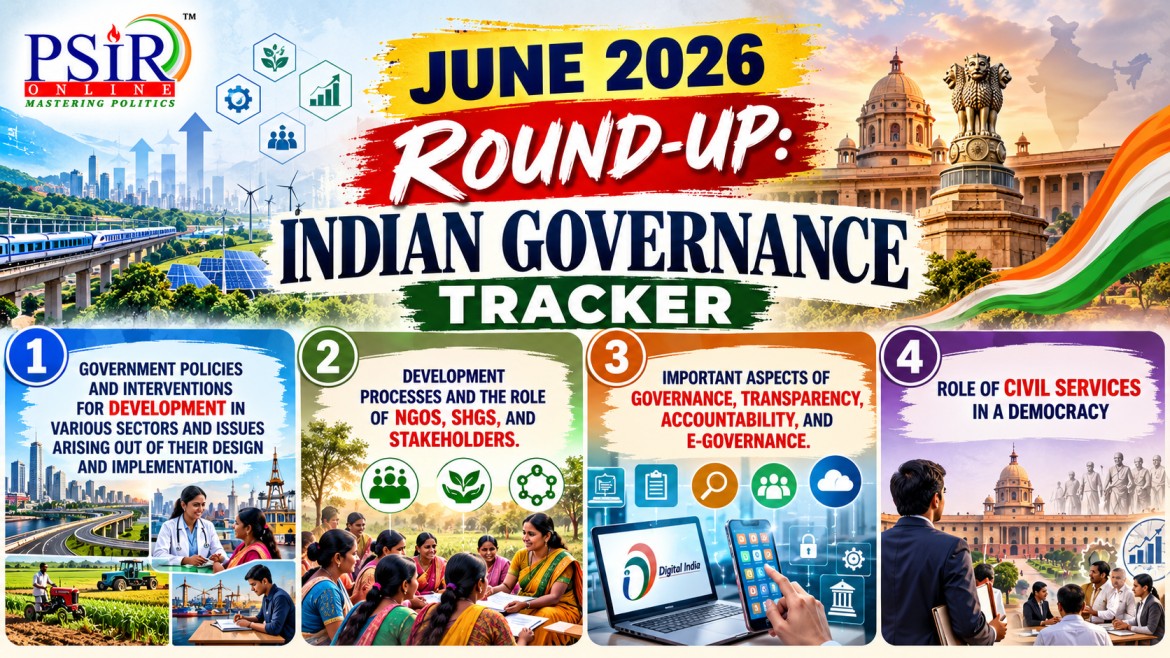
[NOTE: THE CURRENT AFFAIRS FOR THIS MONTH HAS BEEN ORGANISED AS PER THE TOPICS MENTIONED IN GS 2 (MAINS) SYLLABUS. FEW TOPICS MIGHT LOOK REPETITIVE AS IT OVERLAPS UNDER MANY SUB-HEADINGS. BUT THE INFORMATION INSIDE THOSE TOPICS WILL BE DIFFERENT AND WILL PERTAIN TO THE MAIN HEADING CONCERNED. HENCE STUDENTS ARE REQUESTED TO READ EACH AND EVERY LINE OF THE SECTION TO GET COMPLETE UNDERSTANDING]
1. GOVERNMENT POLICIES AND INTERVENTIONS FOR DEVELOPMENT IN VARIOUS SECTORS AND ISSUES ARISING OUT OF THEIR DESIGN AND IMPLEMENTATION.
A. IAS E-CIVIL LIST 2026 — 22 JUNE
Dr Jitendra Singh launched the searchable IAS e-Civil List 2026 (71st edition, sixth e-book) at Kartavya Bhawan. As on 1 January 2026: 5,755 officers in position against authorised 7,026. The list shows batch, cadre, posting, pay, qualification and who retires in the next five years.
A public civil list is a small but real transparency tool: the country can see who holds which chair.
B. FCRA AMENDMENT RULES, 2026 — NOTIFIED 22 JUNE
The Ministry of Home Affairs notified the Foreign Contribution (Regulation) Amendment Rules, 2026 (S.O. 3272(E)). They came into force the same day. They amend the 2011 Rules under the FCRA, 2010.
Main changes you must remember:
Exam line: FCRA moved from “get a licence and work anywhere” to continuous, purpose-bound, geography-bound compliance. That is governance of civil society, not only of companies.
C. FCRA 2.0 PORTAL — LAUNCHED 30 JUNE 2026
Home Minister Amit Shah launched the FCRA 2.0 Portal in New Delhi on 30 June. Applications, renewals and annual returns are now end-to-end digital on MeghRaj cloud: Aadhaar login, e-sign, OCR of papers, links with PAN, NGO-Darpan, banks and ICAI UDIN. A mobile app, AI chatbot and bank dashboard were promised next. The new 22 June Rules are built into the portal.
D. IBBI REGULATIONS AFTER THE IBC AMENDMENT ACT — 2 JUNE AND 9 JUNE
The IBC Amendment Act, 2026 had been brought into force from 26 May (except group insolvency, cross-border, CIIRP and the Fund). In June, IBBI issued the working rules:
E. EPFO VISHWAS SCHEME, 2026 — LIVE FROM 29 JUNE
A six-month dispute-settlement window under the EPF framework started on 29 June 2026 (circular later spelled out the process). It covers pending notices, final orders where recovery is stuck, and pre-order cases — not fraud or unpaid interest. Damages for older defaults can be recalculated at much lower monthly rates if the employer first pays the interest. Application is online on the EPFO portal.
This is the same Jan Vishwas spirit applied to provident-fund damages: close old fights, keep the criminal stick only for real cheating.
F. CORPORATE LAWS (AMENDMENT) BILL, 2026 — JOINT COMMITTEE AT WORK IN JUNE
The Bill (Companies Act + LLP Act) was introduced in March. In June the 31-member Joint Parliamentary Committee (Chair: Sudheer Gupta) was openly taking views. On 9 June it invited experts and industry. On 19 June bodies such as ICGN sent formal comments. The Bill’s idea: more civil penalties instead of jail for paper defaults, stronger NFRA, higher CSR profit threshold, larger “small company” limits.
G. NATIONAL AWARDS FOR E-GOVERNANCE 2026 — RESULTS ON 4 JUNE
DARPG announced 17 winners (10 Gold, 6 Silver, 1 Jury) in seven categories, including Gram Panchayats. Gold names included Agri Stack (Agriculture Ministry) and e-Jagriti (Consumer Affairs). Panchayat Unnati Index and village e-offices also figured. Cash: ₹10 lakh (Gold), ₹5 lakh (Silver) to be used for public work. The awards were to be given at the 29th National Conference on e-Governance, Jaipur, 1–2 July (theme: Viksit Bharat 2047 — AI-enabled, data-driven, secure digital governance). PIB briefed this on 30 June.
Initiative, not a new Act: the Centre using prizes to spread what already works in one district to the whole country.
H. STATE EXAMPLE — CHHATTISGARH’S ATAL MONITORING PORTAL (HIGHLIGHTED IN JUNE)
NITI’s Frontier Tech window in June showcased Chhattisgarh Infotech Promotion Society’s Atal Monitoring Portal: AI, API and GIS on 193 schemes, 729+ indicators, all 33 districts, including tribal and LWE areas. Claimed results: faster data, fewer compliance costs on the single window, help for about 3 crore people.
This is State e-governance: one dashboard so the Chief Minister and the block officer see the same number.
I. WORLD ENVIRONMENT DAY, 5 JUNE 2026 — PM ON GREEN SCHEMES
On World Environment Day the Prime Minister said growth must be sustainable. He listed ten years of work: more green cover, recovery of species such as the Great Indian Bustard, snow leopard, sloth bear and cheetah. He gave credit to Ek Ped Maa Ke Naam for adding about 1.1–1.19 lakh hectares of forest each year, and said India will stay with Mission LiFE and the line “One Earth, One Family, One Future.” He added that people, policy and science must move together.
Design vs implementation: Planting is the easy design. Survival of trees, rights of forest communities, and whether cheetahs actually settle — that is the implementation test. Quote the scheme, then ask “how many plants lived?”
J. INTERNATIONAL DAY OF YOGA, 21 JUNE 2026 — PM IN KOLKATA, PRESIDENT ALSO PRESENT
The Prime Minister led the 12th International Day of Yoga from Red Road, Kolkata. Theme: Yoga for Healthy Ageing. He joined the Common Yoga Protocol, praised Swachhata se Swagat in the city, and said Yoga 365 had already run a 100-day online programme with more than 30 lakh people from 130 countries. Yoga, he said, is not only exercise and not only for the young.
The President also marked the day (events in Kolkata and a message from Jabalpur).
Policy reading: AYUSH and preventive health are cheap on paper. They work only if States keep instructors, public parks and school slots after 21 June. A one-day photo is design. 365 days is implementation.
K. NITI AAYOG 11TH GOVERNING COUNCIL, 11 JUNE 2026 — ALL 28 CHIEF MINISTERS
The Prime Minister chaired the Council at Rashtrapati Bhavan Cultural Centre. Theme: Inclusive Human Development for Viksit Bharat @2047. For the first time in recent years, Chief Ministers of all 28 States sat in one room, including Opposition-ruled States. Five UTs also came.
Four pillars on the table:
The PM said Viksit Bharat must become the resolve of every State, district, block and village; nearly 70 crore Indians under 25 must become a development dividend, not only a census number. He asked States to copy global best practice, stay self-reliant, and look at energy that is available, reliable and competitively priced, including rooftop solar on homes, schools and offices so subsidy pressure falls. Briefings also spoke of measuring growth at district level.
Implementation issue: NITI has no purse like the old Planning Commission. A full house of CMs is political design. The test is whether State vision documents and district GDP actually change next year’s budget.
L. REPUBLIC SUMMIT, 22 JUNE 2026 — PM ON MIDDLE-CLASS HOUSING
Speaking on “Great Power India: Nation First”, the Prime Minister said schemes such as Swachh Bharat, Make in India and Vocal for Local worked because citizens owned them. On the middle class he recalled a ₹25,000 crore special fund to finish stalled housing projects, and said thousands of flats were handed over. India, he said, must be not only a fast economy but a credible one.
Design vs implementation: A housing scheme that stops at the foundation is a broken intervention. The fund is an implementation patch on an old design failure (delayed RERA projects).
M. PRESIDENT AT THE ITDA–ITDP NATIONAL CONCLAVE, 3 JUNE 2026
On 3 June the President addressed the National Conclave on Integrated Tribal Development Agencies / Projects at Vigyan Bhavan. This is the old machinery for Fifth and Sixth Schedule areas — education, health, livelihoods inside tribal blocks.
Why it belongs here: Tribal policy often fails at the last mile (hostel, teacher, land title). When the Head of State speaks to ITDAs, she is saying: the agency on paper must become an office that works. Use this as a federalism-and-implementation example.
N. PRESIDENT — PADMA AWARDS, 23 JUNE 2026
The President conferred the second round of Padma Awards 2026 at Rashtrapati Bhavan. Padma is not a scheme, but it is how the Republic publicly names people who delivered in health, art, social work and science — often the same fields where government schemes need ground workers.
O. SUPREME COURT — MORE JUDGES TAKE OATH, 2 JUNE 2026
After the May Ordinance raised strength from 34 to 38, five new judges took oath on 2 June (including a direct elevation from the Bar; two women then on the Bench). Pendency was still around 92,000–93,000. Experts in June asked the same question: will four extra chairs fix a design that produces too many SLPs and too much government litigation?
P. SUPREME COURT — RTI AND LOKAYUKTA POLICE, 15 JUNE 2026
The Court struck down a Madhya Pradesh notification that had kept the Lokayukta’s Special Police Establishment outside the RTI Act. An anti-corruption wing is not an “intelligence and security” body under Section 24. After charge-sheet, sanction files cannot hide behind a blanket shield.
Link to development: Corruption in a scheme (PDS, road, hostel) is an implementation disease. If the probe file itself is secret, the citizen cannot audit the policy.
2. DEVELOPMENT PROCESSES AND THE ROLE OF NGOS, SHGS, AND STAKEHOLDERS.
A. CSR THROUGH THE SOCIAL STOCK EXCHANGE — JUNE FOLLOW-THROUGH
The CSR Amendment Rules (notified 27 May) were used in June. Companies may put up to 10% of yearly CSR into Zero Coupon Zero Principal instruments issued by NGOs listed on the Social Stock Exchange. On 9 June, NSE said it would itself park 10% of its CSR corpus on NSE-SSE. Commentators in June called this a way for boards to fund NPOs with exchange-level reporting instead of private tracking.
Stakeholder triangle: Company (CSR) + listed NPO + SEBI/SSE. This is how the market is being pulled into development finance.
B. RASHTRIYA GRAMIN VIKAS SAMMELAN, 28–29 JUNE 2026 — STATES AS STAKEHOLDERS
Union Rural Development Minister Shivraj Singh Chouhan chaired a two-day meet at NASC, Pusa, New Delhi. Theme: Gramodaya se Rashtrodaya. For the first time, Rural Development Ministers of 29 States/UTs sat on one platform. The Minister said VB–G RAM G would roll out nationwide from 1 July. Awards from MyGov / My Bharat contests were also given.
Stakeholder map: Centre + State ministers + SRLMs + SHG federations + banks. No NGO can replace this federal table.
C. SHE-LEAPS LAUNCHED 29 JUNE 2026
SHE-LEAPS = Self-Help Entrepreneur–Livelihoods and Enterprise Application for Prosperity and Sustainability.
Launched at the same Sammelan by Shri Chouhan with MoS Dr Chandrasekhar Pemmasani and Shri Kamlesh Paswan. Built by Digital India Corporation, it sits on LokOS. It is a single app for creating an SHG enterprise, tracking sales and income, and linking farm and non-farm work to value chains. It will run in 34 States/UTs through State Rural Livelihood Missions.
Why students should care: Lakhpati Didi was an income target. SHE-LEAPS is the MIS so that target is not only a speech. By August the platform already had over 11 lakh SHG enterprises registered — that is later data, but it shows June was the start.
D. LAKHPATI DIDI DASHBOARD — ALSO 29 JUNE
Same day, a public Lakhpati Didi Dashboard went live. It uses the Digital Aajeevika Register. As of 31 March 2026 more than 3 crore Lakhpati Didis were on the books. The dashboard watches whether the household keeps ₹1 lakh a year for at least two years, not only for one lucky season.
On 14 June the Ministry had already said about 3.07 crore women had crossed the line and that the new national goal was 6 crore, with talk of 700 SHE-Marts and 1,000 District Fulfilment Centres. A five-year bank-linkage roadmap of about ₹10 lakh crore for women-led community enterprises was repeated at the Sammelan.
Implementation warning: A dashboard can hide a weak group if the CRP fills a false number.
E. FCRA AMENDMENT RULES, 22 JUNE + FCRA 2.0 PORTAL, 30 JUNE
This is the NGO half of June. (We listed the legal points in the June governance-law block; here is the development-process reading.)
From 22 June, FCRA registration must name purpose and State. “Key functionary” is defined. Old NGOs have one year to file Form FC-6F. Foreign nationals as bosses are ordinarily barred. Utilisation and donor reporting are tighter.
On 30 June Home Minister Amit Shah opened FCRA 2.0 — fully digital filing, Aadhaar, e-sign, bank and NGO-Darpan links.
Balanced exam line: Foreign funds built many schools and shelters. Unwatched funds can also distort politics. June moved NGOs from a licence culture to a continuous compliance culture. Civil society is still a stakeholder — but not an unaccountable one.
3. IMPORTANT ASPECTS OF GOVERNANCE, TRANSPARENCY, ACCOUNTABILITY, AND E-GOVERNANCE.
A. SUPREME COURT REMARKS ON “RTI ACTIVISM AS A BUSINESS” — EARLY/MID JUNE 2026
A Bench of Justices Sandeep Mehta and Vijay Bishnoi refused anticipatory bail to an RTI activist (and aides) accused of obstructing a Punjab road work. The Court called RTI activism a “new business” and asked what standing a private person has to “supervise” a public work. Commentators warned that such language can chill honest users of the 2005 Act.
It is an observation in a bail matter, not a repeal of RTI. Pair it with the collegium ruling. Transparency needs honest applicants; courts are signalling they will not treat every RTI user as a public auditor.
B. CPGRAMS IN JUNE — RECORD INFLOW, BACKLOG STILL RISING
For States and UTs, June was the heaviest month of 2026 so far: about 96,190 new grievances and about 93,170 disposed — both yearly highs. Yet pendency at the end of June was about 2.16 lakh, roughly 26% higher than December 2025. Maharashtra and Uttar Pradesh sat at the top of the pending heap. The feedback call centre took about 75,300 replies in June; among those marked resolved after a call, about 70% of citizens said they were satisfied.
On 23 June DARPG also published the May Central and State CPGRAMS reports — that publication itself is a transparency habit: the department puts the scoreboard in public every month.
Accountability lesson: Disposal records do not cancel a rising pile. A portal that is easy to use will drown an office that is slow to act.
C. 37TH NATIONAL GOOD GOVERNANCE WEBINAR — 25 JUNE 2026
DARPG held the 37th National Good Governance Webinar on 25 June and later put out the proceedings. These webinars are the Centre’s standing classroom for States: one good practice, many officers, no new statute.
Use it as capacity-building e-governance, not as a new scheme.
D. DIGILOCKER ADDS ELECTRICITY BILLS — REPORTED 11 JUNE 2026
MeitY expanded DigiLocker so that bills of dozens of power utilities (about 68 discoms across 35 States/UTs) can sit in the citizen’s locker. No photocopy shop, no email hunt.
E. SUPREME COURT, ABOUT 23 JUNE — COLLEGIUM IS OUTSIDE RTI
A Bench of Justices B.V. Nagarathna and Joymalya Bagchi refused a Himachal judicial officer’s writ. It said selection of judges of constitutional courts by the High Court and Supreme Court collegiums is not open to judicial review and does not fall under the RTI Act. Seniority alone does not create a right to be elevated. Suitability is for the collegium.
4. ROLE OF CIVIL SERVICES IN A DEMOCRACY
A. KARMAYOGI BHARAT RANKS MINISTRIES — NOTE CIRCULATED 18 JUNE 2026
Karmayogi Bharat sent ministries a capacity-building scorecard (figures as of 31 May, circulated in June). Coal stood at the top of the pack; Civil Aviation at the bottom. Some departments were told that only a small share of registered staff completed even one hour of learning in May–June.
Exam use: Mission Karmayogi 2.0 (CBC Chair S. Radha Chauhan had already said the next phase must go into States and the front line) now has a name-and-shame board. Training is no longer a private virtue. It is a ministry rank.
B. CENTRAL STAFFING SCHEME — 31ST ORIENTATION, 4 JUNE 2026
DoPT issued an OM on 4 June for the 31st Orientation Programme for Directors and Deputy Secretaries joining the Government of India under the Central Staffing Scheme.
Why it matters: An IAS/IPS officer in a State cadre works for one government. When she comes to Delhi on CSS, she works for the Union. A short orientation is how the Republic tries to turn a State officer into a national officer without breaking the cadre bond. That is federalism inside the civil service.
C. LBSNAA IN-SERVICE WEEK — OM OF 1 JUNE 2026
On 1 June DoPT circulated the one-week in-service training calendar of LBSNAA, Mussoorie, for 2026–27 — for AIS officers and for CSS/CSSS.
Mussoorie is not only for probationers. Mid-career weeks are how a 15-year officer is told: the law changed, the citizen changed, you must change. Without this, Mission Karmayogi stays an app.
D. IPS EMPANELMENT AT THE TOP — 12 JUNE 2026
DoPT’s Establishment Officer notified empanelment of 33 IPS officers for Director General / DG-equivalent (batches around 1990–95). Another ADG-level list followed at the month’s edge.
Democratic point: Empanelment is the filter before the Appointments Committee of the Cabinet names a CBI chief, a CAPF DG or a State DGP on central deputation. If the list is thin or late, security governance waits. Students should know the word empanelment — it is not a posting; it is a licence to be considered.
E. CSS DIRECTORS — 30 JUNE 2026
DoPT, with the President’s approval, empanelled 11 Central Secretariat Service officers on the Senior Selection Grade (Director) Select List 2026. They take charge not before 1 July. They sit in Defence, Telecom, Coal, Commerce, Civil Aviation, UPSC and other desks.
The IAS is the face. The CSS is the memory of the ministry. Promoting Directors is how the permanent secretariat stays professional when ministers change.
F. APAR AND CENTRAL STAFFING NOMINATIONS — ALSO 30 JUNE
Same day DoPT:
Accountability: APAR is how a democracy grades its permanent executive. Extending the clock is common; leaving the APAR blank is how mediocrity hides. CVO nominations matter because vigilance is part of the civil service’s democratic duty, not an extra hobby.
