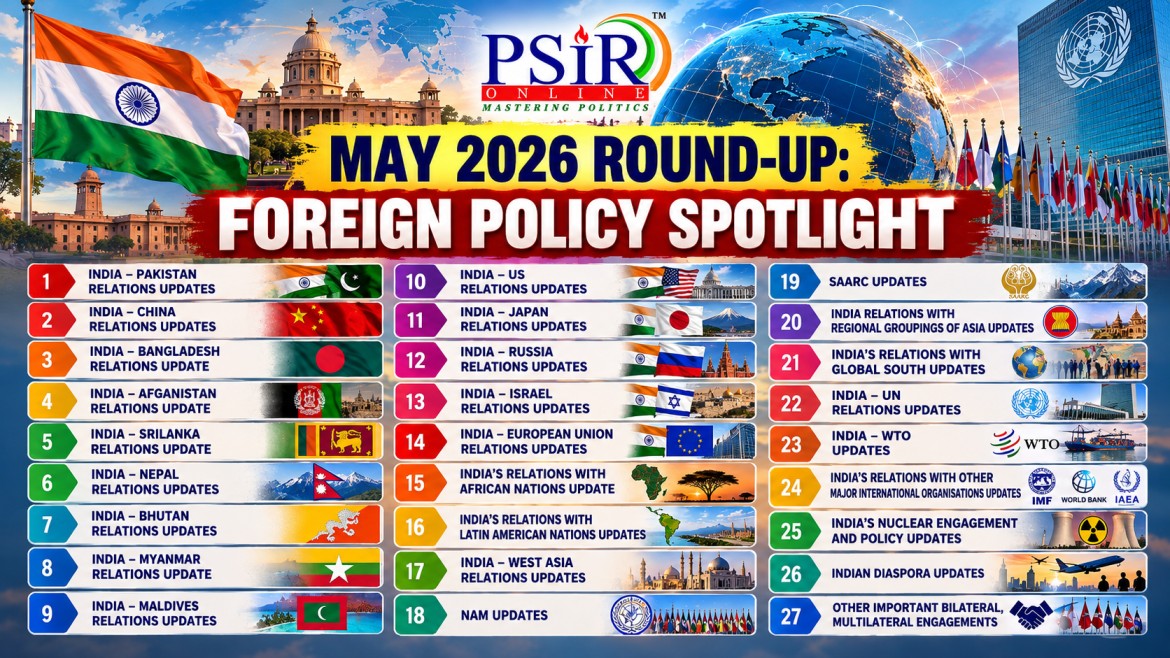
1. INDIA – PAKISTAN RELATIONS UPDATES
A. INDIA–PAKISTAN: Indus Waters Treaty dispute intensifies
On 15 May 2026, the Court of Arbitration constituted under the Indus Waters Treaty issued a supplemental award concerning India’s permissible pondage/storage capacity under the Treaty. India rejected the award, maintaining that the Court of Arbitration was illegally constituted and that its proceedings had no validity. Pakistan, in contrast, welcomed the award and maintained that the Treaty and its dispute-settlement mechanisms remained binding.
PSIR significance: Highlights the continuing India–Pakistan water dispute, treaty-based conflict management, sovereignty versus international dispute-settlement mechanisms, and the post-2025 restructuring of bilateral relations.
2. INDIA – CHINA RELATIONS UPDATES
A. BORDER TALKS AND NORMALISATION
India and China held the 35th meeting of the Working Mechanism for Consultation and Coordination (WMCC) on 27 May 2026 in Beijing. The two sides discussed maintaining peace and tranquillity along the border, border management, cross-border cooperation and preparations for the next meeting of the Special Representatives.
PSIR significance: LAC; border management; confidence-building measures; India–China normalisation.
3. INDIA – BANGLADESH RELATIONS UPDATE
A. INDIA MOVES TO REACTIVATE BILATERAL MECHANISMS
India announced in early May that it was reactivating bilateral engagement mechanisms with Bangladesh, including channels dealing with water, trade, border management, security and consular issues. Foreign Secretary Vikram Misri said ministerial-level contacts were already underway as both sides sought to rebuild engagement under Bangladesh’s new government.
PSIR significance: Neighbourhood First; bilateral institutional mechanisms; India–Bangladesh normalisation; constructive engagement.
B. MARITIME COOPERATION THROUGH IOS SAGAR
The Indian Navy’s INS Sunayna, deployed under the Indian Ocean Ship (IOS) SAGAR initiative, made a port call at Chattogram in May. The visit involved professional interactions and cultural exchanges with the Bangladesh Navy, strengthening bilateral maritime and naval cooperation in the Indian Ocean.
PSIR significance: Maritime security; Indian Ocean Region; SAGAR; naval diplomacy; India’s neighbourhood maritime engagement.
4. INDIA – AFGANISTAN RELATIONS UPDATE
A. INDIA STRENGTHENS HEALTHCARE ASSISTANCE
India delivered 20 tonnes of critical materials for BCG and Tetanus-Diphtheria vaccines to Kabul on 22 May 2026, supporting Afghanistan’s child immunisation programme. India indicated that further consignments were being planned.
PSIR significance: Humanitarian diplomacy; development partnership; soft power; India’s engagement with Taliban-ruled Afghanistan.
B. INDIA–AFGHANISTAN DIPLOMATIC ENGAGEMENT
On 4 May 2026 in Beijing, India’s Ambassador Vikram Doraiswami met Afghanistan’s Ambassador to China, Mawlawi Asadullah (Bilal Karimi). The two sides discussed their longstanding ties and continued engagement, including cooperation and regional connectivity.
PSIR significance: India’s calibrated engagement with Taliban-ruled Afghanistan; regional connectivity; neighbourhood diplomacy.
5. INDIA – SRILANKA RELATIONS UPDATE
A. INDIA–SRI LANKA DEFENCE COOPERATION
India and Sri Lanka strengthened defence cooperation in May through continued military engagement, including the Mitra Shakti joint military exercise and professional exchanges between the two armed forces. The cooperation focused on interoperability, training and strengthening security ties.
PSIR significance: Defence diplomacy; maritime security; Indian Ocean Region; India’s neighbourhood policy.
B. INDIA’S DEVELOPMENT PARTNERSHIP WITH SRI LANKA
India continued its development partnership with Sri Lanka in May, including assistance and cooperation in areas such as infrastructure, energy and community-oriented development projects, reinforcing India’s role as a major development partner during Sri Lanka’s economic recovery.
PSIR significance: Development diplomacy; economic engagement; Neighbourhood First; India’s soft power.
6. INDIA – NEPAL RELATIONS UPDATES
A. LIPULEKH ROUTE AND BORDER DISPUTE
Nepal formally objected in May to the proposed resumption of the Kailash Mansarovar Yatra through Lipulekh Pass, reiterating its territorial claim over the area. India rejected Nepal’s position and maintained that Lipulekh has been a traditional route for the pilgrimage since 1954.
PSIR significance: India–Nepal boundary dispute; territorial claims; neighbourhood diplomacy; China factor.
B. KOSHI–GANDAK WATER COOPERATION
India and Nepal held the 11th Joint Committee on Koshi and Gandak Projects on 30 April–1 May 2026 in Kathmandu. The meeting addressed flood forecasting, river management and outstanding operational issues in the two river systems ahead of the monsoon.
PSIR significance: Transboundary water cooperation; flood management; river diplomacy; India–Nepal institutional mechanisms.
7. INDIA – BHUTAN RELATIONS UPDATES
A. PARLIAMENTARY DIPLOMACY
An Indian Parliamentary Delegation led by Rajya Sabha Deputy Chairman Harivansh visited Bhutan from 13–15 May 2026 at the invitation of Bhutan’s National Assembly. The visit focused on strengthening parliamentary exchanges and people-to-people ties.
PSIR significance: Parliamentary diplomacy; people-to-people relations; India’s neighbourhood policy.
B. DEVELOPMENT PARTNERSHIP UNDER BHUTAN’S 13TH FIVE-YEAR PLAN
India and Bhutan held the Project Monitoring Committee meeting from 17–20 May 2026 to review India-supported development projects under Bhutan’s 13th Five-Year Plan. The review covered 71 medium- and large-scale projects spanning connectivity, education, healthcare, renewable energy, urban infrastructure and other sectors.
PSIR significance: Development diplomacy; economic partnership; Neighbourhood First; India’s development assistance.
8. INDIA – MYANMAR RELATIONS UPDATE
A. INDIA’S HUMANITARIAN ASSISTANCE TO EARTHQUAKE-AFFECTED MYANMAR
India continued its humanitarian assistance to Myanmar following the March 2025 earthquake, including relief and reconstruction support under Operation Brahma. In May, India’s assistance remained focused on rehabilitation and reconstruction, reinforcing its role as an early responder in Myanmar’s recovery.
PSIR significance: Humanitarian diplomacy; disaster relief; Act East Policy; India’s role as a regional first responder.
B. INDIA–MYANMAR CONNECTIVITY AND BORDER ENGAGEMENT
India continued engagement with Myanmar on border connectivity and security, particularly in relation to the India–Myanmar–Thailand Trilateral Highway and the management of the India–Myanmar border. Such engagement remains important for India’s Act East Policy and connectivity with Southeast Asia.
PSIR significance: Act East Policy; regional connectivity; border security; Southeast Asian integration.
9. INDIA – MALDIVES RELATIONS UPDATES
A. INDIA–MALDIVES DEFENCE COOPERATION
India and Maldives continued defence and maritime-security cooperation in May, including joint efforts relating to maritime surveillance, capacity building and security cooperation in the Indian Ocean. The engagement reflects the continuing effort to strengthen bilateral defence ties.
PSIR significance: Maritime security; Indian Ocean Region; SAGAR; defence diplomacy; Neighbourhood First.
B. INDIA–MALDIVES DEVELOPMENT PARTNERSHIP
India continued its development partnership with Maldives, including cooperation in infrastructure, connectivity and community-development projects. The partnership remains an important component of India’s engagement with the Maldives amid wider Indian Ocean strategic competition.
PSIR significance: Development diplomacy; economic engagement; Indian Ocean geopolitics; India’s neighbourhood policy.
10. INDIA – US RELATIONS UPDATES
A. RUBIO VISIT AND INDIA–US TRADE NEGOTIATIONS
US Secretary of State Marco Rubio visited India on 23–24 May 2026 and held talks with Prime Minister Narendra Modi and EAM S. Jaishankar. Discussions focused on accelerating the interim trade agreement, energy security, defence, maritime security and regional developments. Both sides indicated progress towards concluding the interim trade arrangement.
PSIR significance: India–US strategic partnership; trade diplomacy; economic security; strategic autonomy; defence and maritime cooperation.
B. INDIA–US DEFENCE AND UNDERWATER DOMAIN AWARENESS
During the May discussions, India and the US highlighted the recently renewed 10-year Major Defence Partnership framework and the signing of a Comprehensive Underwater Domain Awareness roadmap, aimed at strengthening cooperation in maritime security and the Indo-Pacific.
PSIR significance: Indo-Pacific; maritime security; defence cooperation; technology partnership; Quad.
C. RUBIO–JAISHANKAR DISCUSSIONS
US Secretary of State Marco Rubio and External Affairs Minister S. Jaishankar held discussions in May 2026 covering several dimensions of India–US relations:
PSIR significance: India–US strategic partnership; trade diplomacy; diaspora and mobility; defence cooperation; Indo-Pacific; energy security; strategic autonomy.
11. INDIA – JAPAN RELATIONS UPDATES
A. INDIA–JAPAN DEFENCE AND SECURITY COOPERATION
India and Japan continued to strengthen their defence and security partnership in May 2026, with engagement focused on maritime security, defence cooperation and the broader Indo-Pacific strategic framework.
PSIR significance: Indo-Pacific; maritime security; defence diplomacy; India–Japan Strategic and Global Partnership; Quad.
12. INDIA – RUSSIA RELATIONS UPDATES
A. LAVROV’S VISIT AND HIGH-LEVEL BILATERAL CONSULTATIONS
Russian Foreign Minister Sergey Lavrov met Prime Minister Narendra Modi on 14 May 2026 during his visit to India. Lavrov briefed Modi on progress in bilateral cooperation since the December 2025 India–Russia Annual Summit. The two sides also discussed Ukraine, West Asia and other regional and global issues, with India reiterating its consistent emphasis on dialogue and diplomacy.
PSIR significance: India–Russia strategic partnership; strategic autonomy; Ukraine conflict; dialogue and diplomacy; high-level diplomatic engagement.
B. INDIA–RUSSIA ENGAGEMENT THROUGH BRICS
During Lavrov’s May visit, India and Russia also engaged at the BRICS Foreign Ministers’ level, providing an important platform for coordination on global and multilateral issues. The engagement is significant as India held the BRICS Chairship in 2026, giving India–Russia relations an additional multilateral dimension.
PSIR significance: BRICS; Global South; multilateralism; India’s role in global governance.
13. INDIA – ISRAEL RELATIONS UPDATES
A. INDIA–ISRAEL STRATEGIC AND SECURITY COOPERATION
India and Israel continued high-level engagement in May 2026, with discussions covering defence and security cooperation, counter-terrorism, technology, trade and developments in West Asia. The engagement came amid continuing regional tensions, making security cooperation and coordination on regional developments particularly relevant to the bilateral relationship.
PSIR significance: India–Israel strategic partnership; defence cooperation; counter-terrorism; West Asian geopolitics; technology partnership.
14. INDIA – EUROPEAN UNION RELATIONS UPDATES
A. INDIA–EU FREE TRADE AGREEMENT: IMPLEMENTATION PHASE
The India–EU Free Trade Agreement (FTA) remained a major focus in May following the conclusion of negotiations on 27 January 2026. On 7 May, the EU Ambassador to India highlighted the need to move from the conclusion of negotiations towards legal finalisation, signature and implementation. The agreement covers trade in goods and services, market access, investment-related issues and professional mobility.
PSIR significance: India–EU strategic partnership; economic diplomacy; trade liberalisation; market access; rules-based economic order.
B. INDIA–EU STRATEGIC PARTNERSHIP
The May discussions surrounding the FTA also highlighted the broader India–EU Strategic Partnership, with trade being increasingly linked to technology, investment, supply-chain resilience and strategic cooperation. The EU and India had already agreed in January 2026 to strengthen their strategic partnership through a comprehensive agenda.
PSIR significance: India–EU relations; strategic autonomy; multipolarity; economic security; rules-based international order.
15. INDIA’S RELATIONS WITH AFRICAN NATIONS UPDATE
A. FOURTH INDIA–AFRICA FORUM SUMMIT POSTPONED
The Fourth India–Africa Forum Summit (IAFS-IV), originally scheduled in New Delhi for 28–31 May 2026, was postponed following consultations between India and the African Union over the evolving public-health situation in parts of Africa. India reaffirmed its support for an Africa-led response and its commitment to the India–Africa partnership. New dates are to be decided through mutual consultations.
PSIR significance: India–Africa partnership; South–South cooperation; Global South; African Union; health diplomacy.
B. INDIA–AFRICA BUSINESS AND ECONOMIC ENGAGEMENT
Ahead of the planned IAFS-IV, India held a curtain-raiser for the India–Africa Business Dialogue and Exhibition on 13 May 2026 in New Delhi. The initiative focused on strengthening trade, investment, technology partnerships and people-to-people cooperation between India and African countries.
PSIR significance: Economic diplomacy; India–Africa trade; development partnership; technology cooperation; Global South.
16. INDIA’S RELATIONS WITH LATIN AMERICAN NATIONS UPDATES
A. INDIA–CHILE CEPA AND CRITICAL MINERALS COOPERATION
Chile’s Foreign Minister Francisco Pérez Mackenna visited India from 11–14 May 2026, accompanied by a senior economic and business delegation. Discussions with EAM S. Jaishankar and Commerce Minister Piyush Goyal focused on accelerating negotiations for the India–Chile Comprehensive Economic Partnership Agreement (CEPA), trade and investment, and cooperation in critical minerals. Both sides also explored long-term supply arrangements, processing, technology partnerships and joint ventures.
B. INDIA–CHILE TECHNOLOGY AND INNOVATION COOPERATION
During the visit, the two countries also discussed cooperation in digital technology, innovation, biotechnology and startups. The Chilean delegation visited Bengaluru, including the C-CAMP biotechnology and startup centre, highlighting the growing technology dimension of India–Latin America relations.
PSIR significance: India–Latin America relations; economic diplomacy; critical minerals; Global South; trade diversification; technology partnerships.
17. INDIA – WEST ASIA RELATIONS UPDATES
A. INDIA’S DIPLOMATIC OUTREACH AMID WEST ASIA WAR
As the Iran–Gulf conflict continued through May, India maintained diplomatic engagement with Iran and the Gulf countries, seeking de-escalation and protection of its interests. During his May discussions with US Secretary of State Marco Rubio, EAM S. Jaishankar stressed India's need to maintain relations with the US, Iran, Israel and the Gulf countries simultaneously, while prioritising regional peace, the safety of the Indian diaspora, energy security and open markets.
PSIR significance: Multi-alignment; strategic autonomy; West Asian diplomacy; conflict diplomacy; diaspora diplomacy.
B. STRAIT OF HORMUZ, ENERGY SECURITY AND INDIAN SHIPPING
The war severely affected maritime movement through the Strait of Hormuz, creating direct concerns for India's energy supplies and shipping. India repeatedly called for safe and uninterrupted navigation, while coordinating the movement of Indian vessels and seafarers. On 25–26 May, the Indian-chartered crude tanker Nissos Keros, carrying about 270,000 tonnes of crude oil for India, safely crossed the Strait of Hormuz. India also continued assisting Indian nationals leaving Iran through land routes.
PSIR significance: Energy security; freedom of navigation; maritime security; Strait of Hormuz; protection of Indian diaspora.
18. NAM UPDATES
A. INDIA–SOUTH AFRICA AND THE CONTINUING RELEVANCE OF NAM
South African Deputy President Paul Mashatile visited India from 29 May–3 June 2026. The two countries highlighted their shared commitment to non-alignment, South–South cooperation and strengthening the Global South, with both India and South Africa being members of NAM, BRICS, IBSA, G20 and IORA.
PSIR significance: Non-alignment; strategic autonomy; South–South cooperation; Global South; India–Africa relations.
19. SAARC UPDATES
A. EFFORTS TO REVITALISE SAARC
In 2026, SAARC continued efforts to maintain its institutional mechanisms and revive regional cooperation despite the prolonged suspension of high-level political meetings. The 62nd Programming Committee meeting held in February 2026 discussed the SAARC programme of activities and called for a gradual, step-by-step resumption of pending meetings.
PSIR significance: SAARC; regionalism in South Asia; India–Pakistan factor; regional cooperation; limitations of institutional regionalism.
20. INDIA RELATIONS WITH REGIONAL GROUPINGS OF ASIA UPDATES
A. INDIA–SCO: SECRETARY-GENERAL’S VISIT TO INDIA
The SCO Secretary-General Nurlan Yermekbayev visited New Delhi on 22 May 2026 and met EAM S. Jaishankar. Discussions covered preparations for the upcoming SCO Foreign Ministers’ and Heads of State meetings, the organisation’s development and modernisation, and the international situation. Afghanistan was also discussed, while India briefed the Secretary-General on its 2026 BRICS Chairship.
PSIR significance: SCO; Eurasian regionalism; India’s Central Asian engagement; Afghanistan; multilateral diplomacy; strategic autonomy.
B. INDIA–ASEAN: 2026 COOPERATION AGENDA
India and ASEAN continued implementing their Comprehensive Strategic Partnership Plan of Action (2026–2030), with 2026 designated as the ASEAN–India Year of Maritime Cooperation. The partnership covers maritime security, connectivity, digital transformation, trade, disaster management and the Indo-Pacific.
PSIR significance: Act East Policy; ASEAN centrality; Indo-Pacific; maritime security; regional connectivity.
21. INDIA’S RELATIONS WITH GLOBAL SOUTH UPDATES
A. INDIA HOSTS BRICS FOREIGN MINISTERS’ MEETING
India hosted the BRICS Foreign Ministers’ Meeting in New Delhi on 14–15 May 2026 under its BRICS Chairship. The ministers discussed reform of global governance, multipolarity, economic cooperation and major global challenges. They specifically emphasised the role of BRICS in articulating the priorities and concerns of the Global South and called for a more representative and equitable international order.
PSIR significance: Global South; BRICS; multipolarity; reform of global governance; strategic autonomy.
B. INDIA–JAMAICA: GLOBAL SOUTH AND SIDS COOPERATION
During EAM S. Jaishankar’s visit to Jamaica from 2–4 May 2026, India and Jamaica reaffirmed cooperation on Global South issues, climate justice, climate finance and the concerns of Small Island Developing States (SIDS). India also received Jamaica’s support for its candidature for a non-permanent UN Security Council seat for 2028–29.
PSIR significance: Global South diplomacy; climate justice; SIDS; UN reform; South–South cooperation.
22. INDIA – UN RELATIONS UPDATES
A. INDIA’S CAMPAIGN FOR UN SECURITY COUNCIL REFORM
India continued its diplomatic efforts for reform of the UN Security Council, advocating greater representation for developing countries and the Global South. During May, India reiterated the need for a more representative, inclusive and effective UN system, including expansion of both permanent and non-permanent categories of Security Council membership.
PSIR significance: UN Security Council reform; Global South; multilateralism; India’s permanent-seat claim; global governance.
B. INDIA AND UN PEACEKEEPING
India continued its longstanding engagement with UN peacekeeping operations, including its contribution of military and police personnel and emphasis on the safety and effectiveness of peacekeepers. India also continued advocating greater recognition of the contribution of troop- and police-contributing countries to UN peacekeeping.
PSIR significance: UN peacekeeping; collective security; India's contribution to multilateral institutions; Global South representation.
23. INDIA – WTO UPDATES
A. WTO DISPUTE OVER INDIA’S SOLAR AND IT TARIFF MEASURES
On 22 May 2026, the WTO Dispute Settlement Body considered China’s request to establish a panel concerning India’s measures affecting imports of solar cells, solar modules and certain information-technology goods. The dispute adds another dimension to India’s ongoing engagement with the WTO’s dispute-settlement system.
PSIR significance: WTO dispute settlement; trade policy; tariff measures; India–China economic relations; rules-based trading system.
B. INDIA SUPPORTS ETHIOPIA’S WTO ACCESSION
On 22 May 2026, India and Ethiopia signed a bilateral accession protocol as part of Ethiopia’s process of joining the WTO. India reaffirmed its support for the integration of developing countries and LDCs into the multilateral trading system.
PSIR significance: WTO; Global South; developing-country interests; South–South cooperation; multilateral trading system.
24. INDIA’S RELATIONS WITH OTHER MAJOR INTERNATIONAL ORGANISATIONS UPDATES
A. INDIA–IMF: INDIA’S ECONOMIC OUTLOOK
The IMF’s May 2026 review and consultations with India focused on India’s growth outlook, inflation, fiscal policy, financial-sector resilience and external risks. The IMF continued to recognise India as one of the major contributors to global growth while highlighting the need for structural reforms and resilience against external shocks.
PSIR significance: IMF; global economic governance; India’s economic position; international financial institutions.
B. INDIA–IAEA: NUCLEAR COOPERATION
India continued engagement with the International Atomic Energy Agency (IAEA) in May 2026 on peaceful uses of nuclear technology, nuclear safety and safeguards. The cooperation reflects India’s engagement with the international nuclear governance framework while maintaining its independent strategic nuclear policy.
PSIR significance: IAEA; peaceful uses of nuclear energy; nuclear governance; India's nuclear diplomacy.
25. INDIA’S NUCLEAR ENGAGEMENT AND POLICY UPDATES
A. INDIA’S POSITION ON IRAN’S NUCLEAR PROGRAMME
Amid the May 2026 conflict involving Iran, India continued to emphasise the need for a diplomatic resolution of the Iranian nuclear issue, while supporting the principles of non-proliferation and the peaceful use of nuclear energy. India stressed that the issue should be addressed through dialogue and diplomacy rather than military escalation.
PSIR significance: Nuclear non-proliferation; Iran nuclear issue; strategic autonomy; peaceful uses of nuclear energy; West Asian security.
B. INDIA’S NUCLEAR SECURITY AND NON-PROLIFERATION POSITION
India continued to advocate a universal, non-discriminatory and verifiable approach to nuclear disarmament and non-proliferation, while maintaining its position that global nuclear governance must address the security concerns of all states. India also continued its engagement with international mechanisms dealing with nuclear safety, security and export controls.
PSIR significance: Nuclear disarmament; NPT debate; non-proliferation; nuclear order; India’s responsible nuclear-state position.
26. INDIAN DIASPORA UPDATES
A. INDIA–JAMAICA: DIASPORA AND COMMUNITY ENGAGEMENT
During EAM S. Jaishankar’s visit to Jamaica (2–4 May 2026), India engaged with the Indian-origin community and discussed strengthening people-to-people ties. The visit also highlighted the contribution of the Indian diaspora to the longstanding India–Jamaica relationship.
PSIR significance: Diaspora diplomacy; soft power; people-to-people relations; India–Caribbean engagement.
B. INDIA–NETHERLANDS: INDIAN COMMUNITY AS A BRIDGE
During Prime Minister Narendra Modi’s visit to the Netherlands (16–17 May 2026), India highlighted the contribution of the Indian community in the Netherlands to bilateral economic, technological and people-to-people relations. The diaspora was recognised as an important link between the two countries.
PSIR significance: Diaspora diplomacy; soft power; people-to-people ties; India–Europe relations.
27. OTHER IMPORTANT BILATERAL, MULTILATERAL ENGAGEMENTS
A. INDIA–CANADA: CEPA NEGOTIATIONS AND ECONOMIC RESET
India and Canada concluded the second round of Comprehensive Economic Partnership Agreement (CEPA) negotiations on 8 May 2026. Discussions covered goods, services, intellectual property, rules of origin, SPS measures and technical barriers to trade. Later in May, Commerce Minister Piyush Goyal led a major Indian business delegation to Canada, with both sides reaffirming the objective of concluding the CEPA by the end of 2026.
PSIR significance: India–Canada relations; economic diplomacy; trade negotiations; strategic partnership.
B. INDIA–SOUTH KOREA: CEPA UPGRADE NEGOTIATIONS
India and South Korea held the 12th round of India–Korea CEPA upgrade negotiations from 25–27 May 2026. The two sides agreed to create dedicated sub-groups on digital trade, supply chains and strategic industrial cooperation, while reviewing issues relating to goods, services and investment.
PSIR significance: India–South Korea relations; Indo-Pacific; supply-chain resilience; economic diplomacy; strategic industrial cooperation.
C. QUAD FOREIGN MINISTERS’ MEETING IN NEW DELHI
India hosted the 11th Quad Foreign Ministers’ Meeting on 26 May 2026 with Australia, Japan and the US. The Quad launched the Indo-Pacific Maritime Surveillance Collaboration (IPMSC) initiative to strengthen maritime-domain awareness and information sharing, initially focusing on the Indian Ocean Region. Cooperation was also advanced on critical and emerging technologies, economic security and humanitarian assistance.
PSIR significance: Quad; Indo-Pacific; maritime security; minilateralism; critical technologies; Indian Ocean.
