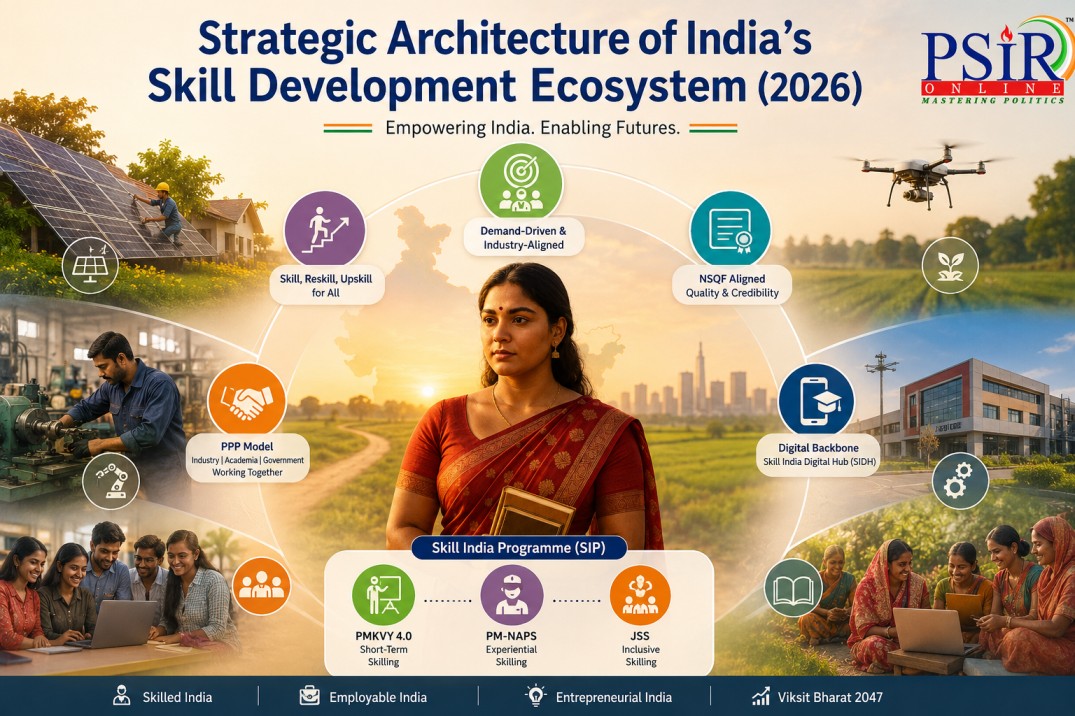
The Government of India approaches skill development as a mission-mode national priority, orchestrated primarily by the Ministry of Skill Development and Entrepreneurship (MSDE) under the overarching umbrella of the Skill India Mission. The overarching strategic objective is to convert India’s demographic dividend into a highly employable, global-standard workforce, driving the nation toward the macroeconomic targets of Viksit Bharat 2047.
CORE OPERATIONAL APPROACH
The ecosystem has transitioned from a supply-driven educational model to a dynamic, market-responsive framework built on five pillars:
· Demand-Driven & Industry-Aligned: Curricula and training matrices are reverse-engineered from actual corporate and industrial requirements rather than theoretical academic standards.
· The Lifecycle Strategy (Skill, Reskill, Upskill): A multi-tiered focus targeting fresh entrants (skilling), workers displaced by automation (reskilling), and existing professionals needing advanced competencies (upskilling). Special emphasis is placed on gender parity, rural penetration, and marginalized communities.
· National Skills Qualification Framework (NSQF) Alignment: Standardized certification ensures uniform competency levels across the country, establishing institutional credibility and linear mobility between vocational and mainstream academic education.
· Public-Private Partnership (PPP) Model: Active structural involvement of Industry Associations and Sector Skill Councils (SSCs) in curriculum design, infrastructure provisioning, assessments, and direct placement pipelines.
THE CONSOLIDATED STRATEGY: SKILL INDIA PROGRAMME (SIP)
To eliminate policy fragmentation and optimize fiscal efficiency, the Union Government operates a restructured architecture under the consolidated Skill India Programme (SIP) (backed by a ₹8,800 crore budgetary commitment running through 2026). This unified framework integrates three distinct training delivery mechanisms:

1. Short-Term Skilling: PMKVY 4.0
PMKVY 4.0 acts as the primary intake funnel for short-term vocational training, explicitly designed for school/college dropouts and the unemployed. Rather than operating on older, rigid, center-based quotas, it functions as a highly flexible, demand-driven vehicle.
· Short-Term Training (STT): Provides free, NSQF-aligned courses ranging from 150 to 600 hours, focusing heavily on digital literacy, soft skills, and financial inclusion.
· Recognition of Prior Learning (RPL): A major formalization tool that assesses, certifies, and validates the skills of informal sector workers (e.g., existing masons, mechanics, technicians) who have expertise but lack formal certification.
· Convergence with National Missions: PMKVY 4.0 is structurally linked with other mega-initiatives. For example, it directly supplies skilled labor to the PM Surya Ghar Yojana (solar installation) and the National Green Hydrogen Mission.
2. Experiential Skilling: PM-NAPS (National Apprenticeship Promotion Scheme)
Once a candidate completes classroom training via PMKVY or an ITI, PM-NAPS serves as the active bridge into the formal workforce. The government uses this scheme to systematically shift India toward an experiential "earn-while-you-learn" corporate culture.
· Direct Benefit Transfer (DBT) Incentives: To incentivize businesses—especially Micro, Small, and Medium Enterprises (MSMEs)—the Central Government uses DBT to directly pay 25% of the apprentice’s monthly stipend (up to ₹1,500 per month) directly to the trainee's bank account.
· Industry 4.0 Focus: Corporate apprenticeship paths under NAPS are heavily prioritized toward high-tech sectors, including semiconductor manufacturing, EV mechanics, robotics assembly, and drone aviation.
3. Inclusive Skilling: Jan Shikshan Sansthan (JSS)
While PMKVY and NAPS are heavily tied to industrial and urban demand, the JSS scheme is the rural and community-based anchor of the SIP.
· Doorstep Skilling: Focuses on non-literates, neo-literates, and rural women (who comprise nearly 80% of JSS beneficiaries) by delivering low-cost, flexible vocational training directly to their villages.
· Livelihood & Self-Employment: Rather than placing candidates in corporate jobs, JSS centers feature dedicated Livelihood Cells designed to help rural youth establish micro-enterprises and co-operatives, drastically mitigating distressed migration to urban cities.
KEY HIGH-GROWTH FOCUS AREAS & ENABLERS
· The Digital Backbone (Skill India Digital Hub - SIDH):
· A unified, mobile-first digital portal that integrates the entire skilling lifecycle—from AI-driven course discovery and digital verifiable credentials (via DigiLocker) to direct job matching and entrepreneurial credit linkage.
· Provides end-to-end digital services for candidates, training providers, and assessment agencies on a single platform.
· Enables easy discovery of free/paid courses, online enrolment, assessment, certification, and lifelong learning opportunities.
· Features personalized dashboards, job opportunities, resources, and integration with various government schemes.
· Supports digitally portable and verifiable credentials, making it easier for users to access opportunities both in India and abroad.
· Institutional Modernization (PM-SETU):
· A targeted initiative to upgrade and revitalize Industrial Training Institutes (ITIs) across states, transforming them into high-tech hubs equipped with modern machinery and industry-vetted trainers.
· Aims to upgrade 1,000 Government ITIs (200 Hub + 800 Spoke) under a Hub-and-Spoke model with an industry-led governance approach.
· Focuses on modernizing infrastructure, equipment, and curriculum to align with current industry needs and improve employability.
· Includes capacity building of trainers and establishment of National Centres of Excellence (NCOEs) in select National Skill Training Institutes (NSTIs).
· Promotes On-the-Job Training (OJT) and Dual System of Training to bridge the gap between classroom learning and real-world industry exposure.
· Preserving Heritage (PM Vishwakarma):
· A dedicated scheme providing end-to-end support—including collateral-free credit, modern toolkits, digital transaction training, and market linkages—to traditional artisans and craftspeople spanning 18 distinct trades.
· Offers collateral-free loans up to ₹3 lakh at concessional interest rates (5%) for enterprise development.
· Provides basic and advanced skill training with a daily stipend of ₹500, plus e-vouchers for modern toolkits worth ₹15,000.
· Issues PM Vishwakarma Certificate and ID Card for formal recognition and easier access to benefits.
· Focuses on integrating artisans into the formal economy through digital payments incentives, branding, and better market linkages.
· Future Skills Integration:
· Deep structural focus on Industry 4.0 technologies. Capital allocation is heavily prioritized toward courses in Generative AI, Robotics, Drone Technology, Cybersecurity, Semiconductors, Electric Vehicles (EVs), and Green Energy/Solar technologies.
· Strong emphasis on Green Skills and sustainable jobs in renewable energy, circular economy, and climate-resilient sectors.
· Integration of future-ready modules into PMKVY, ITIs, and Skill Hubs to prepare youth for emerging job markets.
· Collaboration with industry and Sector Skill Councils to regularly update curricula and introduce new courses in high-demand areas.
· Promotion of hands-on, practical training combined with digital and AI-powered learning tools.
· Global Mobility & International Standards:
· Aligning domestic training metrics with international frameworks (e.g., matching standards with countries across Europe and the Middle East) to position India as a primary exporter of high-skill human capital globally.
· Establishment of Skill India International Centres (SIICs / IISCs) to train and certify candidates specifically for overseas employment.
· Focus on creating a “Trusted Workforce Supply Chain” through quality assurance and bilateral agreements with destination countries.
· Provides orientation on language, culture, and global work practices along with skill certification recognized internationally.
· Aims to send skilled Indian workers abroad while ensuring fair and transparent mobility opportunities.
CONCLUSION
By shifting toward a consolidated, tech-enabled, and industry-funded ecosystem, the Union Government’s skilling strategy in 2026 functions not merely as a social welfare measure, but as a critical economic engine. It successfully balances the preservation of traditional crafts with the aggressive adoption of future-ready technological capabilities.
PRACTICE QUESTIONS FOR GS 2 MAINS
1. “India’s contemporary skill development architecture reflects a transition from welfare-oriented vocationalism to a market-responsive human capital strategy.” Critically examine in the context of the Skill India Programme (SIP). (15 Marks)
2. Discuss the significance of PMKVY 4.0 and PM-NAPS in bridging the gap between formal education and employability in India. How far can these initiatives address the challenges of Industry 4.0? (15 Marks)
3. “Inclusive skilling is essential for achieving both social justice and economic growth.” Analyse the role of Jan Shikshan Sansthan (JSS) and PM Vishwakarma in empowering marginalized and rural communities in India. (10 Marks)
4. Examine the role of digital platforms and institutional modernization in strengthening India’s skill development ecosystem. How do initiatives like Skill India Digital Hub (SIDH) and PM-SETU contribute toward the vision of Viksit Bharat 2047? (15 Marks)