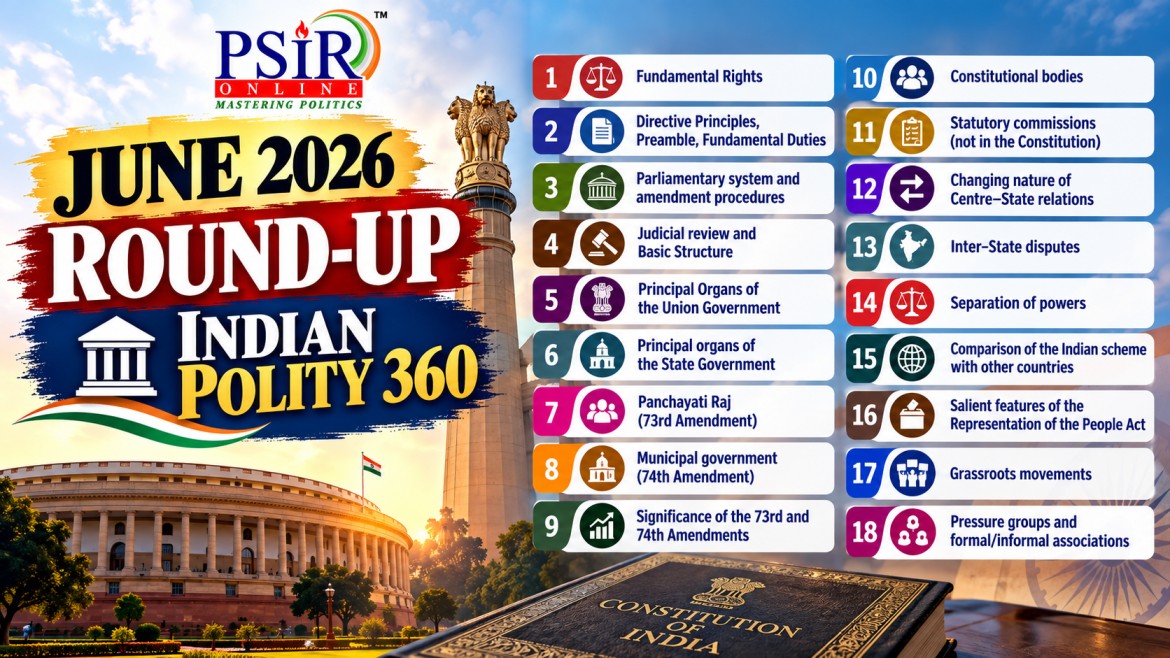
[NOTE: THE CURRENT AFFAIRS FOR THIS MONTH HAS BEEN ORGANISED AS PER THE TOPICS MENTIONED IN PSIR AND GS 2 (MAINS) SYLLABUS. FEW TOPICS MIGHT LOOK REPETITIVE AS IT OVERLAPS UNDER MANY SUB-HEADINGS. BUT THE INFORMATION INSIDE THOSE TOPICS WILL BE DIFFERENT AND WILL PERTAIN TO THE MAIN HEADING CONCERNED. HENCE STUDENTS ARE REQUESTED TO READ EACH AND EVERY LINE OF THE SECTION TO GET COMPLETE UNDERSTANDING]
1: Fundamental Rights
Fundamental Rights under Part III are not a closed list of words in Articles 12 to 35. Courts keep reading new content into them when daily life shows a gap. June 2026 was such a month. The Supreme Court named a new freedom of movement, gave economic value to unpaid household work, struck down a welfare rule that treated a married daughter as an outsider, and reminded accused persons that the right to travel abroad is not a free pass while a trial is pending. At the same time, Parliament’s recent change to transgender law and new FCRA rules brought equality, dignity, privacy and freedom of association back into political debate.
A. Right to walk on a safe footpath — Articles 19(1)(d) and 21
In Maniyar Iliyaz @ Shaik Riyaz v. P. Ayyappan (19 June 2026; 2026 INSC 647), a five-year-old boy walking to school with his father was crushed by a tanker. The accident claim reached the Supreme Court. Justices P.S. Narasimha and A.S. Chandurkar did not stop at enhancing compensation. They held that the “primary right of movement under Article 19(1)(d) is the Fundamental Right to Walk.” Safe, well-marked footpaths are part of Part III. Pedestrians come before motor vehicles. Urban development authorities, municipal corporations, municipalities and panchayats have an enforceable duty to build and maintain footpaths.
Why this matters for students: Article 19(1)(d) has long been read as the right to move freely throughout India. The Court now says the first form of that movement is walking. Article 21 (life with dignity and safety) supports the same idea. The Motor Vehicles Act is a law about vehicles; human safety is not an afterthought. Constitutional remedies and compensation can therefore sit beside the statute, not only inside it. In answers, link this to the Court’s earlier line that safe roads and safe travel are part of Article 21. The new step is the express duty of local bodies.
B. Dignity of unpaid work — homemakers as “nation builders”
In Shishu Pal @ Shish Ram v. Surjeet (11 June 2026; 2026 INSC 634), Justices Sanjay Karol and N. Kotiswar Singh dealt with a motor accident case that had dragged on for about twenty-five years. The deceased was a homemaker. The Court said homemakers are “nation builders.” Notional income based on a servant’s wage does not capture household management, maternal care and spousal support. It created a new head of compensation: “loss of domestic care,” with a basic minimum of Rs 30,000 a month, to rise by 10 per cent every three years.
This is not only motor-accident law. It is Article 14 and Article 21 thinking. Unpaid care work is usually done by women. If the legal system treats that work as zero, it treats those women as less equal and denies their families a dignified remedy. The Court also noted long delay in Motor Accident Claims Tribunals and issued directions to speed up claims. Delay itself can violate Article 21.
C. Equality and a married daughter — Articles 14, 15, 19 and 21
In Kulsum Nisha v. State of Uttar Pradesh (2 June 2026; 2026 INSC 617), Justices P.S. Narasimha and Alok Aradhe struck down a Government Order that kept a married daughter out of a fair-price shop / dependent welfare benefit only because she was married. Married sons and unmarried daughters remained eligible. The Court held that marital status is not an intelligible differentia with a rational link to the object of the scheme. The bar rested on gender stereotypes. It violated Articles 14 and 15(1), and also touched Articles 19(1)(g) and 21.
For Mains: this is classic Article 14 (classification test) plus substantive equality. Marriage does not cut a daughter’s constitutional tie with her parental family. Similar reasoning is now used in compassionate appointment cases. Do not write that “marriage ends dependence” as if it were a constitutional rule. It is not.
D. Right to travel abroad is not absolute — Article 21 in two directions
In Seesa Santosh v. State of Telangana (4 June 2026; 2026 INSC 628), Justices Dipankar Datta and Satish Chandra Sharma set aside a High Court order that had allowed an accused in an abetment-of-suicide case to fly to the United States for treatment. The Court accepted that the right to travel abroad is part of personal liberty under Article 21 (Maneka Gandhi line). It also held that the complainant’s right to a speedy trial is part of the same Article 21. One person’s liberty cannot be read in isolation. Comparable treatment was available in India. The accused’s conduct had added to delay. Passport need not be deposited, but leaving India required the Sessions Court’s permission after committal.
Exam point: Article 21 is a balancing article. Speedy trial, fair investigation and foreign travel all live under the same roof. None is a “trump card” in every fact situation.
E. Privacy versus the right to know parentage — DNA tests
Around the same period the Court, in Chaturbhuj Pradhan v. Amar Pradhan (end of May 2026; widely discussed in June), upheld a DNA test in a long paternity dispute. Privacy and bodily autonomy under Puttaswamy are fundamental. Compelled DNA testing is still exceptional. It is allowed only when parentage is the core issue, other evidence cannot settle the truth, and the balance of interests favours the person seeking identity and legal rights. The Court did not give children an open-ended right to demand a test, and it did not treat privacy as a wall against all scientific proof.
Use this to show that Puttaswamy is a three-part test (law, legitimate aim, proportionality), not a blanket veto.
F. Right to be forgotten — informational privacy in the digital space
The Delhi High Court judgment of 29 May 2026 (reported in the first days of June) held that the right to be forgotten flows from informational privacy under Article 21. People who were acquitted, discharged, or whose cases were quashed, and parties to private or matrimonial disputes, can seek de-indexing of name-based search results for judgments and related news. The text of the judgment stays public by case number and citation. Only name-based searchability is cut when continued display serves no real public purpose. Search engines and legal databases were directed to follow this framework.
This does not delete court history. It reduces perpetual digital stigma. Contrast it with open justice: the law and the reasoning remain visible; the person’s name need not stay on the first page of Google forever after the case is over.
G. Gender identity, dignity and equality — the 2026 transgender amendment in court
The Transgender Persons (Protection of Rights) Amendment Act, 2026 (assent 30 March 2026) deleted the statutory line on self-perceived gender identity, narrowed the definition of “transgender person,” and made a medical board’s recommendation necessary before a District Magistrate issues an identity certificate. Petitioners say this goes against NALSA (2014) and Puttaswamy (2017) — dignity, autonomy, equality, expression and privacy under Articles 14, 15, 19 and 21.
On 15 June 2026 a Bench of Chief Justice Surya Kant and Justice V. Mohana issued notice on the Union’s transfer petition, stayed further High Court hearings in Delhi, Karnataka, Kerala and Rajasthan, and indicated that one forum should decide the validity of a central law. The Act itself was not stayed. High Courts had earlier allowed some ongoing hormone therapy to continue. For students: the live question is whether Parliament can replace self-identification with medical-administrative certification without violating Part III. Watch the final hearing; until then, state the conflict clearly and do not treat the amendment as constitutionally settled.
H. Freedom of association — FCRA rules and the pending Bill
On 22 June 2026 the Ministry of Home Affairs notified Foreign Contribution (Regulation) Amendment Rules. They tighten control over NGOs that receive foreign funds (spending thresholds, management and leadership conditions, risk of cancellation). A separate FCRA Amendment Bill, 2026, debated through June, would vest assets with a designated authority when registration lapses or is refused — including, critics say, assets not built only from foreign money.
Receiving foreign money is not itself a Fundamental Right (Noel Harper). But Article 19(1)(c) protects the right to form associations. If the State can freeze or take an organisation’s means of survival for procedural default, the freedom to associate becomes hollow. Article 19(1)(a) (expression through civil society work) and Article 14 (arbitrariness) are the other hooks. Write both sides: national security and transparency versus overbreadth and chilling effect.
I. Other June notes students should keep
Pension for temporary-status casual workers: Bhikani Devi v. Union of India (1 June 2026) held that workers given temporary status cannot be denied pension only because they were never formally regularised. Livelihood and dignity under Article 21, read with equality, support this.
Reproductive autonomy: a Supreme Court ruling reported in early June (S v. Union of India) again treated bodily integrity and decisional autonomy in pregnancy as part of Article 21. Where the MTP Act gives no statutory route, Articles 32 and 226 still operate. The statute does not exhaust the Constitution.
Rehabilitation of trafficking survivors: Prajwala v. Union of India (29 May 2026) located a right to rehabilitation in Articles 21 and 23. Rescue without rehabilitation is incomplete freedom.
2: Directive Principles, Preamble, Fundamental Duties
The Preamble states the goals. Part IV tells the State how to move towards those goals. Part IVA tells citizens what they owe the Republic. None of the three is a stand-alone justiciable chapter in the way Part III is. Yet June 2026 showed, once again, that courts use all three as a living kit: to read equality, to value unpaid work, to condemn hate speech, and to judge whether a welfare scheme is only a paper promise.
A. Preamble: fraternity, justice and equality of status
The strongest Preamble moment of this period is Ashwini Kumar Upadhyay v. Union of India (29 April 2026; widely circulated in June). The Court refused to turn every grievance about hate speech into a standing Article 32 project. Criminal law already occupies that field. What it did do was write an “ode to Fraternity.” Fraternity in the Preamble is not a slogan. It is a reciprocal duty among citizens to respect equal dignity. Hate speech works against that idea. It also works against India’s civilisational phrase vasudhaiva kutumbakam. True citizenship cannot become an “us versus them” tool. That would corrode both the secular character of the Republic and the unity of the Nation.
Two June judgments give flesh to the other Preamble words.
In Shishu Pal v. Surjeet (11 June 2026) the Court treated homemakers as “nation builders” and created a new compensation head called “loss of domestic care.” Social and economic justice in the Preamble is empty if the legal system prices women’s unpaid household labour at zero.
In Kulsum Nisha v. State of Uttar Pradesh (2 June 2026) a married daughter was kept out of a welfare benefit only because she was married. The Court said marital status is not a valid line under Articles 14 and 15. That is also “equality of status and of opportunity” in the Preamble. Marriage does not erase a daughter’s place in her parental family.
Remember the settled map: the Preamble is part of the Constitution (Kesavananda Bharati). It can be amended under Article 368, but not so as to break the basic structure. “Socialist,” “secular” and “integrity” came in by the 42nd Amendment. Later challenges to those words have failed. The Preamble does not itself give a writ. It guides how Parts III, IV and IVA are read.
B. Directive Principles: the State’s unfinished welfare list
Article 37 still says DPSPs are not enforceable in court, but are “fundamental in the governance of the country.” June developments used that second half.
Social and economic justice (Articles 38, 39, 43).
Shishu Pal is a DPSP case as much as a motor-accident case. Articles 38 and 39 ask the State to reduce inequality and to see that men and women equally have the right to an adequate means of livelihood. Valuing domestic care is a judicial way of taking those clauses seriously. Bhikani Devi v. Union of India (1 June 2026) held that casual workers given temporary status cannot be denied pension only because they were never formally regularised. Long service that looks like regular work cannot be kept in a precarious box to deny social security. Articles 38, 39 and 43, read with Article 21, support that view. The State as model employer cannot hide behind labels.
Right to work as a Directive, not yet a Fundamental Right (Articles 39(a) and 41).
Through June the country prepared for a big statutory change. The Centre had already notified that from 1 July 2026 the Viksit Bharat–Guarantee for Rozgar and Ajeevika Mission (Gramin) Act would replace MGNREGA. Guaranteed days rise from 100 to 125. Ongoing MGNREGA works as on 30 June were to be carried over. Job cards were to stay valid till new Gramin Rozgar Guarantee Cards were issued. This is Article 41 in statutory form: the State shall, within its economic capacity, make effective provision for the right to work. It is still a Directive, not an Article 21 right that a court can order the State to fund at any scale. That distinction matters for Mains. Later in the year the Court itself asked whether the right to work should be lifted to Article 21. In June the live fact was the change of statute, not a change of constitutional rank.
Education, health and the welfare of children (Articles 39(f), 41, 42, 47).
The Court has already treated menstrual hygiene in schools as part of the right to education and dignity. Compliance reporting continued in 2026. DPSPs on nutrition, public health and childhood development explain why a “free napkin” direction is not charity. It is governance under Part IV, enforced through Part III.
Weaker sections and EWS (Article 46, 103rd Amendment).
On 24 June 2026, in Harshvardhan Singh v. State of Rajasthan, Justices B.V. Nagarathna and Joymalya Bagchi refused to force private medical colleges to charge government-level fees for EWS students. Reservation at the point of admission is one thing. A fee subsidy that private, self-financing colleges must pay from their own pocket is another. Capitation is banned. That does not mean private colleges must charge government rates, or they may shut. The larger question of law was left open. For students: Article 46 and the EWS amendment aim at educational opportunity. They do not automatically convert every reserved seat in a private college into a subsidised seat. Minerva Mills still holds the frame — Parts III and IV are two wheels of one chariot. One wheel cannot crush the other.
Article 39(b) and Article 31C — do not confuse the current law.
The nine-judge ruling in Property Owners Association v. State of Maharashtra (2024) remains the governing text. Not every privately owned thing is a “material resource of the community.” Article 31C, in its Kesavananda-approved form, still shields only laws that give effect to Articles 39(b) and 39(c) from challenge under Articles 14 and 19. It does not immunise every DPSP law. June did not reopen that bench. Answers should still state this position when they discuss nationalisation or redistribution.
C. Fundamental Duties: citizens as co-authors of the Republic
Part IVA has eleven duties. They are not directly enforceable. Courts use them to interpret statutes, to test reasonableness, and to remind petitioners that rights have a matching ethic.
Article 51A(e) — harmony and common brotherhood.
Upadhyay tied this duty to the Preamble’s fraternity. Promoting harmony and renouncing practices that insult the dignity of women is not only a sermon. It is the citizen-side of the same value that the State must protect through criminal law. When you write on hate speech, put 51A(e) next to Articles 19(2) and 21.
Article 51A(k) — parent’s duty to educate the child (6–14 years).
This duty, added by the 86th Amendment, sits next to Article 21A and the RTE Act. The State, the school, the local body and the parent are all duty-bearers. June discussion of school infrastructure and child safety (including the “right to walk” to school) makes sense only if the parent’s duty and the State’s DPSP/FR duties are read together.
Article 51A(g) — environment and compassion for living creatures.
Safe streets and liveable cities are not only municipal engineering. Citizens who dump on footpaths and authorities who fail to build them both fail a constitutional ethic. Link 51A(g) with Article 48A (DPSP) and Article 21. That trio is the standard environment answer.
Duties cannot be used as a sword to cut down Fundamental Rights. Minerva Mills and later cases keep that line. A valid law may enforce a duty. A duty cannot, by itself, authorise an arbitrary restriction.
3: Parliamentary system and amendment procedures
India is a parliamentary system. The Council of Ministers is collectively responsible to the Lok Sabha. Ordinary laws need a simple majority. The Constitution itself can be changed only through Article 368. June 2026 was not a sitting month of high law-making. It was a month of numbers, memory and preparation. The special session of April had already shown that a government majority is not the same as a constituent majority. Through June, parties argued about two-thirds, delimitation, women’s reservation, and whether a fresh attempt should be made in the Monsoon Session.
A. Parliamentary system: responsibility, two Houses, and what a majority can and cannot do
Collective responsibility under Article 75(3) is the heart of the system. The Prime Minister and the Cabinet stay in office only while they command the confidence of the Lok Sabha. That is different from the special majority needed to amend the Constitution. A government can pass the Budget and ordinary Bills and still fail an Article 368 vote. That is the lesson of April, which June politics kept repeating.
Bicameralism is not decoration. An ordinary Bill can, in a deadlock, go to a joint sitting under Article 108. A Money Bill cannot, because the Rajya Sabha has only a 14-day recommendatory role. A Constitution Amendment Bill also cannot go to a joint sitting. Each House must pass it separately by special majority. If the Rajya Sabha says no, the amendment dies. That design protects the federal second chamber from being outvoted by the larger Lok Sabha sitting together.
June debate on a “two-thirds majority” was often loose. Students should keep the arithmetic exact. Special majority under Article 368(2) is two conditions at once, in each House: a majority of the total membership of that House, and not less than two-thirds of members present and voting. In the Lok Sabha, if 528 members vote, two-thirds of those present and voting is 352. On 17 April 2026 the Constitution (131st Amendment) Bill got 298 votes in favour and 230 against. It failed. That figure was quoted all through June. It is the best recent classroom example of why “we have a majority” is not enough for constituent power.
The Speaker’s office also belongs to this topic. Earlier in 2026 the Opposition had moved a rare no-confidence motion against the Lok Sabha Speaker (under the House rules, not Article 75). It was discussed and rejected in March. It is not a vote against the government. It is a reminder that the parliamentary system has two different accountability lines: the Cabinet to the House, and the Speaker to the House as a whole.
B. Amendment procedure: Article 368 in real time
The procedure itself did not change in June. The politics of using it did.
A Constitution Amendment Bill may be introduced in either House, by a minister or a private member. The President’s prior sanction is not required. Each House must pass it separately. There is no joint sitting. After both Houses pass it, and after ratification by at least half the State legislatures where the proviso to Article 368(2) applies, the Bill goes to the President. After the 24th Amendment the President must give assent.
The proviso applies when the amendment touches federal items — among others Articles 54 and 55, 73 and 162, 241, Chapter IV of Part V, Chapter V of Part VI, Chapter I of Part XI, any List in the Seventh Schedule, representation of States in Parliament, Article 279A (GST Council), and Article 368 itself. Delimitation and the composition of the Lok Sabha sit in this sensitive zone. That is why the 131st Amendment package was not “just another Bill.”
What the 131st Amendment Bill, 2026 tried to do, in short: operationalise one-third reservation for women by linking it to a fresh delimitation; raise the ceiling on Lok Sabha strength (reports spoke of a House going well beyond 543, towards 816 or even 850 in some drafts); and allow Parliament more room to choose which census figures would drive the new map. The government said this would let women’s reservation work before 2029. The Opposition said it mixed a popular social reform with a federal fight over which States would gain or lose seats. After the amendment failed, the linked Delimitation Bill and Union Territories Laws (Amendment) Bill were withdrawn.
June news was about a second attempt. Reports in early June said the Centre hoped to bring women’s reservation and delimitation back in the Monsoon Session and to pick up issue-based support. The 106th Amendment (Nari Shakti Vandan Adhiniyam, 2023) is still the last enacted amendment. It already creates one-third reservation for women, but it waits for census and delimitation. Until an Article 368 Bill on that machinery is passed — and, where needed, ratified by States — the 106th Amendment stays a promise on paper.
Another pending constituent proposal remained in the background: the Constitution (130th Amendment) Bill, on the Prime Minister, Chief Ministers and Ministers losing office after a long spell in custody. It is an Article 368 Bill. It therefore needs the same special majority in both Houses. A Joint Parliamentary Committee was still sitting on it in June–July. For this topic, the point is not the policy of the Bill. The point is that even a change in who may stay in the Cabinet is not ordinary legislation if it is packed as a constitutional amendment.
As of June 2026 the enacted count still stopped at the 106th Amendment. Failed Bills do not get a serial number as Acts.
C. Limits of amending power: basic structure and parliamentary sovereignty
Article 368 is wide. It is not unlimited. Kesavananda Bharati (1973) holds that Parliament may amend any provision, including Fundamental Rights, but may not damage the basic structure. Minerva Mills (1980) struck down clauses that tried to put amendments beyond the courts and to declare the amending power unlimited. Judicial review of amendments is itself a basic feature. Limited amending power is also a basic feature. Parliament cannot use Article 368 to make Article 368 unlimited.
June commentary that “a two-thirds majority can change anything” is therefore wrong. A two-thirds majority can pass an amendment. The Supreme Court can still test that amendment. Democracy, republicanism, federalism, secularism, separation of powers, rule of law, judicial review and free and fair elections cannot be written out of the book.
Federalism is the practical limit in 2026. Any change in how Lok Sabha seats are shared among States needs State ratification. Southern States that controlled population growth fear a raw population formula. That political fact is also a constitutional fact. The amending process was built so that the Union cannot redraw the federal bargain by Lok Sabha numbers alone.
Do not mix routes. Some changes (creation of States, citizenship rules in parts, a few Schedule entries) can be done by ordinary law and sit outside Article 368. Most of the Constitution needs special majority. Federal provisions need special majority plus half the States. Women’s reservation plus delimitation sits in the third box. That is why it failed in April and why June was a month of coalition arithmetic, not of a new amendment on the statute book.
4: Judicial review and Basic Structure
Judicial review is the Court’s power to test laws and executive acts against the Constitution. Basic structure is the outer wall around that power: Parliament may amend almost everything under Article 368, but it may not pull down the identity of the Constitution. June 2026 did not produce a new thirteen-judge theory. It showed the doctrine at work in smaller rooms — electoral rolls, a failed amendment Bill, EWS fees in private colleges, gender-identity legislation, and everyday writs that keep adding content to Articles 14, 19 and 21.
A. Judicial review in June: what the Court reviewed, and what it refused to rewrite
Judicial review in India runs on Articles 13, 32, 136, 226 and 227. Ordinary statutes, delegated rules, and even constitutional amendments can be tested. The method is not “would we have designed a better policy?” It is “is this measure unconstitutional — arbitrary, disproportionate, or destructive of a basic feature?”
The Special Intensive Revision of electoral rolls in Bihar was upheld in a judgment that June commentary treated as the template for later SIR exercises. The Court accepted that clean rolls and inclusion of every eligible voter are both democratic duties. It used proportionality, not substitution. The question was not whether another method would have been kinder. The question was whether the chosen method was so excessive that it fell outside constitutional bounds. Process — notice, objection, appeal, and later court review — was treated as part of reasonableness. That is judicial review with self-restraint. Free and fair elections are a basic feature (Indira Gandhi v. Raj Narain). That does not mean every Election Commission circular is struck down. It means the Commission cannot act outside the Constitution, and the Court will not run the roll-revision itself.
On 24 June 2026, in Harshvardhan Singh v. State of Rajasthan, Justices B.V. Nagarathna and Joymalya Bagchi refused to force private medical colleges to charge government fees for EWS students. The 103rd Amendment (EWS reservation) had already survived basic-structure review in Janhit Abhiyan (2022). The June case was a second-order review: does an EWS seat in a self-financing college carry a right to a subsidised fee? The Court said no, on the material before it, and left the larger question of law open. This is the difference between reviewing an amendment and reviewing how a State and a private college implement it. Judicial review is available. It is not a blank cheque to redesign fee policy.
On 15 June 2026 the Court stayed High Court hearings on the Transgender Persons (Protection of Rights) Amendment Act, 2026 and issued notice on the Union’s transfer petition. The amendment itself was not stayed. The move is about uniformity of judicial review. A central statute should not receive four different High Court answers on Articles 14, 19 and 21. Centralising the challenge is itself an exercise of the Supreme Court’s place in the review hierarchy (Articles 32, 139A, 141). Students should not write that the law has been struck down. They should write that its validity is now a single constitutional question.
June also showed review as rights-expansion, not only as striking down. Maniyar Iliyaz (right to walk) and Shishu Pal (homemaker’s domestic care) did not invalidate a statute. They read Articles 19 and 21 more fully and placed duties on the State. That too is judicial review: the Court says what the Constitution already contains.
B. Basic structure: the ceiling that June politics kept bumping into
Kesavananda Bharati (1973) is still the holding. Parliament can amend any provision, including Fundamental Rights. It cannot damage the basic structure. There is no closed list. The usual cluster is: supremacy of the Constitution; republican democracy; secularism; federalism; separation of powers; rule of law; judicial review; independence of the judiciary; free and fair elections; harmony of Parts III and IV; and limited amending power itself.
Minerva Mills (1980) struck down Articles 368(4) and (5), which tried to put amendments beyond courts and to declare amending power unlimited. L. Chandra Kumar (1997) held that review by High Courts (226/227) and the Supreme Court (32) is a basic feature and cannot be taken away in favour of tribunals. I.R. Coelho (2007) held that even Ninth Schedule laws after 24 April 1973 can be tested if they damage the basic structure. NJAC (2015) struck down the 99th Amendment because judicial independence is a basic feature.
June 2026 politics made this concrete. The Constitution (131st Amendment) Bill failed the special-majority test in April (298–230, short of 352). All through June, parties spoke as if a future two-thirds majority could “change the Constitution.” That sentence is incomplete. Even a passed amendment can be reviewed. Delimitation that wrecks federal balance, or an election design that wrecks free and fair elections, would face the Kesavananda wall. Failure in the House does not make basic structure irrelevant. It only means the Court was not asked to judge that Bill.
Article 31C, after Property Owners Association (2024), survives only in its Kesavananda form: laws giving effect to Articles 39(b) and (c) get a limited shield from Articles 14 and 19. The bar on judicial review in the old second half of 31C remains void. So even a “Directive Principle law” is not a no-go zone for courts. June answers should still state this. It is the current map of how DPSPs, amendments and review fit together.
Free and fair elections as a basic feature also framed the SIR debate. The Court can uphold a revision exercise and still keep the power to strike a law that makes elections unfree. Later in 2026, benches discussing election-related statutes again said that free and fair elections are beyond doubt as a basic feature; whether a particular section fails that test is a separate merits question. That split — feature settled, application open — is how the doctrine actually works.
C. Separation of powers: review without taking over the other two organs
Basic structure is not a licence for the Court to govern. Separation of powers is itself a basic feature. June writing on the SIR judgment stressed this. Proportionality does not mean the least restrictive option in the abstract. It means the measure must not be palpably arbitrary against its aim. If objections, appeals and writs exist, the Court is slower to call the whole scheme unconstitutional.
The same idea appears when the Court refuses to legislate. Ashwini Kumar Upadhyay (hate-speech batch, circulated in June) said constitutional courts may interpret and direct, but they cannot write a new criminal code. Article 32 is extraordinary. It is not a substitute for the CrPC / BNSS. That is judicial review knowing its own limit.
State of West Bengal v. Jai Hind Pvt. Ltd. (2026) repeated that separation of powers and judicial independence are integral to basic structure. The power of review is a core judicial function. The executive cannot sit in review over its own orders unless a statute clearly says so. If it does so without authority, it blurs the line between executive and judiciary and hurts the rule of law.
For the Transgender Amendment, staying High Court cases while refusing (so far) to stay the Act is the same balance. The Court keeps the last word on validity. It does not, at the interim stage, erase a law passed by Parliament.
5: Principal Organs of the Union Government
The Union’s principal organs are the President, the Vice-President, the Prime Minister and Council of Ministers, Parliament (Lok Sabha and Rajya Sabha), and the Supreme Court. June 2026 was a working month for all of them, even though Parliament itself was not in a regular session. The President appointed judges. The Prime Minister crossed a tenure milestone and reset Cabinet committees. The Vice-President, as Chairman of the Rajya Sabha, swore in new members and recognised the Leader of the Opposition again. The Supreme Court took five new judges and lost two to retirement.
A. President and Vice-President
The President is the constitutional head (Articles 52–62). Real executive power is exercised on the aid and advice of the Council of Ministers (Article 74), except in a thin band of situations. Appointment of Supreme Court judges is a good June illustration of how the offices actually mesh.
On 1 June 2026 the President, acting under Article 124(2), appointed five judges to the Supreme Court: Justices Sheel Nagu, Shree Chandrashekhar, Sanjeev Sachdeva and Arun Palli, and senior advocate V.S. Mohana. The Collegium had recommended the names on 27 May. The Union government processed them in days. Warrants issued in the President’s name. Oaths were administered by the Chief Justice on 2 June. That is the appointment chain in one week: Collegium proposes, Council of Ministers advises, President appoints, CJI swears in.
The same President had, in May, promulgated the Supreme Court (Number of Judges) Amendment Ordinance, 2026 under Article 123, raising sanctioned strength from 34 to 38 (including the Chief Justice). An ordinance is a temporary law when Parliament is not in session. It has the force of an Act, but it must be laid before both Houses and will lapse if not replaced in time. The later replacement Bill is ordinary Union legislation, not an Article 368 amendment. Students should keep that distinction. Number of judges is fixed by statute (the 1956 Act), not by the Constitution’s text on composition.
Droupadi Murmu remained President through June. C.P. Radhakrishnan remained Vice-President and ex-officio Chairman of the Rajya Sabha (Articles 63–64). On 29 June he administered oath to eight newly elected Rajya Sabha members, including Mallikarjun Kharge, and recognised Kharge again as Leader of the Opposition with effect from 26 June under the 1977 Act. The Vice-President’s everyday work is parliamentary, not executive. He has no independent ministry. He steps in as President only if that office is vacant or the President is unable to act (Article 65).
B. Prime Minister, Cabinet and Parliament
The Prime Minister is the real executive (Article 75). The Cabinet is the core of the Council of Ministers. Collective responsibility is to the Lok Sabha.
On 10 June 2026 Narendra Modi completed 4,399 continuous days in office as Prime Minister after the first general elections of the Republic, one day more than Jawaharlal Nehru’s unbroken stretch from 1952 to 1964. Tenure length is political fact, not a new constitutional power. What matters for Polity is continuity of the same office under Article 75: the Prime Minister stays while he commands the confidence of the Lok Sabha.
Around the same period the Prime Minister reconstituted Cabinet committees. These committees are extra-constitutional. They are created by the Prime Minister. They exist to divide Cabinet work — security, economy, political affairs, parliamentary affairs, and so on. A reshuffle of committees is an internal executive act. It does not need a parliamentary vote. It shows how the real executive organises itself between sessions.
Parliament in June was between sessions. The April special sitting had already shown the limit of the government’s numbers on a Constitution Amendment Bill. June politics was about whether that Bill, and the 130th Amendment Bill on ministerial office after custody, would return in the Monsoon Session. For this topic, remember the organs: Lok Sabha Speaker Om Birla; Rajya Sabha Chairman (the Vice-President); Deputy Chairman Harivansh; Leader of the House in the Rajya Sabha J.P. Nadda; Leader of the Opposition in the Rajya Sabha Kharge after 26 June; Leader of the Opposition in the Lok Sabha Rahul Gandhi. The Leader of the Opposition is a statutory office under the 1977 Act, not a constitutional office. Recognition lapses when the member’s term ends and must be given again after re-election. That is what happened to Kharge in the last week of June.
Cabinet responsibility does not freeze when the House is not sitting. Policy notifications (including the July-1 switch from MGNREGA to VB-G RAM G, prepared in May–June) are executive acts of the Union government, accountable later on the floor.
C. Supreme Court as a Union organ
The Supreme Court is the Union’s highest judicial organ (Articles 124–147). June changed its human composition more than its jurisdiction.
Five judges took oath on 2 June. Working strength rose to 37 against a new sanctioned strength of 38. Justice V. Mohana became only the second woman elevated directly from the Bar; Justice B.V. Nagarathna remained the other sitting woman judge. Two judges retired in June: Justice Pankaj Mithal and Justice J.K. Maheshwari. After Justice Maheshwari’s retirement the Collegium’s fifth member became Justice P.S. Narasimha. The Collegium is not in the constitutional text. It is the product of the Second and Third Judges cases. Appointment still formally flows through Article 124(2) and the President.
The Court sat on partial working days in June and still delivered major rulings (right to walk, homemaker’s domestic care, EWS fees, stay of High Court cases on the Transgender Amendment). Institutionally, the point is capacity. The ordinance and the five appointments were justified as a response to pendency and the need for more Constitution Benches. Whether more judges reduce delay is an empirical question. Constitutionally, Parliament (or an ordinance later replaced by Parliament) may fix the number. Independence of the Court remains a basic feature. Adding seats does not, by itself, weaken that feature. Packing the process of who is appointed would.
Attorney-General is also a Union organ (Article 76). June did not turn on a change in that office. Mention it in a full answer as the government’s law officer who has the right of audience in all courts.
6: Principal organs of the State Government
Every State has a Governor, a Chief Minister and Council of Ministers, a Legislature (unicameral or bicameral), and a High Court. The Governor is the constitutional head. The Chief Minister is the real executive. June 2026’s clearest State-organ event was a change of Chief Minister in Karnataka. The same month, four High Courts lost their Chief Justices to the Supreme Court and received Acting Chief Justices. The law on the Governor’s assent to Bills (Article 200) remained the live federal tension in the background.
A. Governor and Chief Minister: how a State government actually changes
Article 163 says the Governor acts on the aid and advice of the Council of Ministers, except where the Constitution gives discretion. Article 164 says the Chief Minister is appointed by the Governor and the other Ministers are appointed on the Chief Minister’s advice. The Council is collectively responsible to the Legislative Assembly. The Deputy Chief Minister is not a constitutional office. The Supreme Court has said the post is not illegal; the person remains a Minister under the Chief Minister.
On 3 June 2026, D.K. Shivakumar took oath as Chief Minister of Karnataka. Governor Thaawarchand Gehlot administered the oath at Lok Bhavan, Bengaluru. Siddaramaiah had resigned on 28 May. The Congress Legislature Party elected Shivakumar as leader on 30 May. G. Parameshwara was sworn in as Deputy Chief Minister, along with a first batch of Cabinet Ministers. A further expansion was left for after Council and Rajya Sabha polls.
This is the textbook sequence in real time. The party in the Assembly chooses its leader. That leader is invited to form the government. The outgoing Chief Minister resigns. The Governor administers oath. There was no Assembly defeat and no Article 356. It was an intra-party transition while the same party kept the majority. Students should not treat a mid-term change of CM as President’s Rule. It is ordinary parliamentary government at the State level.
Other 2026 changes of Chief Minister (Bihar, Kerala, Tamil Nadu, West Bengal, Manipur, Assam’s new term) had already happened before June. June’s own State-executive headline is Karnataka. The Governor’s role there was ceremonial and correct: he did not pick a leader against the party’s choice.
The Governor is appointed by the President and holds office during the pleasure of the President (Articles 155–156). Several Governors had been moved in the March 2026 reshuffle. In June those names were the working list (for example Gehlot in Karnataka, Arlekar holding Kerala and additional charge of Tamil Nadu). Pleasure of the President is the Union’s lever. Aid and advice of the State Cabinet is the State’s lever. Tension between the two is the recurring federal story, not a one-month news item.
B. State Legislature and Article 200
The State Legislature makes law. The Governor is part of that Legislature (Article 168). No Bill becomes an Act until the Governor assents, withholds, returns it (if it is not a Money Bill), or reserves it for the President (Article 200). If a Bill is reserved, Article 201 governs the President.
The Constitution Bench opinion in the Presidential Reference on assent (November 2025) is still the governing reading in 2026. The Governor has three options: assent, reserve for the President, or withhold and return with a message. There is no pocket veto that can kill a Bill by silence forever. Courts may, in a case of long and unexplained inaction, tell the Governor to decide in a reasonable time. They cannot create “deemed assent” under Article 142. They cannot judge the contents of a Bill before it becomes law. After the House passes a returned Bill again, the Governor shall not withhold assent, but reservation for the President can still be used in the situations the Court has mapped.
June did not add a new Article 200 judgment of that size. It kept the doctrine relevant. Any Mains answer on State organs in 2026 must put the Governor inside the legislative process, not only on the oath-taking stage.
Money Bills at the State level follow Article 198. The Legislative Council, where it exists (Karnataka has one), cannot indefinitely block a Money Bill. Ordinary Bills can be delayed. That is why Cabinet expansion in Karnataka waited on Council elections: the second chamber is a real organ, not a decoration.
C. High Courts as State judicial organs
Every State has a High Court (Article 214). Some High Courts serve more than one State or a Union Territory. Judges are appointed by the President under Article 217 after consultation in the Collegium system. The Chief Justice of a High Court is a State organ in the federal sense: the Court controls the State’s subordinate judiciary and hears writs against the State under Article 226.
On 1–2 June 2026 four High Court Chief Justices moved to the Supreme Court: Sheel Nagu (Punjab and Haryana), Shree Chandrashekhar (Bombay), Sanjeev Sachdeva (Madhya Pradesh) and Arun Palli (Jammu and Kashmir and Ladakh). The Centre the same day notified Acting Chief Justices: Ashwani Kumar Mishra (Punjab and Haryana), Ravindra Vithalrao Ghuge (Bombay), Vivek Rusia (Madhya Pradesh) and Sanjeev Kumar (Jammu and Kashmir and Ladakh). Later in June, Calcutta also moved to an Acting Chief Justice after a retirement.
This is how the Union and State judicial organs connect. Elevation to the Supreme Court empties the State Court’s top chair. The President appoints an Acting Chief Justice so that the High Court does not stop. Independence of the High Court is part of the basic structure (L. Chandra Kumar). Changing who sits as Chief Justice does not, by itself, change that. Leaving a High Court without a working head for long would.
Article 226 is the citizen’s daily writ against the State government — more used than Article 32. When High Court leadership changes, the institution remains the same organ. That is the point to write, not a catalogue of every Acting CJ.
7: Panchayati Raj (73rd Amendment)
The 73rd Amendment (1992; in force 24 April 1993) put village democracy into the Constitution. Part IX (Articles 243–243O) and the Eleventh Schedule (29 subjects) created a three-tier Panchayat, a Gram Sabha, reserved seats, a five-year term, a State Election Commission and a State Finance Commission. June 2026 did not rewrite that text. It asked a harder question: how much of that text is still only paper?
A. The constitutional design students must keep sharp
Article 40 told the State to organise village panchayats. The 73rd Amendment made that duty justiciable. Every State (with listed exceptions) must have Panchayats at village, intermediate and district levels. States with population below 20 lakh may skip the middle tier. Members are directly elected. Chairpersons at the two upper tiers are elected indirectly. One-third of seats, and of offices of chairpersons, are reserved for women; seats for SCs and STs follow their share of population. Article 243E fixes a five-year term from the first meeting. If a Panchayat is dissolved early, a new election must be held within six months, unless the leftover term is itself less than six months. A reconstituted body serves only the remainder of the old term, not a fresh five years.
Article 243K gives the State Election Commission superintendence over Panchayat rolls and elections. Article 243I requires a State Finance Commission every five years to recommend how the State should share taxes and grants with Panchayats. Article 243G leaves devolution of the 29 subjects to the State legislature. That last clause is why the system is uneven. The Constitution creates the body. The State decides how much power the body actually holds.
Part IX does not apply to Nagaland, Meghalaya and Mizoram, to certain hill areas of Manipur, or to the Darjeeling Gorkha Hill Council area in the old form. PESA (1996) is the special law for Fifth Schedule areas. Do not write that “all of India has the same Panchayat.”
B. June 2026: the gap between status and self-government
On 8 June 2026 the Chief Economic Adviser, V. Anantha Nageswaran, publicly asked for a Comptroller and Auditor General performance audit of the 73rd Amendment. More than three decades after 1993, he said, the honest question is how much of the constitutional promise has been fulfilled. The request covered three things: functional devolution (which of the 29 subjects actually sit with the Panchayat), financial devolution (own taxes, SFC awards, Finance Commission grants), and administrative devolution (staff who answer to the Panchayat, not only to the line department). That is the language of Article 243G used as a report card, not as a slogan.
The Sixteenth Finance Commission’s award for 2026–31 sat in the same month’s conversation. Rural local bodies were recommended more than Rs 4.35 lakh crore over five years — a large rise over the Fifteenth Commission. The Ministry of Panchayati Raj highlighted this around 20 June. The new design matters more than the headline number. A much bigger share is a basic grant. A slice is a performance grant, tied to own-source revenue and to State conduct (accounts, audit, a living State Finance Commission). Under the Fifteenth Commission, a large part of the rural grant was tied only to water and sanitation. The new mix tries to push Panchayats to tax and collect, not only to spend what Delhi sends.
That is Article 243H and 243I in fiscal form. A Panchayat that cannot raise a rupee of its own is an implementing agency, not a unit of self-government. The Standing Committee on Rural Development and Panchayati Raj, in work that ran through 2026, said the same thing in plainer words: devolution of functions, funds and functionaries is uneven; many Panchayats still work as field offices of the State.
C. Elections, reservation and the courts
Article 243E is not optional. Several States still ran past the five-year clock. Himachal’s non-tribal Panchayats were due from January 2026. Uttar Pradesh’s term issues spilled into the High Court. On 27 June 2026 the Allahabad High Court gave the State a last chance to file the OBC Commission report on reservation for Gram Pradhan and member seats and to say when elections would be held. The petition argued that stretching the old body through administrators, without a fresh poll, collides with Articles 243E and 243K.
OBC reservation in Panchayats is not written into Part IX the way SC, ST and women seats are. States add it by their own Acts. The Supreme Court’s “triple test” still governs that extra quota: a dedicated commission, contemporaneous empirical data, and a total reservation cap so that the open seat does not vanish. Uttar Pradesh had set up a dedicated Backward Classes Commission in May 2026 for this purpose. June’s High Court order was about delay in using that report. Without the test, an OBC roster can be struck down and the whole election can slip.
Manipur’s Cabinet, according to parliamentary material circulating in June, approved a plan to hold Panchayat elections on 1 October 2026 after a long gap. Other States (parts of Gujarat, Telangana’s middle and district tiers, older delays in Puducherry and elsewhere) remained on the Ministry’s “elections delayed” list. The Ministry can advise. Only the State Election Commission can notify the poll. That split of power is the 73rd Amendment’s federal design.
Gram Sabha is the base (Article 243A). Its powers are what the State law says they are. A Panchayat that never calls the Sabha, or calls it only to rubber-stamp a scheme, fails the first unit of Part IX even if the sarpanch was elected on time.
8: Municipal government (74th Amendment)
The 74th Amendment (1992; in force 1 June 1993) did for cities what the 73rd did for villages. Part IX-A (Articles 243P–243ZG) and the Twelfth Schedule (18 subjects) gave municipalities constitutional status. June 2026 did not add a new Article. It showed the same pattern as Panchayati Raj: the structure exists; elections and money still decide whether a city is self-governed or run by a special officer.
A. The constitutional frame
Article 243Q requires three kinds of municipality: a Nagar Panchayat for a transitional area, a Municipal Council for a smaller urban area, and a Municipal Corporation for a larger urban area. The Governor notifies the class on population, density and other factors set by State law. Members are directly elected from wards (Article 243R). Seats are reserved for SCs and STs in proportion to population, and not less than one-third of seats (and of offices of chairpersons) for women. A municipality lasts five years from its first meeting (Article 243U). An election must be completed before that term ends, or within six months of dissolution, unless less than six months of the old term remains. A body elected after mid-term dissolution serves only the leftover period.
Article 243ZA gives the State Election Commission the same role for municipalities that Article 243K gives it for Panchayats. Article 243Y requires a State Finance Commission to look at municipal finances along with Panchayat finances. Article 243W leaves the 18 Twelfth Schedule functions to the State legislature. Wards Committees are compulsory where the municipal population is three lakh or more (Article 243S). Metropolitan Planning Committees (Article 243ZE) and District Planning Committees (Article 243ZD) are meant to join rural and urban plans. Part IX-A does not apply in the same way to every scheduled and tribal area.
The Mayor or Chairperson is often weaker than the Municipal Commissioner, who is usually a State-cadre officer. That is a State-law fact, not a 74th Amendment command. Students should not write that the Amendment created a strong elected executive in every city. It created an elected council. Who runs the file is still a State choice.
B. June 2026: streets, money and overdue polls
On 19 June 2026, in Maniyar Iliyaz, the Supreme Court read a right to walk on safe footpaths into Articles 19(1)(d) and 21. The case began as a motor-accident claim. The Court used it to say that a road without a usable pavement fails the pedestrian. The duty lands on the municipality and the State together. Urban planning, roads and bridges sit in the Twelfth Schedule. The judgment does not print a new municipal tax. It raises the legal cost of treating footpaths as leftover space. For this topic, the point is simple: Part IX-A bodies are the first public authority on the street. A fundamental-rights ruling that needs a pavement is a ruling about municipal government.
The Sixteenth Finance Commission’s award for 2026–31 raised the urban share of local-body grants. Urban local governments were recommended about Rs 3.56 lakh crore over five years — a much larger jump than the rural grant in percentage terms. The package has a basic grant, a performance grant, a special infrastructure grant for wastewater in selected cities in the 10–40 lakh population band, and an urbanisation premium for rural-to-urban transition. Entry conditions still include a duly constituted municipality, public accounts, and a working State Finance Commission. June commentary treated this as the fiscal face of Article 243Y. More money does not, by itself, mean more power. A corporation that cannot levy or collect property tax remains a spending window for State and Union schemes.
Elections told the other half of the story. Punjab voted on 26 May 2026 for 105 urban local bodies (8 corporations, 76 councils, 21 nagar panchayats). Counting and political reading ran into June. Kerala had kept its cycle in December 2025. Gujarat had completed a large round in April. Maharashtra’s municipal elections, including the Brihanmumbai Municipal Corporation, had finally been held earlier in 2026 after years of Supreme Court pressure. Haryana, Telangana and Punjab still carried delays of months to two years. Tamil Nadu’s urban polls, last held in February 2022, were sliding toward 2027 while special officers ran thousands of posts. A June 23 review of local democracy said the problem is no longer only “hold the overdue election.” It is the weakness of State Election Commissions against State governments that control delimitation, reservation rosters and the calendar.
Article 243U uses the same five-year logic as Article 243E. A late municipal election is a constitutional default, not a local custom.
C. What the 74th Amendment still cannot do by itself
Devolution of the 18 subjects is optional in form. Water supply, sanitation, slum improvement, fire services and urban planning often stay with parastatals — development authorities, water boards, smart-city special purpose vehicles. The elected council then debates a budget it does not fully control. That is why “3Fs” (functions, funds, functionaries) is the standard test. June 2026’s Finance Commission design tries to buy better accounts and own-source revenue. It does not transfer staff from the State to the corporation.
Metropolitan Planning Committees exist more on paper than in power in many million-plus regions. District Planning Committees are shared with Panchayats. Peri-urban belts — census towns still sitting under a Gram Panchayat — are the grey zone the new “urbanisation premium” tries to fix. Until the Governor notifies a Nagar Panchayat or a merger, Part IX-A does not apply.
Reservation for OBCs in municipalities, as in Panchayats, is a State addition. It must still pass the judicial triple test. A roster without data can stall the whole poll.
9: Significance of the 73rd and 74th Amendments
The 73rd and 74th Amendments must be read as one reform. They were passed together in December 1992. One gave villages a Constitution. The other gave cities a Constitution. Together they tried to turn India from a two-tier Union–State system into a three-tier Union–State–local system. June 2026 is useful because it measured that promise on three scales at once: money (Sixteenth Finance Commission), elections (overdue civic and Panchayat polls), and rights (who uses the street).
A. What the twin amendments permanently changed
Before 1993, a State could dissolve a Panchayat or a municipality, skip elections, and run the area through an official. Local government was a favour, not a right. The two Amendments closed that door.
They added Part IX and Part IX-A. They fixed a five-year term (Articles 243E and 243U). They created State Election Commissions (243K and 243ZA) and State Finance Commissions (243I and 243Y). They reserved seats for SCs, STs and women. They listed 29 rural subjects and 18 urban subjects. They created the Gram Sabha and, on paper, District and Metropolitan Planning Committees.
The political significance is larger than the list. India suddenly had the world’s largest elected local class — tens of lakh representatives, nearly half of them women in many States. Democracy stopped meaning only Parliament and the Vidhan Sabha. A woman sarpanch and a municipal councillor became constitutional officers, not nominated helpers.
Federal significance follows. Local government is still in the State List. The Amendments did not create a fourth list. They bound the State: you may decide how much to devolve, but you may not abolish the body or freeze the election forever. That is why a High Court can now order a Panchayat or municipal poll. That power did not exist in this form before 1993.
Social significance is the reservation design. One-third of seats for women in local bodies came three decades before the 128th Amendment tried to do the same for Lok Sabha and Assemblies. June 2026 politics still treated national women’s reservation as unfinished, because it waits on census and delimitation. Local women’s reservation has already produced two generations of elected women. The contrast is part of the significance, not a side note.
B. June 2026: why the significance is still unfinished
Significance is not the same as success. June made that distinction public.
The Chief Economic Adviser, on 8 June, asked the CAG to audit the 73rd Amendment on functions, funds and functionaries. The same audit logic applies to the 74th. If the 29 and 18 subjects stay with line departments and parastatals, the Amendments gave status without government. A Panchayat that only spends a scheme, or a corporation that does not control water or planning, is an elected agency, not a unit of self-government. Article 40 and the idea of “institutions of self-government” in 243G and 243W remain the test.
The Sixteenth Finance Commission’s 2026–31 package treated rural and urban bodies as one fiscal family: about Rs 7.91 lakh crore in all, with a much larger urban jump than before, performance conditions, own-source revenue incentives, and a small urbanisation premium for peri-urban merger. That is the Union using Article 280 to push Articles 243I and 243Y. It is also an admission. If local bodies had real taxes and staff, they would not need this much tied concern from Delhi. The grant is significant. Dependence on the grant is the limit of that significance.
Elections in 2026 showed the same split. Some States (Kerala on time; Punjab’s municipal round in late May; Maharashtra after court pressure) proved that Articles 243E and 243U can work. Others (large parts of Tamil Nadu’s rural bodies due since January 2025; Uttar Pradesh under High Court watch for OBC data and dates; special officers in thousands of urban posts) proved that a constitutional term can still be stretched. The significance of the Amendments is that delay is now illegal in principle. It is not that delay has ended.
Maniyar Iliyaz (19 June) belongs here as well as under municipalities. A right to walk is a right against the local public authority that owns the pavement. The 74th Amendment is why that authority is an elected municipality, not only a PWD circle. Rights without a local government have no first address.
C. Second-generation meaning: from existence to power
The first generation of reform (1992–93) answered “shall local bodies exist?” The answer is yes, and it cannot be taken back without a new constitutional amendment.
The second generation, which June 2026 writing kept repeating, answers “shall they govern?” That needs four things the original text left to States:
First, real 3Fs — functions that match the Schedules, funds that include own tax, functionaries who report to the elected body.
Second, State Finance Commissions that sit on time, whose action-taken reports are laid in the House, and whose awards are not ignored.
Third, State Election Commissions strong enough to fix the calendar. The National Declaration 2026 (ECI and SECs, February, still the year’s cooperation text) tried to align rolls, machines and legal standards for Panchayat and municipal polls with Assembly and Lok Sabha practice. That is institutional significance: local elections should not be a poorer cousin of national elections.
Fourth, planning that joins village and city. Census towns and urban villages sit between Part IX and Part IX-A. The new urbanisation premium is a small fiscal recognition of that gap. District Planning Committees remain the constitutional bridge. Few States use them as real planners.
PESA and the exceptions in the North-East remind students that “all-India local government” is still not one map. Significance includes those limits.
10: Constitutional bodies
A constitutional body is created by the Constitution itself. Parliament can regulate its working by law. It cannot abolish it without an amendment. The main Union list is: Election Commission (Article 324), UPSC (315–323), Finance Commission (280), CAG (148–151), Attorney-General (76), National Commissions for SCs, STs and BCs (338, 338A, 338B), Special Officer for Linguistic Minorities (350B), GST Council (279A), and the Inter-State Council (263). June 2026 did not invent a new body. It tested four of them in public: the Election Commission, the Finance Commission’s award in operation, the GST Council’s grip on notifications, and the social-justice commissions around caste and conversion.
A. Election Commission: Article 324 after the SIR judgment
Article 324 gives the Commission superintendence, direction and control of elections to Parliament, State legislatures, and the offices of President and Vice-President. It does not run Panchayat and municipal polls; those belong to State Election Commissions. Tenure of the CEC and Election Commissioners is six years or 65 years of age. Removal of the CEC follows the Supreme Court-judge process. Other Commissioners can be removed on the CEC’s recommendation — an asymmetry that every Mains answer should still mention.
The Chief Election Commissioner and Other Election Commissioners Act, 2023 still governs appointment: a Search Committee, then a Selection Committee of the Prime Minister, the Leader of the Opposition in the Lok Sabha, and a Union Cabinet Minister. That 2:1 executive majority replaced the Supreme Court’s interim Anoop Baranwal mix, which had included the Chief Justice. Through 2026 the Court kept hearing challenges. June commentary again asked whether independence is a procedure (a neutral third member) or only a statute (any law Parliament writes). The Act had not been stayed. CEC Gyanesh Kumar continued in office as the first CEC appointed under the 2023 law.
The live June debate was the Special Intensive Revision of rolls. The Supreme Court had upheld the Bihar SIR on 27 May 2026 under Article 324 read with Section 21(3) of the Representation of the People Act, 1950. June writing unpacked the holding. Clean rolls are part of free and fair elections. The Commission may use an intensive method, not only a summary revision. Proportionality, not substitution of the Commission’s choice, is the test. Aadhaar may be used to prove identity, not citizenship. Names struck from the 2003 roll on citizenship grounds must go to the competent authority under the Citizenship Act, with hearing. Judicial review remains for wrongful deletion. For this topic, the significance is institutional: Article 324 was read as wide enough to purify the roll, not only to hold polling day.
B. Finance Commission, CAG and GST Council: money with conditions
The Sixteenth Finance Commission (Article 280; chair Arvind Panagariya) had already submitted its 2026–31 report. June was the month States and local bodies lived inside that award. Vertical devolution stayed at 41 per cent. Horizontal shares now give weight to a State’s contribution to GDP. Local-body grants rose sharply, with performance conditions and a duty on States to pass on a floor of their own money. Revenue-deficit grants of the old style were dropped. Article 280 recommendations are advisory. In practice the Union accepts the core tax-sharing formula. That convention is part of the body’s real power.
The CAG (Articles 148–151) is appointed by the President, holds office for six years or until 65, and is removable like a Supreme Court judge. He audits Union and State accounts and reports to the legislatures. On 8 June the Chief Economic Adviser asked for a CAG performance audit of the 73rd Amendment — functions, funds and functionaries. That is not a new CAG power. It is a request to use existing audit jurisdiction on a constitutional reform. Off-budget borrowings that the Sixteenth Finance Commission wanted verified also point back to the CAG. Appointment of the CAG still has no statutory selection committee of the 2023 ECI type. Independence rests on tenure and removal, not on a multi-partisan shortlist.
The GST Council (Article 279A) is the newest major constitutional body. The Union Finance Minister chairs it. States hold two-thirds of the vote; the Centre holds one-third; a decision needs three-fourths of those present and voting. Mohit Minerals (2022) said Council recommendations are not binding on legislatures making primary law. On 15 June 2026 the Madras High Court, in a batch reported widely by month-end, held that when the government issues notifications under the CGST Act, it cannot travel beyond what the Council recommended. The Council also cannot later “ratify” an ultra vires notification. So the Council is advisory to Parliament and binding, in that High Court’s reading, on delegated legislation. June also marked nine years of GST (1 July 2017) with the 57th Council meeting still awaited after the 56th meeting of September 2025. Frequency of meetings is a federal-health question, not only a tax question.
C. Commissions under Articles 338, 338A and 338B
NCSC, NCST and NCBC investigate safeguards, advise on planning, and have civil-court powers for inquiry. They report to the President; the reports are laid in Parliament.
NCBC became a constitutional body by the 102nd Amendment (Article 338B). Sadhvi Niranjan Jyoti took over as Chairperson in March 2026 after Hansraj Ahir. The Commission’s work sits next to State OBC lists and the triple-test cases that delayed Panchayat polls in Uttar Pradesh — a reminder that a constitutional commission does not, by itself, finish empirical reservation work.
A related June file was not the NCSC itself but a Commission of Inquiry under the 1952 Act: the Justice K.G. Balakrishnan panel on Scheduled Caste status for Dalits who converted to religions outside the 1950 Order. Its last extension ran to 10 June 2026. By mid-June reporting said the report was ready for submission. Article 341 still vests the SC list in a Presidential Order, alterable only by Parliament. The panel is statutory. The list-power is constitutional. Students must not mix the two.
UPSC and State PSCs (Articles 315–323) had no comparable June headline. Mention them as the recruitment constitutional bodies: independence through tenure, a bar on further employment for the UPSC Chairperson, and reports to the President or Governor.
The Attorney-General (Article 76) remains the Union’s law officer with right of audience in all courts. He is not a minister and not a judge.
11: Statutory commissions (not in the Constitution)
A statutory commission exists because Parliament (or a State legislature) passed an Act. Repeal the Act and the body dies. A constitutional body cannot be killed that way. That is the only line that matters at the start of this topic. June 2026 showed these bodies doing what they were built to do — advise, inquire, recommend — and also showed their limits: they cannot punish like a court, and they depend on the executive to fill chairs and accept reports.
A. How to place them (do not mix the lists)
Statutory, Union-level examples that examiners expect: National Human Rights Commission (Protection of Human Rights Act, 1993); National Commission for Women (NCW Act, 1990); National Commission for Protection of Child Rights (CPCR Act, 2005); National Commission for Minorities (NCM Act, 1992); Central Information Commission (RTI Act, 2005); Central Vigilance Commission (CVC Act, 2003); Lokpal (Lokpal and Lokayuktas Act, 2013); National Commission for Safai Karamcharis; National Commission for Protection of Child Rights’ State counterparts.
NITI Aayog is not statutory. It is an executive body created by Cabinet resolution (2015). CBI is also not a full statutory commission in the NHRC sense; it rests mainly on the Delhi Special Police Establishment Act and an executive resolution. Keep those two out of the “statutory commission” core list.
After 2018, NCBC is constitutional (Article 338B). Do not put it in this topic.
Common features: created by law; members appointed by the President on a statutory selection committee; fixed tenure; recommendatory powers; some civil-court powers for inquiry; annual report to the government, laid in Parliament. The 2019 change to the Human Rights Act cut NHRC tenure from five years to three (or age 70). CIC tenure and salary were made more flexible by the 2019 RTI amendments — a standing criticism that the executive gained leverage.
B. June 2026: NCW, NHRC and the rights cluster
The National Commission for Women was the most visible statutory body in June.
On 10 June 2026 it sent its Law Review 2025–26 report on women in prisons to the Ministries of Home Affairs and Women and Child Development. The report asked for a National Commission for Prisons — a new statutory monitor — and for changes in prison manuals, the Model Prisons Act 2023, BNS/BNSS, and rules on pregnant inmates, children living in jail (raising the age ceiling from six to ten), and transgender detainees. Birth certificates, it said, should not name the prison as the place of birth. This is the classic statutory-commission method: study, consult, recommend a new law. It cannot create the prisons commission itself.
On 19 June 2026 the NCW issued an all-State advisory on the POSH Act, 2013: monitoring cells or digital dashboards, mandatory annual POSH audits for establishments with ten or more workers, and use of SHe-Box. Advisories are not binding decrees. Their force is political and administrative. Chairperson Vijaya Rahatkar framed POSH as livelihood plus dignity — a link back to Articles 14, 15 and 21, enforced through a 2013 statute, watched by a 1990 commission.
The NHRC, chaired by Justice V. Ramasubramanian, put out its June newsletter around business and human rights and migrant workers. The Commission’s international file remained open: GANHRI’s Sub-Committee had recommended a downgrade from ‘A’ to ‘B’ status in 2025; India’s challenge failed; a final decision was pushed toward November 2026. Until that session, India kept ‘A’ status. Students should write “recommendation pending,” not “already downgraded.” The criticism that sits under that review is structural: police-heavy investigation, questions on pluralism of members, and recommendatory orders that departments can ignore. The Protection of Human Rights Act never gave the NHRC a decree power equal to a High Court.
NCPCR remains the statutory child-rights body under the 2005 Act, with extra watch over RTE, POCSO and the Juvenile Justice Act. Vacancy and caseload problems flagged in late-2025 parliamentary data still defined the 2026 working year: a commission with a rising docket and less than full membership cannot do what the statute promises.
C. Integrity and transparency bodies; FCRA as the climate around them
Lokpal (Justice A.M. Khanwilkar as Chairperson) and the CVC continued as the Union’s statutory anti-corruption pair. Lokpal covers specified public servants, including the Prime Minister with conditions. CVC is the vigilance apex for the Centre; it does not try offences. Appointment committees differ: Lokpal’s is larger and includes the Chief Justice or a Supreme Court judge; CVC’s is the Prime Minister, Home Minister and Leader of the Opposition.
The Central Information Commission, under Chief Information Commissioner Raj Kumar Goyal (in office from December 2025), was working at full sanctioned strength — one Chief and ten Commissioners — for the first time in years. That matters because vacancies had been the main story of the CIC. Full benches do not by themselves cut a multi-lakh national pendency of RTI appeals. They only make disposal possible. CIC orders in 2026, including directions that evaluation reports on women-safety schemes should be public, show the body doing statutory work: enforce disclosure, not rewrite policy.
On 22 June 2026 the Union amended the Foreign Contribution (Regulation) Rules, 2011. Tighter purpose, geography, leadership and spending conditions apply to FCRA organisations. That is not a new commission. It is the legal climate in which many rights NGOs — the usual petitioners before NHRC, NCW and CIC — now work. A statutory rights body that cannot receive or support foreign-funded fieldwork as easily as before will lean even more on government data.
NITI Aayog, again, is the Prime Minister’s think tank. Its evaluation reports become public only when a statutory body such as the CIC says they must, or when the government chooses. That pairing — executive planner, statutory disclosure forum — is a clean Mains example of why the two categories are not the same.
12: Changing nature of Centre–State relations
Indian federalism is not a copy of the United States. It is a Union of States with a strong Centre, a Concurrent List, and emergency doors (Articles 352–360). What changes over time is not the text so much as the practice: who writes university rules, who keeps cesses out of the divisible pool, who sits on a Bill in Raj Bhavan, and who decides when Lok Sabha seats will be redrawn. June 2026 was a month of that practice, not of a new Part XI.
A. The constitutional map, then the 2026 pressure points
Legislative relations rest on Articles 245–255 and the Seventh Schedule. Administrative relations rest on Articles 256–263 (including the Inter-State Council). Financial relations rest on Articles 268–293, the Finance Commission (280) and, after 2016, the GST Council (279A). Federalism is a basic feature (Kesavananda; S.R. Bommai). Bommai also made Article 356 justiciable: majority is tested on the Assembly floor; a proclamation can be struck down if it is mala fide.
The nature of the relationship has moved through phases students already know: Nehruvian central planning; post-1967 coalition federalism; Indira Gandhi’s centralisation and misuse of 356; the Sarkaria–Punchhi reform talk; the GST moment of “cooperative federalism”; and the present mix of a dominant national party, a larger Union fiscal footprint, and States that still win elections on their own issues.
June 2026 sat inside three unfinished fights from the same year.
First, representation. The Constitution (131st Amendment) Bill failed the special-majority test on 17 April (298–230). It had tried to enlarge the Lok Sabha, change the census hook for delimitation, and speed women’s reservation. Southern and several other States read seat-redrawing after a long freeze as a penalty for lower fertility. June essays treated that defeat as a federal lock: population equality versus the bargain that kept the Union together after 1976 and 2002. The census–delimitation–women’s-reservation chain remains tied until a later amendment or a later census.
Second, money. The Sixteenth Finance Commission kept vertical devolution at 41 per cent. Eighteen States had asked for 50 per cent. Horizontal shares now give 10 per cent weight to a State’s contribution to GDP, which lifts some southern and western States and cuts the relative share of some large, poorer northern States. The deeper federal complaint, still live in June, is the size of the pool. Cesses and surcharges stay with the Union. Forty-one per cent of a smaller divisible pool is not forty-one per cent of all Union taxes. Revenue-deficit grants of the old style were dropped. GST compensation had already ended. The 57th GST Council meeting had not yet reset that bargain. States live with a recommendatory Council (Mohit Minerals) and a Union that can still write the notification — subject to the Madras High Court’s June reminder that a notification cannot outrun the Council’s recommendation.
Third, the Governor and the Concurrent List. Article 200 (assent) and university appointments remained the everyday friction. A June 11 analysis of higher education put it plainly: education is Concurrent, but the UGC, accreditation bodies and national funding pull the Union forward. Tamil Nadu’s resistance to parts of NEP 2020 and the three-language formula is the political face of that pull. Many Opposition States do not reject the policy wholesale. They adapt pieces. That is “negotiated interdependence,” not dual federalism.
B. Emergency federalism and political federalism in 2026
Article 356 had just completed a cycle in Manipur: imposed in February 2025 after the Chief Minister resigned amid ethnic violence; extended; revoked in February 2026 when a new Chief Minister took office and the same Assembly returned. That is closer to the Bommai script than the 1970s dismissals. President’s Rule is rarer and more court-watched. It has not vanished. The Governor’s report under 356, and the Union’s “or otherwise” power, remain the sharpest centralising clauses in the book.
Simultaneous elections (the 129th Amendment Bill still before a Joint Parliamentary Committee in 2026) split the same federal argument. Supporters told the Committee that syncing cycles does not destroy the basic structure. Critics said State issues would drown in a national wave and that a mid-term State collapse would be yoked to a national clock. June did not settle the Bill. It kept federalism as the test the JPC had to answer.
Party systems still structure the relationship. After the 2026 Assembly round, some States changed colour and some did not. A national party in more Raj Bhavans and more Secretariats does not repeal the Concurrent List. It does change how often a State will fight a UGC regulation or a language circular in court rather than in a Council meeting.
13: Inter-State disputes
Two States can fight over a river, a border, a canal, or a legal right. The Constitution gives two main doors. Article 131 lets the Supreme Court hear an original suit between the Union and a State, or between States, when a legal right is in question. Article 262 lets Parliament keep ordinary courts out of river-water fights and send them to a tribunal. June 2026 used both doors — and also a third method that is not in those Articles: a political MoU that parks a border quarrel so that oil can be drilled.
A. The legal map
Article 131 is exclusive original jurisdiction. It is not for a political quarrel. It is not for a statutory authority that is only an instrumentality of a State. A 2026 Supreme Court reminder (Lucknow Development Authority land case) said an Article 12 body cannot walk into Article 131 as if it were a State in the First Schedule.
Article 262 and the Inter-State River Water Disputes Act, 1956 are the river track. Section 4: if talks fail, the Union shall set up a tribunal. An award, once gazetted, has the force of a Supreme Court decree. The 2018 Cauvery judgment created the Cauvery Water Management Authority (CWMA) and the Cauvery Water Regulation Committee (CWRC) to run the decree year by year. The Inter-State Council (Article 263) and Zonal Councils can talk. They cannot replace a tribunal award.
Boundary disputes sit on a different shelf: States Reorganisation Act machinery, commissions, and sometimes a political settlement while the map stays frozen.
B. June 2026: Cauvery, Mekedatu, Mahadayi, SYL
Cauvery was the loudest file. Karnataka’s Mekedatu balancing reservoir (drinking water for Bengaluru plus power) is still at DPR stage. Tamil Nadu says the basin is already fully allotted and any new upstream storage hurts the delta. In June the Tamil Nadu Assembly’s opposition to the project stayed the political weather. A Congress MP from Tamil Nadu skipped the 4 June swearing-in of Karnataka’s Chief Minister over Mekedatu. Karnataka’s line is that the project uses only its Supreme Court share (284.75 TMC in a normal year; Tamil Nadu 404.25; Kerala 30; Puducherry 7). The Court had earlier called a Tamil Nadu review “premature” while the DPR was still with the Centre. That is the federal pattern: a final judicial allocation, then a fight over new works that may change the timing of the same water.
Pennaiyar (Thenpennai) is the sister dispute. In February 2026 the Supreme Court, on an Article 131 suit by Tamil Nadu, directed the Union to notify a tribunal within a month once negotiations had failed. June writing used that order as the current reading of the 1956 Act: talks first; if they fail, a tribunal is not optional.
Mahadayi (Mandovi) stayed in the same month. The tribunal award giving Karnataka 3.9 TMC is gazetted. Goa still objects. On 17 June a water-law advocate in Belagavi said there is no explicit Supreme Court stay, so delay is administrative — Centre clearance and political will — not a legal freeze. That is a useful exam line: a gazetted award can still wait for a forest or wildlife file.
SYL (Satluj–Yamuna Link) did not move on the ground. Punjab and Haryana had promised official talks after a January meeting. By 23 June not one such meeting had happened. Haryana has built its 92 km. Punjab has not built its 122 km and treats the 1981 allocation as a non-riparian burden. The Supreme Court decree still stands. June’s story was political deadlock under a judicial order — the opposite of the Assam–Nagaland oil MoU.
Krishna (KWDT-II) remained open after Andhra Pradesh’s bifurcation. The tribunal’s term had been stretched toward mid-2026. Telangana and Andhra still fight reservoirs and the Reorganisation Act’s water clause. That file is for later 2026 hearings; June kept it on the list of unfinished four-State disputes.
C. Borders, oil and the third method
On 11 June 2026 the Union, Assam and Nagaland signed a tripartite MoU in New Delhi for hydrocarbon work on more than 1,000 sq km of the Assam–Nagaland disputed belt. Exploration had been stuck for about three decades because neither State would let the other claim the ground. The MoU does not draw a final boundary. It creates a coordination frame so that wells can work while the map stays disputed. Home Minister Amit Shah called it cooperative federalism; both Chief Ministers stood with him. Capacity talk was of a tenfold rise from 1,000–1,500 barrels a day. For this topic the constitutional point is modest and important: some inter-State disputes are managed without being decided. Article 131 and Article 262 decide rights. An MoU can unlock a resource without settling the title.
Godavari–Polavaram type fights (Telangana versus Andhra on a link project) show the Court’s other habit: if the real fight is water between two States, file an Article 131 suit, not only an Article 32 writ.
14: Separation of powers
The Constitution does not use the phrase “separation of powers.” The idea is built into the design: Parliament and State legislatures make law, the executive carries it out, the courts interpret and review. Kesavananda put the doctrine inside the basic structure. India is not the United States. Ministers sit in the House. Ordinances exist. Article 142 lets the Supreme Court do “complete justice.” So the Indian version is functional separation with checks, not a wall. June 2026 did not invent a new wall. It showed where the Court had already redrawn one line — and where Parliament and the Court still pull on another.
A. The doctrine in Indian form
Legislature: Articles 79–122 and 168–212. Executive: 53, 74, 163. Judiciary: 124–147 and 214–237. Judicial review is the judiciary’s check on both the other organs. Impeachment, money control and law-making are the political checks on judges. Delegated legislation is the executive making rules under a parent Act — allowed, but ultra vires if it leaves the parent.
The living tension is always the same. If the Court writes a timeline the text does not contain, has it legislated? If a Governor sits on a Bill for years, has the executive vetoed an elected House without saying so? If Parliament rewrites an appointment process the Court had sketched in a vacuum, who has the last word?
B. The Presidential Reference: the 2026 working rule on Articles 200, 201 and 142
The five-judge opinion of 20 November 2025 (In Re: Assent, Withholding or Reservation of Bills) was still the governing text in June 2026. President Murmu had referred fourteen questions under Article 143 after the April 2025 two-judge Tamil Nadu Governor judgment fixed deadlines and used Article 142 to treat pending Bills as assented.
The Constitution Bench answered the separation-of-powers question first. A Governor has three options under Article 200: assent; reserve for the President; or (if it is not a Money Bill) withhold and return the Bill with a message. There is no fourth option of silent, endless pocket veto. The Governor is not bound by Cabinet aid and advice when choosing among those three. Courts cannot fix a calendar of days. Courts cannot invent “deemed assent.” Article 142 cannot replace the Governor or the President. A Bill does not become law without assent.
What remains is a thin mandamus: if inaction is prolonged, unexplained and indefinite, the Court may tell the Governor to decide within a reasonable time. It may not tell him what to decide, and it may not read the Bill’s merits before it is law.
That is separation of powers stated as self-restraint. The April 2025 bench had used complete justice to finish a legislative process. The November opinion said complete justice cannot take another organ’s chair. June 2026 commentary on Article 142 (including writing around arbitral finality) kept repeating the same formula: 142 may supplement a statute; it may not supplant it (Supreme Court Bar Association, 1998). Highway liquor bans and other old 142 experiments are the warning examples, not the current licence.
Article 143 itself is a separation device. The President asks; the Court advises; the advice is not a decree. The Union used that route instead of only a review of the Tamil Nadu judgment. That is the executive asking the Court to police the Court.
C. Parliament, appointments and the other 2026 files
The Chief Election Commissioner and Other Election Commissioners Act, 2023 was still under challenge through 2026. Anoop Baranwal (2023) had filled a legislative vacuum with a selection mix that included the Chief Justice. Parliament then wrote a different committee: Prime Minister, Leader of the Opposition, Cabinet Minister. June editorials treated this as the classic question: may the legislature occupy a field the Court mapped while the field was empty? Separation of powers says yes, if the law is otherwise valid. Independence of the Election Commission is a different test. Students must not collapse the two.
The failed 131st Amendment (April 2026) was the legislature failing a special-majority test. That is not judicial supremacy. That is Article 368 working. Federalism and representation were the political content; the process was separation of constituent power from ordinary law-making.
Ordinance-making (Articles 123 and 213) and frequent re-promulgation remain the executive’s short-cut around the House. D.C. Wadhwa still condemns a colourable ordinance habit. June had no new Wadhwa-scale case, but the doctrine belongs in every answer on this topic.
Delegated legislation and the GST notification fight (Madras High Court, June 2026: government cannot travel beyond the Council’s recommendation when issuing notifications) is separation inside the executive–legislature grey zone: Parliament made the Act; the Council recommends; the notification must stay inside both.
Maniyar Iliyaz (right to walk, 19 June) is judicial law-making of a softer kind: reading a pavement duty into Articles 19 and 21. Rights expansion is review, not a new Penal Code. The municipal follow-up still needs the legislature and the local executive.
15: Comparison of the Indian scheme with other countries
This topic is not a tourist list of “features borrowed from X.” It is a method: take an Indian institution that moved in June 2026 and ask how another constitution would have handled the same problem. Three live files work well — the parliamentary executive after a Prime Minister falls, simultaneous elections, and who runs the poll and the tax.
A. Parliamentary executive: India and the United Kingdom after Starmer
In late June 2026 Keir Starmer resigned as UK Prime Minister and Labour leader. Britain then changed its head of government inside the same House of Commons majority. That is the Westminster core India copied: the real executive lives only while it holds the confidence of the lower house. There is no separate presidential election to replace him.
The differences that June made easy to teach are still the old ones, and they matter.
The UK has parliamentary sovereignty. Courts may declare a statute incompatible with human rights; they do not strike it down as India does under Articles 13 and 32. India has a written Constitution and a basic structure. A British Parliament can in theory do what an Indian Parliament cannot after Kesavananda.
The UK head of state is a hereditary monarch with almost no personal discretion left. India’s President is elected by an electoral college for five years and has real pockets of power: Article 356, pocket veto in practice, appointment of a Prime Minister when no majority is clear.
The UK is still a unitary state with statutory devolution. Scotland and Wales can be rewritten by Westminster. Indian States are constitutional. Residuary power is with the Union (Article 248), unlike the US Tenth Amendment, where residuary power is with the States.
The UK has no anti-defection statute of the Tenth Schedule type. Party discipline is the whip. India chose a legal ban after 1985. Starmer’s exit was a party and parliamentary event. An Indian Prime Minister in the same spot would also face the anti-defection arithmetic of his own flock.
The US contrast, which June essays used next to Starmer, is sharper. The American President is head of state and government, separately elected, not removable by a confidence vote. Impeachment is a political trial, not a floor test. Fixed terms produce what India does not want at the Centre: a President who can lose Congress and still sit for four years. India rejected that model in 1949 because a newly independent, diverse country needed an executive that could be dropped without waiting for a calendar.
B. Federal second chambers, elections and GST
Rajya Sabha is not the US Senate. The Senate gives every State two seats, directly elected since the Seventeenth Amendment, with treaty and confirmation powers. Rajya Sabha seats follow population (Fourth Schedule). It cannot amend a Money Bill. It can be outvoted in a joint sitting (Article 108). Its special federal tools are Articles 249 and 312. The House of Lords is not federal at all: appointed, delayed veto only.
Simultaneous elections — still before the JPC on the 129th Amendment Bill in 2026 — need a comparative sentence. South Africa holds national and provincial polls together; the President is chosen by the National Assembly. Sweden lines up national, county and municipal polls every four years in a unitary setting. Germany does not lock Bund and Länder to one day; constructive no-confidence is the stability device. Canada keeps federal and provincial clocks separate. Indonesia’s court in 2025 told the country to unbundle some simultaneous polls from 2029 because the ballot was too heavy. So “other countries do it” is true only if you name which country and which tiers. India’s problem is unique: a parliamentary Union whose State Houses can fall mid-term. Syncing them means either a short leftover term or a mid-term national pull — a federal cost the US fixed-term calendar does not face.
GST is the other comparison. Australia runs a single 10 per cent federal GST with a political deal to send the money to States. New Zealand is unitary and simple. Canada is dual: federal GST plus provincial sales taxes or a harmonised tax. India chose a constitutional Council (Article 279A), dual levy, and many rates. June 2026 still waited on a 57th Council meeting after the September 2025 rate cut. Mohit Minerals already said the Council does not bind legislatures. Australia never needed that case because the rate is one and the statute is federal.
C. Election management and judicial review
On 29 June 2026 the Chief Election Commissioner, speaking in Kashmir, said India’s process is among the most transparent of large democracies and noted India’s chair of International IDEA. Use that as a hook, not as a rank. The comparative design is what examiners want.
India: one constitutional Commission (Article 324) for Union and State legislature polls; EVMs; a Model Code that is not a statute; limited postal ballots. The United States: no national commission of that kind; States and counties run the show; mail ballots are normal; the US Supreme Court in June 2026 even upheld a State’s grace period for late-arriving mail ballots in federal races. The UK Electoral Commission watches finance and advertising more than polling-day logistics. Australia combines an independent commission with compulsory voting. Canada’s Chief Electoral Officer is an officer of Parliament.
Judicial review: the US Supreme Court is the classic strong court, but it does not run elections. The UK Supreme Court is young and still lives under parliamentary sovereignty. The Indian Supreme Court combines American-style strike-down power with a parliamentary executive and a basic-structure doctrine neither the US nor the UK has in that form. The November 2025 Presidential Reference on Governors is the Indian answer to a problem the US does not have (no Governor-as-assent-authority of that kind) and the UK solves by convention.
16: Salient features of the Representation of the People Act
Two statutes, not one. The Representation of the People Act, 1950 builds the roll and the map. The Representation of the People Act, 1951 runs the election and polices the candidate. Articles 324–329 sit above both. June 2026 was almost entirely a 1950 month: the Supreme Court’s late-May SIR judgment was unpacked, and Delhi’s Special Intensive Revision began on 30 June. The 1951 Act stayed in the background — disqualification, corrupt practices, two-constituency limit — as the law that still decides who may stand once the roll is clean.
A. What each Act actually does
RPA 1950: allocation of seats; delimitation (now done by a separate Delimitation Act and Commission); who is an elector; preparation and revision of rolls; no person on two rolls (Sections 17 and 18); Electoral Registration Officer as the local statutory officer (Section 13B); correction and deletion (Section 22). Voting age 18 comes from the 61st Amendment (1988) read with this Act. Ordinary residence is the test, not mere presence.
RPA 1951: qualifications and disqualifications for membership; notification of elections; Returning Officers; nominations (Section 33 — a person may contest two seats, not more); political parties (Section 29A); contribution disclosure (Section 29C, restored after electoral bonds fell in 2024); election expenses (Section 77); corrupt practices (Section 123); electoral offences; election petitions in the High Court (Section 80 onwards); disqualification after conviction (Section 8 — generally two years’ imprisonment and a further six-year bar after release). Section 11 lets the Election Commission shorten or remove certain disqualifications for recorded reasons.
Article 329 keeps ordinary courts out of electoral matters except through the petition route. Article 324 fills gaps; it does not repeal the two Acts.
B. June 2026: Section 21(3) after the SIR judgment
Section 21 of the 1950 Act is the hinge. Clause (2) says the roll shall be revised before a general election or bye-election, and in any year if the Commission so directs — intensively, summarily, or partly both (Rule 25 of the Registration of Electors Rules, 1960). Clause (3) says the Commission may, for reasons recorded, order a special revision of any constituency or part, in such manner as it thinks fit.
On 27 May 2026 the Supreme Court held that the Special Intensive Revision that began in Bihar and spread to other States was valid under Article 324 read with Section 21(3). “Any constituency” can mean many or all if the reasons exist: migration, deaths not struck off, duplicates, a long gap since the last intensive pass (Bihar’s last intensive revision was 2003). Aadhaar may prove identity, not citizenship. Names dropped from an old roll on citizenship grounds must go to the authority under the Citizenship Act, with a hearing. Judicial review survives for wrongful deletion.
June writing split into two camps. One said the Court saved the purity of the roll and Article 326 (adult suffrage needs a true list). The other said Section 21(3) was meant for a pocket of a constituency, not a State-wide reconstruction that puts the burden on the existing voter to re-prove eligibility. Both camps agree on the statute’s text. They disagree on how far “in such manner as it thinks fit” can stretch.
Delhi’s SIR started 30 June 2026 (qualifying date 1 October 2026; house-to-house enumeration into August; draft roll end-August; final roll early November). The legal basis cited by the CEO was the same: Article 324 plus Section 21. Sections 17 and 18 were printed on the FAQs: one person, one constituency, one entry.
The 1950 Act still names the Electoral Registration Officer as the person who prepares and revises the roll. Central software and Commission guidelines now shape that work. That tension — local officer on the face of the Act, central design in practice — is a 2026 governance point, not a repeal of Section 13B.
C. The 1951 Act features that still frame every poll
Disqualification under Section 8 remains the conviction rule. A lifetime-ban idea has been in court; the Union’s line has been that duration is for Parliament. Section 8A (corrupt practices found by the President on the Commission’s opinion) is separate.
Section 123 lists corrupt practices: bribery, undue influence, appeal to religion or caste as the ground of vote, hiring of vehicles in the forbidden way, expenditure beyond the cap. A finding can unseat a returned candidate. Ordinary offences sit elsewhere in the Act.
Section 33(7): two constituencies maximum. If both are won, one must be vacated.
Section 126: silence period on election matter in certain media in the 48 hours before the close of poll.
Election petitions: High Court, strict limitation, then appeal to the Supreme Court. The House does not sit as a court of the result.
Party registration under 29A is not a fundamental right. Symbols come from the Election Symbols Order, which the Commission uses to decide splits. That Order is not the 1951 Act itself, but it lives in the same electoral system.
Simultaneous elections, if the 129th Amendment ever passes, will force consequential changes in the 1951 Act on terms, mid-term collapse and bye-elections (Section 151A already says a vacancy with a year or more left should be filled within six months). Until then, the 1951 clock is still one House at a time.
17: Grassroots movements
A grassroots movement starts below the party office. People who share a wound — a leaked exam, a threatened river, a forest, a workplace — organise themselves first. Parties may join later. June 2026 had one movement that grew from a meme into a national sit-in, and several older farmer and environment streams that used the same month to march.
A. How to read a grassroots movement in the syllabus
These movements sit next to pressure groups, not inside them. A pressure group is often a standing organisation with a secretariat. A grassroots surge can be short, digital at birth, and thin on formal membership. Both use Article 19(1)(a) and (b): speech and assembly. Both test the State’s duty under Article 19(2) and (3) to keep order without emptying the right. The 73rd and 74th Amendments matter here only when the demand is local self-rule. Most June 2026 energy was national: exams, a dam, an island.
Social movements in India have a known family: peasants (Tebhaga, Naxalbari, later farm laws), students (JP, Mandal, now exam integrity), women (anti-arrack, Nirbhaya, POSH implementation), environment (Chipko, Narmada, Silent Valley, now islands and rivers), and identity. June touched three of those families at once.
B. June 2026: the exam movement at Jantar Mantar
The Cockroach Janta Party (CJP) began as online satire after a judicial remark that compared some unemployed youth and social-media activists to cockroaches. By early June it was on the street. The wound was concrete. NEET-UG 2026 was hit by leak allegations; the test was cancelled and rerun. Families spoke of student suicides. CBSE on-screen marking added a second grievance. Demands were simple enough for a placard: the Union Education Minister should resign; families of the dead should be compensated; public examinations should be cleaned up.
The first Delhi action was in the first week of June. A larger sit-in began around 20 June at Jantar Mantar. Student unions of the Left joined. On 28 June Sonam Wangchuk, already known for Ladakh’s climate and Sixth Schedule demands, started an indefinite hunger strike at the same ground. That is a classic grassroots pattern: a new, loosely branded youth platform meets an older activist with moral capital.
The movement is useful for PSIR because it was not born in a recognised party. It used humour, a name the State could not easily caste-code, and a demand that cut across States — medical-entrance hope is a national market. Later months took it toward Parliament and a political settlement. For June, the fact to hold is the sit-in and the fast: assembly plus civil resistance, aimed at ministerial accountability rather than a new statute on day one. (A public-examinations amendment followed later in the year.)
C. Farmers, women and the island
Cauvery farmers in Tamil Nadu announced a Delhi protest for 23 June against Karnataka’s Mekedatu reservoir. That is an old basin movement using the national capital as a stage. The legal file is the 2018 Supreme Court allocation and the CWMA. The grassroots file is delta cultivators who fear a new upstream storage even when the decree exists. Andhra tenant-farmer groups planned “Chalo Vijayawada” on 30 June over input costs, insurance and loan-waiver gaps. Maharashtra’s June politics was more Assembly-floor than field: a large State loan-waiver scheme and Opposition protest about whose 7/12 record would be cleaned. BKU in Muzaffarnagar called a 22 June protest on chakbandi (consolidation) irregularities. Peasant movements in 2026 were therefore fragmented by State policy, not a single national farm-law moment like 2020–21.
Women’s mobilisation in June had two layers. A National Coalition for Women’s Reservation met in Hyderabad on 27 June to demand that the 106th Amendment’s 33 per cent seats not wait on census and delimitation — the same federal lock that killed the 131st Amendment in April. That is a movement using a statute already on the book. Separately, the NCW’s 19 June POSH advisory (audits, local committees, district officers) is not a grassroots movement. It is a statutory commission trying to make a 2013 Act work in the unorganised sector. Mention it only as the institutional echo of older women’s workplace struggles.
Great Nicobar ran as an environment-and-tribe campaign through June: letters, signature drives, arguments over leatherback turtles, Shompen and Nicobarese, and a transshipment-port-plus-city plan. NPR and Indian commentary in the first half of June framed it as isolated forest versus strategic port. This is closer to Narmada than to a street occupation: experts, tribal-rights groups and Opposition MPs carrying a place that most citizens will never visit. The constitutional hooks are the Forest Rights Act, coastal regulation, and PVTG protection — not Part IX.
FCRA rule changes notified on 22 June tightened the air in which many of these groups raise money. That is the legal climate around grassroots work, not a movement by itself.
18: Pressure groups and formal/informal associations
A pressure group tries to influence policy without itself forming the government. It may be a registered union, a chamber of commerce, a professional body, an NGO, or a loose platform that lasts one season. Formal associations have a constitution, office-bearers and a statute that names them. Informal ones have a WhatsApp list and a slogan. June 2026 showed both — and showed the State tightening the tap on the ones that take foreign money.
A. The map students must keep
Sectional (interest) groups defend a slice of society: FICCI, CII, ASSOCHAM for business; INTUC, CITU, AITUC, BMS for labour; BKU, AIKS, SKM for farmers; IMA, Bar Council for professions.
Cause (promotional) groups defend an idea: environment, women’s reservation, exam integrity, tribal land.
Anomic groups flare and fade. Non-anomic groups persist.
Techniques: memorandum, pre-Budget note, strike, dharna, PIL, media, inside committees, and — when the door is shut — the street. Almond and Powell’s language is useful if you keep it light. Fadia’s Indian list is enough if you attach a 2026 example to each type.
Do not confuse these with political parties (they seek office) or with statutory commissions (Topic 11 — they are created by law to be the State’s conscience). An NGO may lobby the NCW; it is not the NCW.
B. June 2026: FCRA as the legal climate for associations
On 22 June 2026 the Home Ministry notified the Foreign Contribution (Regulation) Amendment Rules, 2026 — the tenth change to the 2011 Rules under the FCRA, 2010. Associations that take foreign contribution must now pick purposes from a fixed schedule under five heads: religious, cultural, economic, educational, social. They must name the States and Union Territories of work. They must declare websites, social-media accounts and publications. Political content is barred. Extra fee is charged for each extra purpose and each extra State. Existing registrants have a year to fit the new box. A minimum spend of foreign contribution (about ₹10 lakh over two years on the chosen work) is tied to renewal. Associations with foreign nationals as key functionaries are ordinarily not eligible, unless the Centre carves an exception. “Key functionary” now reaches trustees, partners, a HUF karta, and anyone who controls the body.
This is not a ban on associations. It is a narrower pipe. Article 19(1)(c) protects the right to form associations. FCRA is the Union’s filter on foreign money under a 2010 Act that the Supreme Court has treated as a reasonable restriction when the object is sovereignty and public order. June’s debate is the old one in a new form: transparency versus shrinking civic space. Use it as the statutory frame around every NGO example.
C. Farmer unions, labour, doctors — and the informal surge
Farmer organisations behaved as classic sectional pressure groups. On 25 June more than a hundred leaders met at Kisan Bhawan, Chandigarh, under banners including SKM (non-political), Azad Kisan Morcha and Rashtriya Kisan Mahasangh. They set aside faction fights to oppose a proposed India–US trade deal they said would hurt farm prices, livestock and small trade. A follow-up was fixed for 1 July. AIKS, after a Mumbai meeting on 28–29 June, called for joining SKM’s July convention and an 10 August jail-bharo, adding MSP at C2+50, loan waiver and labour-code resistance. This is institutionalised peasant pressure: named unions, a calendar, a coalition. It is Topic 18. The same month’s Mekedatu march and “Chalo Vijayawada” sit closer to Topic 17 when the crowd is wider than the letterhead.
Central trade unions were quieter in June than in February (the general strike against the four Labour Codes) or April (NCR wage protests). June was planning time: link up with SKM, keep the demand to scrap the Codes. BMS remains the outlier that often stays out of anti-Code fronts. That split is itself a pressure-group fact.
The Indian Medical Association is a professional pressure group. On 1 June it was kept out of a Parliamentary Standing Committee sitting on NEET after ruling-party MPs said it had taken a political line. That episode teaches the limit of inside access: a committee can un-invite the very body that claims technical expertise. IMA’s long record — Clinical Establishments Act, regulation of private practice — is interior lobbying plus the strike threat. NEET 2026 made that threat public again.
CJP at Jantar Mantar (Topic 17) is the informal end of this topic. No FCRA file, no union registration required for a sit-in. When such a platform later talks to a Cabinet minister, it is acting as a pressure group for a week. If it registers and lasts, it becomes formal. Students should mark the passage, not freeze the label.
Business chambers (FICCI, CII) did not dominate June headlines the way farmer unions did. Their year-round method is the pre-Budget memo and the GST Council corridor. Mention them as the quiet, resource-rich type so the answer is not only about protests.
