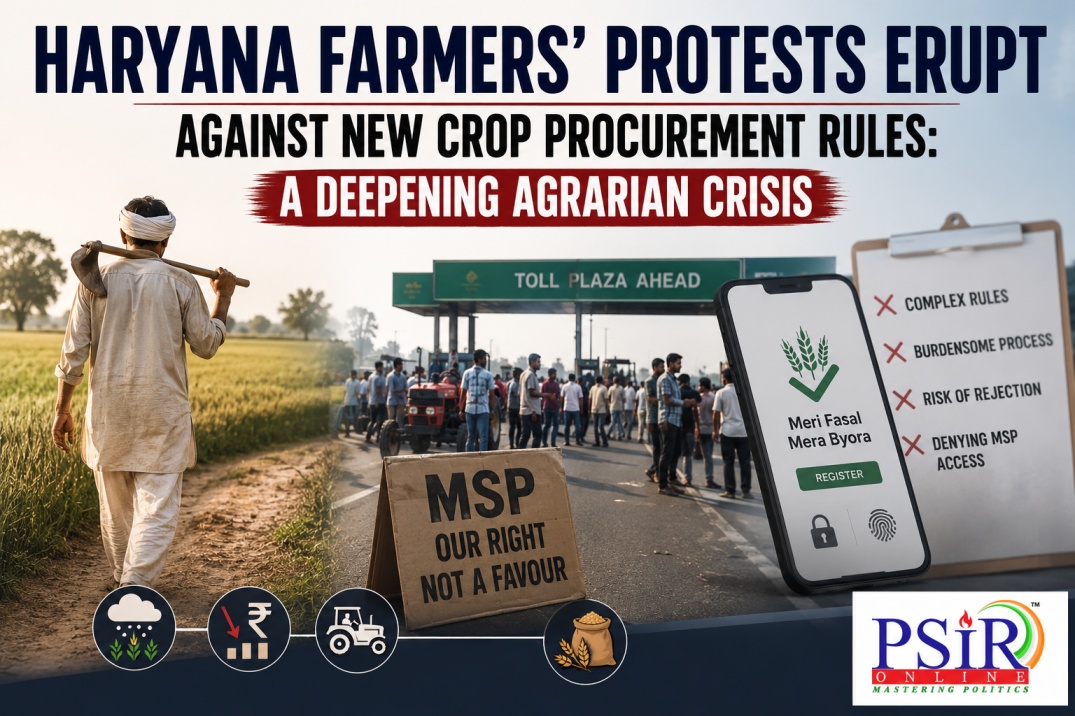
On April 11, 2026, Haryana witnessed widespread demonstrations by farmers across multiple districts. Protesters blocked roads, including a notable sit-in near the Landhari-Chikanwas toll plaza in Hisar, as part of a coordinated action called by the Samyukt Kisan Morcha (SKM). The trigger was the Haryana government's new rules for Rabi crop procurement, particularly for wheat in the 2026-27 season. Farmers viewed these measures—mandatory ‘Meri Fasal Mera Byora’ registration, Aadhaar-linked biometric verification, vehicle number registration for gate passes via the e-Kharid app, slot booking, and strict quality checks—as burdensome and designed to restrict access to Minimum Support Price (MSP) procurement.
These protests were largely peaceful, with sit-ins lasting about four hours on national highways while allowing emergency vehicles to pass. Yet they signaled growing frustration in a state long central to India's food security. This article examines the protests' context, historical background, specific grievances, government rationale, broader implications, and potential paths forward.
HISTORICAL CONTEXT OF FARMER PROTESTS IN HARYANA
Haryana, along with Punjab, formed the heartland of India's Green Revolution in the 1960s and 1970s. High-yielding variety seeds, irrigation, and fertilizers transformed the region into a major producer of wheat and rice. The government assured farmers of MSP and procurement through mandis (agricultural markets) to encourage surplus production for national food security.
This system worked effectively for decades. Haryana consistently contributes significantly to India's wheat procurement. In recent seasons, the state has procured tens of lakhs of metric tonnes of wheat, providing crucial income stability. However, the model also created dependencies. Farmers focused heavily on wheat-rice rotation, leading to soil degradation, groundwater depletion, and vulnerability to market and weather risks.
Major farmer protests have marked recent history. The 2020-21 protests against the three central farm laws (later repealed) saw strong participation from Haryana farmers alongside Punjab counterparts. Key demands included a legal guarantee for MSP on all crops, as recommended by the Swaminathan Commission (C2 + 50% formula). While the laws were withdrawn, underlying issues like MSP assurance, debt, and diversification persisted.
The 2024-25 protests ("Farmers' Protest 2.0") further highlighted demands for legal MSP, loan waivers, and better support. Haryana's farmers, though sometimes less vocal than Punjab's in border marches, have repeatedly raised concerns over procurement access and input costs. The April 2026 protests build on this legacy, shifting focus to state-level procedural hurdles amid ongoing weather challenges like unseasonal rains and hailstorms.
DETAILS OF THE NEW PROCUREMENT RULES
The Haryana government, led by Chief Minister Nayab Singh Saini, introduced these rules ahead of the 2026-27 wheat procurement season to enhance transparency and curb irregularities. Key elements include:
· Mandatory Registration: Farmers must register on the ‘Meri Fasal Mera Byora’ portal.
· Biometric Verification: Aadhaar-based authentication for the farmer or authorized representative before auction.
· Vehicle and Slot Requirements: Advance vehicle number registration for gate passes via e-Kharid app; arrivals only at booked slots.
· Three-Tier Verification and Quality Norms: Strict checks on moisture, quality, and geo-fencing to prevent influx from neighboring states.
· Direct Bank Payments: Aiming for completion within 72 hours.
The government claims these measures prevent "ghost" procurement scams (e.g., recent multi-crore paddy issues) and ensure only genuine local farmers benefit. Officials, including the CM, emphasized technology for accountability without intending to harass farmers.
FARMERS' GRIEVANCES: WHY THE RULES ARE SEEN AS BURDENSOME
Farmers and SKM leaders argue the rules create unnecessary barriers, effectively denying MSP access:
· Technological and Logistical Hurdles: Many small and marginal farmers (who dominate Haryana's agrarian landscape) lack easy access to smartphones, reliable internet, or digital literacy for portal registration and slot booking. Elderly farmers and those in remote areas face particular difficulties. Mandatory vehicle number plates are impractical for many tractors.
· Timing Amid Crisis: Unseasonal rains and hailstorms damaged crops in northwestern regions. Farmers expected relaxed norms (as granted in some past cases or neighboring states), but faced stricter rules instead. Strict moisture and quality checks risk rejection of produce already compromised by weather.
· Fear of Exclusion: The complex process may push farmers toward private traders at lower prices, undermining MSP's purpose. Leaders allege this indirectly benefits middlemen and reduces government procurement burden.
· Broader Economic Pressures: Rising input costs (fertilizers, diesel, labor), stagnant real incomes, and debt burdens compound the issue. Haryana's intensive farming has high costs, making reliable MSP crucial.
Protests in districts like Hisar, Sirsa, Fatehabad, Rohtak, and others highlighted these points, with slogans demanding withdrawal of rules and restoration of simpler processes.
GOVERNMENT ACTIONS AND DEFENSE
The state government defends the reforms as progressive. CM Saini stated they strengthen the system through three-tier verification, biometrics, and geo-fencing. Nodal officers were deployed at mandis, with assurances of smooth operations and timely payments.
Procurement agencies like HAFED continue operations, with reports of accelerating lifting processes in some districts. The BJP government has accused opposition parties (e.g., Congress) of misleading farmers for political gain.
However, critics point to a political slugfest. Former CM Bhupinder Singh Hooda and others slammed the rules as anti-farmer, arguing they add distress rather than ease it.
BROADER IMPLICATIONS FOR HARYANA'S AGRICULTURE AND ECONOMY
Haryana's agriculture contributes substantially to the state's economy and national food security. Wheat and rice dominate, supported by MSP procurement. Disruptions risk:
· Reduced Procurement Volumes: Early 2026 trends showed sluggish national wheat procurement partly due to weather and policy issues.
· Farmer Distress and Diversification Challenges: Continued focus on wheat-rice exacerbates environmental issues. Diversification efforts (e.g., to pulses, maize) need better MSP assurance and markets.
· Social and Political Ramifications: Escalation could lead to larger agitations, affecting supply chains, highways, and elections. It reflects deeper rural discontent over livelihoods.
Nationally, this ties into ongoing debates on MSP legal guarantee, WTO compliance, and sustainable farming.
SUGGESTIONS AND POTENTIAL SOLUTIONS
To resolve the crisis and build long-term resilience:
1. Immediate Rollback or Relaxation: Temporarily ease digital and biometric mandates for the current season, especially for small farmers and weather-affected produce. Introduce helplines and on-ground assistance for registration.
2. Stakeholder Dialogue: Hold inclusive talks with SKM and farmer unions before finalizing rules. Transparent grievance redressal mechanisms are essential.
3. MSP and Procurement Reforms:
a. Work towards a legal MSP framework or assured procurement for more crops.
b. Improve storage, processing, and market linkages to reduce post-harvest losses.
c. Expand schemes like PM-AASHA for pulses and oilseeds.
4. Technological Inclusion: Make digital tools user-friendly with training camps, simplified apps, and offline options. Subsidize smartphones or provide common service centers at mandis.
5. Sustainable Agriculture Push:
a. Incentives for crop diversification, water conservation (e.g., micro-irrigation), and organic farming.
b. Crop insurance improvements and timely compensation for weather losses.
c. Debt relief or restructuring for distressed farmers.
6. Long-Term Policy: Address root causes like rising costs, groundwater crisis, and youth migration from farming. Invest in rural infrastructure, value addition (e.g., food processing), and skill development.
THE ROAD AHEAD
The April 11, 2026 protests serve as a "warning and rehearsal," per farmer leaders. If unaddressed, they could escalate into a larger movement. Haryana's government faces a balancing act: modernizing procurement for transparency while ensuring no genuine farmer is left behind.
This episode underscores the need for empathetic, farmer-centric policies in India's agriculture. As one of the nation's breadbaskets, Haryana's stability is vital for national food security. Collaborative solutions respecting farmers' contributions while embracing technology and sustainability offer the best path forward.
The coming weeks will test the resolve of both sides. Meaningful dialogue and swift corrective actions could transform this crisis into an opportunity for stronger agrarian reforms.
PRACTICE QUESTIONS FOR PSIR OPTIONAL
1. “Digital governance in agriculture often reproduces existing inequalities rather than eliminating them.” Critically examine this statement in the context of the 2026 Haryana crop procurement reforms.
2. Discuss the political economy of Minimum Support Price (MSP) in India with special reference to the Haryana farmers’ protests of 2026. How do procurement reforms affect state–farmer relations?
3. “The agrarian crisis in India is not merely economic but also institutional and ecological.” Analyse this statement with reference to Haryana’s wheat procurement protests and the legacy of the Green Revolution.
4. Examine the challenges of balancing technological modernization, transparency, and inclusiveness in India’s agricultural governance. What lessons emerge from the Haryana farmers’ protests against digital procurement mechanisms?