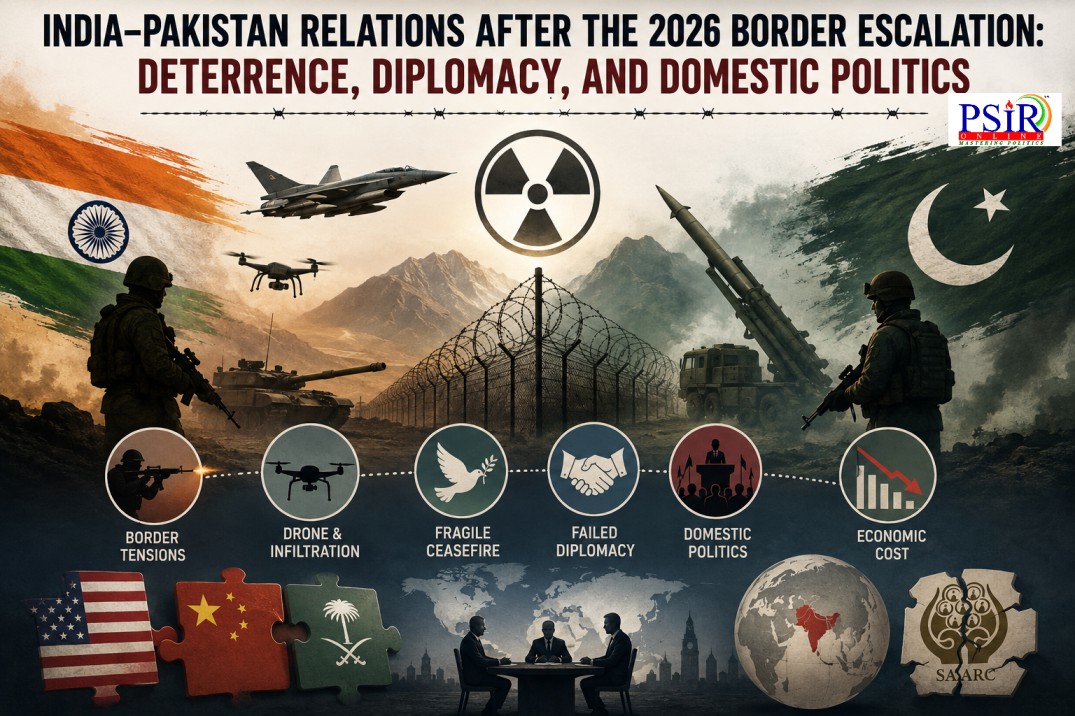
The year 2026 has once again thrust India–Pakistan relations into a familiar yet perilous cycle of heightened tension, marked by repeated ceasefire violations along the Line of Control (LoC), allegations of cross-border terrorism, aggressive political rhetoric, and nationalist mobilisations on both sides. One year after the 2025 crisis—triggered by the April 22 Pahalgam terrorist attack that killed 26 tourists in Indian-administered Jammu and Kashmir and India’s subsequent Operation Sindoor missile and air strikes on nine terror-linked sites in Pakistan and Pakistan-occupied Kashmir (PoK)—LoC skirmishes, drone incursions, and cross-border firing have persisted into 2026. While a US-mediated ceasefire on May 10, 2025, halted immediate large-scale fighting, mutual accusations of violations have kept tensions simmering.
Full-scale war remains improbable because of the nuclear arsenals both nations possess, yet the pattern reflects unresolved structural conflicts: the Kashmir dispute, cross-border terrorism, and competing visions of regional order. India has refined a doctrine of calibrated military responses below the nuclear threshold, building on the 2019 Balakot precedent. Pakistan counters with strategic deterrence and tactical preparedness to offset conventional asymmetry. This creates what analysts term “unstable deterrence”—a fragile equilibrium where controlled escalation signals resolve without triggering apocalypse.
Domestic politics increasingly shape these dynamics. In India, assertive nationalism bolsters political legitimacy; in Pakistan, the military establishment leverages anti-India posturing to maintain influence amid internal challenges. Diplomacy suffers from a profound trust deficit, with formal mechanisms weakened and backchannels limited. International actors— the United States, China, and Gulf states—favour stability for economic and strategic reasons, yet global distractions in Europe and West Asia have reduced sustained mediation. Economically, the hostility exacts a heavy toll: minimal bilateral trade despite geographic proximity, stalled regional connectivity, and a paralysed South Asian Association for Regional Cooperation (SAARC). South Asia remains one of the world’s least integrated regions, with intra-regional trade hovering around just 5% of total commerce.
THE 2026 BORDER ESCALATION: EVENTS AND TRIGGERS
The 2025 Pahalgam attack—where militants targeted tourists in a calculated bid to inflame communal tensions—served as the immediate catalyst for Operation Sindoor. India described the strikes as “focused, measured, and non-escalatory,” targeting infrastructure linked to Lashkar-e-Taiba (LeT) and Jaish-e-Mohammed (JeM) without hitting Pakistani military sites. Pakistan denied involvement and responded with counter-strikes, leading to a brief but intense four-day multidomain conflict involving missiles, drones, and artillery. The US-brokered ceasefire on May 10, 2025, brought an uneasy pause, yet violations resumed almost immediately and have continued sporadically through 2026, particularly in sectors like Khuiratta, Lipa, and Battal.
Key triggers in the 2026 phase include:
· Persistent infiltration attempts: Alleged cross-LoC movement of militants, with India accusing Pakistan of state support and Pakistan denying it while highlighting Indian “occupation” actions.
· Ceasefire breakdowns: Repeated small-arms firing, mortar shelling, and drone sightings, echoing pre-2021 patterns despite the 2021 DGMO understanding.
· Political signalling: Heightened rhetoric during election cycles or internal crises, with both sides using border incidents to rally domestic support.
· Technological escalation: Increased use of drones and loitering munitions, raising risks of miscalculation in a densely populated border region.
These incidents revive long-standing structural issues rooted in the 1947 Partition, the unresolved Kashmir dispute, and four major wars (1947–48, 1965, 1971, 1999). Post-2019, India’s abrogation of Article 370 and integration of Jammu and Kashmir further complicated narratives. The 2025–26 phase demonstrates how a single terror incident can rapidly escalate due to doctrinal shifts and domestic incentives.
DETERRENCE DYNAMICS IN THE NUCLEAR AGE: FROM STABILITY TO CONTROLLED RISKS
Since the 2019 Balakot airstrikes, India has signalled a willingness to conduct limited conventional operations across the border in response to terror attacks. Operation Sindoor in 2025 represented a significant evolution: deeper strikes into Pakistani territory (including Punjab province), use of precision missiles and drones, and explicit rejection of nuclear blackmail as a deterrent. This “calibrated response” doctrine aims to punish perpetrators while staying below the nuclear threshold, altering traditional calculations.
Pakistan maintains a “full-spectrum deterrence” posture, including tactical nuclear weapons like the Nasr missile, designed to counter any Indian conventional incursion. Islamabad views its nuclear capability as an equaliser against India’s superior conventional forces (military budget roughly eight times larger). The result is the classic stability-instability paradox: nuclear weapons stabilise the strategic level by making all-out war suicidal, but they enable instability at lower levels through proxy actions and limited conventional clashes.
Factors sustaining unstable deterrence include:
· Doctrinal mismatch: India’s emphasis on punishment and denial versus Pakistan’s reliance on escalation dominance and first-use ambiguity.
· Command-and-control vulnerabilities: Risk of miscalculation during rapid multidomain operations involving drones and missiles.
· Proximity and fog of war: Dense population centres near the LoC amplify civilian risks and escalation pressures.
· Technological proliferation: Cheap drones and loitering munitions lower thresholds for initiation of conflict.
· Domestic signalling: Leaders on both sides may escalate to demonstrate resolve, complicating de-escalation.
The 2025 crisis and its 2026 aftermath illustrate that while both sides exercised restraint to avoid nuclear thresholds, the margin for error remains dangerously thin. Neither seeks war, yet both engage in controlled escalation to deter future provocations.
DOMESTIC POLITICS: NATIONALISM AS THE HIDDEN DRIVER
Domestic political considerations now exert outsized influence on foreign policy behaviour. In both countries, border tensions serve as potent tools for consolidating support, projecting strength, and diverting attention from internal challenges.
In India, national security has become a central pillar of political mobilisation under assertive nationalism. The ruling establishment frames responses like Operation Sindoor as decisive assertions of sovereignty, resonating with voters amid narratives of a strong state. Economic or governance issues can be overshadowed by security successes, particularly during electoral cycles.
In Pakistan, the military establishment retains significant influence by positioning itself as the indispensable guardian of national sovereignty against a larger neighbour. Anti-India rhetoric bolsters institutional legitimacy, especially when civilian governments face economic or political turbulence. The Inter-Services Intelligence (ISI) and armed forces shape narratives around Kashmir and terrorism, often framing India as an existential threat.
Key ways domestic politics fuel tensions:
· Electoral dividends: Leaders leverage nationalist sentiment to rally public opinion; security crises often boost approval ratings temporarily.
· Diversionary tactics: Internal economic pressures, governance failures, or ethnic/regional unrest prompt heightened external posturing.
· Identity politics: In India, Hindu-majoritarian narratives sometimes intersect with security discourse; in Pakistan, Islamic solidarity frames the Kashmir issue.
· Institutional incentives: Military and intelligence agencies on both sides derive budgets, influence, and prestige from sustained threat perceptions.
· Media amplification: 24/7 news cycles and social media accelerate escalation spirals by amplifying incidents and hardline voices.
This intertwining of domestic legitimacy with bilateral hostility makes de-escalation politically costly, even when strategic interests might favour restraint.
THE DIPLOMATIC IMPASSE: TRUST DEFICIT AND WEAKENED MECHANISMS
Formal dialogue mechanisms have atrophied. The 2004–08 Composite Dialogue and later attempts at comprehensive talks collapsed amid terror incidents and mutual recriminations. Post-2025, backchannel diplomacy—once useful during crises—appears limited. Ceasefire understandings along the LoC provide temporary relief but lack enforcement or confidence-building measures.
Core disagreements remain intractable:
· Terrorism versus state sponsorship: India demands concrete action against groups like LeT and JeM; Pakistan insists on addressing “root causes” in Kashmir.
· Kashmir status: Divergent interpretations of the Simla Agreement and UN resolutions.
· Water and connectivity: Suspension of the Indus Waters Treaty during the 2025 crisis added a new layer of mistrust.
· Verification and transparency: Mutual suspicions hinder joint mechanisms for monitoring or investigation.
The absence of sustained engagement heightens miscalculation risks during heightened military activity. Without institutionalised dialogue, each incident risks being interpreted through the lens of maximalist narratives rather than pragmatic problem-solving.
GREAT POWER POLITICS AND REGIONAL DYNAMICS
Major powers shape the environment but rarely force resolution. The United States mediated the 2025 ceasefire, reflecting its interest in South Asian stability and strategic partnership with India via the Quad and Indo-Pacific framework. China’s “ironclad” alliance with Pakistan—underpinned by the China-Pakistan Economic Corridor (CPEC)—provides Islamabad strategic depth while complicating India’s security calculus. Gulf states (Saudi Arabia, UAE) maintain strong economic ties with both nations—remittances, energy, and investments—and quietly favour de-escalation to protect labour and trade flows.
Global attention diverted toward conflicts in Europe and West Asia has reduced sustained international mediation, granting regional actors greater autonomy. This vacuum allows domestic politics freer rein but also removes external pressure for compromise.
THE HEAVY ECONOMIC TOLL AND MISSED OPPORTUNITIES
Prolonged tensions impose substantial costs. Direct military expenditures, infrastructure damage along the border, and disrupted trade exact billions. Estimates from the 2025 crisis alone suggested hourly costs approaching $1 billion during peak fighting. Bilateral official trade, already minimal at around $1.2 billion by 2024, has further declined amid sanctions, suspensions, and mistrust; unofficial trade via third countries hovers near $10 billion but lacks formal benefits.
Broader impacts include:
· Stalled regional integration: SAARC remains paralysed, with intra-regional trade at just 5% of total (versus ASEAN’s 25%). Potential gains estimated at $67 billion remain unrealised.
· Investment deterrence: Heightened risk perceptions scare away foreign direct investment and tourism.
· Connectivity losses: Missed opportunities in energy corridors, rail links, and cross-border markets.
· Human development costs: Resources diverted from health, education, and infrastructure in two populous nations with significant poverty.
· Water security risks: Suspension of the Indus Waters Treaty during crises threatens agricultural stability for millions.
South Asia’s developmental potential is severely constrained by this hostility, perpetuating cycles of underachievement relative to more integrated regions.
CHARTING A PATH FORWARD: BREAKING THE CYCLE
Sustainable normalisation requires:
· Political courage at the top: Leaders must decouple domestic legitimacy from perpetual hostility and invest political capital in dialogue.
· Institutionalised confidence-building: Revive composite dialogue with verifiable steps on terrorism, LoC management, and people-to-people contacts.
· Economic incentives: Gradual trade normalisation, visa liberalisation, and joint projects in non-contentious areas (e.g., climate, health) to create constituencies for peace.
· Track-II and civil society engagement: Strengthen backchannels involving academics, business leaders, and retired officials.
· International facilitation: Leverage US, Chinese, and Gulf influence for quiet mediation without imposing solutions.
· Nuclear risk reduction: Bilateral or multilateral measures on crisis communication, hotlines, and doctrinal transparency.
Without meaningful engagement, South Asia risks remaining trapped in recurring escalation-de-escalation cycles. Nuclear deterrence prevents catastrophe but cannot deliver lasting peace. The developmental aspirations of both societies—young populations seeking jobs, education, and prosperity—demand a shift from zero-sum rivalry toward pragmatic cooperation. The 2026 tensions underscore that the status quo is neither stable nor sustainable.
Political will, not just military restraint, will determine whether the region moves toward normalisation or remains locked in perpetual confrontation.
PRACTICE QUESTIONS FOR GS 2 MAINS
1. “Nuclear deterrence between India and Pakistan has prevented full-scale war but encouraged limited conflicts below the nuclear threshold.” Critically examine in the context of the 2025–26 border escalation.
2. Discuss how domestic political considerations and nationalist mobilisation influence India–Pakistan relations in contemporary South Asia.
3. Examine the role of external powers such as the United States, China, and Gulf countries in shaping India–Pakistan relations after the 2026 border tensions.
4. “The absence of sustained diplomatic engagement has increased the risks of miscalculation in South Asia.” Analyse the statement with reference to India–Pakistan relations.
PRACTICE QUESTIONS FOR PSIR OPTIONAL
1. Analyse the India–Pakistan conflict through the lens of the Stability–Instability Paradox in nuclear deterrence theory.
2. How can Realist and Liberal approaches explain the persistence of hostility and the failure of regional integration in South Asia? Discuss with reference to India–Pakistan relations.
3. “Nationalism and identity politics have become central drivers of foreign policy behaviour in South Asia.” Critically evaluate with suitable examples from India and Pakistan.
4. Evaluate the limitations of bilateral diplomacy in resolving the Kashmir issue. Can Track-II diplomacy and economic interdependence provide a viable alternative?