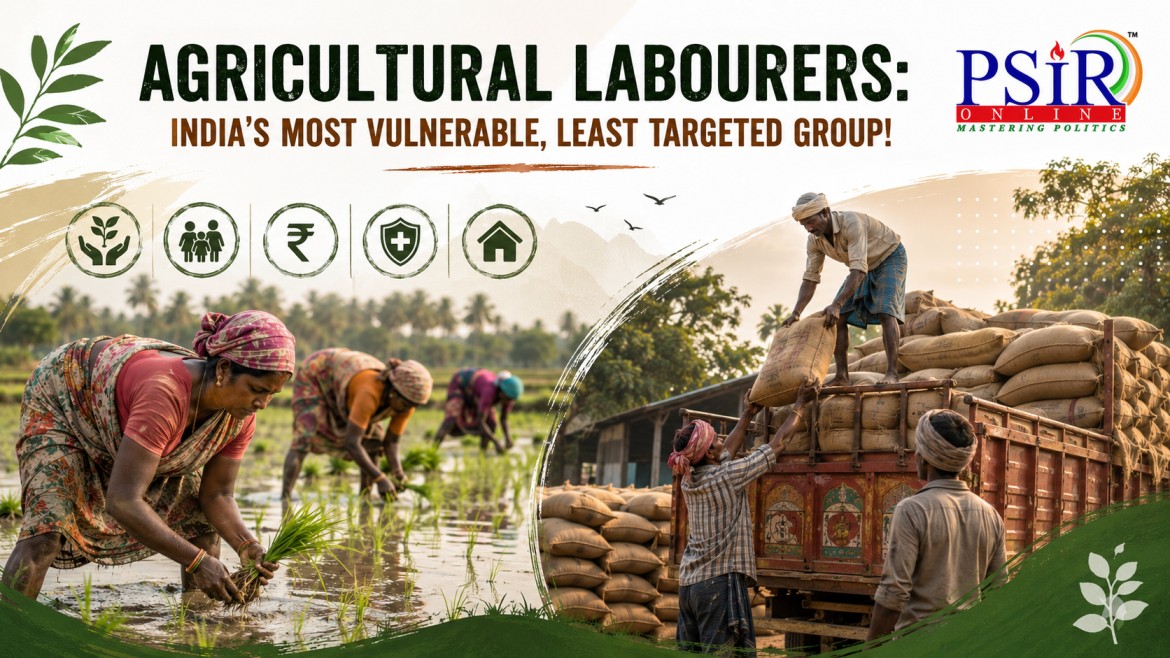
Agricultural Labourers are individuals (or households) who primarily earn their livelihood by working on the land/farms owned by others, in return for wages paid in cash, kind (food/grains), or both. They do not own land (or own very negligible land) and work as hired/wage workers in agricultural activities.
Agricultural labourers are among India’s most vulnerable groups — landless, seasonal, low-paid, exploited, and lacking social security. Despite this, the government has no comprehensive, dedicated scheme exclusively for them, unlike PM-KISAN for farmers. They are only covered under general unorganised worker programmes like MGNREGA (100 days employment), PM-SYM (pension), and Ayushman Bharat (health insurance). These schemes suffer from poor targeting, low coverage, irregular implementation, and leakages. Political focus remains on vote-rich small farmers, while landless labourers — mostly Dalits and Adivasis — continue to face chronic poverty, debt, and distress without focused policy attention.
|
KEY FACTS
· Share in Workforce: Around 46.1% of India's total workforce was engaged in agriculture in 2023-24 (up from 44.1% in 2017-18). · Most of these are casual agricultural labourers (not landowners), who work on others' farms for daily wages. · They are mostly from Scheduled Castes (Dalits), Scheduled Tribes, and Other Backward Classes, landless, and belong to the poorest rural households.
|
WHY THEY ARE HIGHLY VULNERABLE
|
Issue |
Details |
|
Low & Irregular Wages |
Daily wages often range from ₹200–400 (varies by state & season). Many states report 40–52% of agricultural workers not getting even minimum wages. Earnings are highly seasonal. |
|
Seasonal & Uncertain Employment |
Work available only during sowing & harvesting. Remain underemployed or unemployed for several months. |
|
Exploitation |
Bonded labour in some areas, caste-based discrimination, no written contracts, long working hours. |
|
Lack of Social Security |
Limited access to pensions, health insurance, maternity benefits, or provident fund. Most are in the unorganized sector. |
|
Poor Living Conditions |
Malnutrition, poor housing, lack of clean water, sanitation, and healthcare. High debt burden (often from moneylenders). |
|
Climate & Disaster Vulnerability |
Directly affected by droughts, floods, erratic monsoons, and crop failures. |
|
Gender Dimension |
Women form a large and growing share (feminization of agriculture). They get lower wages than men for the same work. |
GOVERNMENT SUPPORT & SCHEMES FOR AGRICULTURAL LABOURERS
The Union government does not run many schemes exclusively for “agricultural labourers”; instead it treats them as part of the wider unorganised‑sector and rural workforce and extends a patchwork of social‑security, employment, food, health and housing schemes to them, mainly via the Unorganised Workers’ Social Security Act and the e‑Shram platform. This gives agricultural workers access to multiple programmes in principle, but protection is indirect, eligibility‑based and fragmented rather than designed around their specific vulnerabilities as landless, seasonal workers.
Policy framing of agricultural labourers
The Unorganised Workers’ Social Security Act, 2008 explicitly covers workers in the unorganised sector, including agricultural labourers, and mandates the Centre to formulate social‑security schemes in areas like old‑age protection, health, maternity and insurance. Recent social‑security press notes similarly refer to “landless labourers” and “agricultural workers” as part of the unorganised workforce eligible for generic schemes such as pensions and insurance rather than as a distinct, separately legislated category.
Parliament replies on “welfare schemes for rural and farm labourers” list a basket of existing schemes (MGNREGA, pensions, PDS, health insurance, skills, housing, etc.) as applicable to farm and agricultural labourers, while noting that states run additional, more specific schemes at their level. The overall framing, therefore, is that agricultural labourers are to be covered through mainstream unorganised‑sector and rural‑development schemes rather than through a dedicated national mission focused only on them.
Core social‑security schemes (pension and insurance)

These schemes show that the government’s primary social‑justice response to agricultural labourers is through generic pension and insurance products rather than tailored labour‑law protections or occupation‑specific social‑security funds. Coverage is conditional on age, income, and ability to maintain bank accounts and contributions, which can exclude the poorest or most casualised labourers in practice.
Food, health and basic welfare
For basic consumption security, the Public Distribution System under the National Food Security Act and the One Nation One Ration Card (ONORC) mechanism are repeatedly cited as available to unorganised workers including rural and agricultural labourers, allowing subsidised foodgrains and portability of rations for migrants. This portability is particularly significant for seasonal migrant agricultural labourers who move across districts or states in search of work.
On health, Ayushman Bharat–Pradhan Mantri Jan Arogya Yojana (AB‑PMJAY) is described as the universal health‑insurance scheme under which 17.81 crore individuals, including agricultural labourers, had been verified and issued Ayushman cards by March 2022, with coverage up to ₹5 lakh per family for secondary and tertiary care. Maternity benefits for poor households are also routed through schemes like Pradhan Mantri Matru Vandana Yojana, which is integrated into the e‑Shram ecosystem for eligible unorganised workers.
Employment, wages and livelihoods
Parliament replies and PIB notes consistently list Mahatma Gandhi National Rural Employment Guarantee Act (MGNREGA) as one of the central schemes available to rural and agricultural labourers, providing wage employment in rural areas. For farm and rural labourers more broadly, replies on “welfare schemes for rural and farm labourers” again put MGNREGA at the top of the list of central interventions.
Skill and livelihood programmes such as Deen Dayal Upadhyaya Gramin Kaushal Yojana (DDU‑GKY) and Deen Dayal Antyodaya Yojana are also flagged as schemes for upliftment of rural and farm labourers, aiming to enhance employability and promote self‑employment among poor rural youth. During and after the pandemic, temporary programmes like the Garib Kalyan Rojgar Abhiyan were deployed as additional employment support for migrant and rural workers, including those previously engaged in agricultural wage labour.
Housing and other development schemes
Housing security for poor rural and urban households, including agricultural labour families, is addressed through Pradhan Mantri Awas Yojana–Gramin and –Urban, which are repeatedly mentioned as schemes available to unorganised workers depending on eligibility. Access to basic amenities and assets is indirectly supported through these housing schemes and through broader rural‑development and self‑employment programmes under Deen Dayal Antyodaya Yojana.
In addition, general financial‑inclusion and livelihood schemes such as PMSVANidhi and various labour‑welfare programmes are listed among the schemes mapped to unorganised workers, though they are more directly targeted at street vendors or specific sectors rather than agricultural labourers per se. This reinforces the pattern of coverage through a wide but non‑specialised scheme architecture.
Digital platforms and e‑Shram
A major recent shift in how the government “treats” agricultural and other unorganised labourers is the creation of the e‑Shram portal and mobile application. The Ministry of Labour and Employment describes e‑Shram as a “one‑stop solution” integrating different social‑security and welfare schemes on a single portal that houses a National Database of Unorganised Workers (NDUW), explicitly including agricultural labourers.
Government statements note that fourteen central schemes—such as PMSBY, PMJJBY, MGNREGA, PMAY‑G/PMAY‑U, AB‑PMJAY, PM‑KISAN, ONORC and PMMVY—have been mapped onto e‑Shram so that registered unorganised workers can see and access benefits through a unified interface, with a dedicated mobile app launched in February 2025 to enhance accessibility for migrant, construction and agricultural labourers. In principle, this signals a move towards convergence and easier delivery, but it also assumes digital access, literacy and bank linkage on the part of very poor workers.
NEED FOR TREATING AGRICULTURAL LABOURERS AS SEPARATE ENTITIES
Treating agricultural labourers as a distinct policy category and designing special schemes for them is necessary because they form a huge, structurally different and far more vulnerable group than land‑owning farmers, yet are mostly covered only indirectly through generic unorganised‑sector schemes. Separate, tailored schemes are essential to address their specific problems of landlessness, seasonal unemployment, low wages, debt and social marginalisation that existing “one‑size‑fits‑all” programmes do not adequately tackle.
Large, distinct and highly vulnerable workforce
Census 2011 data show that India had 263.1 million agricultural workers, of whom 144.3 million were agricultural labourers working mainly on others’ land; thus, labourers themselves are the single largest component of the farm workforce. Studies note that agriculture still employs around 46% of India’s total workforce, and a significant proportion of these workers are wage‑earning labourers without any effective asset base.
Agricultural labourers are typically landless or near‑landless, depending on daily wages in cash or kind for tasks like sowing, weeding and harvesting, unlike cultivators who own or lease land and can access credit or asset‑building schemes. A large share of these labourers belong to Scheduled Castes, Scheduled Tribes and Other Backward Classes, which means economic vulnerability is tightly intertwined with caste‑based social exclusion.
Excluded by design from farmer‑centric schemes
Many flagship “farmer” schemes are explicitly defined around land ownership, automatically excluding landless agricultural labourers even though they work in the same sector. For example, Pradhan Mantri Kisan Maandhan Yojana targets small and marginal farmers with up to two hectares of land whose names appear in land records, so a landless labourer who spends his entire life working in agriculture cannot qualify.
Similarly, income‑support schemes like PM‑KISAN are structured around being recorded as a landholder in state land records rather than around actual contribution of labour to agriculture, again leaving out landless workers. Without separate, labour‑focused schemes, government policy ends up reinforcing a hierarchy within agriculture: landowners are recognised as “farmers” deserving specific support, while labourers are treated as generic poor.
Deep, multi‑dimensional deprivation
Research on agricultural labourers highlights chronic landlessness, persistently low wages, seasonal unemployment, and high indebtedness as core features of their economic life. Academic work using NSS and Census data shows that the incidence of poverty among agricultural labourers has historically been far higher than among cultivators, with some estimates placing it above 60%, underlining the need for targeted anti‑poverty interventions.
Because agricultural work is seasonal and irregular, labourers often face months without employment or income, forcing distress migration or dependence on usurious credit. Women agricultural labourers in particular suffer a gender wage gap, heavier physical workloads and limited access to social‑security information, making generic schemes without a gender‑sensitive design especially inadequate.
Generic unorganised‑sector schemes are not enough
Government statements emphasise that unorganised‑worker schemes such as PM‑SYM (pension), PMJJBY/PMSBY (insurance), AB‑PMJAY (health) and PDS/ONORC (food) are “available” to agricultural labourers along with other informal workers. However, these schemes are voluntary or eligibility‑based (age limit, income ceiling, bank account, contribution ability), creating high entry barriers for the poorest and most casualised workers, who often lack stable incomes, documents or financial literacy.
Even the e‑Shram database, where 13.78 crore of the 26 crore registered unorganised workers self‑identify as agricultural labourers, mainly serves as a platform to converge existing schemes rather than as the base for dedicated, occupation‑specific protections. In other words, the state recognises the sheer size of this group in its data architecture but has not matched this recognition with equally specific, tailored social‑justice schemes.
Why special, dedicated schemes are justified
Because agricultural labourers face problems that are qualitatively different—landlessness, seasonal lay‑offs, migratory work, bonded labour, caste‑linked discrimination—justice demands schemes built around these realities rather than generic poor‑relief. Dedicated schemes could, for instance, provide season‑linked unemployment insurance, floor‑wage top‑ups during lean periods, portable social‑security benefits for migrants, targeted debt‑relief packages, and strong enforcement against bondage and child labour in agriculture, which generic schemes currently do not address.
From a constitutional perspective, Article 38 and Article 39 direct the state to minimise inequalities and protect the weakest sections; given that agricultural labourers combine class and caste vulnerability, treating them as a separate category is consistent with these Directive Principles and with SDG commitments on ending poverty, hunger and inequality. In policy terms, distinct schemes would also improve targeting and measurement: outcomes for agricultural labourers could be separately monitored—on wages, employment days, health and education—rather than being hidden inside broad “rural poor” or “unorganised workers” aggregates.
In sum, the case for treating agricultural labourers as separate entities rests on both ethics and evidence: they are numerically large, structurally distinct, systematically excluded from land‑based farmer schemes, and more deeply deprived than most other rural groups, so social‑justice policy that continues to subsume them under generic categories will inevitably fall short.
CONCLUSION
Agricultural labourers form the backbone of India’s agriculture and the single largest vulnerable group in rural India, yet they continue to remain invisible in policymaking. While land-owning farmers receive focused attention and dedicated schemes like PM-KISAN, landless labourers are left to survive through scattered, inadequately implemented general welfare programmes. True social justice demands that they be recognised as a distinct policy category.
The time has come for the government to design targeted interventions addressing their unique realities — seasonal unemployment, low wages, landlessness, and social marginalisation. Only then can India claim to truly uplift its most hardworking yet most neglected workforce
PRACTICE QUESTIONS FOR GS 2 MAINS
1. “Agricultural labourers constitute the backbone of India’s rural economy, yet remain the most neglected category in welfare policymaking.” Critically examine the vulnerabilities faced by agricultural labourers in India. Discuss the limitations of existing government schemes in addressing their concerns. (15 Marks)
2. Despite being central to agricultural production, landless agricultural labourers are largely excluded from farmer-centric welfare schemes in India. Analyse the reasons for this exclusion and suggest policy measures for ensuring social and economic justice to agricultural labourers. (15 Marks)
3. “The problems of agricultural labourers in India are not merely economic but deeply linked to caste, landlessness, and structural inequalities.” Discuss in the context of rural labour relations, social justice, and constitutional obligations of the Indian state. (20 Marks)
4. How can digital platforms like e-Shram, combined with targeted labour welfare policies, improve the living conditions and social security of agricultural labourers in India? Explain with suitable examples. (10 Marks)