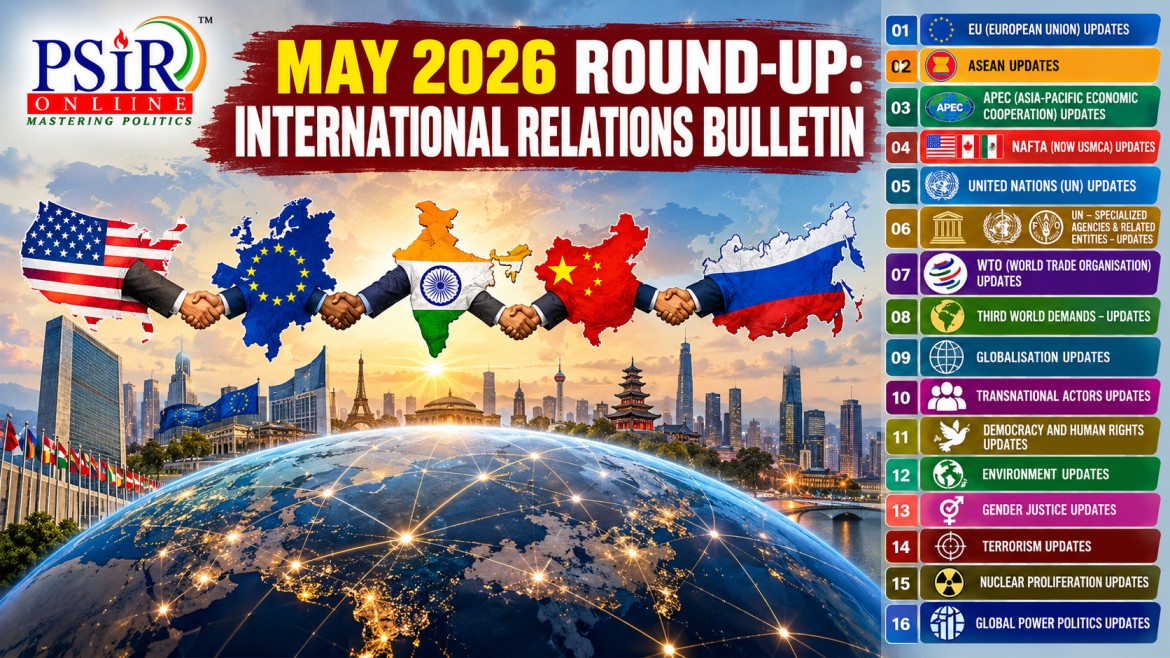
1. EU (EUROPEAN UNION) UPDATES
A. EU–MERCOSUR TRADE AGREEMENT ENTERS PROVISIONAL APPLICATION
The EU–Mercosur Interim Trade Agreement began provisional application on 1 May 2026, covering the EU and Argentina, Brazil, Paraguay and Uruguay. The agreement reduces tariffs and trade barriers and expands opportunities for European goods, services and investment in South America. It creates a major trading relationship covering around 700 million people.
PSIR significance: The agreement highlights the EU’s role as a global economic actor, the importance of regional trade blocs, and the use of trade agreements as instruments of economic diplomacy and globalisation.
B. EU–US TRADE RELATIONS: AGREEMENT ON TARIFF IMPLEMENTATION
On 20 May 2026, the Council of the EU and the European Parliament reached a provisional agreement on legislation to implement the tariff-related elements of the EU–US Joint Statement. The proposed measures include removing remaining EU customs duties on US industrial goods and providing preferential access for certain US agricultural and seafood products, alongside safeguards for EU economic interests.
PSIR significance: The development illustrates the importance of transatlantic economic relations, trade diplomacy and the EU’s attempt to protect its economic interests while maintaining cooperation with the United States.
C. EU PACT ON MIGRATION AND ASYLUM: IMPLEMENTATION PROGRESSES
On 8 May 2026, the European Commission reported substantial progress in implementing the EU Pact on Migration and Asylum, with member states advancing preparations for the Pact’s full application from 12 June 2026. The framework seeks to combine stronger external-border management, common asylum procedures and greater solidarity and responsibility-sharing among member states.
PSIR significance: The Pact reflects the continuing tension between state sovereignty, border security, human rights and international protection, while also demonstrating the challenges of collective decision-making within a regional organisation.
D. SCHENGEN AREA: STRONGER EXTERNAL BORDER MANAGEMENT
The European Commission's State of Schengen Report 2026, released on 18 May, highlighted efforts to strengthen the EU’s external borders and improve returns. It reported a 26% decline in irregular border crossings in 2025 compared with 2024 and a 28% return rate for people without the right to remain in the EU.
PSIR significance: Schengen demonstrates the tension between regional integration and national sovereignty, particularly over free movement, border control and internal security.
E. EU–ARMENIA SUMMIT: DEEPENING STRATEGIC ENGAGEMENT
The EU–Armenia Summit, held in Yerevan on 4–5 May 2026, focused on strengthening cooperation in areas including connectivity, energy, transport and digital cooperation. The leaders also discussed regional security developments, including Ukraine and the Middle East.
PSIR significance: The summit illustrates the EU’s expanding role in its Eastern neighbourhood and its use of economic, connectivity and diplomatic instruments to deepen regional partnerships.
2. ASEAN UPDATES
A. 48th ASEAN SUMMIT: ASEAN REAFFIRMS CENTRALITY AND RULES-BASED REGIONAL ORDER
The 48th ASEAN Summit, held in Cebu, Philippines, on 8 May 2026, reaffirmed ASEAN’s commitment to ASEAN centrality, unity and a rules-based regional order amid growing geopolitical tensions. Leaders emphasised peaceful settlement of disputes, respect for international law and UNCLOS, while also addressing the implications of the Middle East crisis for regional energy, food and economic security.
The Summit is particularly significant because ASEAN continues to navigate US–China strategic rivalry while seeking to preserve its strategic autonomy and central role in the Indo-Pacific.
PSIR significance: Relevant to ASEAN centrality, regionalism, Indo-Pacific geopolitics, balance of power, strategic autonomy and the rules-based international order.
3. APEC (ASIA-PACIFIC ECONOMIC COOPERATION) UPDATES
A. APEC TRADE MINISTERS PUSH FOR REGIONAL ECONOMIC INTEGRATION
At the APEC Ministers Responsible for Trade Meeting in Suzhou, China, on 22–23 May 2026, the 21 APEC economies reaffirmed their commitment to regional economic integration and the Free Trade Area of the Asia-Pacific (FTAAP). Ministers also stressed the importance of the WTO-based multilateral trading system and called for meaningful WTO reform amid rising protectionism and trade fragmentation.
PSIR significance: Important for understanding regionalism, globalisation, trade fragmentation, WTO reform and the changing Asia-Pacific economic order. It is also relevant to India's engagement with the wider Indo-Pacific economic architecture.
4. NAFTA (NOW USMCA) UPDATES
A. US–MEXICO BEGIN FIRST ROUND OF USMCA JOINT-REVIEW NEGOTIATIONS
On 29 May 2026, the United States and Mexico concluded the first bilateral negotiating round ahead of the USMCA Joint Review scheduled for 1 July 2026. Discussions focused on automotive rules of origin, steel and aluminium, economic security and strengthening North American supply chains. The negotiations also addressed concerns about production and trade involving countries outside the agreement.
PSIR significance: The development highlights the shift from free trade towards strategic trade and economic security, while showing how the US is attempting to reshape North American supply chains amid wider US–China economic competition and global trade fragmentation.
5. UNITED NATIONS (UN) UPDATES
A. UN80 INITIATIVE: PUSH FOR A MORE EFFICIENT AND EFFECTIVE UNITED NATIONS
On 29 May 2026, UN Secretary-General António Guterres updated the General Assembly on the UN80 Initiative, aimed at making the UN more efficient, transparent and effective. The initiative seeks to improve coordination across UN entities, reduce duplication and strengthen the organisation’s ability to deliver on its mandates amid growing global challenges.
PSIR significance: Important for debates on UN reform, multilateralism, institutional effectiveness and the changing global order. It is also relevant to India’s long-standing demand for a more representative and effective multilateral system, including Security Council reform.
6. UN - SPECIALIZED AGENCIES & RELATED ENTITIES- UPDATES
A. WHO DECLARES EBOLA OUTBREAK IN DRC AND UGANDA A PUBLIC HEALTH EMERGENCY
On 17 May 2026, the World Health Organization (WHO) declared the Ebola outbreak caused by the Bundibugyo virus in the Democratic Republic of the Congo and Uganda a Public Health Emergency of International Concern (PHEIC). WHO cited concerns over the scale and speed of the epidemic and the risk of cross-border transmission.
PSIR significance: Highlights the importance of global health governance, international cooperation, WHO’s role in global emergencies and the tension between national sovereignty and collective action.
B. WMO WARNS OF CONTINUED NEAR-RECORD GLOBAL TEMPERATURES
The World Meteorological Organization (WMO) reported on 28 May 2026 that global temperatures are likely to remain at or near record levels during 2026–2030. It estimated an 86% probability that at least one year in this period will exceed 2024 as the warmest year on record, while there is a 91% probability that at least one year will temporarily exceed 1.5°C above the 1850–1900 average.
PSIR significance: Important for global climate governance, climate justice, sustainable development and the implementation challenges of the Paris Agreement, with implications for developing countries such as India.
7. WTO (WORLD TRADE ORGANISATION) UPDATES
A. WTO DISPUTE OVER INDIA’S SOLAR AND IT GOODS MEASURES
On 22 May 2026, WTO members considered China’s request for a dispute panel concerning certain Indian measures affecting solar products and information-technology goods. The dispute brings India's industrial and strategic policy measures under scrutiny within the WTO rules-based system.
PSIR significance: Important for understanding the tension between WTO rules and national policy space, particularly for developing countries such as India seeking to promote domestic manufacturing while meeting international trade commitments.
8. THIRD WORLD DEMANDS – UPDATES
A. G77 DEMANDS FAIRER GLOBAL ECONOMIC ORDER FOR DEVELOPING COUNTRIES
On 21 May 2026, the G77 and China, representing developing countries, reiterated at a UN General Assembly dialogue on commodity markets that structural inequalities in the global trading, financial, monetary and technological systems continue to disadvantage commodity-dependent developing countries. The Group called for fairer and more predictable market access, action against commodity price instability and improved terms of trade.
PSIR significance: The development reflects the continuing North–South divide and the Global South’s demand for a more equitable international economic order, particularly in trade and commodity markets. It directly connects with the traditional Third World agenda of economic justice, redistribution and reform of global institutions.
9. GLOBALISATION UPDATES
A. GLOBALISATION UNDER PRESSURE FROM GEOPOLITICAL FRAGMENTATION
A UN Trade and Development (UNCTAD) report released on 19 May 2026 warned that geopolitical tensions are increasingly disrupting trade, investment and global supply chains. Global merchandise-trade growth is projected to slow from 4.7% in 2025 to 1.5–2.5% in 2026, while developing economies face greater exposure to energy shocks, tighter financing and supply-chain disruptions. UNCTAD called for greater investment in clean energy, critical technologies and resilient supply chains to reduce vulnerability.
PSIR significance: The development illustrates the emerging shift from unrestricted globalisation towards resilient, diversified and strategically secure globalisation, driven by geopolitics. It is relevant to debates on deglobalisation, geoeconomics, global value chains and the future of the liberal economic order.
10. TRANSNATIONAL ACTORS UPDATES
A. AMNESTY INTERNATIONAL CALLS FOR STRONGER ACCOUNTABILITY FOR CIVILIAN HARM
In May 2026, Amnesty International continued to document alleged violations of international humanitarian and human-rights law in conflicts including Gaza, Sudan and Ukraine, calling for greater accountability and compliance with international law. Its May interventions also highlighted the protection of civilians and the need for states and international institutions to address alleged violations.
PSIR significance: The development illustrates the growing role of transnational civil-society actors and international NGOs in shaping global discourse, documenting human-rights violations and pressuring states and international institutions. It is relevant to non-state actors, global civil society and the changing nature of sovereignty.
11. DEMOCRACY AND HUMAN RIGHTS UPDATES
A. US–IRAN WAR RAISES SERIOUS CONCERNS OVER CIVILIAN PROTECTION AND INTERNATIONAL LAW
The continuing US–Iran conflict and fragile ceasefire in May 2026 raised renewed concerns over the protection of civilians and compliance with international humanitarian law. The conflict also had wider humanitarian consequences, including disruption to essential trade and energy supplies through the Strait of Hormuz. The UN Security Council continued discussions on civilian protection amid the broader Middle East crisis.
PSIR significance: The conflict highlights the tension between national security and human security, the protection of civilians during armed conflict, international humanitarian law, and the effectiveness of the UN system in preventing and responding to violations.
12. ENVIRONMENT UPDATES
A. WMO WARNS OF CONTINUED GLOBAL WARMING AND CLIMATE EXTREMES
The World Meteorological Organization (WMO), in its Global Annual to Decadal Climate Update released on 28 May 2026, warned that global temperatures are expected to remain at exceptionally high levels during 2026–2030. The report highlights the continuing risk of extreme heat and other climate impacts, reinforcing the urgency of accelerating mitigation and adaptation efforts.
At the same time, the UN climate process stressed in May that the energy crisis linked to the Middle East conflict demonstrated the importance of accelerating the clean-energy transition for both climate protection and energy security.
PSIR significance: The development highlights the continuing challenge of climate governance, the 1.5°C goal, climate justice, energy security and the need for stronger international cooperation. For India and other developing countries, it also reinforces the importance of finance, technology transfer and adaptation support in global climate negotiations.
13. GENDER JUSTICE UPDATES
A. UN ADOPTS NEW RESOLUTION TO STRENGTHEN WOMEN’S PARTICIPATION IN PEACE AND SECURITY
In May 2026, the UN continued efforts to strengthen women’s participation in peace processes, conflict prevention and post-conflict reconstruction, with member states reaffirming the importance of the Women, Peace and Security (WPS) agenda. The UN highlighted persistent under-representation of women in formal peace negotiations and decision-making despite the disproportionate impact of armed conflicts on women and girls.
PSIR significance: The development is relevant to feminist international relations, gender and security, women’s political representation, and the argument that conventional security frameworks must incorporate gendered experiences of conflict and peace-building.
14. TERRORISM UPDATES
A. GLOBAL ACTION AGAINST TERRORIST FINANCING
The Fifth Ministerial Conference “No Money for Terror”, hosted by France on 19 May 2026, brought together more than 70 ministerial-level delegations to strengthen international cooperation against the financing of terrorism. The conference, involving the UN Counter-Terrorism Committee Executive Directorate and FATF, focused on emerging terrorism-financing risks and implementation of UN Security Council Resolution 2462.
PSIR significance: Important for understanding the shift towards a comprehensive counter-terrorism framework, particularly the role of terror financing, international cooperation, FATF and multilateral institutions in combating transnational terrorism.
B. INDIA–BRICS COUNTER-TERRORISM COOPERATION
India hosted the 11th BRICS Counter-Terrorism Working Group meetings in New Delhi on 21–22 May 2026. BRICS members discussed emerging terrorist threats and cooperation against terror financing, radicalisation, emerging technologies and terrorist networks, while reaffirming their commitment to international counter-terrorism cooperation.
PSIR significance: Particularly relevant to India’s efforts to use BRICS and other multilateral platforms to strengthen international cooperation against terrorism and promote a coordinated global response.
15. NUCLEAR PROLIFERATION UPDATES
A. NPT REVIEW CONFERENCE ENDS WITHOUT CONSENSUS AMID RISING NUCLEAR RISKS
The 11th Review Conference of the Nuclear Non-Proliferation Treaty (NPT) concluded at the UN in New York on 22 May 2026 without agreement on a substantive outcome document. The conference addressed nuclear disarmament, non-proliferation, IAEA safeguards, peaceful uses of nuclear energy and regional nuclear risks. The failure to reach consensus came amid heightened geopolitical tensions and growing concerns over nuclear weapons and the weakening of arms-control mechanisms.
PSIR significance: The development highlights the widening gap between nuclear-weapon states and non-nuclear-weapon states, the continuing debate over Article VI disarmament obligations, and the difficulty of achieving consensus within the global non-proliferation regime. It is particularly relevant to NPT, nuclear disarmament, strategic stability and the crisis of multilateralism.
16. GLOBAL POWER POLITICS UPDATES
A. TRUMP–XI SUMMIT: US–CHINA RIVALRY AND STRATEGIC STABILITY
US President Donald Trump visited China from 13–15 May 2026 and met President Xi Jinping in Beijing. The discussions covered trade, technology, strategic competition and the US–Iran conflict, with both sides seeking to prevent further deterioration in bilateral relations despite continuing disagreements over trade, technology and security.
The summit was particularly significant because the US–China relationship remains central to the emerging global power structure, while Washington was simultaneously dealing with the Iran conflict and Beijing was seeking to protect its economic and strategic interests in the Middle East.
PSIR significance: Relevant to US–China strategic competition, balance of power, bipolar tendencies, strategic stability and the changing global order.
B. PUTIN–XI SUMMIT DEEPENS CHINA–RUSSIA STRATEGIC COORDINATION
Russian President Vladimir Putin visited Beijing on 19–20 May 2026, shortly after Trump's visit. China and Russia reaffirmed strategic coordination and criticised US plans for the Golden Dome missile-defence system, while also raising concerns about the erosion of strategic arms-control arrangements.
PSIR significance: The summit demonstrates the continuing China–Russia alignment in opposition to aspects of US strategic policy and is important for understanding multipolarity, strategic balancing and the restructuring of global power relations.
C. US–IRAN CONFLICT CONTINUES TO RESHAPE GREAT-POWER POLITICS
The US–Iran conflict and the fragile ceasefire remained a major geopolitical issue throughout May. The continuing US blockade around the Strait of Hormuz had implications for global energy security, while China and Russia maintained diplomatic engagement with Tehran.
PSIR significance: The crisis demonstrates how a regional conflict can become a great-power geopolitical issue, involving US military power, Chinese economic interests, Russian diplomacy and the strategic importance of the Middle East and global energy routes.
