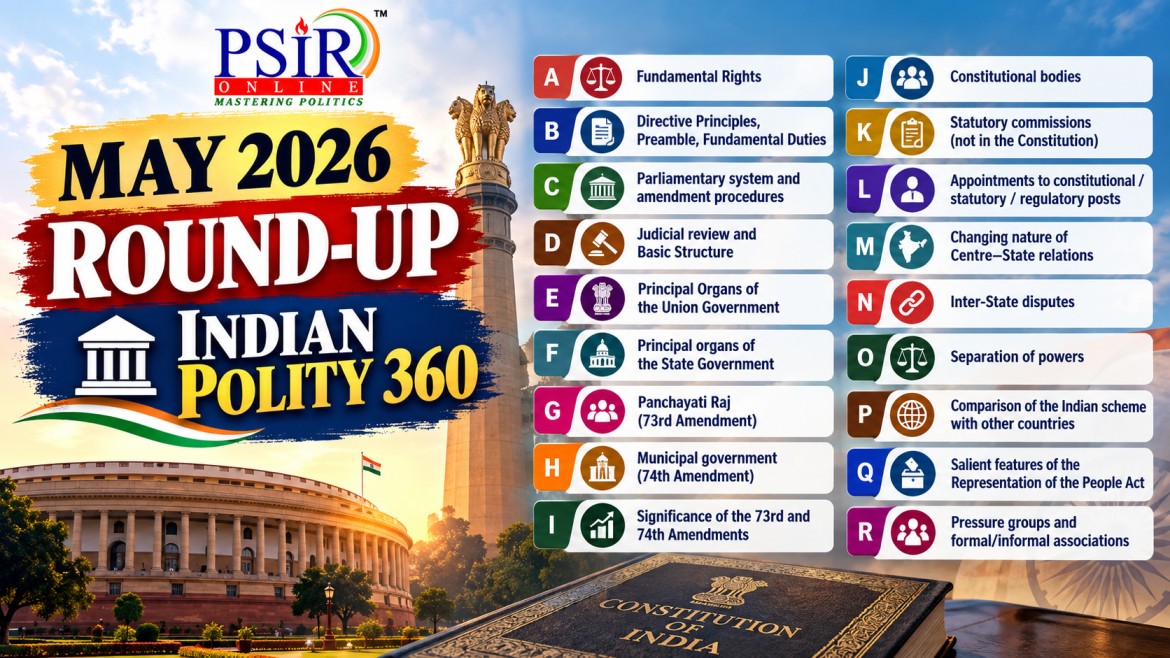
[NOTE: THE CURRENT AFFAIRS FOR THIS MONTH HAS BEEN ORGANISED AS PER THE TOPICS MENTIONED IN PSIR AND GS 2 (MAINS) SYLLABUS. FEW TOPICS MIGHT LOOK REPETITIVE AS IT OVERLAPS UNDER MANY SUB-HEADINGS. BUT THE INFORMATION INSIDE THOSE TOPICS WILL BE DIFFERENT AND WILL PERTAIN TO THE MAIN HEADING CONCERNED. HENCE STUDENTS ARE REQUESTED TO READ EACH AND EVERY LINE OF THE SECTION TO GET COMPLETE UNDERSTANDING]
A. Fundamental Rights
1. Franchise, Article 324, free and fair elections
Association for Democratic Reforms v. Election Commission of India — 27 May 2026
Three-judge Bench: CJI Surya Kant, Justices Joymalya Bagchi and Vipul M. Pancholi.
The Court upheld the Election Commission’s Special Intensive Revision (SIR) of electoral rolls (the Bihar drive was the immediate trigger). It held that SIR does not conflict with the Representation of the People Act, 1950 or the 1960 Rules, and does not undercut the constitutional mandate of free and fair elections. Article 324 “breathes life” into the process through Section 21(3) of the 1950 Act.
On the nature of the vote: it is a “valuable constitutional right” under Article 326, not absolute, and may be regulated to keep rolls accurate. Democracy is “not only a story of voting, but of identifying the persons entitled to participate.” Integrity of the franchise requires both inclusion of the eligible and exclusion of the ineligible. That tracks Rajbala (2015): voting is a constitutional right subject to statutory conditions, not a Fundamental Right in Part III.
2. Trafficking survivors — Articles 21 and 23
Prajwala v. Union of India, 2026 INSC 609 — 29 May 2026
Justices J.B. Pardiwala and R. Mahadevan.
Rehabilitation of trafficking / commercial-sexual-exploitation survivors is not mere policy. It is part of dignity under Article 21 read with Article 23 (traffic in human beings and forced labour), in the Bandhua Mukti Morcha line. “Rescue is not enough.” The Court issued a detailed victim-protection / rehabilitation plan binding States.
3. Article 21 and delayed justice
Pila Pahan @ Peela Pahan v. State of Jharkhand, 2026 INSC 604 — 29 May 2026
CJI Surya Kant and Justice Joymalya Bagchi, under Article 142.
Delay in pronouncing reserved High Court judgments was treated as an Article 21 problem. Binding directions:
· reserved reasoned judgments ordinarily within three months;
· bail orders same day or next day;
· release after bail / acquittal / suspension of sentence the same or next day;
· monthly automated lists to Chief Justices; litigants may apply for pronouncement after three months. Builds on Anil Rai (2001).
4. Illegal detention after a release order
Daudayal v. State of Rajasthan, 2026 INSC 599 — 29 May 2026
Justices Sanjay Karol and A.G. Masih.
Twenty-four days in jail after a High Court permanent-parole order and verified sureties = illegal detention. Principle: “obey first, appeal later.” Even a convict keeps Article 21. Compensation of ₹11 lakh as a public-law remedy (Rudul Sah, Nilabati Behera). Habeas corpus remains available.
5. UAPA bail and Article 21 as grundnorm
Syed Iftikhar Andrabi v. NIA, 2026 INSC 503 — 18 May 2026
(and related May bail matters such as Sahil Manoj Machare, 11 May).
Prolonged pre-trial custody (here nearly six years, hundreds of witnesses still to be examined) can make Section 43-D(5) UAPA “melt away.” Union of India v. K.A. Najeeb (3-judge) remains binding; a smaller Bench cannot hollow it out without a reference. “Bail is the rule” is given constitutional content under Article 21. On 22 May a related UAPA–Article 21 clash was flagged toward a larger Bench.
6. Challenge to the Transgender Amendment Act
4 May 2026: Notice issued on petitions against the Transgender Persons (Protection of Rights) Amendment Act, 2026. No stay. Petitioners argue that replacing NALSA self-identification with medical-board / District Magistrate certification violates Articles 14, 15, 19 and 21. The Court asked the Union whether self-identification can be misused. Matter pending.
7. Other May FR threads
· Disabled prisoners (Sathyan Naravoor): Articles 14 and 21 plus the RPwD Act; custody does not extinguish dignity or reasonable accommodation. Coverage continued into May.
· Stray dogs / public safety (19 May): Article 21 includes access to public spaces without fear of physical harm; ABC Rules framework upheld with directions on sterilisation, vaccination, and limited euthanasia of rabid or demonstrably dangerous dogs.
· DPDP Act, 2023: clubbed privacy challenges (Article 21 / Puttaswamy) were expected to be taken up around late May; no final May ruling on validity.
B. Directive Principles, Preamble, Fundamental Duties
· DPSP: Prajwala operationalises the spirit of Articles 39 and 39A (livelihood, dignity, equal justice) through Articles 21 and 23 rather than by amending Part IV. Labour-code rules and VB-G RAM G draft rules are the main policy instruments on work and social security.
· Preamble: No May judgment amended or re-interpreted the Preamble. SIR reasoning used democratic participation and purity of the electoral roll; rehabilitation reasoning used dignity.
· Fundamental Duties: No notable May legislation or leading case.
C. Parliamentary system and amendment procedures
No Constitution Amendment Bill was passed in May 2026. The 106th Amendment (2023) remains the last enacted amendment. After the 131st Amendment Bill failed on 17 April, political commentary in May–June turned on whether the NDA could later assemble an Article 368 special majority to revive delimitation and women’s reservation; that is politics, not a May enactment.
Supreme Court (Number of Judges) Amendment Ordinance, 2026 — 16 May 2026
The President issued an Ordinance amending the Supreme Court (Number of Judges) Act, 1956 to raise sanctioned strength from 33 to 37 (plus the CJI). This is ordinary law, not an Article 368 amendment. It matters for the parliamentary/judicial system because it is how the Union used Article 123 in the inter-session gap to expand the Court’s capacity. A replacing Bill was later introduced in the Monsoon Session.
Other May policy, not constitutional text: Central rules under the four labour codes were notified; draft Rules under the VB-G RAM G Act, 2025 were opened for comment. These sit closer to Directive Principles on livelihood than to Part III or Article 368.
D. Judicial review and Basic Structure
1. SIR UPHELD — REVIEW THAT VALIDATES POWER, BUT ON CONSTITUTIONAL TERMS
Case: Association for Democratic Reforms v. Election Commission of India (27 May 2026).
Bench: CJI Surya Kant, Justices Joymalya Bagchi and Vipul M. Pancholi.
What was under review. Petitioners said the Election Commission’s Special Intensive Revision of electoral rolls (the Bihar exercise was the flashpoint) would delete genuine voters, sit outside the Representation of the People Act, 1950 and the 1960 Rules, and damage free and fair elections.
What the Court did. It did not treat Article 324 as a blank cheque, and it did not strike the drive down. It held:
· The story of democracy is not only voting; it is also identifying who may vote.
· SIR does not supplant the 1950 Act or the 1960 Rules. It “breathes life” into Article 324 through the precise statutory conduit of Section 21(3) of the 1950 Act (special revision).
· So long as the Commission stays inside the statute, records reasons for using the special power, and does not breach an express prohibition, a different procedure from ordinary revision is not, by itself, ultra vires.
· The vote is a valuable constitutional right under Article 326, not absolute. Purity of the roll requires both inclusion of the eligible and exclusion of the ineligible. That follows Rajbala v. State of Haryana (2015).
Why this is judicial review. The Court sat in judgment on a constitutional authority (the ECI), measured its action against Articles 324–326 and the RP Act, and then sustained the action because it fitted that framework. Review is not only striking down. Upholding after a full constitutional audit is still review — and it simultaneously restated free and fair elections as a constitutional imperative (the same feature treated as Basic Structure since Indira Nehru Gandhi v. Raj Narain).
2. UAPA EMBARGO “MELTS” BEFORE ARTICLE 21 — REVIEW THAT LIMITS A STATUTE
Lead case: Syed Iftikhar Andrabi v. National Investigation Agency, 2026 INSC 503 (18 May 2026).
Related May cluster: Sahil Manoj Machare v. State of Maharashtra (around 11 May) — bail where almost no witnesses had been examined after years in custody.
What was under review. Section 43-D(5) of the UAPA tells courts not to grant bail if a prima facie case exists. The accused had spent nearly six years in pre-trial custody; the prosecution still spoke of 350+ witnesses. A co-equal Bench in Gulfisha Fatima had been read as watering down the earlier three-judge ruling in Union of India v. K.A. Najeeb (2021).
What the Court did.
· Article 21 (personal liberty + speedy trial) is the grundnorm. A special statute cannot oust constitutional courts when delay itself becomes the violation.
· K.A. Najeeb (three judges) remains binding stare decisis. A smaller Bench cannot hollow out a larger-Bench holding without expressly disagreeing and referring the question.
· On the facts — very long incarceration + no realistic end to trial — the statutory embargo “melts away.” Bail was granted.
· “Bail is the rule, jail the exception” was given constitutional, not merely CrPC, content.
· Around 22 May the Court also flagged the 43-D(5) vs Article 21 clash for a larger Bench, which is itself a review-discipline move (Article 141 / judicial hierarchy).
Why this is judicial review. This is classic constitutional limitation of legislation in application. The Court did not strike Section 43-D(5) off the book. It held that Part III prevails in operation when the statute’s routine application would make liberty and speedy trial illusory. That is the same logic as Maneka Gandhi and the prolonged-detention line: procedure established by law must still be fair, just and reasonable.
3. HIGH COURT LISTING DISCIPLINE UNDER ARTICLE 142 — REVIEW OF THE JUDICIAL PROCESS ITSELF
Case: Pila Pahan @ Peela Pahan v. State of Jharkhand, 2026 INSC 604 (29 May 2026).
Bench: CJI Surya Kant and Justice Joymalya Bagchi.
What was under review. Convicts whose Jharkhand High Court criminal appeals had been heard and reserved in 2022 still had no judgment. The Supreme Court called for nationwide data on reserved-but-unpronounced High Court matters.
What the Court did (binding directions under Article 142, grounded in Article 21):
· Reserved reasoned judgments: ordinarily within three months (Anil Rai v. State of Bihar, 2001, given teeth).
· Bail / anticipatory bail: pronounce and upload the same day, or the next day if reserved.
· Bail, acquittal, or suspension of sentence: communicate to jail and trial court on the day of pronouncement; release same day or next day unless another case or unfulfilled conditions stand in the way.
· Automated monthly lists of reserved matters to each Chief Justice; after three months the Registrar General must place the file before the CJ; litigants may apply for pronouncement, and beyond four months for reassignment.
Why this is judicial review. Review is not only of Parliament and the executive. The Supreme Court also polices delay inside the judiciary, because an unpronounced judgment can keep a person in prison as effectively as an invalid statute. Article 142 was used to impose a national timetable so that Article 21 is not defeated by the Court’s own backlog. That is institutional review: the apex court supervising High Courts as constitutional courts.
4. COMPENSATION FOR ILLEGAL DETENTION — REVIEW THAT REMEDIES A COMPLETED VIOLATION
Case: Daudayal v. State of Rajasthan, 2026 INSC 599 (29 May 2026).
Bench: Justices Sanjay Karol and A.G. Masih.
What was under review. A High Court Single Judge had granted permanent parole (5 November 2024). Sureties were furnished and verified. The State still held the convict for 24 days while it thought about an appeal. A Division Bench later ordered release on habeas corpus. The Supreme Court was asked for public-law compensation.
What the Court did.
· Once a judicial release order is in force and conditions are met, continued custody is illegal detention.
· “Obey first, appeal later.” Only a superior court’s stay can keep the person inside. Administrative hesitation is not a legal ground.
· A convict does not shed Article 21.
· Compensation of ₹11 lakh as a public-law remedy — the Rudul Sah (1983) → Nilabati Behera (1993) line — to mark the constitutional wrong, not as private tort damages.
Why this is judicial review. After the fact, the Court examined State conduct against Article 21, declared it unconstitutional in effect, and awarded a constitutional remedy. That completes the review cycle: invalidate the detention, declare the principle, and make the State pay so the right is not a paper guarantee.
E. PRINCIPAL ORGANS OF THE UNION GOVERNMENT
LEGISLATURE — ENVISAGED VS ACTUAL
Envisaged: Parliament makes law, controls the executive, and must approve any Ordinance (Arts. 79, 107, 123).
Actual in May 2026:
Both Houses were out of session. No Bills were passed. The live constitutional issue was therefore not debate in the House, but whether the executive would legislate by Ordinance and how the Court would fill gaps.
The April defeat of the 131st Constitution Amendment Bill still framed political talk (special majority, delimitation, women’s reservation), but that was unfinished parliamentary business, not May legislation.
EXECUTIVE — ENVISAGED VS ACTUAL
Envisaged: President as formal head; real power in the Council of Ministers (Arts. 53, 74, 75). Ordinance power (Art. 123) only when at least one House is not in session and immediate action is necessary. Cabinet sets policy.
Actual working in May:
1. Cabinet (5 May) approved raising Supreme Court strength. That is the Council of Ministers discharging its policy role.
2. President’s Ordinance, 16 May 2026 — Supreme Court (Number of Judges) Amendment Ordinance, 2026
o Article 123; gazette records that Parliament was not in session and the President was “satisfied” that immediate action was necessary.
o Amends the 1956 Act: judges excluding the CJI from 33 → 37; total 34 → 38.
o Justification: pendency above 93,000 cases. Last statutory increase was 2019.
o Same force as an Act, but must be laid when Parliament next meets and dies six weeks after reassembly if not enacted.
Experts later treated this as a case study of Art. 123: backlog is chronic, not a sudden emergency, so “immediate necessity” is contestable even if the policy aim (more judges) is sound.
3. Policy programmes (executive, not statutes):
o Cabinet approval of ECLGS 5.0 (credit guarantees for MSMEs and airlines).
o Notification of rules under the four labour codes.
o Draft Rules under the VB-G RAM G Act, 2025 (rural employment replacing MGNREGA), including wage-payment rules gazetted 22 May.
o External executive: India–Nordic Summit; India–US critical minerals framework; PM visit to UAE.
This is the textbook gap between envisaged law-making in Parliament and actual law-and-policy making by Cabinet + President when the House is dark.
SUPREME COURT — ENVISAGED VS ACTUAL
Envisaged: Highest constitutional court; original, appellate and advisory jurisdiction; guardian of Fundamental Rights; independence under Arts. 124–147; binding law under Art. 141; complete justice under Art. 142.
Actual working in May 2026 was unusually institutional as well as doctrinal:

The Court was not only deciding cases. It was re-tooling the judicial system (more sanctioned judges + binding HC timelines) while reviewing the Election Commission and special criminal statutes. That is the “actual working” of the third Union organ in a month when the first organ was silent.
F. Principal organs of the State Government
STATE LEGISLATURE — ENVISAGED VS ACTUAL
Envisaged: Governor + Assembly (and Council where it exists) make State law (Arts. 168–212); fixed five-year term (Art. 172); Governor summons, prorogues, dissolves (Art. 174).
Actual in May 2026: several Assemblies were in post-election transition, not ordinary law-making.
· West Bengal: Governor R.N. Ravi dissolved the Assembly with effect from 7 May 2026 (end of term / Art. 174). The first BJP Council of Ministers in the State was to be sworn on 9 May. Debate followed on whether a defeated CM must resign at once, pleasure of the Governor under Art. 164, and the floor test as the only test of majority (S.R. Bommai, Shivraj Singh Chouhan).
· Tamil Nadu: After the 2026 Assembly verdict, the DMK legislature party on 7 May authorised M.K. Stalin to take decisions for a “stable” government. Public argument turned on the Governor’s insistence on majority support and the shadow of President’s Rule (Art. 356) if no stable combination emerged. That is Art. 164 / 174 / 356 in live politics, not a new statute.
No major new State constitutional amendment of Union-level significance is recorded for May; the month’s State-legislative story is formation, dissolution, and confidence, not Bills.
STATE EXECUTIVE — ENVISAGED VS ACTUAL
Envisaged: Governor as constitutional head (Arts. 153–167); real power in the CM and Council, who hold office during the Governor’s pleasure but must command the Assembly. Governor’s options on Bills: assent, withhold and return, or reserve for the President (Art. 200).
Actual working:
· Government formation in Bengal and the Tamil Nadu stalemate show the Governor as crisis manager, not a ceremonial bystander: dissolution, invitation to form government, demand for proof of majority.
· Art. 200 / Governors and Bills was not newly decided in May 2026. The live doctrine remained the November 2025 advisory opinion on the President’s Art. 143 reference (no judicial timelines for Governors; no “deemed assent”). Commentary in mid-May 2026 was still digesting that 2025 retreat, not a fresh May judgment.
· State executives also faced Supreme Court compliance duties: Prajwala rehabilitation plan; SIR implementation through State CEO machinery; labour-code and rural-employment rules that States must administer.
HIGH COURTS — ENVISAGED VS ACTUAL
Envisaged: Constitutional courts for the State (Arts. 214–231); writs under Art. 226; superintendence over district courts (Art. 227); judges appointed by the President after consultation (Art. 217).
Actual working in May 2026:
1. Supreme Court supervision of High Courts — Pila Pahan (29 May)
Binding Art. 142 directions to all High Courts: reserved judgments in three months; bail same day / next day; upload in 24 hours; monthly lists to the Chief Justice; reassignment if delay continues. This is the Union apex court telling State High Courts how to run their boards — a sharp picture of envisaged autonomy vs actual hierarchy.
2. Vacancies (as of 1 May 2026): working strength about 797 against a sanctioned strength near 1,120, i.e. roughly 325 vacancies (~three in ten empty). Worst absolute gaps: Allahabad; Punjab and Haryana also far below strength. Raising sanctioned strength over a decade has not closed the working-strength gap. That is the High Court as an institution under strain.
3. High Courts talking back (late May): On 27 May, an Allahabad High Court Division Bench said recent Supreme Court rulings on illegal arrests had opened “floodgates” of delayed habeas corpus petitions and disrupted ongoing trials. That is rare, public friction between two layers of the same judiciary — actual working, not the textbook picture of quiet compliance.
4. Appointment pipeline: Collegium recommendations and Centre notifications continued in the background; several High Courts later in 2026 ran under acting Chief Justices after elevations linked to the larger Supreme Court. The May Ordinance on SC strength is what later pulled HC Chief Justices upward.
G. Panchayati Raj (73rd Amendment)
1. UTTAR PRADESH: TERM ENDS, ADMINISTRATORS IN, POLLS DELAYED
This is the month’s central 73rd-Amendment event.
· Gram panchayats elected in 2021 completed five years on 26 May 2026 (block and zila panchayats follow in July). About 57,694 outgoing pradhans were appointed administrators from 27 May, for up to six months, with no policy powers except via the DM.
· 18 May: State Cabinet created a Dedicated Backward Classes Commission so OBC reservation in three-tier panchayats can meet the Supreme Court triple test (dedicated commission → contemporaneous data → proportionate reservation without breaching the 50% cap). Without that, SECs cannot notify reserved seats. Allahabad HC had already pressed the State in March to finish this before the term died.
· Reporting in early May said the government was examining whether polls could slip past the 2027 Assembly election — which would break the 243E timetable. That is the classic tension: constitutional election cycle vs State political calendar.
Later note (for context, June): Allahabad HC held the May 25–26 administrator orders non est because they rested on a provision already struck down, and said pradhans cannot sit as administrators indefinitely; the State must give an election timeline. The May orders are what triggered that fight.
Significance for the syllabus: Art. 243E is mandatory. Substituting elected Gram Panchayats with administrators after the term is the exact practice the 73rd Amendment was meant to end. The OBC-commission delay shows how a judicial doctrine (triple test) can freeze the SEC’s Art. 243K calendar.
2. HIMACHAL PRADESH: STATE PANCHAYATI RAJ LAW AMENDED
· 4 May 2026: Himachal Pradesh Panchayati Raj (Amendment) Act, 2026. Defines “Gram Sabha member”; Gram Sabha quorum cut from one-fourth of families to one-tenth of members; new disqualifications (NDPS charges, encroachment on government/panchayat land by the candidate or family, false declarations, employment under government or panchayats, including contract/daily-wage staff).
· 6 May: a follow-on Ordinance widened “family” in the land-encroachment disqualification to include daughter-in-law.
These are State laws under the 73rd Amendment’s enabling scheme (Arts. 243C, 243F) — eligibility and Gram Sabha procedure, not a change to the Constitution.
3. OTHER RURAL CALENDARS
Maharashtra SEC issued May orders on reservation rotation and draws for Gram Panchayats whose terms expired in 2024–25 or expire in 2026. J&K published the final panchayat roll with 1 April 2026 as qualifying date, target publication 15 May. Manipur’s panchayat polls remained overdue.
4. POLICY AND EXPERT COMMENT
· 20 May: Ministry of Panchayati Raj issued Programme Guidelines for the Atmanirbhar Panchayat Programme — a Union scheme sitting on the 243G / Eleventh Schedule space (own revenue, less grant-dependence).
· 28 May (SPMRF / Alok Virendra Tiwari): “The Unfinished Tier” — 30+ years on, functions–funds–functionaries still sit with State legislatures; no penalty for thin devolution. Points to 16th Finance Commission (2026–31) performance-linked grants as a possible lever. May commentary also noted 16th FC allocation to local bodies of about ₹5.10 lakh crore for 2026–31 (up from ₹4.36 lakh crore under the 15th FC), tied to elected bodies, accounts, and sanitation outcomes.
No new PESA statute in May; the parliamentary PESA review came later (July).
H. Municipal government (74th Amendment)
Here the 74th Amendment worked as designed: SECs notified polls, five-year cycle, party contests in corporations / councils / nagar panchayats.

Andhra Pradesh did not poll ULBs in May; it was still on rules and delimitation (direct mayor came later in the year).
Supreme Court, municipal property (1 May): Prem Porwal v. Jagdeesh Chandra Prajapati — a writ/PIL court cannot decide title between a Municipal Council and the State, or order demolition of shops, without necessary parties. Civic land disputes stay in the civil court. That is 74th-Amendment institutions meeting ordinary civil jurisdiction.
(The Kolhapur / Unchgaon village-panchayat vs municipal-limits case is 22 April 2026, not May.)
I. Significance of the 73rd and 74th Amendments
What the amendments achieved (visible in May):
Urban SECs in Punjab, Himachal and Haryana ran large, timed municipal elections. That is Arts. 243U and 243ZA doing what they were written to do: no indefinite postponement of city government.
What they still leave unfinished:
· Elections can still slip in the countryside when a State waits on an OBC commission (UP). Art. 243E has no self-executing penalty.
· Administrators replacing elected pradhans after the five-year clock is the pre-1993 habit in new clothes.
· Devolution of the 29 + 18 subjects remains a State choice. Expert writing in May treated the 16th FC’s performance grants as a substitute for the compulsion the text never imposed.
· Disqualifications and Gram Sabha quorum are still rewritten by State Acts/Ordinances (Himachal), which is lawful but shows how much of “grassroots democracy” is State legislation, not the constitutional articles themselves.
J. Constitutional bodies
Election Commission of India (Art. 324)
Judgment — 27 May 2026: Association for Democratic Reforms v. Election Commission of India (often cited as 2026 INSC 564). Bench: CJI Surya Kant, Justices Joymalya Bagchi and Vipul M. Pancholi. Hearings had run for months; the Bihar SIR (from June 2025) was the test case, later rolled out elsewhere.
Holdings on powers and functions:
· SIR is traceable to Article 324 plus Section 21(3) of the Representation of the People Act, 1950 (“special revision at any time, for reasons recorded, in such manner as the Commission thinks fit”).
· It does not supplant the 1950 Act or the 1960 Rules. A different procedure from ordinary revision is not, by itself, ultra vires.
· Purpose — accuracy and integrity of the roll — has a rational nexus with free and fair elections.
· The Commission may refuse enrolment or start deletion; that is not a declaration that the person is not a citizen. Citizenship questions must go to the authority under the Citizenship Act.
· Direction: within four weeks, refer 2003-roll deletions made on “not a citizen” grounds to that authority; decide before the next Assembly or local-body poll, after notice and hearing.
· Aadhaar had already been directed to be accepted as an identity document in interim proceedings.
Expert/ADR line: the Court expanded ECI’s roll-purification power but delivered the verdict after Bihar had already voted (Nov 2025), so review came late for that cycle. Safeguards (notice, hearing, appeal, citizenship referral) were treated as what keeps the power proportionate.
Appointment: CEC remained Gyanesh Kumar (from Feb 2025). No May change in the Commission’s composition.
This is the month’s core text on “powers, functions and responsibilities” of a constitutional body.
Finance Commission (Art. 280)
The 16th Finance Commission (Chair: Arvind Panagariya; award 2026–31) had already submitted its report (Nov 2025) and seen it tabled with the Action Taken Memorandum on 1 February 2026. May 2026 was implementation and expert debate, not a new report.
Live points in May commentary:
· Vertical devolution kept at 41% of the divisible pool (same as 15th FC).
· Horizontal formula: new 10% weight for a State’s contribution to GDP; tax/fiscal-effort criterion dropped.
· Grants ~₹9.47 lakh crore over five years: local bodies ₹7.91 lakh crore (rural ₹4.35 lakh cr, urban ₹3.56 lakh cr, 80% basic / 20% performance) plus disaster management. Special urban infrastructure ₹56,100 cr; urbanisation premium ₹10,000 cr.
· Entry conditions for grants: elected local bodies, audited accounts, functioning State Finance Commissions — tying Art. 280 to Parts IX / IX-A.
7 May (Policy Circle and former FC members): the GDP criterion is the real shift in fiscal federalism — reward for output versus equalisation. Silence on some State-demand issues was called a notable omission.
No new FC was constituted in May (the 16th is the sitting Commission for 2026–31).
Union Public Service Commission (Arts. 315–323)
No major May 2026 statute or landmark judgment. Chairperson Ajay Kumar (from May 2025) continued. UPSC’s ordinary functions (recruitment rules, interviews, disciplinary advice) ran as usual. Nothing comparable to the SIR case.
Comptroller and Auditor General (Arts. 148–151)
K. Sanjay Murthy continued (from Nov 2024). No May appointment, no new CAG Act amendment, no headline audit tabled that month that reset the office’s mandate. The constitutional chain (audit → President/Governor → PAC) was unchanged.
National Commission for Scheduled Castes (Art. 338)
Chairperson Kishor Makwana continued. On 19 May 2026 NCSC held a review meeting with HPCL on SC welfare, scheme coverage and shortfalls — the classic Art. 338(5) function of monitoring safeguards and calling public undertakings to account. Member Dr Partha Biswas was already in place (from March 2026). No new constitutional amendment.
National Commission for Scheduled Tribes (Art. 338A)
Chairperson Antar Singh Arya continued. No standalone May 2026 judgment or Act. (The Justice K.G. Balakrishnan Commission on SC status for Dalit converts was preparing to submit around June, after an April extension to 10 June — adjacent to May, not a May NCST event.)
National Commission for Backward Classes (Art. 338B)
Sadhvi Niranjan Jyoti became Chairperson on 18 March 2026 (first woman to head NCBC) and was in office through May. The body itself issued no May headline ruling.
State-level echo (18 May): Uttar Pradesh Cabinet created a Dedicated Backward Classes Commission to run the Supreme Court’s triple test before OBC reservation in panchayat polls. That is a State statutory commission doing the work Vikas Kishanrao Gawali / local-body cases require before SECs can notify reserved seats — not a change to Art. 338B, but the same “backward classes commission” logic.
K. Statutory commissions (not in the Constitution)
The National Human Rights Commission is set up under the Protection of Human Rights Act, 1993. Through May 2026 it continued under Chairperson Justice V. Ramasubramanian, who had assumed office in December 2024. There was no reconstitution of the Commission that month and no amendment to the parent Act. For the functions listed in clauses (b) to (j) of Section 12, the chairs of the National Commission for Scheduled Castes, the National Commission for Scheduled Tribes, the National Commission for Backward Classes, the National Commission for Women, the National Commission for Minorities, the National Commission for Protection of Child Rights, and the Chief Commissioner for Persons with Disabilities sit as deemed members.
The National Commission for Women is a statutory body under the National Commission for Women Act, 1990. Vijaya Kishore Rahatkar remained Chairperson (in office since October 2024). Academic debates restated the familiar points: the Commission is statutory rather than constitutional, its recommendations are not binding, and it depends on the Ministry of Women and Child Development for budget and establishment. No new Act or amendment was passed in May.
The National Commission for Minorities, created under the National Commission for Minorities Act, 1992, was the vacancy story of the month rather than a story of a new mandate. The chairperson’s post and several member posts had been empty for a long stretch; a public-interest petition before the Delhi High Court seeking a mandamus to reconstitute the body was still pending. Harjit Singh Grewal was appointed Chairperson only in July 2026, so May itself recorded the gap, not a fresh statutory design.
L. Appointments to constitutional / statutory / regulatory posts
Constitutional posts: no new CEC, CAG, UPSC Chair, Attorney General, or Finance Commission Chair in May.
Statutory / regulatory (illustrative of “appointment to various posts”):
1. RBI Deputy Governor — Rohit Jain
Appointments Committee of the Cabinet; three-year term from on/after 3 May 2026, replacing T. Rabi Sankar. RBI Act, 1934 requires four DGs. Statutory regulator, not a constitutional body.
2. CBI Director selection committee — 12–13 May 2026
Committee under the Lokpal Act / CVC framework: PM + CJI + Leader of Opposition. LoP Rahul Gandhi dissented (denied candidate dossiers; process called a “rubber stamp”). Government then notified a further one-year extension for incumbent Director Praveen Sood. Expert comment (Frontline, 14 May) asked what the CJI’s seat is worth if files are not shared and extensions keep flowing. This is the month’s sharpest fight over appointment process for a statutory investigating agency.
3. Market infrastructure (SEBI-cleared): e.g. Metropolitan Stock Exchange chair approved in May — regulatory, not constitutional.
M. Changing nature of Centre–State relations
Fiscal federalism — expert debate, 7 May.
The 16th Finance Commission (Arvind Panagariya) had already been accepted in the February Budget: States’ vertical share stays 41% of the divisible pool; horizontal formula now gives 10% weight to a State’s contribution to GDP; tax/fiscal-effort is out; revenue-deficit and most State-specific grants are gone. Local-body grants are large but conditional (elected councils, audited accounts, a living State Finance Commission).
May commentary (Policy Circle, former FC members) treated this as a shift from equalisation toward rewarding output. Southern and western States gain; several Hindi-heartland States lose share.
States also repeated the older complaint that cesses and surcharges sit outside the pool, so 41% on paper is closer to 29–30% of gross tax revenue. That is cooperative federalism under strain: the Union keeps the 41% headline and changes the ethic of sharing.
Electoral federalism — SIR, 27 May.
The Supreme Court upheld the Election Commission’s Special Intensive Revision under Article 324 and Section 21(3) of the RP Act, 1950. Rolls are a Union Commission’s job even when the election is a State Assembly poll. The Court drew a federal line on citizenship: ECI may drop a name; it may not declare a person a non-citizen.
Those cases go to the authority under the Citizenship Act, to be finished before the next Assembly or local-body election. Integrationist reading: one national roll standard. Regional anxiety: a Union body can shrink a State’s electorate just before a State election.
Third-tier federalism.
Uttar Pradesh’s panchayat term ended on 26 May; outgoing pradhans were made administrators pending an OBC “triple test” commission created on 18 May. That is the Union constitutional design (Part IX) colliding with a State’s election calendar — the same Centre–State–local triangle the 16th FC tried to police with grant conditions.
Executive at the Centre while legislatures sat in recess.
The Supreme Court (Number of Judges) Amendment Ordinance, 16 May (Article 123) raised sanctioned strength to 38 including the CJI. Academic debates reminded: ordinance is not a parallel Parliament; it must come to both Houses; separation of powers is functional, not rigid. Raising the apex court is a Union subject; the method (ordinance) is what federalists and parliamentarians watch.
N. Inter-State disputes
Mahanadi (Odisha–Chhattisgarh).
On 3 May both States filed a joint water-availability report before the Mahanadi Water Disputes Tribunal (constituted 2018 under Article 262 / ISWD Act). The Tribunal (Chair: Justice Bela M. Trivedi) had given a last chance after an 8 April technical meeting. Next date: 30 May. Advocate General Odisha called the joint report a milestone toward settlement. This is the textbook dispute-redressal path: negotiation first, tribunal second, Supreme Court only later.
Kaveri did not have a May flashpoint of the July 2026 kind.
Indus Waters Treaty is international, not inter-State. On 15 May the Court of Arbitration at The Hague issued a further award on pondage at Indian projects on the western rivers. India rejected it as void and kept the treaty in abeyance. Useful as contrast: India will sit before an inter-State tribunal (Mahanadi) while refusing an international one on Indus.
O. Separation of powers
May 2026 is rich on which organ may do what.
Legislature vs judiciary.
Hearings in the challenge to the Chief Election Commissioner and Other Election Commissioners Act, 2023 began on 6 May (Jaya Thakur batch). The live questions are pure separation-of-powers: can Parliament replace the Anoop Baranwal collegium-style panel with PM + Cabinet Minister + LoP; do Article 142 directions survive once the field is occupied by statute. Judgment came later; May is when the Court started listening.
Around 1 May the Court (Justices Vikram Nath and Sandeep Mehta) dismissed a plea asking it to frame new hate-speech offences: creating crimes is for Parliament; the judiciary will not expand criminal law under Article 32. That is the cleanest May statement of functional separation.
Executive vs legislature.
The 16 May judges Ordinance is executive law-making during recess — valid only if urgency is real and Parliament is asked to convert it.
Executive vs judiciary (appointments).
On 12–13 May the CBI Director committee (PM, CJI, Leader of Opposition) sat. The LoP dissented that files were withheld; the government then extended Director Praveen Sood. The fight is about whether a statutory selection panel is a real check or a formality — separation of powers inside an appointment process.
Judiciary using Article 142.
Pila Pahan v. State of Jharkhand (29 May) used Article 142 to impose listing and adjournment discipline on High Courts. Supporters: complete justice and Article 21 delay. Critics: the Supreme Court running State High Court registries. Same month, other benches used 142 for compensation and case-specific relief while repeating that 142 cannot supplant a statute or invent “deemed assent” (the November Reference already closed that door).
Judiciary vs a harsh Union statute.
UAPA default-bail / delay cases (including the Andrabi line) subordinated a parliamentary embargo to Article 21 where trial delay was extreme. That is judicial review as a check, not a rewrite of the federal division of powers.
P. Comparison of the Indian scheme with other countries
Election management.
Most parliamentary democracies give roll revision to an independent commission (UK Electoral Commission is statutory; Election Commission of India is constitutional, Art. 324). The US leaves registration largely to the States. On 27 May the Supreme Court held that Indian legislation under Article 327 (the RPA) does not extinguish Article 324. That is closer to a constitutional commission with plenary residual power than to the UK model of a statute-bound commission, and far from US federalism on voter lists.
Citizenship vs the franchise.
Many constitutions separate “who is a citizen” (statute / interior ministry / courts) from “who may vote.” The May SIR ruling does the same: ECI may enquire into citizenship only to decide a name on the roll; it cannot declare a person a non-citizen. That is the Indian answer to a problem other democracies handle through civil registries (France, Germany) or jury-style naturalisation courts (US).
Written constitution + judicial review.
Academic debates restated India as a written constitution with unwritten conventions (seniority for CJI, basic structure). The SIR bench used proportionality — a tool familiar from German and Canadian rights jurisprudence — to test a roll-revision drive. India still has no US-style Marbury political-question bar on election administration; the Court sat in judgment on the Commission and then upheld it.
Parliamentary vs presidential appointment of election chiefs.
Hearings in Jaya Thakur on the CEC and Other Election Commissioners Act, 2023 began on 6 May. The comparative hook: Anoop Baranwal had pushed toward a CJI-inclusive panel (closer to some independent-commission models); Parliament put PM + Minister + LoP in the statute. May is when the Court started asking whether that is permitted separation of powers — not when it answered.
Q. Salient features of the Representation of the People Act
The judgment: ADR v. ECI, 27 May 2026 (CJI Surya Kant, Justices Joymalya Bagchi and Vipul Pancholi; often 2026 INSC 564). Petitioners included Association for Democratic Reforms, PUCL and several MPs. The Bihar SIR of 2025 was the test case.
What the Court did to the 1950 Act:
· Section 21(3) is the engine. Special revision may be of “any” constituency and, where conditions exist (migration, urbanisation, stale 2003 intensive revision), of many or all. Different procedure from routine Section 21(2) / Rule 25 revision does not make the exercise ultra vires.
· SIR does not supplant the RPA or the Registration of Electors Rules, 1960. It “breathes life” into Article 324 inside Section 21(3).
· Section 16 (disqualification of non-citizens) plus Section 19 (citizenship, 18 years, ordinary residence) allow the Commission a limited citizenship enquiry for inclusion or deletion. Presumption in favour of a person already on the roll is rebuttable. Deletion is not a Citizenship Act verdict.
· Safeguards the Court treated as part of the statutory scheme: notice, hearing, objections, speaking orders, appeals. Rule 21A deletions were held consistent where those safeguards exist.
· Direction: cases deleted from the 2003 roll on “not a citizen” grounds must be referred within four weeks to the authority under the Citizenship Act and decided before the next Assembly or local-body election.
· Aadhaar had already been directed as an identity document in interim orders.
What was not done in May: Parliament did not pass an RPA Amendment Act. The Court interpreted the existing 1950 Act; it did not rewrite the 1951 Act (nominations, corrupt practices, election petitions). Municipal polls in Haryana (10 May), Himachal (17 May) and Punjab (26 May) ran under State municipal law + Arts. 243ZA, not the Union RPA — useful to keep distinct.
Expert / ADR line after the verdict: the Court preserved Commission independence against the argument that Article 327 legislation shrinks Article 324 to a residual scrap; critics said the ruling arrived after Bihar had already voted and that nationwide SIR still risked mass deletion. Both belong in an answer on “role of associations” as well as on the RPA.
R. Pressure groups and formal/informal associations
ADR, PUCL and Opposition MPs were the petitioners in the SIR case — formal associations using Article 32 as their pressure instrument, not the street. That is the institutionalised end of the pressure-group spectrum.
FCRA politics in May.
The March Bill was still pending; notes as of May record deferral after Opposition and NGO resistance. Licence cancellations remained in the 22,000 range; active FCRA entities were a fraction of the 2014 stock. May is therefore the month of stalemate, not enactment. (The next tightening is the FCRA Amendment Rules notified 22 June, outside this month.)
Local elections as association politics.
Punjab’s 26 May municipal contest (AAP, Congress, SAD, BJP) is parties plus urban civic associations, not “pressure groups” in the Finer sense — but SECs and party machines are how formal associations enter the polity at the 74th-Amendment tier.
No new central law on trade unions, societies or political parties was passed in May. The Labour Codes fight of March–April did not produce a May repeal.
