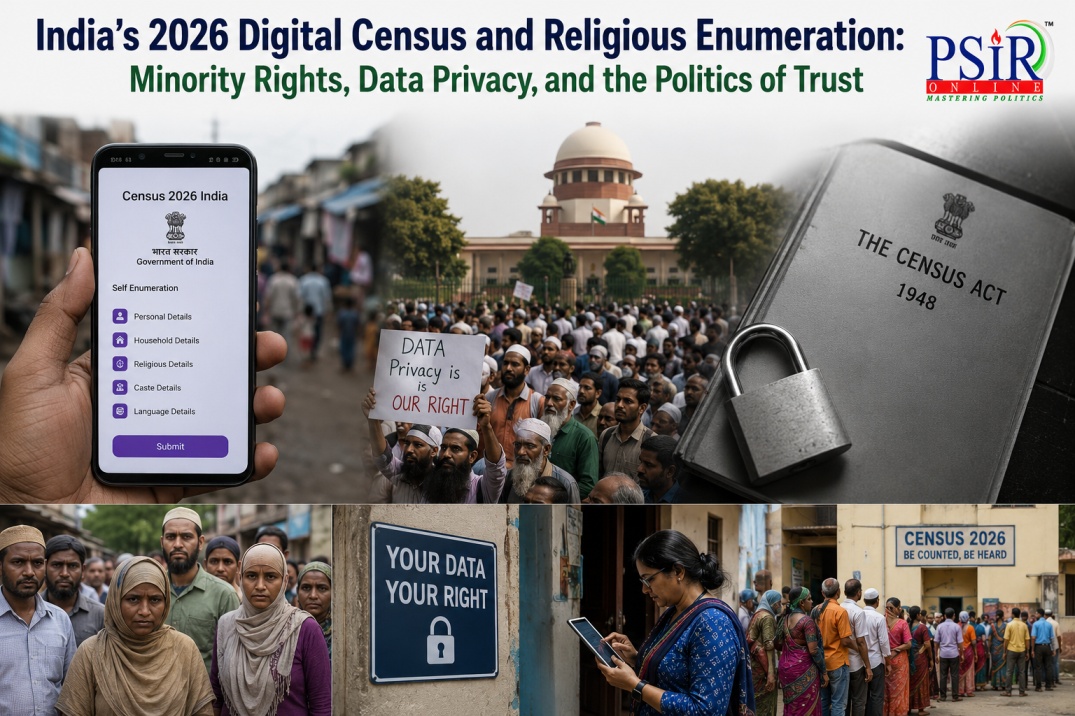
The 2026 national census is India’s first large-scale, fully digital enumeration and includes more granular questions on religion (including sect/sub‑religion) alongside expanded caste enumeration — changes that officials say will improve policymaking but that critics say raise serious risks for religious minorities.
WHAT CHANGED THIS TIME
· Digital methodology and self-enumeration options: For the first time the exercise uses a predominantly digital platform and allows citizens to submit information online before an enumerator’s visit, a shift the government says increases speed and confidentiality.
· Granular religion and sect data: Respondents can specify sects and sub‑religious identities (for example, denominational or sect affiliations within larger faiths), restoring levels of detail not collected since earlier historical counts.
· Comprehensive caste listing: The census also includes a countrywide caste enumeration phase, the most detailed caste data gathering in decades. Officials and proponents argue this can inform targeted welfare and representation policy.
WHY MINORITIES ARE ALARMED
· Risk of misuse and targeting: Minority groups — especially Muslims and Christians — worry that digitally linked, disaggregated religion data could be cross‑referenced with other administrative databases and used for surveillance, exclusion from welfare, or law‑enforcement actions. This fear is amplified by past policy initiatives critics say have disproportionately affected minorities.
· Links to CAA/NRC-era anxieties: Although the census is a statistical exercise, many civil‑society voices fear data could feed or be interpreted in ways that revive debates around citizenship verification, the Citizenship Amendment Act (CAA), and National Register of Citizens (NRC) processes. Those links are politically sensitive and fuel suspicion among minorities.
· Caste‑and‑faith complications for converts and Dalit Christians/Muslims: Collecting caste and religion together raises specific legal and social problems for those of Dalit background who are Christian or Muslim, because Scheduled Caste protections have legal exclusions tied to religion; declaring religion could affect access to entitlements. This has been raised in commentary and reporting.
PRACTICAL PROBLEMS WITH DIGITISATION
· Digital divide and accessibility: Critics note uneven internet access and digital literacy risk undercounting or forcing reliance on intermediaries, which can create errors or manipulation opportunities.
· Credibility and political acceptance: Several former administrators and analysts warn that technology alone does not guarantee trust — political transparency and independent oversight matter for public confidence.
GOVERNMENT ASSURANCES AND LEGAL SAFEGUARDS
The Indian government has made specific, documented assurances to minorities about how religious sub-sect data will be handled in the 2026–2027 census. Here are the key assurances:
1. Religion/sect will be recorded exactly as stated by the respondent
In a written reply to the Lok Sabha (March 2026), Minister of State for Home Affairs Nityanand Rai stated:
"In Census, the enumerator records all religions/sects/beliefs as stated by the respondents. In Census 2027 also, the enumerators will record the name of the religion as stated by the respondent."
This means no enumerator can impose or change a person's reported religion or sect.
2. Census records are legally protected from misuse
Under the Census Act, 1948:

3. Data will not be published at granular level that could identify individuals
· Sub-tribe-wise data is NOT published separately (only ST lists per state/UT)
· Religion-by-caste tables are published only at state/UT and district levels, not at village/household level
4. Census and SIR (Sample Investigation Register) are independent
The Census Commissioner has stated:
"There is no proposal to correlate the SIR data with the census data. The two processes are happening independent of each other."
This addresses fears about linking census data to citizenship verification processes.
5. Specific data safety mechanisms promised
The Census Commissioner has repeatedly assured:
"All the data that is being collected, there is a proper data safety mechanism in place. Your data is safe."
PIB press releases emphasize encryption, access controls, and legal penalties for unauthorized disclosure.
WHY STILL MINORITIES WORRY?
The minorities believe that government has NOT assured
· No explicit guarantee that data won't eventually inform citizenship-related exercises (CAA/NRC remain separate laws)
· No assurance about cross-matching with other government databases through judicial orders or future legislation
· The government has reiterated: "No reservation based on religion" which some minorities see as limiting welfare protections
There are also some key concerns that remains unresolved like Dalit Christians and Dalit Muslims cannot claim Scheduled Caste status (excluded by the 1950 Presidential Order), so if they declare their religion in the census, they may lose caste-based entitlements. The government has not addressed this legal exclusion
RECOMMENDED MEASURES TO EMBRACE MINORITIES
1. Permanent, Independent Oversight Mechanism
The government must establish a permanent multi-stakeholder Census Safeguards Board with representatives from Muslim, Christian, Buddhist, Sikh, and tribal minority organizations, along with former Supreme Court judges as independent members and data privacy experts from civil society. This board must have real powers to audit data collection, access logs, and investigate complaints in real-time. Without independent oversight with actual inspection authority, verbal assurances from the government lack credibility among communities that have experienced systematic marginalization. The board should be established by law, not by executive order, to ensure it cannot be dismantled when political pressure mounts.
2. Legally-Binding Non-Use Guarantee
Parliament must pass a binding resolution or amend the Census Act, 1948 to explicitly prohibit that census data on religion and caste shall NOT be used for citizenship verification, law enforcement, welfare exclusion, or any administrative action against individuals. The amendment must specifically ban cross-matching census data with the National Population Register (NPR), Aadhaar database, NRC processes, and law enforcement databases except via Supreme Court order in genuine national security cases. This directly addresses the core fear that minority communities have expressed: that granular religion data could eventually feed into CAA/NRC processes despite current government denials. The legal protection must be written into statute, not just promised through press releases.
3. Public, Verifiable Data Security Audit
The government must publish comprehensive third-party security audit reports of the digital census platform that disclose the encryption standards used, detailed access logs showing who can view individual records, and results of penetration testing conducted by independent cybersecurity firms. The audit methodology and full findings must be made publicly available in English and all official Indian languages so that minorities and civil society can verify claims about data protection. Trust requires transparency and verifiable evidence rather than verbal assurances from government officials who may have political incentives to downplay risks. Without public access to security audits, communities have no way to independently verify that their sensitive religious data is actually protected.
4. Granular Aggregation to Prevent Identification
Census data on religion and caste should be published only at the state and Union Territory level, not at district or village level, and cells with small sample sizes must be suppressed to prevent re-identification of specific communities using statistical disclosure control techniques like noise addition and rounding. This prevents communal mapping that could lead to targeted violence, discrimination, or harassment against religious minorities in specific localities. When aggregate data shows precise numbers of Muslims or Christians in a particular village or neighborhood, it can be weaponized by majoritarian groups to justify exclusion or violence, as has happened in past communal incidents. Statistical protection must be built into the publication protocol from the start.
5. Community-Led Sensitization and Grievance Redressal
Minority community leaders must be trained as official census awareness ambassadors who can build trust within their communities by explaining their rights and the safeguards in place. District-level fast-track grievance cells must be established with minority representatives, legal aid for victims of coercion or intimidation, and a 24-hour multilingual complaint hotline with immediate response capability. Fear spreads faster than government messaging, and community leaders who enjoy trust within their communities can build credibility far more effectively than distant bureaucracy. The grievance mechanism must be accessible, responsive, and empowered to take immediate action when violations occur.
6. Clear Self-Enumeration Guidelines
Detailed FAQs must be published in all official languages explaining practically what "recorded as stated by respondent" means, how to verify enumerator identity before providing information, steps to report coercion or intimidation, and an explicit statement of legal rights under Census Act Section 15 regarding confidentiality. The government must also provide offline self-enumeration portals for those without reliable internet access, ensuring that digital exclusion doesn't force minorities to rely on potentially biased intermediaries who might misrepresent their religion or sect. Clear, accessible guidance empowers respondents to protect their own rights during the enumeration process.
7. Enumerator Training and Accountability
Mandatory training modules on religious sensitivity and non-discrimination must be required for all enumerators, emphasizing the "record exactly as stated" rule with no interpretation or correction permitted, and making clear the legal consequences of data misuse under Section 17 of the Census Act (up to 6 months jail and fine). Two-step verification of self-enumerated data by different supervisors must be required to reduce errors and prevent deliberate manipulation. Enumerators are the frontline of the census, and their attitudes and behavior directly determine whether minorities feel safe providing accurate information about their religious identity.
8. Public Demonstration of Data Protection
The government should run a pilot test in a few districts with full transparency, publishing sample data, methodology, and security protocols, while independent monitoring by civil society organizations observes the process and a post-pilot public report addresses concerns raised by communities. This approach allows the government to show, not just tell, that data is encrypted at the device, transmission, and server levels, and that security claims are genuine rather than marketing. Pilots can also reveal practical problems with the digital platform before nationwide rollout, allowing corrections that build confidence.
9. Decouple Census from Citizenship Processes Explicitly
The Home Minister must officially state that census data will not be used for NRC or citizenship verification under any circumstances, and clarify that no update to the National Population Register is planned, as the Census Commissioner has already stated that census and SIR (Election Commission exercise) are independent processes. Repeated inconsistent statements from different government officials fuel distrust, so a single authoritative, unambiguous statement from the highest authority is essential. The statement must be formal, written, and publicly documented, not just delivered in a press interview that can be denied or retracted later.
CONCLUSION
The 2026 Census marks a transformative moment in India’s governance architecture by combining digital enumeration with detailed caste and religious data collection. While the government presents the exercise as a tool for evidence-based policymaking and inclusive welfare planning, concerns among religious minorities reveal a deeper crisis of trust between the state and vulnerable communities. Constitutional democracies depend not merely on legal assurances but on public confidence in institutional neutrality and procedural fairness. Therefore, the success of the census will depend on whether the state can ensure transparency, data protection, independent oversight, and an explicit separation between demographic enumeration and citizenship politics. In a plural society like India, the census must function as an instrument of democratic inclusion rather than a source of social anxiety.
PRACTICE QUESTIONS FOR PSIR OPTIONAL
1. “The modern census is not merely a statistical exercise but also an instrument of state power.” Critically examine this statement in the context of India’s 2026 digital census and religious enumeration.
2. Discuss the relationship between data governance, minority rights, and democratic legitimacy in contemporary India. How does the 2026 Census debate reflect these tensions?
3. Examine the constitutional and political implications of collecting caste and religion data simultaneously in India. How does it affect debates on social justice and secularism?
4. “Trust is the foundation of democratic governance in multicultural societies.” Analyse this statement with reference to minority concerns regarding India’s digital census and data privacy framework.