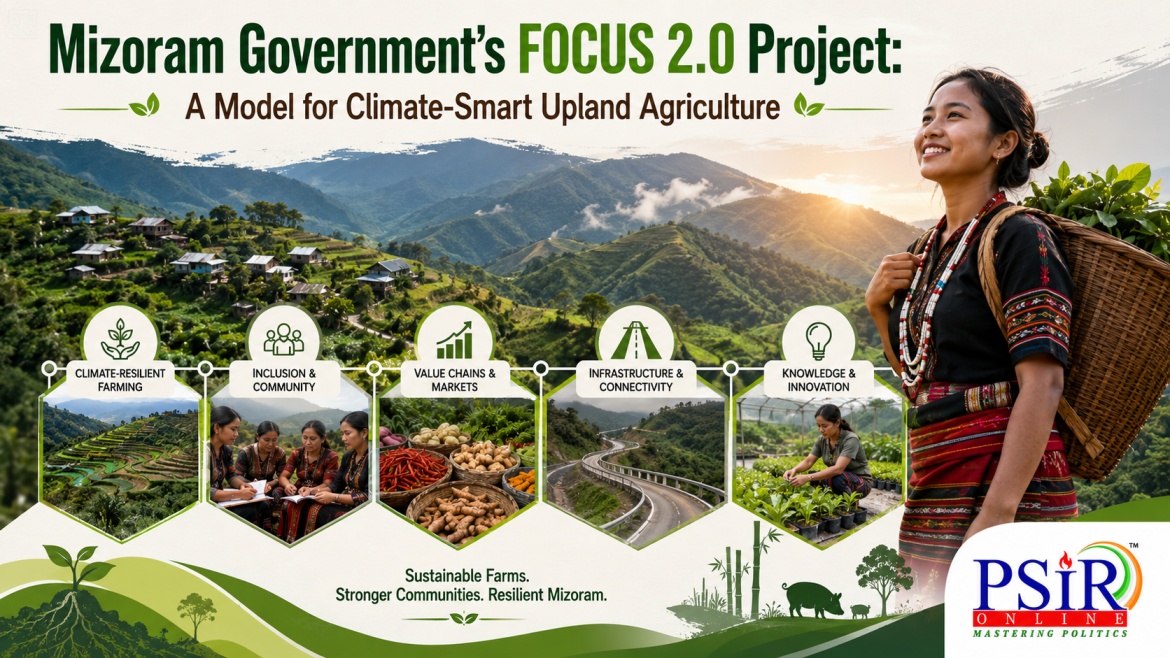
FOCUS 2.0 (Fostering Climate Resilient Upland Farming Systems in the Northeast) is a major follow-on agricultural development project in Mizoram, India. On 9 April 2026, the Government of Mizoram (through the Government of India) signed a US$45.78 million (≈ ₹380 crore) financing agreement with the International Fund for Agricultural Development (IFAD).
BACKGROUND AND PHASE 1 SUCCESS
The original FOCUS project (Phase 1, 2018–2024) operated in 6 districts of Mizoram (and also Nagaland). It targeted smallholder farmers practicing traditional jhum (shifting cultivation), which has become unsustainable due to shorter fallow cycles, leading to soil degradation, lower yields, and vulnerability to climate change.
Key achievements in Phase 1:
· Participating households saw a 43% increase in income through integrated farming systems.
· Combined climate-smart agriculture, livestock support, and better market access.
· Supported settled agriculture, improved jhum practices, value chains (e.g., spices like chilli, ginger, turmeric), and infrastructure.
FOCUS 2.0: SCALE AND OBJECTIVES
FOCUS 2.0 scales up the successful models from Phase 1 and expands statewide.
Timeline and Coverage:
· Period: 2026–2032 (6 years).
· Coverage: All 11 districts of Mizoram (expanded from 6), targeting ~700 villages.
· Beneficiaries: Around 150,000 people (or ~75,000 households, including landless families).
Main Goals:
· Increase incomes and shift from subsistence jhum farming to market-oriented, climate-resilient production.
· Enhance resilience to climate risks (extreme weather, soil degradation).
· Strengthen value chains, markets, and rural enterprises.
· Align with Mizoram’s Bana Kaih policy (self-reliance and sustainable livelihoods) and India’s national priorities for inclusive, climate-smart growth.
Key Components
The project strengthens both production and market ecosystems:
· Climate-Resilient Farming: Promote sustainable practices, settled agriculture (instead of shifting cultivation), soil/water conservation, agroforestry, improved seeds, and diversification (crops + livestock, e.g., pigs).
· Value Chains & Markets: Support Farmer Producer Organizations (FPOs), self-help groups, aggregation/processing centres, storage, and linkages to agribusinesses and formal markets. Focus on high-value crops like spices, fruits, and bamboo.
· Infrastructure: Climate-resilient market infrastructure, link roads, and facilities that withstand extreme weather.
· Inclusion & Capacity Building: Financial/digital inclusion, support for small/medium agribusinesses, training, and special focus on poorer/landless households.
· Knowledge & Management: Institutional strengthening, monitoring, and learning (building on Phase 1 collaboration with ICAR, FAO, etc.).
WHY IT MATTERS FOR MIZORAM
Mizoram’s agriculture faces deep structural and environmental challenges, making projects like FOCUS 2.0 particularly transformative for the state’s rural economy, food security, and long-term sustainability.
1. Hilly and Fragile Terrain
Mizoram is one of India’s most mountainous states — over 97% of its area consists of steep, rugged hills with precipitous slopes. This topography makes large-scale mechanized farming nearly impossible. Landholdings are typically very small and fragmented, often scattered across slopes, which limits productivity and increases the cost of farming. Soil erosion is a constant risk on these slopes, especially during heavy monsoon rains.
2. Heavy Dependence on Rain-fed and Jhum (Shifting Cultivation) Farming
· Agriculture in Mizoram is almost entirely rain-fed (very limited irrigation infrastructure). Any irregularity in rainfall — delayed monsoons, droughts, or excessive rain — directly hits crop yields.
· Jhum (slash-and-burn) remains the dominant traditional system for many tribal communities. Farmers clear forest patches, cultivate for 1–2 years, then abandon the land for long fallow periods to restore fertility.
· Due to population pressure and land scarcity, jhum cycles have shortened dramatically (from 15–20 years to as little as 3–5 years). This leads to:
o Rapid soil nutrient depletion and erosion.
o Lower yields and declining productivity of staple crops (paddy, chilli, ginger, etc.).
o Increased vulnerability to pests and invasive species.
Studies show clear signs of climate change impacts already hitting jhum farmers: erratic rainfall, rising temperatures, crop failures, and higher pest incidence.
3. High Climate Vulnerability
Mizoram ranks among the most climate-vulnerable regions in India. Farmers (especially small and marginal jhumias) have limited adaptive capacity due to:
· Poor education and resources.
· Sole dependence on agriculture for livelihood.
· Exposure to natural hazards like landslides, flash floods, and droughts.
This vulnerability threatens not just individual households but the state’s overall food security.
4. Underdeveloped Markets and Low Incomes
· Most farming is subsistence-oriented, with limited surplus for sale.
· Weak value chains, poor storage/processing facilities, and difficult market access (due to hilly roads) mean farmers get low prices for their produce.
· Rural youth often migrate or seek non-farm jobs because traditional farming offers low, unstable income. Only a small percentage of young people show interest in continuing agriculture without modernization.
How FOCUS 2.0 Addresses These Holistically
FOCUS 2.0 is designed as a comprehensive response to these interconnected problems:
· Shifts toward settled, climate-resilient farming — Promoting agroforestry, improved soil & water conservation, better seeds/varieties, and integrated systems (crops + livestock like pigs) to reduce reliance on destructive short-cycle jhum.
· Boosts productivity and incomes — Phase 1 already delivered 43% higher income for participants. Phase 2 scales this up to ~75,000 households across all 11 districts.
· Builds market linkages — Strengthens Farmer Producer Organizations (FPOs), value addition (processing spices, fruits, bamboo), storage, and connections to formal markets — moving from subsistence to market-oriented production.
· Creates rural jobs and entrepreneurship — Supports small/medium agribusinesses, youth involvement, women’s groups, and landless families.
· Enhances resilience — Climate-smart practices, infrastructure that withstands extreme weather, and better risk management help farmers cope with changing rainfall and temperature patterns.
· Environmental sustainability — Reduces forest loss from jhum, conserves biodiversity, and promotes long-term ecological balance.
In essence, FOCUS 2.0 supports Mizoram’s Bana Kaih (self-reliance) vision by making upland farming more productive, profitable, and climate-proof. It helps stabilize rural livelihoods for ~150,000 people, reduces poverty, curbs distress migration, and contributes to the state’s food and ecological security in a highly vulnerable region. Without such interventions, continuing with unsustainable practices would deepen poverty, environmental degradation, and climate risks.
POTENTIAL CHALLENGES FOR FOCUS 2.0 IN MIZORAM (AND LESSONS FROM PHASE 1)
FOCUS 2.0 is an ambitious scale-up, but like any large rural development project in a challenging hilly region, it faces several risks. The overall project risk is rated moderate by IFAD, with financial management and procurement rated as substantial. Here are the main potential challenges:
1. Implementation and Institutional Capacity
· Staff shortages and high turnover: Frequent vacancies in key positions (MIS, accounts, field staff) slowed Phase 1. FOCUS 2.0 needs a leaner but stronger structure with district-level capacity.
· Decentralized execution across 11 districts: Coordinating with multiple line departments, village councils, and ~700 villages risks delays in remote areas.
· Project management overload: Scaling from 6 to all 11 districts while managing convergence with other schemes.
2. Financial Management and Fund Flow Issues
· Delays in counterpart funding: Phase 1 saw slow release of state funds, low disbursement, and pre-financing burdens on the government. Partial cancellations occurred due to absorptive capacity limits.
· Procurement delays: Substantial risk due to limited qualified staff, complex processes, and compliance with IFAD rules in a state with unique geography.
· Audit and reporting: Timely audits, reconciliations, and use of tools like Tally software remain concerns.
3. Transition from Jhum (Shifting Cultivation)
· Cultural and livelihood resistance: Farmers may be reluctant to fully shift from traditional practices, especially if settled alternatives (terracing, agroforestry) take time to show results or require new skills.
· Land tenure issues: Small/fragmented holdings and customary land systems complicate secure tenure for landless households and long-term investments.
· Risk of incomplete transition: Shortened cycles continue to cause soil degradation if adoption is uneven.
4. Climate and Environmental Risks
· High vulnerability: Erratic rainfall, landslides, floods, droughts, and rising temperatures can damage crops, infrastructure, and livestock.
· Biodiversity and ecosystem impacts: Poorly managed intensification or livestock scaling could affect forests and indigenous species.
· Infrastructure durability: Market facilities, roads, and water systems must withstand extreme weather.
5. Market and Economic Challenges
· Weak value chains: Remote locations, poor connectivity, and limited processing/storage make it hard to achieve consistent market access and fair prices.
· Price volatility and buyer linkages: Dependence on high-value crops/spices/livestock risks market fluctuations.
· Post-harvest losses: Common in hilly areas without adequate infrastructure.
6. Social and Inclusion Risks
· Reaching the most vulnerable: Landless, women, youth, and poorer households need targeted support to avoid elite capture.
· Community buy-in: Ensuring free, prior, and informed consent (FPIC) and grievance redress across diverse tribal communities.
· Migration and youth disinterest: Retaining young people in agriculture despite better opportunities elsewhere.
7. External and Contextual Factors
· Geographical isolation: Hilly terrain increases costs and logistics challenges for inputs, extension services, and monitoring.
· Convergence complexities: Aligning with state Bana Kaih policy and multiple central schemes without duplication or gaps.
· Political/administrative changes: Elections, staff transfers, or policy shifts can disrupt momentum.
· Monitoring & Evaluation gaps: Real-time data collection in remote areas and attribution of impacts (income, resilience) can be difficult.
Mitigation Measures Built into FOCUS 2.0
· Stronger institutional setup (senior leadership, convergence officers, business promotion specialists).
· Cluster-based (zau) approach for economies of scale.
· Enhanced training, incubation support, and private sector/FI linkages.
· Robust safeguards, grievance mechanisms, and climate-smart designs.
· Lessons from Phase 1 (e.g., land agreements, market-led systems, livestock integration) are explicitly incorporated
CONCLUSION
FOCUS 2.0 represents a well-designed and timely intervention to transform Mizoram’s upland agriculture from vulnerable, low-productive jhum systems into climate-resilient, market-oriented farming. Building on the strong results of Phase 1, the project has the potential to significantly raise incomes for ~75,000 households, reduce environmental degradation, and strengthen rural livelihoods across all 11 districts.
While challenges related to implementation capacity, fund flow, and market linkages remain, the integrated approach and lessons from the pilot phase provide a solid foundation for success.
If effectively executed, FOCUS 2.0 can emerge as a replicable model for other hilly and tribal regions of India, demonstrating that sustainable development in fragile ecosystems is both achievable and impactful.
PRACTICE QUESTIONS FOR GS 2 MAINS
1. “FOCUS 2.0 represents a shift from subsistence-oriented jhum cultivation to climate-resilient market agriculture in Mizoram.” Examine the significance of the project in addressing the environmental and socio-economic challenges of Northeast India. (15 Marks)
2. Discuss the structural and climatic vulnerabilities of Mizoram’s agricultural economy. How does the FOCUS 2.0 project seek to balance ecological sustainability with livelihood security? (15 Marks)
3. Critically analyze the role of climate-smart agriculture and value-chain integration in transforming rural economies in hilly and tribal regions. Illustrate your answer with the example of Mizoram’s FOCUS 2.0 initiative. (20 Marks)
4. Large-scale rural development projects often face challenges of implementation, inclusion, and sustainability. Evaluate the potential challenges before FOCUS 2.0 and suggest measures to ensure its success as a replicable model for other tribal regions of India. (20 Marks)