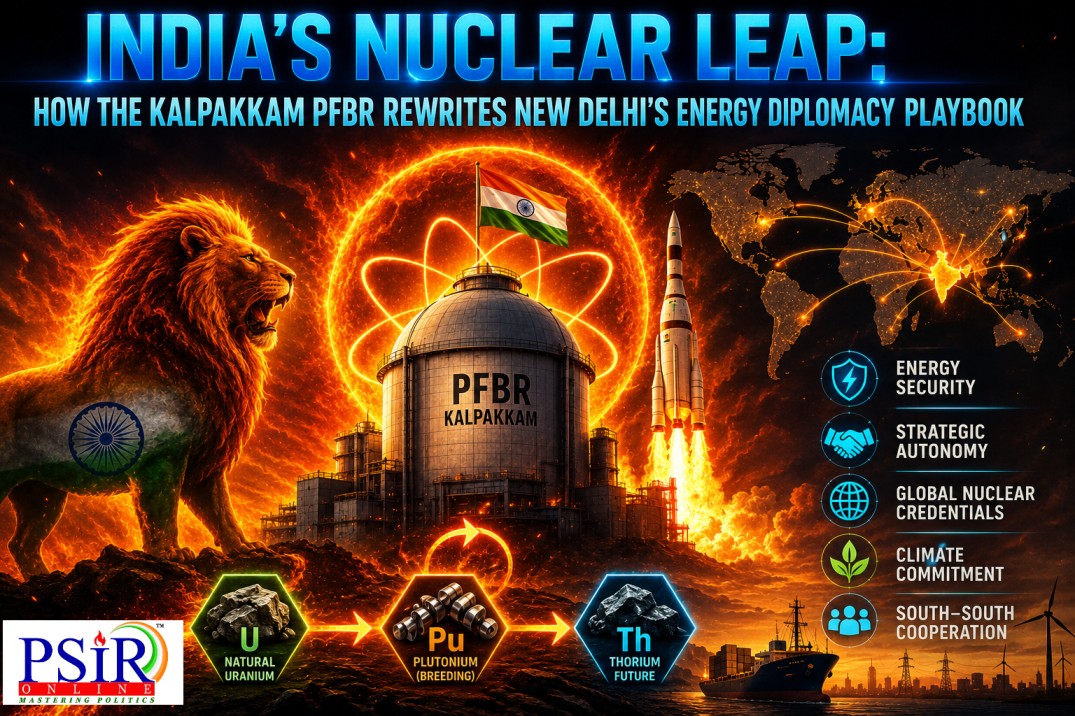
On 6 April 2026, at 20:25 IST (often reported as around 20:26 hrs), inside the shielded confines of the Kalpakkam Nuclear Complex in Tamil Nadu, India crossed a quiet but historic threshold. The indigenously designed 500 MWe Prototype Fast Breeder Reactor (PFBR) attained first criticality — the point at which a self-sustaining nuclear chain reaction begins. Prime Minister Narendra Modi promptly hailed the moment on social media: “The indigenously designed and built Prototype Fast Breeder Reactor at Kalpakkam has attained criticality. This advanced reactor, capable of producing more fuel than it consumes, reflects the depth of our scientific capability and the strength of our engineering enterprise. It is a decisive step towards harnessing our vast thorium reserves in the third stage of the programme. A proud moment for India.”
This was not merely a technical success after decades of delays. It marked India’s formal entry into the second stage of its unique three-stage nuclear programme. In the realm of energy diplomacy, it signals a fundamental shift in India’s leverage, autonomy, and bargaining power on the global stage.
|
First Criticality is a major milestone in the life of any nuclear reactor. It marks the exact moment when the reactor achieves a self-sustaining nuclear chain reaction for the first time.
Simple Explanation: Imagine building a nuclear reactor. You load the fuel, insert control rods, and gradually remove the control rods (or adjust other parameters) while monitoring neutron levels. At a certain point, the number of neutrons produced by fission equals the number lost or absorbed — the reactor becomes critical. The chain reaction sustains itself without needing an external neutron source. · Sub-critical: Chain reaction dies out. · Critical: Chain reaction is exactly self-sustaining (steady power level). · Super-critical: Chain reaction grows (power level increases). First Criticality = The very first time the reactor reaches this “critical” state during its commissioning.
Why It Matters (Especially for PFBR): · It proves the core design, fuel, control systems, and safety mechanisms all work together as intended. · It is the transition from a “machine” to a functioning nuclear reactor. · For the Prototype Fast Breeder Reactor (PFBR) at Kalpakkam on 6 April 2026, this meant India successfully entered Stage II of its nuclear programme. · After first criticality, engineers gradually raise power in controlled steps, conduct extensive tests, and only then connect the reactor to the electricity grid (usually months later).
Key Technical Points:
|
BHABHA’S VISION AND STAGE II BREAKTHROUGH
Dr. Homi J. Bhabha conceived India’s three-stage nuclear programme in the 1950s to achieve long-term energy independence, leveraging the country’s modest uranium reserves and abundant thorium (roughly 25% of global deposits).
· Stage I relies on Pressurised Heavy Water Reactors (PHWRs) using natural uranium, producing plutonium-239 as a byproduct.
· Stage II deploys Fast Breeder Reactors (FBRs) like the PFBR, which use plutonium-uranium mixed oxide (MOX) fuel and a uranium-238 blanket to “breed” more fissile plutonium than they consume. The reactor also paves the way for converting thorium-232 into uranium-233.
· Stage III will feature thorium-based reactors for near self-sufficiency.
The PFBR’s criticality makes India only the second country after Russia to operate a commercial-scale fast breeder reactor. It validates decades of indigenous effort by the Department of Atomic Energy (DAE), Bharatiya Nabhikiya Vidyut Nigam Ltd (BHAVINI), and the Indira Gandhi Centre for Atomic Research (IGCAR).
CORE FOREIGN POLICY IMPLICATIONS
1. Enhanced Strategic Autonomy and Reduced Energy Dependence By breeding its own fuel and moving toward thorium utilisation, India diminishes long-term reliance on imported uranium from suppliers like Russia, Kazakhstan, Canada, and Australia. This “energy deterrence” strengthens New Delhi’s hand in volatile geopolitics, from the Middle East to sanctions-prone environments. Former Atomic Energy Commission Chairman Dr. Anil Kakodkar has long emphasised that this closed fuel cycle approach secures India’s future energy independence, especially as demand is projected to rise sharply for a developed India.
2. Strengthened Credentials in the Global Nuclear Order Despite remaining outside the NPT and NSG, India’s demonstrated mastery of fast breeder technology bolsters its claim as a responsible, advanced nuclear state. It differentiates India from many Western nations that abandoned breeder programmes due to technical, economic, or proliferation concerns. This success could accelerate advocacy for NSG membership and open doors for technology partnerships while reinforcing India’s impeccable non-proliferation record.
3. Evolution of Civil Nuclear Diplomacy The milestone shifts India from a technology recipient to a more equal partner (and potential future exporter). Deals with the US (under the 123 Agreement and Quad framework), France, Russia, Japan, and Australia gain new dynamics. India needs less “fuel security” assurances and can negotiate from greater strength. In the long term, thorium expertise could become a tool of South-South cooperation, offering the Global South an alternative to dominant SMR or traditional reactor models.
4. Climate Diplomacy Leverage As India pursues net-zero by 2070, the PFBR provides a firm baseload, non-weather-dependent decarbonisation pathway. In COP negotiations, G20 forums, and bilateral talks, New Delhi can credibly resist unrealistic timelines for phasing out coal, pointing to its indigenous, scalable nuclear route. This aligns domestic energy security with international climate commitments.
5. Geopolitical Signalling Amid Great-Power Competition In the Indo-Pacific context, operational fast breeder capability quietly underscores technological resilience and depth — countering narratives of lag while complementing initiatives like the Quad. It positions India as a pole in the multipolar energy landscape, alongside (but distinct from) China’s own breeder efforts.
BROADER IMPLICATIONS FOR GLOBAL NUCLEAR ORDER AND ENERGY GEOPOLITICS
The PFBR’s successful first criticality arrives at a pivotal moment when nations worldwide are confronting acute challenges: energy security amid geopolitical tensions, fragile supply chains for critical minerals and fuels, and mounting pressure to deliver reliable, dispatchable low-carbon power for net-zero targets. In this environment, India’s achievement stands out not merely as a national triumph but as a potential inflection point for the global nuclear landscape.
While countries like the United States, France, Japan, the United Kingdom, and Germany invested billions in fast breeder programmes decades ago, most largely abandoned or scaled them back. Reasons included technical hurdles (notably sodium coolant leaks and fires), prohibitive costs, public opposition, proliferation concerns linked to plutonium handling, and the unexpected abundance of cheap uranium that reduced the urgency for breeding more fuel. The U.S. alone spent roughly $15 billion (in adjusted terms) before cancelling major projects like Clinch River; Japan’s Monju reactor faced repeated setbacks and was eventually shuttered; France’s Superphénix operated at low capacity before closure. Collectively, Western nations poured nearly $50 billion into the technology with limited commercial success.
Russia remains the current leader, operating the BN-600 and BN-800 commercial fast reactors. China is actively advancing its programme with the CFR-600 demonstration reactor and plans for larger units. India’s entry into operational Stage II now positions it as only the second country after Russia with meaningful commercial-scale fast breeder capability. This elite status, achieved through persistent indigenous development rather than imported turnkey solutions, underscores the value of context-specific strategies tailored to resource endowments.
If India successfully scales the PFBR into a fleet of commercial fast breeders and transitions toward thorium utilisation in Stage III, the implications could ripple globally:
· Revival of Closed Fuel Cycles: Success would demonstrate that breeders can work reliably at scale in a developing-economy context, potentially rekindling interest in plutonium recycling and waste reduction. This challenges the once-dominant “once-through” uranium fuel cycle model and offers a pathway to extract far more energy from existing spent fuel stockpiles.
· Thorium as a Diversifier: With thorium reserves roughly four times more abundant globally than uranium — and India holding over 25% of known deposits — a proven thorium route could diversify the nuclear technology marketplace. It offers countries an alternative to dominant light-water and small modular reactor (SMR) models, particularly appealing for nations with thorium resources or seeking greater fuel-cycle independence. Renewed global R&D interest in thorium (visible in China, and historically in the US, Japan, and Europe) could gain fresh momentum.
· Energy Geopolitics and “Weaponised Interdependence”: In a world where energy supplies are increasingly politicised — from LNG disruptions to uranium export controls — India’s move toward a closed, largely self-sustaining cycle reduces vulnerabilities. It enhances New Delhi’s strategic autonomy while making it a more attractive, resilient partner for others. This could reshape civil nuclear diplomacy, positioning India as both a technology collaborator and, eventually, a potential exporter of breeder/thorium expertise to the Global South.
· India’s Rising Profile: By maintaining full sovereign control over its programme while upholding a strong non-proliferation record, India joins an exclusive club without compromising its strategic independence. This strengthens its credentials in forums like the IAEA, NSG discussions, and climate negotiations, portraying it as a responsible innovator rather than a mere consumer in the global nuclear order.
Overall, the PFBR milestone highlights a shift from a unipolar or Western-dominated nuclear technology ecosystem toward a more multipolar one. It validates long-term, patient investment in indigenous capabilities and could inspire other emerging powers facing similar resource and climate constraints. In an era demanding both energy abundance and security, India’s perseverance offers a compelling case study in turning resource realities into strategic advantage.
CONCLUSION: A NEW BARGAINING POSITION
The Kalpakkam milestone does more than advance Bhabha’s vision — it rewrites India’s energy diplomacy playbook. In future negotiations — whether for NSG entry, expanded civil nuclear deals, or climate finance — New Delhi arrives with demonstrable self-reliance and long-term fuel security. It cements India’s role as an indispensable pole in the emerging multipolar energy order: not just a consumer or partner, but a technology leader capable of shaping the rules of the game.
As Dr. Kakodkar and others have noted, the real work of scaling and parallel Stage III development lies ahead. Yet on 6 April 2026, India lit a beacon of strategic autonomy whose glow will be felt far beyond Tamil Nadu’s coast — in boardrooms, chancelleries, and negotiating tables worldwide.
PRACTICE QUESTIONS FOR GS 2 MAINS
1. “India’s transition towards a closed nuclear fuel cycle has implications beyond energy security.” Examine the strategic and diplomatic significance of the Prototype Fast Breeder Reactor (PFBR) for India’s foreign policy.
2. Discuss how India’s advancements in indigenous nuclear technology strengthen its claim for greater integration into the global nuclear order, despite remaining outside the Nuclear Non-Proliferation Treaty (NPT).
3. “Energy security is increasingly becoming a component of strategic autonomy.” Analyse this statement in the context of India’s three-stage nuclear programme and the Kalpakkam PFBR achievement.
4. Evaluate the role of nuclear energy in balancing India’s developmental imperatives with its climate commitments under global climate governance frameworks.
PRACTICE QUESTIONS FOR PSIR OPTIONAL
1. “Technological self-reliance is emerging as a major determinant of power in the contemporary international system.” Discuss with reference to India’s fast breeder reactor programme and evolving energy diplomacy.
2. Critically examine how India’s PFBR milestone reflects the changing nature of strategic autonomy in an era of weaponised interdependence and geoeconomic competition.
3. “Control over advanced energy technologies shapes the hierarchy of the international order.” Analyse this proposition in the context of global nuclear politics and India’s thorium strategy.
4. Discuss the implications of India’s entry into commercial-scale fast breeder reactor capability for the emerging multipolar global order and South-South technological cooperation.