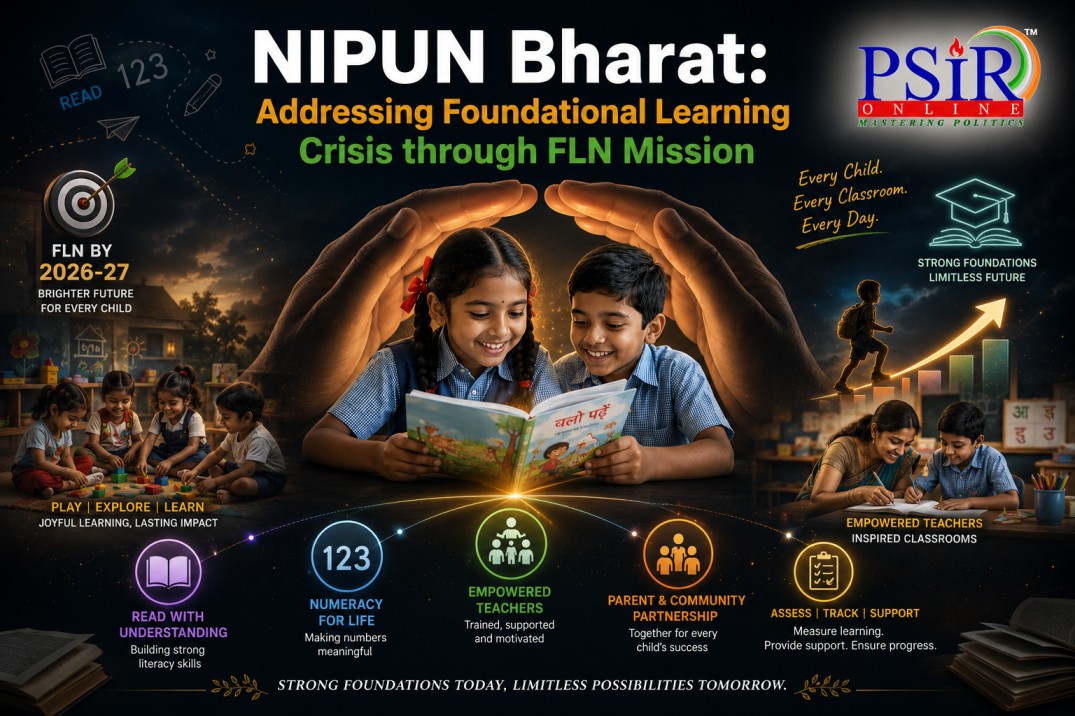
NIPUN Bharat (National Initiative for Proficiency in Reading with Understanding and Numeracy) is a national mission under the Ministry of Education to ensure that every child in India attains foundational literacy and numeracy (FLN) by the end of Class 3, targeted by the academic year 2026–27. It operationalizes a key mandate of the National Education Policy (NEP) 2020, which treats FLN as the “highest priority” of the schooling system.
It was launched on 5 July 2021 by the then Union Education Minister Ramesh Pokhriyal ‘Nishank’ and functions under the Centrally Sponsored Scheme of Samagra Shiksha.
VISION, TARGET GROUP AND OBJECTIVES
The mission’s vision is that all children in the age group of 3–9 years (Balvatika/pre‑school to Class 3) acquire the ability to read with understanding and to handle basic numeracy tasks so that they can progress meaningfully in later classes. NEP 2020 explicitly warns that the rest of school reforms will be “irrelevant” if children do not first achieve these basic skills at the foundational stage.
Key objectives include:
· Ensuring that every child by the end of Grade 3 can read age‑appropriate text with comprehension, write meaningfully, and perform basic mathematical operations (addition, subtraction, etc.).
· Making foundational learning universal by 2026–27 so that “no child is left behind” in terms of basic reading and numeracy.
WHY NIPUN BHARAT WAS NEEDED?
Multiple learning surveys and ASER‑type studies have consistently shown that a significant share of children in higher grades cannot read a simple text of lower grades or solve basic arithmetic, indicating large “learning deficits.” NEP 2020 therefore treats FLN as an emergency–level national priority and recommends a dedicated mission to address this.
Without strong foundations, children accumulate learning gaps year after year, leading to low achievement, dropouts, and inefficiency of the education system. NIPUN Bharat attempts to fix the problem at the root by focusing on early‑grade competencies instead of only syllabus completion.
KEY FEATURES AND DESIGN
1. FLN Lakshyas (Targets)
A distinctive feature is the formulation of explicit “Lakshya Soochi” – grade‑wise, stage‑wise targets for foundational literacy and numeracy from Balvatika to Grade 3. These targets are based on NCERT learning outcomes and international research and specify, for example, expected reading speed (like approximate words per minute with comprehension) by the end of Grade 2 and 3.
These Lakshyas serve as concrete benchmarks for teachers, parents and administrators to know what “proficiency” means at each stage, instead of vague notions of learning.
2. Pedagogical Approach
· Emphasis on play‑based, activity‑based and discovery‑based learning rather than rote memorization, especially in pre‑school and early primary.
· Use of the child’s mother tongue or home language as the primary medium of instruction in early years, in line with NEP 2020, to improve comprehension and participation.
· Focus on holistic development – physical, socio‑emotional, cognitive and language skills – rather than only decoding text and numbers.
The mission connects literacy and numeracy tasks to children’s everyday contexts (local stories, markets, games) so that learning is meaningful and not abstract.
IMPLEMENTATION FRAMEWORK AND INSTITUTIONAL MECHANISM
NIPUN Bharat operates as a mission under the Department of School Education and Literacy, supported through Samagra Shiksha. Mission implementation structures are envisaged at national, state, district and block levels to plan, coordinate, and monitor FLN interventions.
States and UTs are expected to prepare their own FLN mission implementation plans, aligned with national guidelines but contextualized to local language, culture and administrative realities. The guidelines outline roles and responsibilities of various stakeholders, including SCERTs, DIETs, BRCs, CRCs, head teachers and school management committees.
Major Components and Strategies
1. Curriculum, Teaching‑Learning Material and Jaadui Pitara
· Development of age‑appropriate, competency‑based FLN curriculum and learning outcomes for Balvatika to Grade 3, aligned with NEP 2020.
· Creation of high‑quality teaching‑learning materials (TLMs), including workbooks, storybooks, big books, flashcards, and digital resources.
· Introduction of “Jaadui Pitara” – a play‑based learning kit with toys, games, puzzles and other materials designed for the 3–8 age group to support experiential and joyful learning.
These materials are meant to replace text‑heavy, formal classroom practices with interactive and multi‑sensory experiences.
2. Teacher Training and Capacity Building
· Large‑scale professional development of teachers, head teachers and academic resource persons on FLN pedagogy, child psychology, and formative assessment.
· Use of blended modes – in‑service training, on‑site support, mentoring, and digital platforms – to continuously upgrade teacher skills.
Teachers are expected not only to deliver content, but to diagnose learning gaps early, provide remediation, and create a supportive classroom environment.
3. Assessment and Tracking of Learning
· Mission guidelines emphasize periodic, competency‑based assessments to track each child’s progress against FLN Lakshyas instead of relying solely on annual exams.
· Use of classroom‑based formative assessments, school‑based and system‑level surveys to identify children who need additional support.
The aim is to shift from “pass–fail” to “measure and support learning,” making learning outcomes visible and actionable for teachers and administrators.
4. Parental and Community Involvement
· The mission explicitly highlights the role of parents, community members, volunteers and local bodies in supporting reading and numeracy at home.
· Activities like reading campaigns, community libraries, and awareness drives are encouraged so that FLN is seen as a shared social responsibility, not just a school responsibility.
This aligns with evidence that home learning environments strongly influence early literacy and numeracy outcomes.
DEVELOPMENTAL GOALS AND CHILD OUTCOMES
NIPUN Bharat links its FLN efforts to three broad developmental goals for young children:
1. Children maintain good health and well‑being.
2. Children become effective communicators.
3. Children become involved learners and connect with their environment.
Foundational literacy and numeracy are thus embedded within a wider early childhood care and education (ECCE) paradigm, not treated as narrow academic drills.
RELATIONSHIP WITH NEP 2020 AND OTHER SCHEMES
NIPUN Bharat concretizes NEP 2020’s recommendation for a national mission on FLN and supports the restructuring of school education into the 5+3+3+4 curricular and pedagogical model. It dovetails with Samagra Shiksha by channeling resources for early grades, including teacher positions, TLM, and training.
KEY CHALLENGES IN NIPUN BHARAT
1. Intent–implementation gap at ground level
· While FLN Lakshyas and guidelines are clear, many districts and schools struggle to translate them into day‑to‑day classroom practice due to weak local planning and monitoring.
· Mission structures exist on paper, but capacity at block/cluster level (BRCs, CRCs, DIETs) is often limited, leading to uneven implementation across states and districts.
2. Inadequate teacher capacity and overload
· Many teachers have not been fully oriented to competency‑based, play‑based FLN pedagogy and formative assessment; training is often one‑off, generic, or overly online.
· Teachers already handle multi‑grade classrooms, administrative work, and non‑teaching duties, leaving limited time for individualised support to children lagging in FLN skills.
3. Infrastructure and resource constraints
· In many schools, especially in rural and socio‑economically backward areas, classrooms are overcrowded, and there is shortage of age‑appropriate TLMs, libraries, and digital devices.
· Regular supply, maintenance and effective use of kits like Jaadui Pitara or digital content are uneven due to budget, logistics, and electricity/connectivity issues.
4. Socio‑economic and language barriers
· Children from marginalised communities often enter school without adequate school‑readiness (pre‑literacy, pre‑numeracy, language exposure), making FLN targets harder to achieve on time.
· Multilingual classrooms pose challenges where the home language differs from the school language, and teachers are not trained or supported in multilingual pedagogy.
5. Assessment quality and data use issues
· There is a risk of reducing FLN assessment to mechanical testing instead of rich, classroom‑based formative assessment; teachers may see it as an additional exam burden.
· Data from assessments and monitoring is not always used effectively at district or school level to redesign strategies, target support, or provide timely remediation.
6. Limited focus beyond Grade 3 and continuity
· Early gains in FLN sometimes do not translate into sustained improvements in higher grades; students may struggle with advanced concepts once they leave the “mission radar.”
· Support for Grades 3–5 is often inadequate, risking relapse of gains if pedagogy in upper primary remains traditional and textbook‑centric.
MITIGATION STRATEGIES (POLICY AND IMPLEMENTATION)
1. Strengthening decentralised planning and governance
· Districts are increasingly being treated as the core units of change, with dedicated district‑level PMUs and data‑driven planning to close implementation gaps between policy and classrooms.
· Regular review meetings, supportive monitoring, and convergence with other schemes (Samagra Shiksha, RTE norms, ECCE/ICDS) can make FLN a central agenda in district education planning.
2. Deep, continuous teacher capacity building
· Programmes like NISHTHA (FLN‑focused) are being used to train teachers in competency‑based education, play‑based pedagogy, and formative assessment, including via online and blended modes.
· For mitigation, answer can recommend: school‑based mentoring, peer learning circles, demonstration classrooms, and reducing non‑teaching burdens so teachers can focus on early‑grade instruction.
3. Ensuring adequate and appropriate learning resources
· Guidelines emphasise age‑appropriate TLMs, Jaadui Pitara, storybooks and digital resources; some states are investing in classroom libraries, low‑cost manipulatives and bilingual content.
· Mitigation requires ring‑fenced FLN funding within Samagra Shiksha, timely procurement and replenishment of materials, and training teachers to use these resources effectively instead of locking them in cupboards.
4. Targeted support for disadvantaged children and multilingual contexts
· Evidence and recent analyses stress the need to invest more in Early Childhood Education (ECE) and school‑readiness programmes (e.g., Vidya Pravesh‑type modules) to reduce initial gaps.
· Mitigation should include: community‑based pre‑school activities, mother‑tongue based instruction, bridge courses, and flexible, local language‑rich materials.
5. Improving assessment practices and data use
· The mission already promotes competency‑based, low‑stakes assessments, but the quality of tools and teacher support is crucial.
· Mitigation: capacitate teachers to design and interpret simple formative assessments, create user‑friendly dashboards at district/block level, and link data to targeted academic support instead of punitive ranking.
6. Extending FLN support beyond Grade 3
· Experts argue that extending structured FLN support up to Grade 5 and maintaining focus till at least 2030 is essential for sustained impact.
· Mitigation: align upper‑primary curricula and pedagogy with FLN principles (conceptual understanding, applications, language‑rich classrooms) so that foundational gains are reinforced through higher grades.
7. Community engagement and parental awareness
· NIPUN already envisages reading campaigns and community participation; several studies recommend deeper involvement of parents via simple home‑based FLN activities.
· Mitigation: structured parent orientation, local reading melas, community volunteers, and partnerships with NGOs/CSOs to support children outside school hours.
CONCLUSION
NIPUN Bharat represents a decisive shift in India’s school education paradigm from input‑based expansion to outcome‑oriented foundational learning, aligning closely with the spirit of NEP 2020. By prioritising reading with understanding and basic numeracy in the early years, it seeks to break the vicious cycle of cumulative learning deficits that have long plagued the system.
However, its success will ultimately depend on how effectively intent translates into practice in overcrowded, resource‑constrained classrooms, especially for children from disadvantaged backgrounds. Strengthening teacher capacity, ensuring sustained financing for FLN, deepening community engagement and building robust, child‑friendly assessment systems are crucial to realise its ambitious 2026–27 targets.
If these challenges are systematically addressed, NIPUN Bharat can become a foundational pillar for India’s long‑term human capital development, turning the present learning crisis into an opportunity for transformative reform.
PRACTICE QUESTIONS FOR GS 2 MAINS
1. “Foundational Literacy and Numeracy (FLN) is the indispensable basis for achieving the broader goals of the National Education Policy (NEP) 2020.” Examine the role of NIPUN Bharat Mission in addressing India’s foundational learning crisis. (15 Marks)
2. Critically analyse the major implementation challenges faced by NIPUN Bharat in achieving universal foundational literacy and numeracy by 2026–27. Suggest suitable measures to improve its effectiveness. (15 Marks)
3. “India’s learning crisis is rooted not merely in school access, but in the absence of foundational competencies during early childhood.” Discuss in the context of NIPUN Bharat and the evolving approach towards competency-based education in India. (20 Marks)
4. How can community participation, mother-tongue instruction, and technology-enabled assessments strengthen the outcomes of NIPUN Bharat Mission? Explain with suitable examples. (10 Marks)