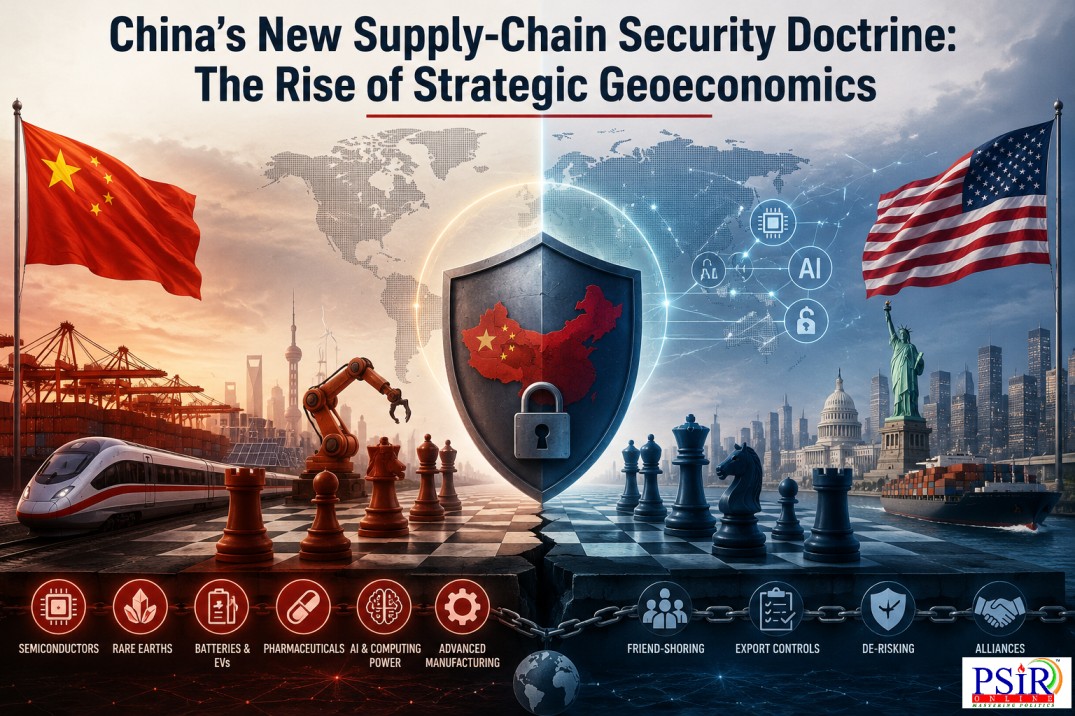
In April 2026, China took a landmark step in reshaping its economic strategy by formally institutionalizing the “Supply-Chain Security Doctrine” through State Council Order No. 834—the Provisions on Industrial and Supply Chain Security. This comprehensive administrative regulation, effective immediately upon promulgation, marks a decisive pivot from the market-driven globalization of previous decades toward a state-directed model of techno-economic security. No longer viewing supply chains as purely commercial networks optimized for efficiency and cost, Beijing now treats them as strategic assets integral to national security, geopolitical leverage, and great-power competition. The doctrine elevates industrial and supply-chain resilience to a core pillar of national sovereignty, intertwining economics, technology, and security in unprecedented ways.
BACKGROUND: BEIJING’S DEEPENING FEAR OF EXTERNAL VULNERABILITY
China’s new doctrine did not emerge in isolation. It is the culmination of years of perceived external pressures that exposed the risks of over-reliance on Western-dominated global systems.
· US-China Trade War and Technological Containment (2018 onward): Tariffs on hundreds of billions of dollars in Chinese exports, export controls on advanced semiconductors, sanctions on major firms like Huawei, and restrictions on AI chips and other dual-use technologies.
· Weaponization of Finance and Global Systems: Exclusion from SWIFT-like mechanisms or similar financial infrastructures in extreme scenarios, alongside efforts by Western allies to “de-risk” critical manufacturing dependencies.
· Lessons from the Russia-Ukraine Conflict: The war demonstrated how sanctions could rapidly disrupt finance, trade, logistics, energy, and technology flows, turning economic interdependence into a tool of coercion.
· Broader Disruptions: Global events like the COVID-19 pandemic further highlighted supply-chain fragility, reinforcing Beijing’s conviction that excessive openness creates strategic vulnerabilities.
These developments convinced Chinese policymakers that interdependence with the West is no longer a mutual benefit but a potential liability in an era of intensifying great-power rivalry.
CORE ELEMENTS OF THE 2026 SUPPLY-CHAIN SECURITY DOCTRINE
The doctrine aims to build secure, controllable, and resilient supply chains through a whole-of-government framework. It establishes coordinated mechanisms involving central and local authorities, dynamic monitoring of risks, emergency response systems, and targeted countermeasures against foreign discriminatory actions.
Key objectives include:
· Reducing dependence on foreign (especially Western) technologies and chokepoints.
· Enhancing domestic control over critical nodes in global networks.
· Strengthening overall industrial autonomy while maintaining selective international engagement.
Priority Sectors (explicitly targeted for heightened protection and self-reliance):
· Semiconductors and advanced electronics
· Rare earth minerals and critical raw materials
· Batteries, electric vehicles, and green energy technologies
· Pharmaceuticals and active pharmaceutical ingredients (APIs)
· Artificial intelligence infrastructure and computing power
· Telecommunications equipment and next-generation networks
· Shipping, maritime logistics, and global transport chains
· Advanced manufacturing and high-tech equipment
The regulation also introduces a “key sector list” that will be periodically updated, along with provisions for investigations and retaliation against entities whose actions harm China’s supply-chain interests.
TECHNO-ECONOMIC NATIONALISM: REDEFINING ECONOMIC STATECRAFT
At its heart, the doctrine embodies techno-economic nationalism—a paradigm that treats economic and technological capacity as instruments of national power rather than neutral market outcomes. This contrasts sharply with classical globalization, which assumed free trade and interdependence would inherently promote peace and prosperity.
Beijing’s toolkit includes:
· Massive state subsidies and strategic investment funds
· Export controls on critical materials (e.g., rare earths, gallium, germanium)
· Industrial planning mandates for localization and “dual circulation” (emphasizing domestic markets while selectively engaging global ones)
· Diplomatic partnerships and talent recruitment programs
· Legal mechanisms for data security, technology transfer restrictions, and countermeasures
This approach institutionalizes economic security as an extension of national sovereignty, building on earlier initiatives like Made in China 2025 while adapting to the current geopolitical environment.
STRATEGIC DECOUPLING AND PARALLEL TECHNOLOGICAL ECOSYSTEMS
A primary implication is the acceleration of selective decoupling between China and the United States. Rather than full economic separation, both powers are constructing parallel ecosystems in sensitive domains.
· The US advances “friend-shoring,” “de-risking,” and alliances to secure supply chains among trusted partners.
· China doubles down on “self-reliance” (zìlì gēngshēng) and dual circulation.
Critical sectors affected include semiconductors, AI, telecommunications, biotechnology, clean energy, and advanced manufacturing. The result: a gradual bifurcation of the global economy into competing technological and industrial blocs, with ripple effects on standards, investment flows, and innovation.
THE WEAPONIZATION OF INTERDEPENDENCE
The doctrine underscores a concept articulated by political economists Henry Farrell and Abraham Newman: the weaponization of interdependence. In a hyper-connected world, control over key network nodes grants leverage for geopolitical coercion.
· US leverage: Dominance in the dollar-based financial system, advanced semiconductor manufacturing, and alliance-based export controls.
· Chinese leverage: Dominance in rare earth processing, battery supply chains, manufacturing scale, and market access for foreign firms.
Interdependence, once seen as a stabilizing force, is increasingly viewed as a domain of strategic competition and potential coercion.
OPPORTUNITIES AND RISKS FOR DEVELOPING COUNTRIES
This shift creates a complex landscape for the Global South.
Opportunities:
· Supply-chain diversification away from China creates new manufacturing destinations.
· Countries like Vietnam, Indonesia, India, and Mexico stand to attract foreign direct investment (FDI) and technology transfers.
Risks:
· Pressure to “choose sides” between US-led and China-led economic ecosystems.
· Fragmentation of global trade, reduced efficiency, and higher costs for smaller economies.
· Potential loss of neutral trading status in a bloc-based world.
India’s Strategic Calculus India occupies a particularly nuanced position. On one hand, New Delhi is aggressively courting global manufacturers through Production Linked Incentive (PLI) schemes, semiconductor missions, and infrastructure upgrades. On the other, it remains heavily dependent on Chinese imports in electronics, solar panels, APIs, and industrial machinery. China’s doctrine may intensify regional competition for supply-chain dominance while simultaneously pushing India to accelerate its own “China+1” and Atmanirbhar Bharat (self-reliant India) policies.
RESHAPING THE INDO-PACIFIC AND GLOBAL ALLIANCES
Supply-chain security is now central to great-power diplomacy in the Indo-Pacific. Alliances and frameworks such as the Quad (US, India, Japan, Australia), the Indo-Pacific Economic Framework (IPEF), and EU Indo-Pacific strategies increasingly focus on:
· Securing critical minerals and maritime trade routes
· Building resilient digital infrastructure
· Coordinating standards for emerging technologies
Economic statecraft—subsidies, investment screening, export controls, and supply-chain diplomacy—has become the primary theater of rivalry, often eclipsing traditional military competition.
FROM GLOBALIZATION TO GEOECONOMICS
China’s Supply-Chain Security Doctrine symbolizes a broader global transition from an era of efficiency-driven globalization to one defined by geoeconomics. Economic networks are now evaluated not only by profitability and speed but also by resilience, sovereignty, and strategic autonomy.
The central question for the coming decade is clear:
· Can the international community preserve elements of cooperative globalization amid intensifying strategic rivalry?
· Or will supply chains themselves become the new frontlines of geopolitical conflict?
The answer will shape trade patterns, technological progress, and international stability for generations to come.
PRACTICE QUESTIONS FOR GS 2 MAINS
1. “The weaponization of economic interdependence is transforming globalisation into geoeconomics.” Examine in the context of China’s 2026 Supply-Chain Security Doctrine.
2. Discuss how strategic decoupling between the United States and China is reshaping the Indo-Pacific economic and security architecture.
3. “Supply-chain resilience has become a critical component of national security.” Analyse the implications of this trend for India’s foreign and economic policy.
4. Evaluate the opportunities and challenges created for developing countries by the emergence of techno-economic nationalism and bloc-based global trade systems.
PRACTICE QUESTIONS FOR PSIR OPTIONAL
1. Critically examine the concept of “weaponization of interdependence.” How does China’s Supply-Chain Security Doctrine reflect this emerging logic of international political economy?
2. “The era of liberal globalisation is giving way to strategic geoeconomics.” Discuss with reference to US-China rivalry and the evolution of parallel technological ecosystems.
3. Analyse the implications of techno-economic nationalism for the future of global governance, multilateralism, and international cooperation.
4. How does China’s evolving approach toward supply-chain security alter the balance between economic interdependence and strategic autonomy in international relations?