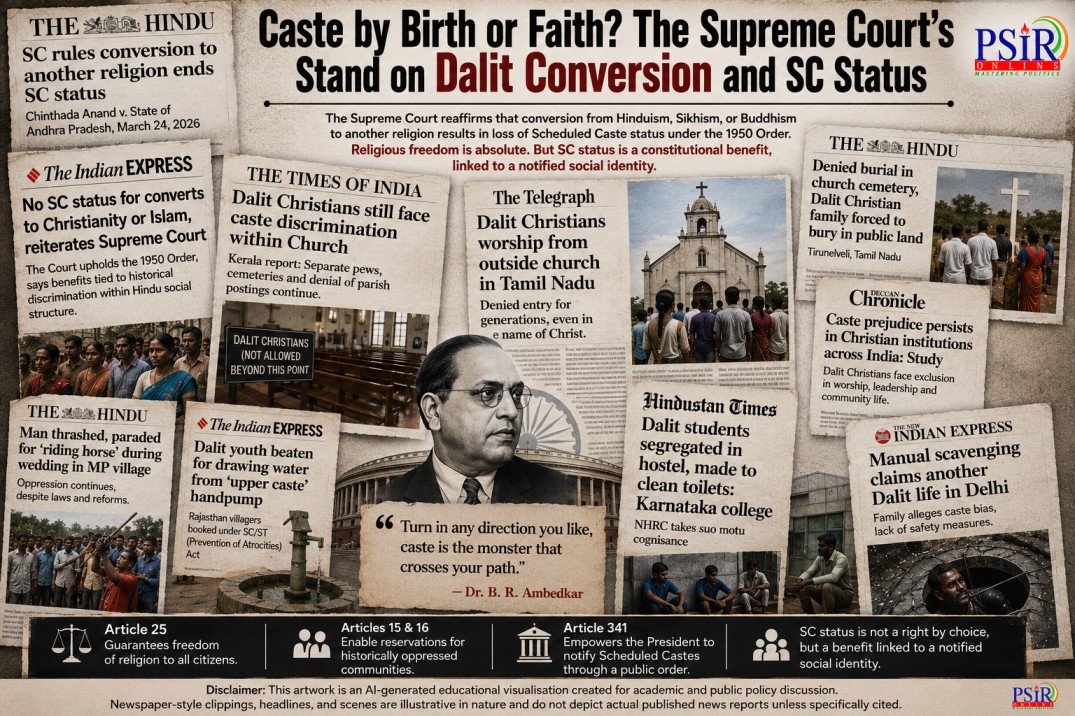
In its judgment dated March 24, 2026, in Chinthada Anand v. State of Andhra Pradesh Judgment, the Supreme Court of India reaffirmed that a person who converts from Hinduism, Sikhism, or Buddhism to another religion loses Scheduled Caste (SC) status under the Constitution (Scheduled Castes) Order, 1950. The ruling revisited the constitutional relationship between equality, affirmative action, and religious freedom. While Article 25 guarantees every citizen the freedom to profess and practise any religion, the Court held that SC status and reservation benefits under Articles 15 and 16 remain tied to the specific religious communities recognised under the Presidential Order issued under Article 341.
WHAT DOES THE 1950 SCHEDULED CASTES ORDER PROVIDE?
Clause 3 of the Constitution (Scheduled Castes) Order, 1950 states:
“No person who professes a religion different from the Hindu, the Sikh or the Buddhist religion shall be deemed to be a member of a Scheduled Caste.”
This means that conversion from Hinduism, Sikhism, or Buddhism to another religion such as Christianity or Islam results in the immediate loss of SC status, irrespective of the person’s caste origin by birth. The restriction is categorical in nature. A person professing another religion cannot simultaneously claim Scheduled Caste identity or the constitutional benefits attached to it.
The loss of SC status also means the loss of reservation benefits in education and public employment under Articles 15(4) and 16(4), political reservation benefits, and legal protections available under the Scheduled Castes and Scheduled Tribes (Prevention of Atrocities) Act, 1989.
However, earlier judicial precedents have recognised a limited reconversion exception. In cases such as Kailash Sonkar v. Maya Devi, the Court held that SC status may be restored if the individual proves original SC membership, genuine reconversion, and acceptance by the caste community concerned.
CONSTITUTIONAL FRAMEWORK BEHIND THE JUDGMENT
Under Article 341, the President has the power to notify Scheduled Castes through a public order. The 1950 Order originally applied only to Hindus, but it was later extended to Sikhs in 1956 and Buddhists in 1990. Any future modification requires parliamentary approval, while states can only recommend changes.
The Court observed that the classification under the Order survives scrutiny under Article 14 because it is linked to the historical experience of caste discrimination and untouchability within the Hindu social structure and related communities. Scheduled Caste reservations are therefore viewed not as general poverty alleviation measures, but as a form of compensatory discrimination designed to address specific historical injustices.
Articles 15 and 16 permit affirmative action for socially disadvantaged groups, but eligibility is determined within the constitutional framework established under Article 341. Consequently, religion becomes a qualifying condition for SC recognition.
At the same time, the Court clarified that Article 25 remains fully protected. Every citizen possesses the freedom to convert and practise any religion of choice. However, the Court distinguished religious freedom from entitlement to reservation benefits, stating that SC status is a constitutionally regulated benefit attached to a notified social identity rather than an unconditional individual right. According to the judgment, a person may freely change religion, but cannot automatically retain benefits specifically structured for historically oppressed communities recognised under the Order.
HISTORICAL AND SOCIOLOGICAL RATIONALE
The constitutional scheme rests on the understanding that caste-based untouchability historically emerged within Hindu society. Sikhism and Buddhism were later included because of their Indic social context and the continued existence of caste-like practices among sections of their followers.
Christianity and Islam, on the other hand, were not included because their doctrinal foundations formally reject caste hierarchies, even though caste-based social discrimination may continue in practice among some communities. The constitutional design therefore distinguishes between social backwardness in general and the specific historical disabilities associated with untouchability.
The Court also noted that extending SC status universally across religions could significantly strain the existing reservation framework and dilute benefits intended for historically recognised SC communities. Thus, the present framework attempts to balance secular religious freedom with a religion-linked affirmative action policy rooted in historical and sociological realities.
PREVIOUS JUDGEMENTS WHICH UPHELD THE 1950 PRESIDENT ORDER
Here are the key previous judgments (pre-2026) from the Supreme Court and High Courts that have consistently upheld the validity of Clause 3 of the Constitution (Scheduled Castes) Order, 1950. These rulings affirm that conversion from Hinduism/Sikhism/Buddhism to another religion (like Christianity or Islam) results in the immediate loss of Scheduled Caste (SC) status and associated benefits, including reservations and PoA Act protections.
Landmark Supreme Court Judgments
|
Year |
Case Name |
Key Holding |
|
1985 |
Soosai v. Union of India (AIR 1986 SC 733) |
Most important foundational case. The Court upheld the 1950 Order and denied SC benefits (welfare schemes) to a Christian convert from Adi-Dravida community. It held that the religion bar is not arbitrary under Article 14. Converts must prove they suffer the same level of disabilities within their new religious community as in the Hindu fold — mere birth in SC caste is not enough. |
|
1965 |
Punjabrao v. D.P. Meshram |
Interpreted the word “professes” in the Order. A person who has converted and is openly practising another religion cannot claim SC status. |
|
1976 |
C.M. Arumugam v. S. Rajagopal |
Conversion to Christianity severs the link with the original caste. Social and economic disadvantages attached to the caste in the Hindu social order do not automatically continue. |
|
2004 |
State of Kerala v. Chandramohan |
Reaffirmed that SC status is tied to the religious framework in the 1950 Order. |
|
2010 |
M. Chandra v. M. Thangamuthu |
Conversion leads to loss of SC benefits unless there is reconversion with community acceptance. |
|
2015 |
K.P. Manu v. Scrutiny Committee |
Laid down the three-fold test for reconversion (original caste + genuine return to faith + acceptance by community). This implies that without reconversion, status remains lost. |
|
2024 |
C. Selvarani v. Special Secretary |
Claiming SC status while actively practising Christianity amounts to a “fraud on the Constitution”. The Court strongly upheld the religion-specific bar. |
Other Notable Rulings
· Guntur Medical College v. Y. Mohan Rao (1976): Early affirmation that conversion changes legal eligibility for SC benefits.
· Multiple Madras High Court and Andhra Pradesh High Court rulings (including the 2025 AP HC judgment in the Chinthada Anand matter itself) have followed these precedents and quashed PoA cases or service claims by converts.
COMMISSIONS APPOINTED FOR THE PURPOSE AND ITS RECOMMENDATIONS
Here are the major commissions appointed by the Government of India to examine the issue of extending Scheduled Caste (SC) status to Dalit converts to Christianity and Islam (i.e., reviewing or amending Clause 3 of the 1950 Presidential Order).
1. Ranganath Misra Commission (National Commission for Religious and Linguistic Minorities)
· Appointed: 2005 by the UPA Government
· Chairperson: Justice Ranganath Misra (former Chief Justice of India)
· Report Submitted: May 2007
Key Recommendations:
· De-link SC status from religion — SC benefits should be based on social and economic backwardness, not the religion professed.
· Dalits who converted to Christianity or Islam should be included in the SC list and get full benefits (reservations in education/jobs, PoA Act protection, etc.).
· The 1950 Presidential Order’s religion bar (Clause 3) should be amended or deleted.
· Criteria for identification: Socio-economic backwardness with foolproof certification, not religion or caste alone.
Government Response: The UPA and subsequent NDA governments rejected the report. The Centre told the Supreme Court that the report was “flawed”, prepared “within four walls of a room” without proper field studies, and took a “myopic view”. It has never been implemented.
2. Sachar Committee (Prime Minister’s High-Level Committee)
· Appointed: 2005
· Chairperson: Justice Rajinder Sachar
· Report: 2006 (focused mainly on Muslims)
Relevant Observations:
· Documented severe socio-economic backwardness among Muslims, including those from Dalit-like backgrounds (e.g., Arzals).
· Recommended targeted affirmative action for backward Muslim groups, but did not directly recommend full SC status for Dalit Muslims/Christians (it focused more on OBC-like sub-quotas within minorities).
· Highlighted that caste-like discrimination persists among Muslims and Christians.
This report is often cited by activists alongside the Misra Commission but was not primarily about SC status for converts.
3. Justice K.G. Balakrishnan Commission (Commission of Inquiry)
· Appointed: October 2022 by the NDA Government
· Chairperson: Justice K.G. Balakrishnan (former Chief Justice of India)
· Members: Prof. Sushma Yadav and retired IAS officer Ravinder Kumar Jain
· Terms of Reference: Examine whether SC status can be granted to persons who historically belonged to SC communities but converted to religions other than Hinduism, Sikhism, or Buddhism. Specifically study:
o Changes in customs, traditions, social status, and discrimination after conversion.
o Implications for existing SC beneficiaries.
o Broader socio-economic conditions.
Status (as of May 2026): The commission’s tenure has been extended three times. Latest extension is till 10 June 2026. It has not yet submitted its final report.
|
Other Mentions / Earlier Efforts · First Backward Classes Commission (Kaka Kalelkar, 1953–1955): Touched on caste among non-Hindus but did not recommend religion-neutral SC status. · Various State-level commissions and demands (especially in Tamil Nadu, Kerala, Andhra) have pushed for inclusion, but no national change has occurred. Current Position (2026) · No commission recommendation has been accepted to amend the 1950 Order. · The Supreme Court (in the March 2026 Chinthada Anand case and earlier judgments) continues to uphold the existing religion-specific framework, pending any parliamentary amendment based on empirical data (likely from the Balakrishnan Commission).
|
ARGUMENTS OF PARTIES THAT OPPOSE 1950 PRESIDENTIAL ORDER
Many Dalit parties, activists, Dalit Christian organisations, and civil rights groups have strongly criticised the 1950 Presidential Order (and its reaffirmation in the March 24, 2026 Supreme Court judgment in Chinthada Anand v. State of Andhra Pradesh) for stripping converted Dalits of SC status and PoA protection. Protests, statements, and campaigns have come from groups like the National Council of Dalit Christians, Tamil Nadu Bishops’ Council SC/ST Commission, Civil Rights Initiative Internationale (CRII), All India Lawyers Association for Justice (AILAJ), and broader Dalit voices including Viduthalai Chiruthaigal Katchi (VCK) in Tamil Nadu, which consistently champions Dalit rights on related issues.
Here are their main arguments, drawn from public statements and protests after the 2026 ruling:
1. Caste discrimination is by birth and social reality — it does NOT disappear with conversion
· They argue that untouchability, caste-based atrocities, slurs, and segregation (e.g., separate churches for Dalit Christians, social exclusion) continue exactly as before. The Court’s assumption that Christianity or Islam “doctrinally reject caste” is theoretical and ignores India’s ground reality.
· “Faith changes, but discrimination doesn’t.” Dalit converts still face the same stigma and violence, yet the law removes their only shield (PoA Act). This leaves them more vulnerable.
2. The 1950 Order and ruling violate core constitutional rights
· Article 14 (Equality): Religion-based classification is arbitrary and discriminatory when social backwardness is identical. SC status should be based on caste origin and current deprivation, not the religion one professes.
· Article 15: It amounts to discrimination on grounds of religion.
· Article 25 (Freedom of Religion): It creates a heavy “penalty” or disincentive for converting — effectively punishing the exercise of religious freedom. Converts must choose between faith and constitutional protections.
3. The 1950 Presidential Order is outdated and inconsistent
· Originally limited to Hindus; later amended for Sikhs (1956) and Buddhists (1990) — showing the rule is not absolute.
· Multiple government commissions (e.g., Ranganath Misra Commission, Sachar Committee, and the pending Balakrishnan Commission) have documented that caste persists among Christians and Muslims and recommended religion-neutral SC benefits based on social/educational backwardness.
· The Order was made in 1950 without proper data on converted communities and does not reflect 75+ years of lived experience.
4. Double discrimination and denial of justice
· Dalit Christians/Muslims face caste oppression from dominant castes + religious minority bias.
· Removing PoA protection and reservations forces many to hide their faith or reconvert (“Ghar Wapsi”) just to access benefits — which activists call a “quiet denial of justice” and an attack on dignity.
· Reservations and PoA are not religious charity but tools to correct historical and ongoing social injustice.
5. Demand for immediate reform
· Parliament must amend/delete Clause 3 of the 1950 Order to make SC status religion-neutral.
· In Tamil Nadu specifically, Dalit Christian groups and the Bishops’ Council have demanded internal quotas (e.g., 4.6% within BC/MBC) as an interim step and full SC inclusion.
· They view the judgment as protecting finite quotas for Hindu SCs at the cost of equality and secularism.
These groups have held protests, issued memorandums, and filed/continued constitutional challenges in the Supreme Court (some pending for decades). VCK leader Thol. Thirumavalavan and other Dalit leaders broadly support extending protections to all similarly placed communities, framing it as essential for true Dalit emancipation.
In short, their core message is: “Caste is not a Hindu-only problem — it is an Indian social evil. The Constitution must address the victim, not police their faith.”
ARGUMENTS OF PARTIES THAT SUPPORT 1950 PRESIDENTIAL ORDER
Here are the main counter-arguments to the demands by Dalit parties, activists, and Christian/Muslim groups for extending SC status and PoA protection to converts (religion-neutral approach). These come from the Supreme Court’s reasoning (including the March 2026 Chinthada Anand judgment), the Union Government’s official position, constitutional scholars, and organisations like certain Dalit Hindu groups and Hindu organisations.
1. Caste and Untouchability are Historically Rooted in the Hindu Social Order (Not Universal)
· SC status was created specifically to address untouchability and social disabilities that originated and were systematised within the Hindu varna and jati system. Christianity and Islam doctrinally reject caste hierarchies, so extending SC benefits would contradict the original intent of the 1950 Presidential Order.
· Amendments for Sikhs (1956) and Buddhists (1990) were made because these are Indic religions with historical continuity and documented persistence of caste-like practices in some sections. Christianity and Islam are viewed as religions of “foreign origin” without the same structural link.
· Counter to “caste persists after conversion”: While social discrimination may continue in practice, the constitutional definition of SC is tied to the notified communities within the specified religions. The law does not treat “caste” as a purely secular social phenomenon for this purpose.
2. The 1950 Order is Constitutionally Valid and Not Arbitrary
· Article 341 empowers the President (with Parliament’s approval for changes) to define SCs. Clause 3’s religion bar is “categorical and absolute.” The Supreme Court in 2026 reiterated that one cannot “profess” another religion while claiming SC membership — this upholds constitutional text, not discrimination.
· Extending it now would require parliamentary amendment, not judicial rewriting. Courts have consistently refused to strike down the Order.
3. Dilution of Existing SC Benefits and Overburdening Quotas
· Adding millions of Dalit Christians and Muslims (estimates vary widely, often 1–5 crore) to the fixed SC quota (~15% in many states) would shrink opportunities for current beneficiaries who remain within the original framework. Many Hindu Dalit organisations oppose this, fearing loss of hard-won gains.
· Reservations are compensatory discrimination for a specific historical wrong, not a general poverty or backwardness scheme. Making them religion-neutral could turn them into something else entirely.
4. Risk of Misuse and “Benefit-Driven” Conversions
· Allowing dual claims (new faith + old caste benefits) could incentivise conversions primarily for reservations rather than genuine belief. The Court has noted that SC benefits are not a right attached to birth alone once one leaves the qualifying religious framework.
· Administrative challenges: Identifying “Dalit converts” is harder because these religions officially deny caste, leading to potential fraud (fake certificates, etc.).
5. Government and Commission Views
· The Union Government has rejected the Ranganath Misra Commission (2007) recommendation for religion-neutral SC status, calling it “flawed,” lacking field studies, and myopic. It appointed the Balakrishnan Commission (2022, extended multiple times) to examine the issue empirically.
· Earlier commissions and Constituent Assembly debates show SCs were never intended to be fully religion-neutral from the start.
6. Secularism Cuts Both Ways
· True secularism means the state does not extend religion-specific affirmative action indefinitely. Converts exercise Article 25 freedom fully — they can convert without coercion — but cannot demand benefits tailored to address disabilities in the Hindu fold while rejecting that identity.
· General protections (IPC, other welfare schemes, or BC/MBC lists in states like Tamil Nadu) remain available. PoA is specifically tied to constitutional SC definition.
Summary of the Counter Position: The policy is not anti-convert or anti-equality; it preserves a targeted historical redressal mechanism without diluting it. Any expansion must come via Parliament after proper study (e.g., Balakrishnan Commission report), not through judicial or activist pressure. Critics of extension argue that changing it would fundamentally alter the nature of SC reservations from “caste within Hindu/Indic framework” to a broader social backwardness quota.
This debate remains politically charged, with strong views on both sides. The current legal position (as of 2026) firmly supports the restricted framework unless Parliament amends the 1950 Order.
PRACTICE QUESTIONS FOR GS 2 MAINS
1. The Constitution (Scheduled Castes) Order, 1950 links Scheduled Caste status with religion. Critically examine the constitutional validity and socio-political implications of this framework in light of recent Supreme Court judgments.
2. “Freedom of religion under Article 25 and affirmative action under Articles 15 and 16 often intersect in complex ways.” Discuss with reference to the debate over Scheduled Caste status for converted Dalits.
3. Examine the role of Article 341 in defining Scheduled Castes. Should Parliament reconsider the religion-based restrictions under the 1950 Presidential Order? Substantiate your arguments.
4. Reservation policies in India are designed as instruments of historical justice rather than poverty alleviation. Discuss in the context of the debate surrounding Dalit converts and Scheduled Caste status.
PRACTICE QUESTIONS FOR PSIR OPTIONAL
1. “The Indian Constitution attempts to balance liberal individual rights with group-based social justice.” Analyse this statement with reference to the Supreme Court’s interpretation of Scheduled Caste status and religious conversion.
2. Critically evaluate the tension between constitutional secularism and religion-linked affirmative action in India. Discuss with reference to the Constitution (Scheduled Castes) Order, 1950.
3. Ambedkar viewed caste as a system of graded inequality embedded in Hindu social order. In the light of contemporary debates on Dalit conversions, assess the relevance of Ambedkar’s ideas on caste and social justice.
4. Discuss the judicial approach towards affirmative action and identity-based claims in India with reference to major Supreme Court judgments on Scheduled Caste status after religious conversion.