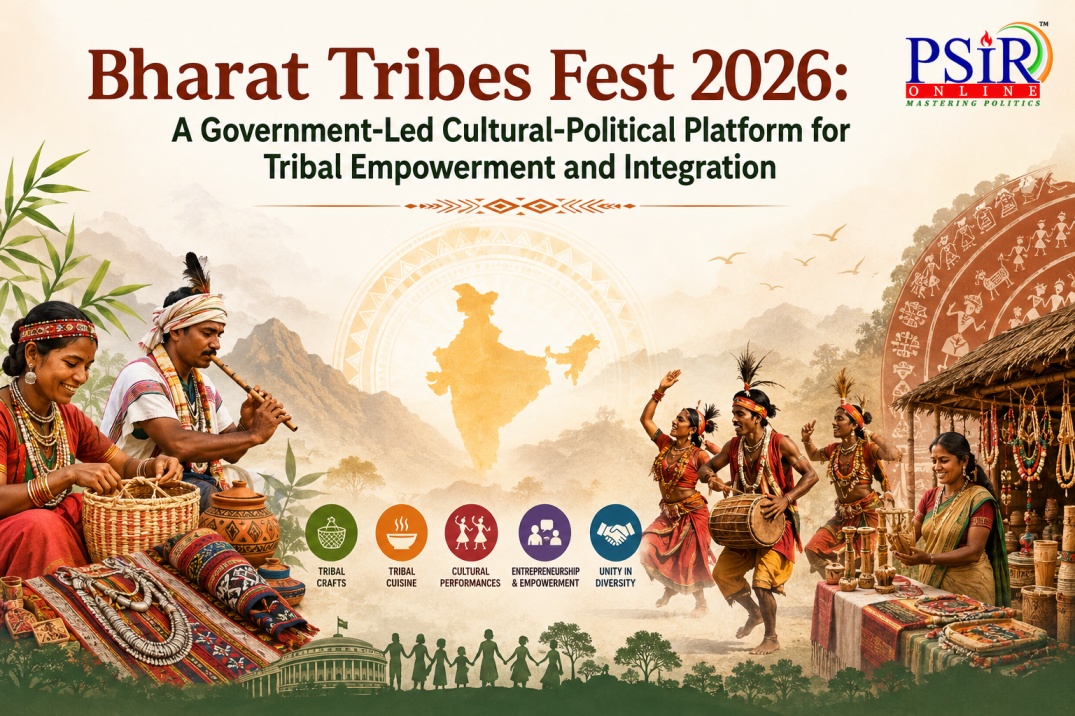
The Bharat Tribes Fest 2026, organised by the Ministry of Tribal Affairs in collaboration with TRIFED (Tribal Cooperative Marketing Development Federation of India), emerged as a significant national initiative showcasing India's rich tribal heritage. Held at the scenic Sunder Nursery in New Delhi, the festival originally scheduled from March 18 to 30, 2026, was extended till April 5 due to overwhelming public response. It served not merely as a cultural fair but as a deliberate political platform for tribal visibility, economic inclusion, and narrative-building in contemporary Indian politics.
OBJECTIVES AND SCALE OF THE FESTIVAL
The event brought together tribal artisans, entrepreneurs, Self-Help Groups (SHGs), and communities from across states to display their art, crafts, cuisine, music, dance, and traditional knowledge. Key highlights included:
· Live demonstrations of tribal handicrafts (textiles, jewellery, bamboo & cane work, pottery, paintings).
· Culinary experiences offering authentic tribal cuisines.
· Van Dhan Conclave focusing on entrepreneurship and value addition under the Van Dhan Yojana.
· Cultural performances and storytelling sessions.
By providing direct market access, the festival aimed to strengthen livelihoods, promote “Vocal for Local” and “Buy Tribal” campaigns, and bridge the gap between tribal producers and urban/consumers markets. High footfall and record sales underscored its success as an economic bridge.
POLITICAL DIMENSIONS: BEYOND CULTURAL REPRESENTATION
Bharat Tribes Fest 2026 can be understood not merely as a cultural exhibition but as a multidimensional policy instrument that intersects with governance, identity formation, federal dynamics, and developmental strategy.
CRITICAL REFLECTIONS: OPPORTUNITIES AND LIMITATIONS
A comprehensive assessment of Bharat Tribes Fest 2026 requires balancing its visible achievements with underlying structural concerns, situating it within broader debates on development, representation, and governance.
Strengths and Positive Outcomes
The festival plays a significant role in enhancing visibility and recognition of tribal communities within the national public sphere. By providing a prominent platform for cultural expression, it fosters a sense of pride and identity, particularly among younger generations.
It also delivers tangible economic benefits by creating direct market access for tribal artisans, forest produce gatherers, and performers. Through exhibitions, sales, and networking opportunities, participants gain both income and recognition of their skills, contributing to livelihood diversification.
Beyond domestic impact, the festival functions as an instrument of cultural diplomacy. At a time when global discourse increasingly emphasizes indigenous rights, sustainability, and cultural preservation, such initiatives help position India as a country that values and promotes its indigenous heritage.
Challenges and Areas of Concern
Despite these gains, the festival raises concerns about the commodification of culture. The packaging of tribal traditions for urban and commercial consumption risks reducing complex, lived cultural practices into simplified or “exotic” representations, potentially undermining their authenticity and meaning.
More importantly, the initiative has limited engagement with deeper structural challenges faced by tribal communities. Issues such as land alienation, displacement due to mining and infrastructure projects, left-wing extremism in certain regions, and the disproportionate impact of climate change on forest-dependent livelihoods remain only marginally addressed within such platforms.
Questions of sustainability also persist. While annual events generate short-term visibility and income, their long-term impact on systemic policy change, institutional strengthening, and durable livelihood security is less clear. Without sustained follow-up mechanisms, there is a risk that such initiatives remain largely symbolic rather than transformative.
Broader Political and Policy Context
In a context of competitive electoral politics, large-scale cultural events increasingly function as instruments of political communication and outreach. They help signal governmental commitment to historically marginalized communities and reinforce narratives of inclusive development and “last-mile” governance.
At the same time, these initiatives contribute to shaping public perception by highlighting state efforts in empowerment and integration. This dual role—as both developmental intervention and symbolic messaging—underscores the need to critically evaluate their effectiveness beyond immediate visibility, particularly in terms of long-term social justice and structural transformation.
CONCLUSION
Bharat Tribes Fest 2026 exemplifies how cultural policy can be leveraged as an instrument of governance and political legitimacy. For students, it is a rich example of the intersection between culture, economy, and politics in multi-ethnic democracies. It underscores Ambedkar’s emphasis on social and economic justice alongside political democracy—extended here to India’s indigenous communities.
As India aspires to become a developed nation (Viksit Bharat), platforms like this test the state’s capacity to harmonize diversity with development. Engaging deeply with such initiatives helps students understand evolving contours of Indian federalism, inclusive growth strategies, and the politics of recognition in the 21st century.
PRACTICE QUESTIONS FOR PSIR OPTIONAL
1. “Bharat Tribes Fest 2026 reflects the transformation of tribal policy from welfare-oriented governance to market-linked cultural integration.” Critically examine in the context of contemporary Indian politics and tribal development.
2. Discuss how state-sponsored cultural platforms such as Bharat Tribes Fest 2026 shape the politics of identity, recognition, and nation-building in India. Analyse with reference to tribal assertion and cooperative federalism.
3. “Cultural representation without structural justice risks reducing indigenous communities to symbols of diversity.” Evaluate this statement with reference to Bharat Tribes Fest 2026, Forest Rights Act, PESA, and debates on tribal autonomy in India.
4. Compare India’s tribal cultural diplomacy initiatives with indigenous recognition movements in other democracies such as Canada and Australia. How do such platforms influence debates on multiculturalism, development, and democratic inclusion?