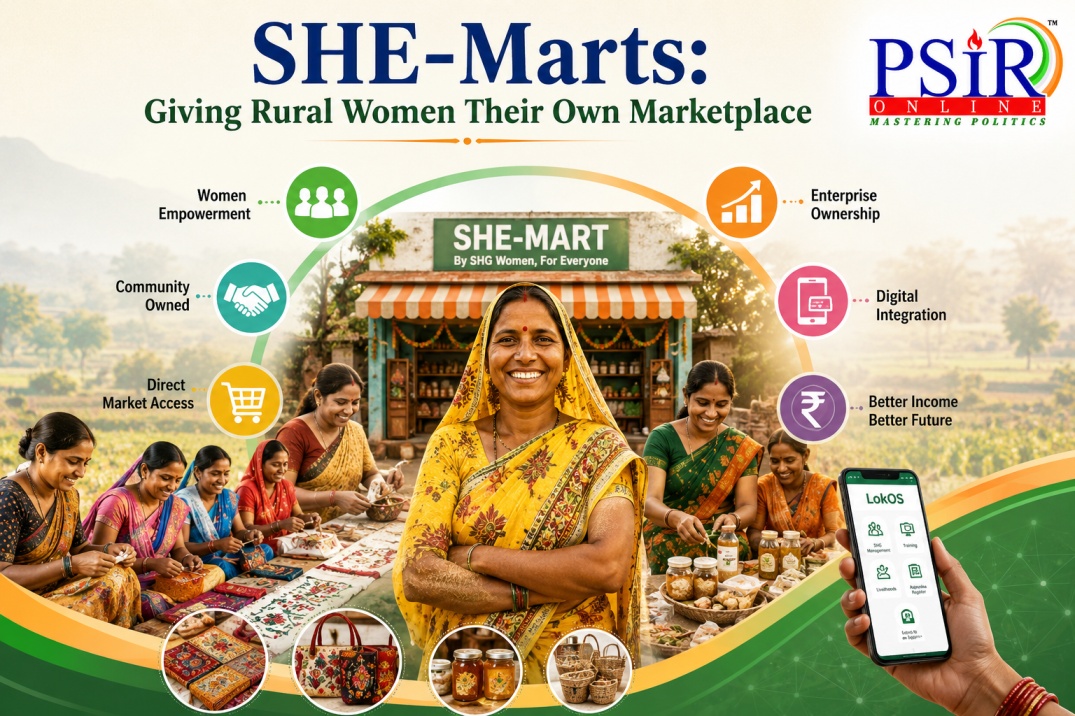
SHE-Marts (Self-Help Entrepreneur Marts) is a new initiative announced in India's Union Budget 2026-27 by Finance Minister Nirmala Sitharaman. It aims to empower rural women by shifting them from credit-dependent livelihoods (e.g., under Self-Help Groups or SHGs) to full enterprise ownership, with dedicated marketing and retail infrastructure. This framework is part of a broader "Nari Shakti" push in the 2026-27 budget, building on SHG momentum to create a more robust ecosystem for rural women entrepreneurship.
BACKGROUND AND CONTEXT
India's Deendayal Antyodaya Yojana – National Rural Livelihoods Mission (DAY-NRLM) has mobilized over 10 crore (100 million) rural women into more than 90.90 lakh (9.09 million) SHGs across 28 states and 6 Union Territories. These women engage in savings, credit, and various livelihood activities like handicrafts, agriculture, food processing, animal husbandry, and small manufacturing.
While SHGs have improved financial inclusion, social capital, and basic livelihoods, many women producers face a "missing market" problem:
· Limited access to steady, wider markets beyond local villages, fairs, or occasional exhibitions.
· Dependence on middlemen, leading to low prices and inconsistent income.
· Challenges in branding, scaling, logistics, and reaching urban or national consumers.
· Most enterprises remain micro-scale and subsistence-oriented.
SHE-Marts address this by creating structured, community-owned retail outlets as dedicated marketing platforms. They build on programs like Lakhpati Didi (aiming for women to earn ₹1 lakh+ annual household income) and represent a policy shift from "credit-led livelihoods" to "enterprise ownership."
|
A BRIEF HISTORY OF SELF-HELP GROUPS (SHGS) IN INDIA
Origins (1970s – Mid-1980s) · The concept of SHGs in India draws inspiration from global microfinance experiments, notably Muhammad Yunus’s Grameen Bank in Bangladesh (1970s), which focused on small loans to poor women. · In India, early roots trace back to the Self-Employed Women’s Association (SEWA) founded by Ela Bhatt in 1972 in Gujarat. It organized poor self-employed women (weavers, hawkers, etc.) for collective strength and better incomes. · In the mid-1980s, MYRADA (Mysore Resettlement and Development Agency), an NGO in Karnataka, pioneered the modern SHG model. They formed small groups (initially called Credit Management Groups) of 10–20 poor women who saved regularly, met frequently, and built mutual trust and discipline.
Formal Launch and Scaling (1990s) · 1987: NABARD (National Bank for Agriculture and Rural Development) supported MYRADA with a grant of ₹10 lakh to promote and study these groups. NABARD renamed them Self-Help Groups (SHGs). · 1992: NABARD officially launched the SHG-Bank Linkage Programme (SHG-BLP) — a pilot to connect SHGs with formal banks for credit. This was a game-changer, allowing groups to open savings accounts and access bank loans without collateral, based on group guarantee. · The Reserve Bank of India (RBI) supported this by treating SHG loans as Priority Sector Lending and issuing guidelines.
Expansion Phase (Late 1990s – 2000s) · 1999: The Government of India launched Swarnajayanti Gram Swarozgar Yojana (SGSY), which used SHGs as the main vehicle for rural self-employment and poverty alleviation. · By the early 2000s, SHGs spread rapidly, especially in southern states (Andhra Pradesh, Tamil Nadu, Karnataka, Kerala). The model proved highly successful due to high repayment rates by women groups. · SHGs evolved from simple savings groups into platforms for livelihoods, skill training, social empowerment, and leadership development.
Modern Era (2011 onwards) · 2011: SGSY was restructured into the National Rural Livelihoods Mission (NRLM) — a flagship program to mobilize poor women into SHGs on a massive scale. · 2016: Renamed Deendayal Antyodaya Yojana – National Rural Livelihoods Mission (DAY-NRLM). · Today, India has over 90–120 lakh SHGs with more than 10 crore women members — making it the world’s largest microfinance and women’s empowerment movement.
|
KEY FEATURES OF THE SHE-MART POLICY FRAMEWORK
Community-Owned Retail Outlets: Established in every district, often at the Cluster Level Federation (CLF) level of SHGs. These are physical (brick-and-mortar) stores run and owned by women SHG federations, not private entities or government shops. They aggregate and sell products made by SHG members.
Products Sold: Handicrafts, traditional goods, farm/organic produce, handmade items, local beauty/wellness products, food items, textiles, and more. The focus is on value-added, women-produced goods with potential for branding and quality standards.
Operational Model:
· SHGs produce goods.
· Cluster federations manage the marts (inventory, sales, customer service).
· Direct market access reduces intermediaries and ensures better margins for producers.
· Potential for physical stores + digital integration (e.g., online sales, e-commerce linkages).
Technological Integration (as mentioned in the query):
· LokOS App: A mobile platform for SHG management, member registration, profile creation (SHG, Village Organization, CLF), training, and livelihood tracking. It serves as a central hub for NRLM initiatives.
· Digital Aajeevika Register: Integrated with LokOS, this is a digital record of income, business activities, and enterprise details for SHG women. It enables real-time economic tracking, data-driven policy making, proof for loans/credit, and monitoring progress toward goals like creating more "Lakhpati Didis." It covers the vast network of 10+ crore women.
· These tools support transparency, financial record-keeping, training, and integration with banking/loans.
Financing and Support:
· Innovative financing instruments (e.g., enhanced credit, seed capital).
· Training in inventory management, digital payments, customer service, branding, and business skills.
· Convergence with other schemes (e.g., ODOP – One District One Product, GeM portal for government procurement).
· Increased NRLM budget allocation (20% hike in 2026-27).
|
OBJECTIVES
· Bridge rural production and urban/local consumption. · Provide assured, sustainable markets and steady income. · Promote women as enterprise owners (not just producers or borrowers). · Contribute to goals like creating 3 crore Lakhpati Didis. · Foster financial independence, leadership, and inclusive economic growth.
|
IMPLEMENTATION AND ELIGIBILITY
· Eligibility: Active members of NRLM-registered SHGs (priority for Lakhpati Didi trainees), local artisans, and women entrepreneurs in relevant sectors.
· Process (phased, via State Rural Livelihood Missions – SRLMs):
o Join/form an SHG.
o SHG submits proposal to CLF.
o Quality/quantity/marketability checks.
o Training and shortlisting.
o Shop allotment, branding, and operations.
· Dedicated state portals and integration with existing NRLM structures.
HOW SHE-MARTS (SELF-HELP ENTREPRENEUR MARTS) EMPOWER WOMEN
SHE-Marts represent a significant evolution in India’s women’s empowerment journey, building on the foundation of Self-Help Groups (SHGs). While SHGs primarily focused on savings, credit access, and basic livelihoods, SHE-Marts shift the focus to enterprise ownership, market control, and business leadership. This moves women from being “credit-seekers and producers” to “confident business owners and market players.”
Here’s a detailed breakdown of how this initiative empowers women:
1. Economic Empowerment: Higher Incomes and Financial Independence
· Assured and Better Markets: Women often sell products (handicrafts, food items, organic produce, textiles) through middlemen at low prices. SHE-Marts provide dedicated, community-owned retail outlets in every district, ensuring direct access to local, urban, and national customers. This reduces intermediary exploitation and increases profit margins.
· Higher and Stable Earnings: By controlling retail spaces, women become price-makers rather than price-takers. This supports the goal of creating more Lakhpati Didis (women with annual household income of ₹1 lakh+).
· Ownership of Assets: The marts are community-owned (run by SHG Cluster-Level Federations), so women collectively own and manage a physical business asset — a big step beyond just taking loans.
2. Entrepreneurial Shift: From Borrowers to Owners
· Traditional SHG model: Women borrow money → produce goods → sell locally or to middlemen.
· SHE-Marts model: Women produce → own and run the retail outlet → manage inventory, branding, sales, and profits.
· This builds business skills in areas like customer service, digital payments, inventory management, branding, and scaling.
3. Skill Development and Leadership
· Women receive training in enterprise management, quality standards, marketing, and digital tools (via LokOS app and Digital Aajeevika Register).
· Leadership roles emerge as women manage stores, make collective decisions in federations, and handle operations — boosting confidence and public visibility.
· Creates safe, women-only business spaces, which is especially empowering in conservative rural areas.
4. Social and Personal Empowerment
· Increased Visibility and Respect: Running a visible retail outlet gives women a public identity as entrepreneurs, enhancing their social status and decision-making power within families and communities.
· Reduced Dependency: Greater financial control leads to better household decisions, education for children, and participation in local governance (e.g., Panchayats).
· Role Modeling: Successful women entrepreneurs inspire the next generation, normalizing female leadership in business.
5. Broader Systemic Support
· Access to Finance: Innovative financing instruments, credit enhancement, and convergence with other schemes.
· Technology Integration: Real-time income tracking and digital records help women access larger loans, government benefits, and data-driven growth.
· Market Linkages: Potential integration with e-commerce, ONDC, GeM portal, and One District One Product (ODOP) for wider reach.
Expected Scale and Impact
· Targets millions of the 10+ crore SHG women.
· Aims to create structured retail networks that keep economic value within rural communities.
· Part of a larger “Nari Shakti” vision in Budget 2026-27, with increased NRLM funding.
In Simple Terms: SHGs helped women come together and borrow. SHE-Marts help them come together, own shops, sell directly, earn more, and lead businesses.
This is not just about money — it’s about dignity, agency, and long-term self-reliance. Success will depend on implementation quality, training effectiveness, and market demand, but the policy direction is clearly transformative.
SOCIO-CULTURAL AND IMPLEMENTAL CHALLENGES FOR SHE-MARTS
SHE-Marts are an ambitious initiative to turn SHG women from producers/borrowers into enterprise owners. While promising, they face significant socio-cultural barriers rooted in Indian rural society and implemental (operational/structural) hurdles common to large-scale rural programs. These challenges are drawn from studies on SHGs, women entrepreneurship, and early analyses of the SHE-Marts framework.
Socio-Cultural Challenges
These stem from deep-rooted patriarchal norms, gender roles, and social structures that limit women's agency:
· Patriarchal Norms and Family Resistance: In many rural areas (especially in northern and central states like Bihar, UP, Rajasthan), women need family (often male) approval to participate in business activities. Mobility restrictions, expectations to prioritize household chores and childcare, and suspicion around women interacting with outsiders or traveling for markets/training create barriers. This "dual burden" reduces time and energy for managing retail outlets.
· Gendered Mobility and Public Space Constraints: Conservative communities may frown upon women running visible public retail shops, handling cash, or dealing with male customers. This can lead to social backlash, safety concerns, or limited participation.
· Caste, Class, and Elite Capture Risks: SHGs sometimes get dominated by relatively better-off or influential women, leading to exclusion of poorer, lower-caste, or marginalized members. Community-owned assets like SHE-Marts risk being controlled by a small elite group, reducing equitable benefits.
· Low Confidence and Traditional Mindsets: Many women lack prior exposure to business management or public leadership. Societal views that business is a "male domain" can undermine self-belief, even with training.
· Social Pressure and Dropouts: Domestic responsibilities, migration of family members, or community interference can cause high dropout rates from SHG activities or mart operations.
These barriers slow the shift from "credit-linked livelihoods" to true enterprise ownership and vary by region — stronger in conservative areas, weaker in southern states with better SHG track records.
Implemental (Operational & Structural) Challenges
These relate to execution, scalability, and sustainability:
· Supply Chain and Product Consistency: Rural production is often seasonal, small-scale, and variable in quality/quantity. Keeping SHE-Marts stocked with attractive, standardized products year-round is difficult. Empty shelves would erode customer trust.
· Skills and Capacity Gaps: Most SHG women have limited experience in retail management, inventory handling, customer service, branding, digital payments, demand forecasting, or competitive marketing. Training gaps could lead to poor operations.
· Fierce Market Competition: SHE-Marts must compete with established local shops and powerful FMCG companies with strong distribution networks, branding, and pricing power. Thin retail margins make sustainability tough without strong differentiation (e.g., unique handmade/organic products).
· Infrastructure and Logistics: Poor rural roads, storage facilities, cold chains (for food items), and reliable electricity/internet hinder operations, especially for linking to urban or e-commerce markets.
· Financial and Funding Risks: While innovative financing is planned, initial capital, working capital for inventory, and sustaining losses in early stages remain concerns. Dependence on subsidies or loans can create debt traps if marts underperform.
· Technology and Digital Integration: Effective use of LokOS app and Digital Aajeevika Register requires digital literacy, which is uneven. Connectivity issues in remote areas add friction.
· Monitoring, Equity, and Governance: Ensuring transparent management in community-owned federations, preventing mismanagement, and scaling across thousands of districts pose coordination challenges for state rural livelihood missions (SRLMs).
· Regional Disparities: Southern states (with mature SHGs) may implement faster than northern/eastern states with weaker institutions.
POTENTIAL WAYS FORWARD (MITIGATION)
Success of SHE-Marts will largely depend on how effectively the government, State Rural Livelihood Missions (SRLMs), NABARD, and SHG federations address the identified challenges. Here is a more detailed, practical explanation of the key mitigation approaches:
1. Strong Training & Mentorship Programs
What is needed: Most SHG women have production skills but lack retail business experience (inventory management, customer handling, digital payments, demand forecasting, accounting, etc.).
How to implement:
· Intensive, hands-on training modules (30–90 days) covering retail operations, soft skills, and digital literacy.
· Mentorship model: Pair new SHE-Mart operators with successful women entrepreneurs or existing high-performing marts (e.g., from southern states like Kerala’s Kudumbashree or Tamil Nadu’s experiences).
· Use Lakhpati Didi women as resource persons and trainers.
· Continuous refresher training and peer-learning workshops at cluster/district levels.
· Tie-ups with institutions like RSETIs (Rural Self Employment Training Institutes), NSDC, or private partners for specialized modules.
Expected outcome: Builds confidence and reduces failure rates in the critical first 2–3 years.
2. Quality Standards & Supply Chain Management
Challenge addressed: Seasonal, inconsistent, and variable-quality production.
Solutions:
· Introduce standard operating procedures (SOPs) for grading, packaging, labeling, and quality testing.
· Set up common facility centers or production clusters for year-round supply (e.g., staggered cropping, multiple SHGs feeding one mart).
· Certification support (FSSAI for food, handicraft marks, organic certification) to build consumer trust.
· Digital tools (via LokOS app) for supply planning and traceability.
Best practice example: Many SRLMs already run successful producer groups; these can be scaled.
3. Branding Support
Why critical: Generic local products struggle against branded FMCG items.
How:
· Develop a common SHE-Mart brand with sub-brands for different product categories (e.g., “SHE Organic”, “SHE Heritage”).
· Professional packaging design support through convergence with design institutes or NID (National Institute of Design).
· Marketing campaigns highlighting “women-made”, “rural India”, “sustainable” stories.
· Integration with e-commerce (ONDC, GeM, Amazon/Flipkart SHG portals) and social media for wider visibility.
Outcome: Higher pricing power and customer loyalty.
4. Convergence with Existing Schemes (especially ODOP)
One District One Product (ODOP): Perfect synergy — each district promotes its signature product (e.g., pickles in one district, handlooms in another) through SHE-Marts.
Other convergences:
· PMFME (Pradhan Mantri Formalisation of Micro Food Processing Enterprises) for food products.
· SVANidhi, Stand-Up India, or Mudra for additional credit.
· Tourism schemes for homestays/crafts linked to marts.
· GeM portal for bulk government purchases.
Benefit: Leverages existing infrastructure, funding, and market linkages instead of building everything from scratch.
5. Continuous Monitoring & Transparent Governance
Tools: Full use of Digital Aajeevika Register and LokOS for real-time tracking of sales, income, inventory, and member benefits.
Mechanisms:
· Regular social audits and third-party evaluations.
· Performance dashboards at state and national levels.
· Grievance redressal systems accessible to all SHG members.
· Incentive structures linked to performance (e.g., additional grants for high-performing marts).
6. Safeguards Against Elite Capture
Risk: Influential or better-off women/families dominating the marts.
Mitigation:
· Mandatory rotation of leadership positions in Cluster Level Federations (CLFs).
· Transparent selection criteria with priority to poorer, SC/ST, and marginalized members.
· Profit-sharing formulas clearly defined and audited.
· Capacity building focused on inclusive decision-making.
· Reservation or weighted voting for vulnerable groups in mart governance.
7. Pilot Phases in Select Districts
Recommended approach:
· Start with 100–200 districts (mix of well-performing southern/eastern states and challenging northern/central states).
· Run for 1–2 years, document lessons (what works, what fails).
· Refine guidelines, training modules, and financing models before nationwide scale-up.
· Use findings to create model SHE-Marts that others can replicate.
Additional Supporting Measures
· Initial Hand-Holding: Government/NABARD support for first 2–3 years (subsidized rent, seed capital, marketing grants).
· Technology: Vernacular, user-friendly POS systems and apps.
· Safety & Social Support: Safe transport, creche facilities near marts, and family sensitization campaigns.
· Financing: Innovative instruments like equity-like support, revenue-based repayment, or blended finance.
Overall Outlook: These mitigation strategies turn SHE-Marts from a risky experiment into a sustainable model. The 20% increase in NRLM budget for 2026-27 signals strong central backing. States with mature SHG ecosystems (Tamil Nadu, Kerala, Andhra, Karnataka) are likely to succeed faster and can mentor others.
CONCLUSION
SHE-Marts: Giving Rural Women Their Own Marketplace represents a transformative leap in India’s women’s empowerment journey. By evolving from the foundational Self-Help Group model — which focused primarily on savings and credit — to community-owned retail enterprises, this initiative aims to place rural women at the centre of economic decision-making as producers, owners, and marketers.
While the promise is significant — higher incomes, entrepreneurial ownership, enhanced social status, and reduced dependence on middlemen — its success is not guaranteed. Deep-rooted socio-cultural barriers such as patriarchal norms, mobility restrictions, and caste dynamics, along with practical implementation challenges like supply consistency, skill gaps, and market competition, must be addressed with care and urgency.
The real success of SHE-Marts will be measured not just by sales figures, but by how many rural women finally get to call the marketplace their own.
PRACTICE QUESTIONS FOR GS 2 MAINS
1. “SHE-Marts represent a shift from ‘credit-led livelihoods’ to ‘enterprise ownership’ for rural women.” Critically examine the significance of this transition in the context of women’s empowerment and rural development in India.
2. Discuss the role of Self-Help Groups (SHGs) in transforming rural socio-economic structures in India. How do SHE-Marts seek to address the limitations of the traditional SHG model?
3. Analyze the socio-cultural and implementation challenges associated with the SHE-Marts initiative. Suggest suitable measures to ensure its inclusive and sustainable success.
4. “Market access remains the missing link in rural women entrepreneurship.” In the light of the SHE-Marts initiative, evaluate how digital integration and community-owned retail infrastructure can strengthen grassroots economic empowerment.