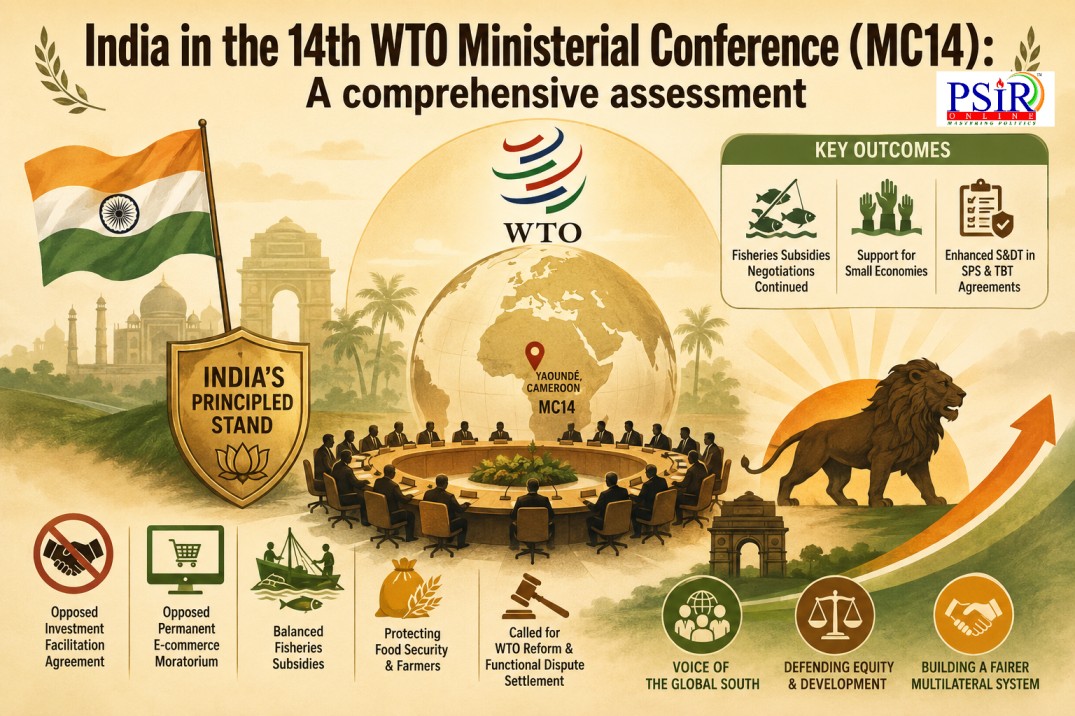
The 14th WTO Ministerial Conference (MC14) was held from 26 to 30 March 2026 in Yaoundé, Cameroon. It was the highest decision-making body of the World Trade Organization (WTO), bringing together trade ministers from its 166 members. Cameroon’s Minister of Trade, Luc Magloire Mbarga Atangana, chaired the conference—the second time it was hosted in Africa (after MC10 in Nairobi in 2015).
|
Key Details · Location: Yaoundé, Cameroon · Dates: 26–30 March 2026 (concluded early on 30 March) · Focus: Challenges and opportunities in the multilateral trading system, WTO reform, fisheries subsidies, e-commerce/digital trade, agriculture, development issues, and more.
|
MAIN OUTCOMES
MC14 produced limited results amid geopolitical tensions, with no comprehensive ministerial declaration. Some decisions were adopted, but several high-profile issues (especially digital trade) ended in impasse and were referred back to Geneva for further work.
Adopted Decisions:
· Fisheries Subsidies: Commitment to continue negotiations toward comprehensive disciplines on subsidies contributing to overcapacity and overfishing (building on the 2022 Agreement, which has entered into force).
· Small Economies: Decision to enhance their integration into the multilateral trading system.
· Development/SPS & TBT: Measures to make special and differential treatment (for developing countries) more effective under the Sanitary and Phytosanitary (SPS) Measures and Technical Barriers to Trade (TBT) Agreements (e.g., longer comment periods for new measures).
No Agreement On:
· Extension of the e-commerce moratorium (on customs duties on electronic transmissions) — a major sticking point. The US pushed for permanence; others (including Brazil and Turkey) opposed or sought shorter extensions. It expired at the start of MC14.
· Broader WTO reform work plan (though some directional progress was made on decision-making, development, and "level playing field" issues).
· Incorporation of the Investment Facilitation for Development Agreement into the WTO framework (opposed by India, among others).
· Other issues like TRIPS non-violation complaints moratorium and certain LDC extensions.
Plurilateral Progress:
· Participants in the E-Commerce Joint Statement Initiative (covering ~70% of global trade) adopted interim arrangements to implement their agreement.
INDIA IN WTO - MC14
Major Stands and Demands
1. Blocked the China-led Investment Facilitation for Development (IFD) Agreement India stood alone (after South Africa and Türkiye dropped objections) in opposing the incorporation of the plurilateral IFD Agreement into the WTO framework (as Annex 4).
a. Reason: Investment issues fall outside the WTO’s core trade mandate; it could undermine the consensus-based multilateral system and set a precedent for plurilaterals bypassing full membership agreement.
b. Piyush Goyal cited Gandhian principles of “truth prevailing over conformity” and described it as India showing courage to stand alone.
2. E-Commerce Moratorium on Customs Duties India strongly opposed a permanent or long-term extension of the moratorium on customs duties on electronic transmissions (which expired at MC14).
a. Concern: Significant potential revenue loss (estimated over $1 billion annually for India) and loss of policy space for digital trade regulation.
b. India was open to a short compromise extension but the issue deadlocked (mainly US vs. others) and was referred back to Geneva. India did not join the plurilateral interim e-commerce arrangement.
3. Fisheries Subsidies India pushed for balanced, equitable disciplines that protect small-scale and artisanal fishers (affecting ~9 million in India).
a. Demanded a 25-year transition period for developing countries.
b. Called for stricter curbs on subsidies by large industrial fishing nations (distant-water fleets) while safeguarding subsidies for subsistence and traditional fishers.
c. Emphasised “equity-plus-sustainability” — environmental goals should not disproportionately harm the poor.
4. Agriculture and Food Security
a. Continued to demand a permanent solution on Public Stockholding (PSH) for food security (beyond the existing peace clause).
b. Pushed for a Special Safeguard Mechanism (SSM) to protect farmers from import surges.
c. No breakthrough was achieved; the issue remains pending in Geneva. Indian farmer groups expressed disappointment over the lack of progress.
5. WTO Reform and Dispute Settlement
a. Advocated restoring a fully functional Appellate Body (defunct since 2019) and an effective, accessible dispute settlement system.
b. Called for member-driven, inclusive reforms focused on development, decision-making, and a “level playing field.”
c. Emphasised that reforms must not erode special and differential treatment (S&DT) for developing countries.
Other Actions
· Supported decisions on small economies and enhanced Special & Differential Treatment in SPS/TBT agreements.
· Highlighted the need for technology transfer to developing countries.
· Actively participated in coalition-building with other developing nations.
ASSESSMENT: STRENGTHS, CRITICISMS, AND IMPACT
Strengths and Achievements
· Principled Defence of Multilateralism: India consistently positioned itself as a guardian of the WTO’s consensus rule and developing-country interests, preventing outcomes it viewed as biased toward developed nations or China-led initiatives. Goyal repeatedly stated that India’s positions were “heard and reflected” in final decisions.
· Global South Leadership: Effectively articulated concerns of poorer members on equity, food security, and policy space. This reinforced India’s traditional role (seen in past ministerials).
· Domestic Political Win: The government projected a firm, values-driven stance (Gandhian references) that resonated at home and with like-minded developing countries.
· No Major Concessions: India avoided binding commitments that could constrain future industrial or agricultural policy.
Criticisms and Weaknesses
· Isolation and Obstructionism Perception: Standing alone on IFD drew sharp criticism from both developed countries and many developing ones (including African hosts). Some viewed it as prioritising anti-China geopolitics and protecting domestic subsidies over collective progress.
· Contribution to Deadlock: Combined with US tactics, India’s firm lines helped produce one of the thinnest ministerial outcomes in years. Agriculture and e-commerce collapsed; reform was watered down.
· Strategic Rigidity?: Post-MC14 expert seminars (e.g., ICRIER/CRF) suggested India consider a “dual-track” approach—defend core multilateral principles while selectively engaging in plurilaterals that align with its interests (e.g., digital or investment rules where India is competitive). India’s blanket opposition to plurilaterals risks marginalising it as the WTO fragments.
· Missed Opportunities: Blocking IFD and the e-moratorium may have cost India goodwill and future leverage, especially as many Global South countries supported these deals for development gains.
Net Impact on MC14 and WTO India helped ensure that any outcomes respected S&DT and consensus norms—but at the cost of broader momentum. The conference highlighted the WTO’s deepening crisis: consensus paralysis in a multipolar world. India’s actions underscored that emerging powers like itself, China, and the US are now shaping (and stalling) the system. Long-term, it reinforces calls for WTO reform but also risks accelerating the shift toward plurilaterals and regional deals outside Geneva.
Reactions and Future Implications
· Official Indian View: Goyal described the participation as “constructive” and a success for the Global South.
· International/Media: Mixed—praised for courage and consistency by some in the developing world; criticised as “one member deciding to do away with 70% of the text” by others.
· Post-MC14 Discourse: Think tanks and experts in India are debating whether New Delhi should evolve its strategy to remain a “normative leader” without becoming isolated. Work on unresolved issues resumes in Geneva, with MC15 (likely 2027–28) as the next deadline.
EXPERT COMMENTS ON INDIA'S PERFORMANCE AT WTO MC14
Post-conference analyses from leading think tanks and experts present a mixed but largely constructive critique of India’s strategy. Officials (including Minister Piyush Goyal) and some domestic voices framed it as a principled success: India defended multilateral consensus, Special & Differential Treatment (S&DT), policy space for developing countries, and the “voice of the Global South,” while blocking outcomes seen as eroding WTO foundations.
Independent experts, however, offered sharper assessments:
· ICRIER Policy Brief (“A Difficult Ministerial,” April 2026): India’s defensive stance was a “necessary evil” to protect core interests but is increasingly untenable as India becomes a major economy. Blocking the IFD Agreement (despite support from 129 members, including many developing countries) drew backlash and positioned India as a “significant obstacle” akin to the US. Non-participation in plurilaterals risks turning India into a rule-taker rather than rule-shaper.
· Lowy Institute: India’s opposition to IFD was less about pure multilateralism and more about countering China’s influence (via BRI) and safeguarding domestic policy flexibility. While principled on paper, it harmed smaller nations and potential global welfare gains (US$200–800 billion).
· PIIE and Hinrich Foundation: India was the “primary opponent” of plurilaterals and a source of “frustration” and “obstructionism.” Its veto power contributed to the thin outcomes and growing shift toward side deals outside the WTO.
· Other voices (Business Standard, Deccan Herald, GTRI): Isolation on IFD weakened India’s leverage. Critics noted the collapse was not India’s fault alone (US rigidity on agriculture played a big role), but India’s rigidity amplified the deadlock.
Overall, experts praised India’s consistency and courage in standing alone on principle but highlighted risks of diplomatic isolation, lost goodwill, and marginalisation in a fragmenting system.
WHAT INDIA COULD HAVE DONE BETTER: EXPERT RECOMMENDATIONS
Experts broadly agree that India’s core red lines (protecting food security, small farmers, S&DT, and consensus) were legitimate, but its blanket defensive approach could have been more nuanced and proactive. Here is a synthesis of the main suggestions:
1. Adopt a “Dual-Track” Strategy on Plurilaterals Instead of opposing all plurilaterals on principle, selectively engage in those aligning with India’s strengths (e.g., digital trade, investment facilitation with strong guardrails, or green supply chains).
a. India is already a global ICT powerhouse (35% of world IT services; US$257 bn in digitally delivered exports). Experts urged a forward-leaning posture—becoming a “demandeur” for the e-commerce moratorium rather than a reluctant participant.
b. Develop and propose clear “guardrails” or legal safeguards for plurilateral integration (e.g., no additional obligations on non-parties, explicit development carve-outs).
2. Pursue Strategic Trade-Offs and Linkages Use leverage creatively: e.g., signal conditional flexibility on IFD incorporation in exchange for concrete movement on permanent Public Stockholding (PSH) for food security or Special Safeguard Mechanism (SSM). Pre-MC14 analyses explicitly suggested this bargain to break deadlocks.
3. Strengthen Coalition-Building and Diplomacy Avoid standing completely alone (as on IFD after South Africa and Türkiye dropped objections). Invest more in building broader alliances with the Global South, African hosts, and middle powers. Bilateral meetings on the sidelines were useful, but deeper pre-MC14 coordination could have prevented isolation and amplified influence.
4. Be More Proactive on Rule-Shaping Move beyond blocking to tabling positive proposals on WTO reform, technology transfer, or development issues. Integrate domestic reforms (e.g., on subsidies, digital regulation) with multilateral engagement to gain credibility and leverage in FTAs.
5. Reassess Long-Term Costs of Rigidity As India’s economy grows and integrates deeper into global value chains, pure defence of the status quo risks limiting FDI, technology inflows, and influence over 21st-century rules (digital, investment, sustainability). Experts urge recalibration to remain a “normative leader” without becoming marginalised.
Bottom line from experts: India’s MC14 performance was coherent and domestically popular, successfully shielding sensitive sectors. However, in a WTO facing existential pressures and a clear shift toward plurilaterals, a more flexible, coalition-driven, and opportunity-seeking approach would better serve India’s rising-power interests while still upholding developmental principles.
Many analysts see MC14 as a wake-up call for New Delhi to evolve from “obstructionist defender” to “constructive architect” of the system.
PRACTICE QUESTIONS FOR GS 2 MAINS
1. “The 14th WTO Ministerial Conference (MC14) exposed the deepening crisis of multilateral trade governance in a multipolar world.” Examine India’s role in shaping the outcomes of MC14.
2. India’s opposition to the extension of the e-commerce moratorium at WTO MC14 reflects concerns over “digital sovereignty and policy space.” Critically analyse.
3. Discuss India’s approach towards fisheries subsidies negotiations at the WTO. How does India seek to balance sustainability with developmental equity?
4. “India’s defence of consensus-based multilateralism at WTO MC14 strengthened its image as a voice of the Global South, but also raised concerns of diplomatic isolation.” Evaluate.
PRACTICE QUESTIONS FOR PSIR OPTIONAL
1. “The WTO today reflects the tensions between multilateralism and plurilateralism.” Analyse India’s response to the Investment Facilitation for Development (IFD) Agreement at MC14 in this context.
2. Critically examine how India’s stand at WTO MC14 demonstrates the changing nature of North–South relations in global economic governance.
3. “Trade negotiations are increasingly shaped by geo-economics rather than pure economic liberalism.” Discuss with reference to the debates on digital trade and e-commerce moratorium at WTO MC14.
4. Assess India’s role as a ‘normative leader of the Global South’ in the WTO framework. Do India’s actions at MC14 strengthen or weaken this claim?