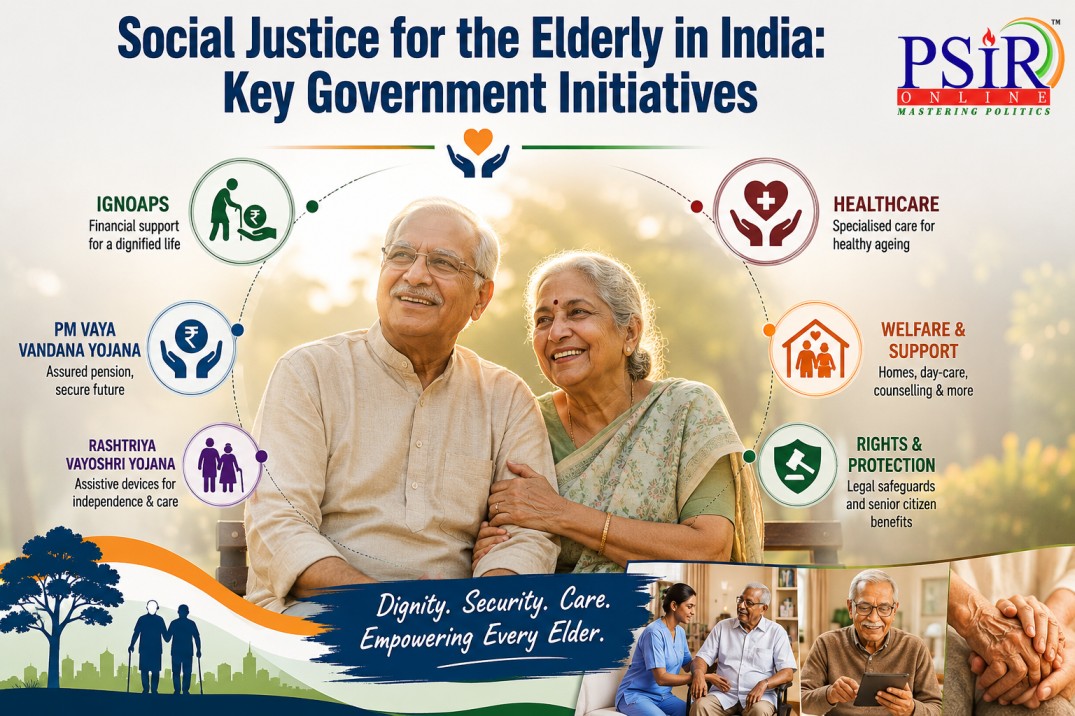
The elderly population (aged 60+) in India is growing rapidly due to improved life expectancy and declining fertility rates. As per projections, it is expected to rise significantly in the coming decades. This demographic shift poses challenges related to income security, healthcare, social isolation, and dignity. The Indian Constitution, through Directive Principles (Articles 41, 46), mandates the state to provide public assistance in cases of old age, unemployment, and sickness. Successive governments have responded with a mix of pension support, health programmes, assistive devices, and welfare schemes under the broader framework of social justice in GS Paper 2.
1. INDIRA GANDHI NATIONAL OLD AGE PENSION SCHEME (IGNOAPS) UNDER NSAP
Launched in 2007 (renamed from National Old Age Pension Scheme), IGNOAPS is a core component of the National Social Assistance Programme (NSAP), implemented by the Ministry of Rural Development. It is a non-contributory, social assistance scheme targeting vulnerable elderly.
Eligibility:
· Age: 60 years and above.
· Belongs to Below Poverty Line (BPL) household.
· No regular income or support from family (destitute focus).
Benefits:
· ₹200 per month (60–79 years) from Central Government.
· ₹500 per month (80+ years).
· Many states/UTs provide top-ups (₹50 to ₹5,700+), leading to an average of around ₹1,100 in several states.
Significance: It ensures basic income security for the poorest elderly, reducing vulnerability to poverty and neglect. Challenges include delays in disbursement, identification of beneficiaries, and limited coverage of non-BPL elderly.
2. PRADHAN MANTRI VAYA VANDANA YOJANA (PMVVY)
This is a pension scheme administered by LIC and backed by the Government of India, launched in 2017 to provide assured income amid falling interest rates.
Key Features:
· Eligibility: Indian citizens aged 60+.
· Investment: Minimum ₹1.5 lakh; Maximum ₹15 lakh (per senior citizen).
· Term: 10 years.
· Pension: Monthly/quarterly/half-yearly/yearly options at an assured rate (e.g., ~7.4% p.a. in later years).
· Return of purchase price at maturity; full return to nominee on death.
Current Status (2026): New subscriptions closed after 31 March 2023, but existing policies continue. It complements contributory options like Senior Citizens Savings Scheme (SCSS).
This scheme targets middle-income elderly seeking stable returns and protection against market volatility.
3. ATAL VAYO ABHYUDAY YOJANA (AVYAY)
Atal Vayo Abhyuday Yojana (AVYAY) is an umbrella scheme of the Ministry of Social Justice and Empowerment aimed at ensuring dignity, security, care and empowerment of senior citizens. It moves beyond income support by addressing shelter, healthcare, nutrition, protection, social participation and productive ageing.
Its major components include Integrated Programme for Senior Citizens (IPSrC) for senior citizen homes and care services, State Action Plans for Senior Citizens (SAPSrC), Rashtriya Vayoshri Yojana for assistive devices, SCOPE for productive engagement of elderly persons, and SAGE to promote innovations and the emerging silver economy. Elderline (14567) provides information, guidance and support to senior citizens.
Thus, AVYAY reflects a broader shift in elderly policy:
From protecting senior citizens from vulnerability to enabling them to live with dignity, participate in society and remain active and productive.
4. RASHTRIYA VAYOSHRI YOJANA (RVY)
Launched in 2017 by the Ministry of Social Justice and Empowerment, RVY is a Central Sector Scheme fully funded from the Senior Citizens’ Welfare Fund and implemented by ALIMCO.
Eligibility:
· Age: 60+.
· BPL category (or low income, often capped around ₹15,000/month).
· Age-related disabilities: locomotor, visual, hearing, dental issues.
Benefits: Free physical aids and assisted-living devices (walking sticks, crutches, walkers, hearing aids, spectacles, dentures, wheelchairs). Distribution through camps; doorstep for 80+.
Objective: Restores near-normal bodily functions, promotes independence, and improves quality of life for poor elderly with disabilities.
OTHER MAJOR SCHEMES FOR THE ELDERLY
· National Programme for Health Care of the Elderly (NPHCE) (Ministry of Health & Family Welfare, launched 2010–11): Provides dedicated geriatric care at primary, secondary, and tertiary levels. Includes preventive, curative, rehabilitative services, and establishment of geriatric departments/wards. It focuses on healthy ageing and outpatient/inpatient services.
· Integrated Programme for Senior Citizens (IPSrC) / National Action Plan for Senior Citizens (NAPSrC) (Ministry of Social Justice & Empowerment): Supports old age homes, day-care centres, physiotherapy, counselling, and active ageing activities through NGOs and local bodies. Includes maintenance grants for homes and capacity building.
· Ayushman Vaya Vandana Card / Senior Citizen Health Coverage: Recent initiatives extend free or subsidised treatment (e.g., under Ayushman Bharat) for elderly, especially 70+.
· Maintenance and Welfare of Parents and Senior Citizens Act, 2007 (and amendments): Provides legal recourse for maintenance by children and establishes tribunals. It is a rights-based approach to social justice.
· Tax and Other Benefits: Higher income tax exemptions, Section 80D deductions, interest income exemptions, travel concessions (rail/air), and priority services.
ACHIEVEMENTS OF GOVERNMENT SCHEMES FOR THE ELDERLY
These schemes reflect a well-designed multi-pronged strategy that addresses the diverse needs of India’s ageing population — ranging from basic survival support to dignity, independence, and active ageing.
Income Security
· IGNOAPS under NSAP provides direct cash transfers to the poorest elderly, covering over 2.21 crore beneficiaries (as of recent data). It offers a central pension of ₹200–500 per month, supplemented by many states, and has significantly reduced extreme poverty and destitution among vulnerable seniors. Direct Benefit Transfer (DBT) and Aadhaar linkage have improved transparency and minimised leakages.
· PM Vaya Vandana Yojana (PMVVY) has extended assured pension income to middle-income senior citizens, shielding them from volatile market interest rates. By guaranteeing returns (around 7.4–8% p.a.) for 10 years with return of capital, it has promoted financial self-reliance and stability for lakhs of pensioners who could invest up to ₹15 lakh.
Healthcare
· National Programme for Health Care of the Elderly (NPHCE) has achieved nationwide coverage by establishing geriatric services in all 713 districts. This includes dedicated OPDs, IPDs, physiotherapy units, and laboratory services at district hospitals, along with 19 Regional Geriatric Centres (RGCs) for tertiary care. It has enabled millions of elderly to access specialised outpatient and inpatient services, promoting preventive and rehabilitative care.
Assistive Support
· Rashtriya Vayoshri Yojana (RVY) has distributed free assisted-living devices (walking aids, hearing aids, spectacles, wheelchairs, dentures, etc.) to over 3 lakh BPL senior citizens suffering from age-related disabilities. This has directly enhanced physical mobility, sensory functions, and overall independence, reducing dependency on family and institutions.
Institutional and Community Care
· Integrated Programme for Senior Citizens (IPSrC) / NAPSrC supports the establishment and maintenance of old age homes, day-care centres, continuous care homes for dementia patients, physiotherapy clinics, and mobile medicare units through NGOs and local bodies. It has facilitated hundreds of senior citizen homes and promoted active ageing programmes, fostering social engagement and emotional well-being.
Collectively, these initiatives align with SDG 1 (No Poverty) through income support and SDG 3 (Good Health and Well-being) via healthcare and assistive devices. They operationalise the spirit of the National Policy on Older Persons (1999), which emphasises financial security, healthcare, shelter, and active participation of seniors in society.
The schemes demonstrate a shift from fragmented welfare measures to a more integrated ecosystem, supported by legal backing under the Maintenance and Welfare of Parents and Senior Citizens Act, 2007. While coverage and funding have expanded over the years, the real achievement lies in mainstreaming elderly concerns within the broader social justice framework of Indian governance.
CHALLENGES IN IMPLEMENTING SCHEMES FOR THE ELDERLY
Despite notable progress, the welfare schemes for senior citizens in India continue to face several structural, operational, and emerging challenges that limit their effectiveness in delivering social justice.
Coverage Gaps
The BPL-centric approach remains a major limitation. Schemes like IGNOAPS and RVY primarily target Below Poverty Line households, excluding a large segment of vulnerable non-BPL elderly who may be economically marginalised but do not possess BPL cards. This exclusion error is significant: many genuine beneficiaries, especially in urban and semi-urban areas, are left out due to outdated or flawed BPL lists. Reports indicate that a substantial proportion of poor elderly remain uncovered, with exclusion rates as high as 60-70% in some states because of rigid eligibility criteria and documentation barriers. This creates inequities, particularly for the “near-poor” elderly who face similar vulnerabilities but fall outside the official poverty net.
Implementation Issues
Ground-level execution suffers from persistent problems:
· Leakages and delays: Even with Direct Benefit Transfer (DBT) and Aadhaar linkage, issues like failed transactions, delayed disbursements (sometimes 1–38 months), and suspension of pensions continue in several states. CAG audits have highlighted financial losses to beneficiaries due to administrative lapses.
· Low awareness: There exists a wide gap between awareness and utilisation. Many eligible elderly, especially in rural and remote areas, are unaware of schemes like IGNOAPS, RVY, or NPHCE services.
· Uneven state contributions: While the Centre provides core funding, state top-ups vary widely. Some states offer generous additions (e.g., ₹1,000–5,000+ pensions), while others provide minimal or no support, leading to regional disparities in outcomes.
Bureaucratic hurdles, lack of trained manpower, and poor convergence between schemes further weaken implementation.
Demographic Pressure
India’s elderly population (60+) is growing rapidly — projected to reach around 20% of the total population by 2050, with the number exceeding 300 million. This demographic shift is increasing the old-age dependency ratio significantly. The rising numbers are straining limited resources, infrastructure, and budgets.
Urban-rural and gender disparities are stark:
· Around 70% of the elderly live in rural areas with poorer access to healthcare and services.
· Elderly women are more vulnerable due to higher widowhood rates, lower economic independence (only ~10-11% in rural/urban areas), longer life expectancy, and greater risk of abuse and neglect.
These pressures risk overwhelming the existing welfare architecture if not addressed proactively.
Holistic Needs
Current schemes focus predominantly on basic income, physical health, and assistive devices, but fall short on broader dimensions of well-being:
· Mental health: Limited integration of geriatric mental health services despite rising cases of depression, dementia, and isolation.
· Skill utilisation and productive ageing: Minimal emphasis on leveraging the experience of seniors through skilling, livelihood programmes, or volunteering.
· Intergenerational bonding and social integration: Weak focus on community-based models, day-care centres, and efforts to counter the breakdown of joint families and social isolation.
Additional concerns include elder abuse (physical, emotional, financial), digital exclusion, and inadequate long-term care infrastructure.
Overall, these challenges highlight the need to move beyond a welfare-oriented, fragmented approach towards a more universal, rights-based, and integrated framework for elderly care. Addressing them effectively will be crucial for realising the vision of “Ageing with Dignity” in India.
SUGGESTIONS / WAY FORWARD
To overcome the existing limitations and build a more robust, dignified, and sustainable ecosystem for elderly care, the following measures are recommended:
1. Universalise Basic Pension with Automatic Indexation
The current BPL-centric approach under IGNOAPS should evolve into a universal old-age pension scheme covering all citizens above 60 or 65 years, irrespective of income status. A minimum assured pension (say ₹2,000–3,000 per month) indexed to inflation or Dearness Relief (similar to government employee pensions) would protect seniors from rising living costs.
This reform would eliminate exclusion errors, reduce administrative discretion, and ensure dignity for all elderly. Several countries like China, Brazil, and South Africa have successfully implemented near-universal pension models. In India, this can be phased in starting with the 75+ or 80+ age group (as partially done) and gradually expanded. Linking it with the proposed Universal Basic Income (UBI) pilots for vulnerable sections could provide fiscal feasibility.
2. Integrate Schemes under a Single Digital Platform
Fragmentation across ministries (Rural Development, Social Justice & Empowerment, Health) leads to poor convergence and low awareness. A unified Senior Citizens Welfare Portal (building on existing platforms like the Senior Citizens’ Portal) should be developed as a one-stop digital solution.
This portal should enable:
· Single registration for all schemes (IGNOAPS, RVY, NPHCE, IPSrC, PMVVY).
· Real-time tracking of pension credits, health records, and device distribution.
· AI-based eligibility checking and grievance redressal.
· Integration with PM-JANMAN, Ayushman Bharat, and state portals.
Such digital integration would enhance transparency, reduce leakages, improve last-mile delivery, and empower elderly (and their families) through user-friendly interfaces, including voice-based support in regional languages.
3. Strengthen Geriatric Training and Infrastructure
India faces a severe shortage of trained geriatric professionals. Medical and nursing curricula must mandatorily include geriatric care modules. The government should expand the network of Regional Geriatric Centres and dedicated geriatric wards beyond the current numbers.
· Establish at least one fully functional Geriatric Department in every medical college.
· Train ASHA workers, ANMs, and community health officers in basic elderly care.
· Promote public-private partnerships for specialised long-term care facilities (hospices, palliative care).
This would shift the focus from reactive treatment to preventive, promotive, and rehabilitative care, aligning with the goals of Healthy Ageing under the UN Decade of Healthy Ageing (2021–2030).
4. Promote Community-Based Models and Productive Ageing
Instead of over-reliance on institutional old-age homes, greater emphasis should be placed on community-centric models:
· Expand day-care centres, senior citizen clubs, and multi-generational community centres under IPSrC/NAPSrC.
· Encourage productive ageing by creating opportunities for seniors to utilise their experience — as mentors, teachers, consultants, or volunteers in education, skill development, and environmental programmes (e.g., “Senior Citizens as Climate Mentors”).
· Launch livelihood and skilling initiatives specifically for healthy elderly in the 60–75 age group.
These steps would reduce social isolation, strengthen intergenerational bonding, and convert the elderly population from a perceived “burden” into a valuable social capital.
5. Convergence with Ayushman Bharat, PMJJBY, and Digital Inclusion Initiatives
Stronger convergence is essential for holistic coverage:
· Automatically enrol all eligible elderly under Ayushman Bharat PM-JAY with enhanced coverage (e.g., higher sum insured for seniors).
· Integrate life and accident insurance through PMJJBY and PMSBY.
· Launch a dedicated Digital Inclusion Mission for seniors — providing smartphones, training in digital payments, tele-medicine, and online grievance filing.
· Link schemes with the Maintenance and Welfare of Parents and Senior Citizens Act through awareness drives and fast-track tribunals.
Additionally, increased budgetary allocation (currently less than 1% of GDP on elderly welfare), periodic evaluation by NITI Aayog, and incorporation of elderly-specific indicators in the Social Progress Index would strengthen accountability.
CONCLUSION
Aging is not merely a demographic challenge but a test of our civilisational values of respect and care for the elderly (Vridha Seva). By moving from a welfare-oriented, fragmented approach to a rights-based, integrated, and empowering framework, India can ensure “Adding Life to Years.”
Effective implementation of these suggestions, coupled with active state participation and community involvement, will be critical for realising the vision of Viksit Bharat where no senior citizen is left behind.
PRACTICE QUESTIONS FOR GS 2 MAINS
1. “India’s ageing population requires a transition from welfare-centric schemes to a rights-based and dignity-oriented social protection framework.” Examine in the context of major government initiatives for the elderly in India. (15 Marks)
2. Critically analyse the effectiveness of government schemes such as IGNOAPS, Rashtriya Vayoshri Yojana, and NPHCE in addressing the socio-economic and healthcare challenges of the elderly in India. (15 Marks)
3. Despite multiple welfare schemes, elderly persons in India continue to face issues of economic insecurity, social isolation, and inadequate healthcare. Discuss the major implementation challenges and suggest suitable policy measures for ensuring “Ageing with Dignity.” (20 Marks)
4. Digital governance and integrated welfare delivery are increasingly shaping social justice administration in India. Examine how technology-driven convergence can improve the effectiveness of elderly welfare schemes in India. (10 Marks)