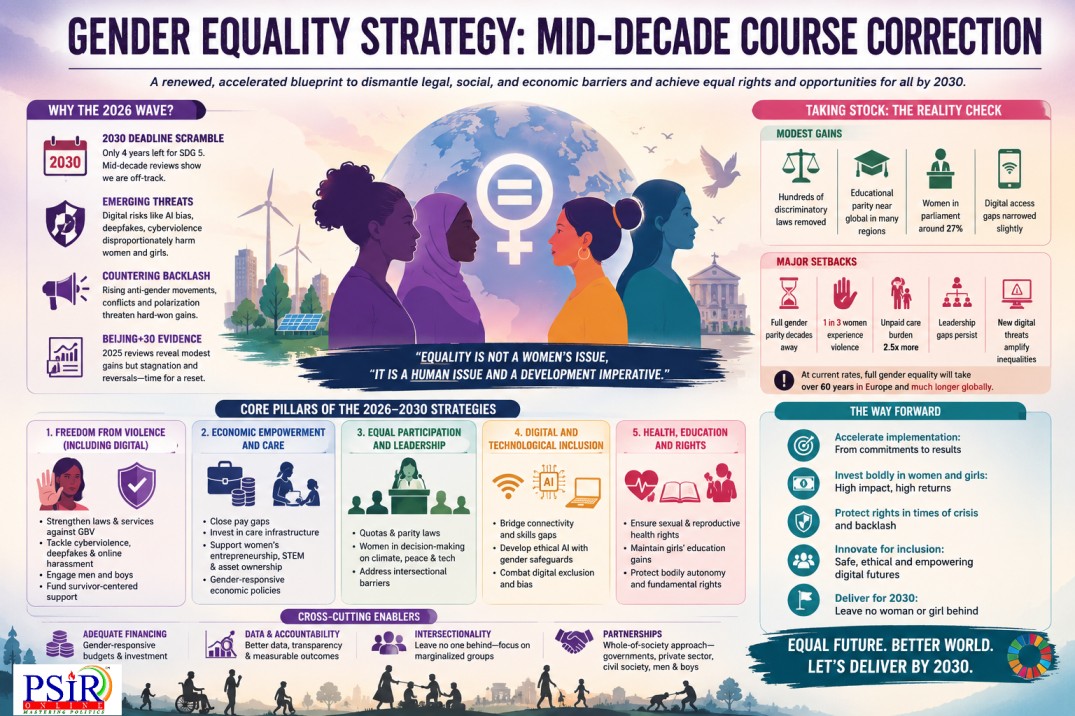
In early 2026, a wave of new gender equality strategies rolled out from major international organizations. The European Commission released its Gender Equality Strategy 2026–2030 in March. UNDP published its Gender Equality Strategy 2026–2029 in April. UN Women and UNICEF aligned their 2026–2029 plans with the final push toward the 2030 Agenda. These documents represent a deliberate mid-decade course correction—a refreshed, accelerated blueprint to dismantle legal, social, and economic barriers preventing equal rights and opportunities for people of all genders.
A Gender Equality Strategy serves as a comprehensive action plan used by governments and organizations. It identifies systemic obstacles and deploys targeted policies, investments, and accountability mechanisms to achieve parity. While such strategies are not new, the 2026 cohort stands out for its urgency and adaptation to contemporary realities. With only four years left until the 2030 deadline for the Sustainable Development Goals (SDGs)—especially SDG 5 on gender equality—these frameworks signal a global “scramble” for accelerated impact.
This article explains the current landscape, why this wave of strategies emerged now, persistent gaps, root causes, and a practical roadmap forward. It draws on the latest releases from UNDP, the EU, UN Women, and others to provide clear, actionable insights.
WHY THE 2026 WAVE? UNDERSTANDING THE TIMING OF MID-DECADE STRATEGIES
Organizations like UNDP, the EU, UNICEF, and UN Women timed these releases for compelling reasons. Here are the key drivers:
· The 2030 Deadline Scramble: The world committed to SDG 5 by 2030. Mid-decade reviews (especially Beijing+30 in 2025) revealed that progress is off-track. These new strategies act as “accelerators” for the final four-to-five-year sprint. UNDP explicitly positions gender equality as one of three core accelerators in its 2026–2029 Strategic Plan.
· Addressing Emerging Threats: Earlier strategies under-addressed digital risks. The new EU Strategy explicitly targets AI-related risks, sexually explicit deepfakes, cyberviolence, and online harassment—issues that have surged and disproportionately harm women and girls. UNDP and others integrate digital transformation with safeguards.
· Countering Global Backlash: A rising “anti-gender” narrative, authoritarian shifts, and conflicts threaten hard-won gains. The EU Strategy openly acknowledges “escalating backlash” and commits to opposing any backtracking on rights. New plans double down on protecting and advancing fundamental rights amid polarization.
· Evidence from Beijing+30 Reviews: The 2025 thirtieth anniversary of the Beijing Platform for Action produced extensive national reports and UN assessments. These showed modest gains alongside stagnation or reversals, prompting a data-driven reset for the second half of the decade.
These strategies are not standalone documents. They complement national action plans and emphasize intersectionality, financing, and measurable outcomes.
TAKING STOCK: PROGRESS, SETBACKS, AND THE CAUSES OF STAGNATION
Global assessments at mid-decade paint a sobering picture.
Modest Gains:
· Legal reforms continue (hundreds of discriminatory laws removed in recent years).
· Educational parity is near-global in many regions.
· Women’s parliamentary representation has risen to around 27%.
· Digital access gaps have narrowed slightly in some areas.
Major Setbacks:
· Full gender parity remains decades or centuries away at current rates.
· Extreme poverty still has a female face; violence affects one in three women.
· Unpaid care work burdens women 2.5 times more than men.
· Leadership gaps persist in management, boards, and peace processes.
· New digital threats compound old inequalities.
The EU’s own Gender Equality Index projects it will take over 60 years for full equality in Europe alone. Globally, the picture is worse in many regions. This data justified the mid-decade pivot.
Root Causes of Stagnation
Progress stalls due to interlocking barriers:
· Structural Inequalities: Discriminatory norms, unequal asset ownership (e.g., land), and the motherhood penalty in labor markets.
· Crises and Backlash: Conflicts, climate shocks, economic fragmentation, and anti-gender movements.
· Financing and Implementation Gaps: Gender-responsive budgets remain underfunded.
· Data Deficits: Insufficient sex-disaggregated and intersectional data.
· Digital Transformation Risks: Without safeguards, AI and online spaces amplify bias and violence.
CORE PILLARS OF THE 2026–2030 STRATEGIES
While each organization tailors its approach, common pillars emerge from UNDP, EU, UN Women, and Beijing+30 frameworks.
1. Freedom from Violence (Including Digital)
· Strengthen laws and services against gender-based violence (GBV).
· Tackle cyberviolence, deepfakes, and online harassment (a major EU focus).
· Engage men and boys in prevention.
· Fund survivor-centered support systems.
2. Economic Empowerment and Care
· Close pay gaps and promote equal opportunities.
· Invest in care infrastructure (childcare, eldercare) to reduce unpaid work burdens.
· Support women’s entrepreneurship, leadership in STEM/AI, and asset ownership.
· UNDP emphasizes gender-responsive economic policies and sustainable finance.
3. Equal Participation and Leadership
· Use quotas, parity laws, and pipelines for political and corporate roles.
· Promote women in decision-making on climate, peace, and technology.
· Address intersectional barriers for marginalized groups.
4. Digital and Technological Inclusion
· Bridge connectivity and skills gaps.
· Develop ethical AI with gender safeguards.
· Combat digital exclusion and bias (cross-cutting in new strategies).
5. Health, Education, and Rights
· Ensure sexual and reproductive health rights.
· Maintain high standards in education and lifelong learning.
· Protect rights amid backlash.
6. Climate, Peace, and Humanitarian Action
· Integrate gender into climate plans and disaster response.
· Advance Women, Peace and Security agenda.
· Support women human rights defenders.
Cross-Cutting Enablers:
· Financing: Gender-marked budgets and innovative funding.
· Data and Accountability: Robust monitoring with indicators.
· Partnerships: Whole-of-society approach involving governments, civil society, private sector, and youth.
· Intersectionality: Address overlapping discriminations (race, disability, migration status, ETC.).
IMPLEMENTATION ROADMAP: FROM STRATEGY TO IMPACT
Translating high-level gender equality strategies into tangible, measurable change requires disciplined execution at national, regional, and local levels. The 2026 strategies from the EU, UNDP, UN Women, and partners move beyond aspirational language by emphasizing concrete actions, timelines, accountability mechanisms, and multi-stakeholder partnerships. Success hinges on adapting global frameworks to local realities while maintaining rigorous oversight.
Below is an expanded, practical roadmap structured around the core elements, with specific tools, timelines, responsibilities, and examples drawn from the latest strategies.
1. National Alignment: Localizing Global Commitments with Budgeted Action Plans
Global strategies succeed only when embedded in national contexts. Organizations strongly urge countries to develop or update tailored plans.
· Develop or Revise National Gender Equality Action Plans (GEAPs): The EU Strategy calls on all Member States to adopt or strengthen national plans by 2027, aligned with the EU framework and the Violence Against Women Directive. UNDP supports country offices in integrating gender equality as an “accelerator” across national development priorities, linking it to poverty reduction, governance, climate action, and digital transformation.
· Budget Integration: Mandate gender-responsive budgeting (GRB) in all public expenditures. The EU introduces technical guidance for tracking gender equality expenditure in the next Multi-Annual Financial Framework (MFF). Countries should allocate at least 5–10% of sectoral budgets (education, health, infrastructure) with explicit gender markers. UNDP emphasizes aligning public finance, taxation, and debt instruments to gender goals.
· Intersectional and Contextual Adaptation: Plans must address overlapping discriminations (e.g., rural women, ethnic minorities, persons with disabilities, LGBTQ+ individuals). Conduct participatory consultations with civil society and affected communities during drafting.
· Timeline and Milestones: Complete national plans by end-2027; include annual implementation reports and mid-term reviews in 2028.
Practical Tip: Use tools like the UN Women/UNDP Gender Equality Seal for public institutions to certify progress and build institutional capacity.
2. Monitoring and Accountability: Annual Scorecards, Mid-Term Reviews, and Transparent Data
Robust monitoring turns commitments into results and enables rapid course adjustments.
· Annual Gender Equality Scorecards: Publish national and organizational dashboards using standardized indicators (e.g., from the EU Gender Equality Index, WEF Global Gender Gap, and SDG 5). Track progress on pay gaps, violence prevalence, leadership representation, digital access, and care work distribution.
· Mid-Term and Thematic Reviews: Conduct comprehensive mid-decade reviews in 2028, feeding into the final 2030 evaluation. The EU Strategy commits to regular reporting on the 30 concrete measures, including implementation of the Pay Transparency Directive and Work-Life Balance Directive.
· Independent Oversight: Strengthen national equality bodies, involve parliaments, and support civil society shadow reporting. UNDP and UN Women promote integrated results frameworks with clear baselines, targets, and sex-disaggregated data.
· Digital Tools for Transparency: Leverage open data platforms and AI-supported monitoring (with safeguards against bias) to track expenditures and outcomes in real time.
Expected Outcome: Early identification of lagging areas (e.g., cyberviolence response) allows reallocation of resources within 12–18 months.
3. Resource Mobilization: Doubling Investments and Innovative Financing
Chronic underfunding remains a primary barrier. The new strategies treat financing as a core pillar.
· Scale Up Public Funding: Aim to double gender-marked Official Development Assistance (ODA) and domestic budgets. The EU commits to gender-sensitive budgeting across all programs and continued support for civil society via CERV and ESF+ funds.
· Private Sector and Blended Finance: Promote gender bonds, impact investing, and corporate Gender Equality Seals. UNDP targets leveraging over $100 billion through taxation, public spending, and private capital.
· Care Economy Investment: Fund infrastructure for childcare, eldercare, and parental leave. The EU advances a European Care Deal by 2027.
· Targeted Funds for Emerging Issues: Create dedicated envelopes for digital safety (anti-deepfake initiatives), women’s health research, and climate-gender projects.
Accountability Measure: Require all major donors and governments to report annually on the percentage of budgets contributing to gender equality outcomes.
4. Policy Integration: Gender Mainstreaming Across All Sectors
Gender equality must become a lens applied to every policy, not a standalone silo.
· Mandatory Gender Mainstreaming: Embed analysis in all new legislation, trade agreements, AI regulations, and infrastructure projects. The EU Strategy integrates gender across the Union of Equality framework and requires gender checks in medicine approval and clinical trials.
· Sector-Specific Actions:
o Digital and AI: Structured regulatory dialogue with Very Large Online Platforms (VLOPs) to combat cyberviolence; capacity building for trusted flaggers.
o Economy and Trade: Enforce pay transparency; support women in STEM and entrepreneurship; address occupational segregation via initiatives like “Girls Go STEM” and “Boys in HEAL”.
o Health: Launch flagship WHO partnerships for gender-sensitive research, diagnostics, and treatment (including menopause and menstrual health).
o Climate and Crisis: Integrate gender into Nationally Determined Contributions (NDCs) and humanitarian response.
· Legislative Acceleration: Fast-track transposition of directives (e.g., EU Violence Against Women Directive by mid-2027) and close remaining legal gaps in inheritance, land rights, and workplace harassment.
5. Engagement and Partnerships: Whole-of-Society Mobilization
Sustainable change requires broad buy-in.
· Involving Men and Boys: The EU Strategy explicitly recognizes their role and benefits, launching initiatives to shift norms around care, violence prevention, and career choices. UNDP scales community-based programs promoting positive masculinities.
· Amplifying Women’s Movements and Civil Society: Provide sustained, flexible funding and protect defenders. The EU and UNDP commit to partnership frameworks with feminist organizations.
· Multi-Stakeholder Platforms: Establish national gender equality councils involving government, private sector, academia, youth, and unions. Foster South-South and triangular cooperation.
· Youth and Private Sector Engagement: Integrate gender modules in education and corporate ESG reporting; run mentorship and leadership pipelines.
|
EU-Specific Depth: The Strategy outlines 30 concrete measures across pillars, including: · Regulatory dialogue on online violence. · Toolkit on gender-neutral job evaluation. · Assessment of corporate board gender balance directive. · Initiatives on women’s health gap and housing inequality.
|
|
UNDP Focus: As a country-level accelerator, UNDP prioritizes integrated portfolios (not isolated projects), policy advisory services, and scaling solutions in 80+ countries on care services, clean energy access, and digital assets for women. |
|
OVERCOMING COMMON IMPLEMENTATION PITFALLS · Political Will: Counter backlash through high-level leadership and public communication of economic benefits. · Capacity Building: Train officials, judges, police, and journalists on gender-responsive approaches. · Evaluation and Learning: Use rigorous, independent evaluations to refine approaches annually. · Sustainability: Design exit strategies so national institutions own the agenda beyond 2030.
|
SEIZING THE MID-DECADE MOMENT
The 2026 gender equality strategies mark a pivotal course correction. They respond to the 2030 deadline, emerging threats like AI-driven violence, and global backlash with renewed ambition and evidence-based action. UNDP, the EU, UN Women, UNICEF, and partners provide blueprints—not just documents, but calls to accelerate.
Success depends on political will, adequate financing, accountability, and inclusive partnerships. Gender equality is a multiplier for all SDGs, a driver of economic prosperity, and a cornerstone of justice and peace.
With four years remaining, the question is not whether another strategy is needed—but whether we will implement these boldly enough to deliver real equality by 2030. The mid-decade correction is here. Now is the time to act decisively for all women, girls, and people of all genders.
PRACTICE QUESTIONS FOR GS 2 MAINS
1. “The 2026 Gender Equality Strategies of global institutions represent a mid-decade course correction toward achieving SDG-5.” Examine the major drivers behind this renewed global push for gender equality.
2. Discuss how emerging digital challenges such as AI bias, cyberviolence, and deepfakes have transformed the discourse on gender equality in contemporary governance frameworks.
3. “Gender equality is not merely a social justice issue but a developmental and governance imperative.” Analyse in the context of economic empowerment, political participation, and care economy reforms.
4. Critically evaluate the role of international organizations such as United Nations Development Programme, UN Women, and European Commission in advancing global gender equality agendas.
PRACTICE QUESTIONS FOR PSIR OPTIONAL
1. “The contemporary global gender equality discourse reflects the intersection of liberal feminism, intersectionality, and global governance.” Critically examine.
2. Analyse the impact of globalization and digital transformation on gender relations in world politics, with special reference to cyberviolence and AI governance.
3. “International institutions increasingly frame gender equality as a strategic component of peace, development, and democratic governance.” Discuss with reference to contemporary global policy frameworks.
4. Critically examine the challenges posed by anti-gender movements and rising authoritarian tendencies to the global human rights regime and feminist internationalism.