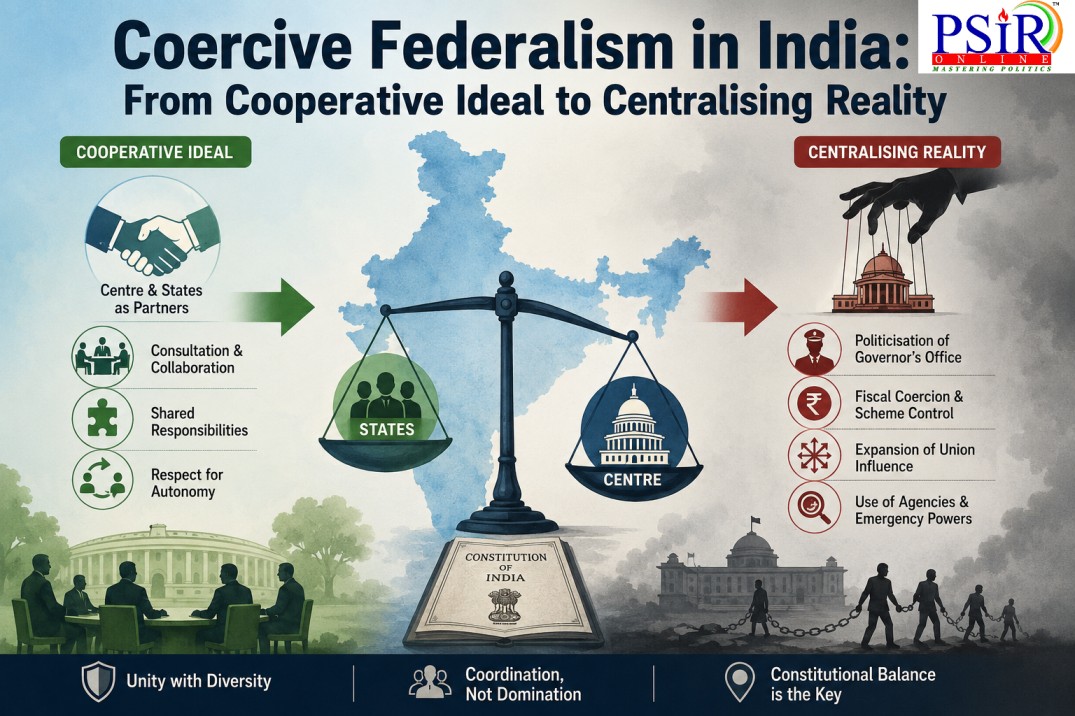
The Indian Constitution created a federal system that is unusual in nature because it combines a strong Union with constitutionally empowered States. It is often described as a Union of States under Article 1, which shows that the framers did not imagine India as a loose confederation, but neither did they intend an over-centralised unitary structure. Instead, the constitutional design aimed to balance national unity with regional autonomy, allowing the Centre and States to work together as partners in governance.
The idea behind this arrangement is cooperative federalism, where different levels of government consult, coordinate, and share responsibilities in a manner that respects each other’s constitutional space. Institutions such as the Inter-State Council, NITI Aayog, and the GST Council were meant to strengthen this spirit of collaboration and shared decision-making.
However, recent debates suggest that this ideal is being weakened by a growing tendency toward coercive federalism or coercive centralism. In simple terms, this means the Union government increasingly uses constitutional, fiscal, and administrative instruments to dominate States, reduce their discretion, and turn them into implementers of centrally decided policies rather than equal participants in the federal process.
The issue gained fresh attention in 2026 after public interventions by political leaders, especially Karnataka Chief Minister Siddaramaiah. His warnings about a shift from cooperative federalism to coercive centralism, along with Tamil Nadu’s concerns over Governor-related delays, fiscal inequities, and the need for a new federal compact, have made this a major constitutional and political debate.
UNDERSTANDING COERCIVE FEDERALISM
Coercive federalism is not a constitutional phrase found in Indian law. It is instead an analytical concept used to describe situations where the Centre begins to exercise excessive control over States through legal, financial, or institutional means. In the Indian context, it reflects a growing imbalance in which the Union becomes far more powerful than the States, not just in text but in actual governance practice.
Its basic logic is simple:
· the Centre does not merely coordinate with States;
· it increasingly directs or constrains them;
· and it often uses authority, funds, or institutions as instruments of pressure rather than partnership.
Some common features of coercive federalism in India include:
· Politicisation of the Governor’s office. The Governor’s discretionary space is often criticised when assent to State bills is delayed or withheld.
· Fiscal coercion. Centrally sponsored schemes, restricted fund flexibility, and disputes over GST compensation can reduce State autonomy.
· Expansion of Union influence. The Centre may rely on the Concurrent List and residuary powers to enter policy areas that States believe should remain under their control.
· Selective use of central agencies and emergency powers. Critics argue that investigative bodies and constitutional emergency provisions are sometimes used in ways that weaken federal balance.
Unlike the cooperative model, where the Centre and States negotiate as partners, coercive federalism treats States more like subordinates. That changes federalism from a shared constitutional project into a top-down system of control.
WHY IT IS TRENDING
The debate on coercive federalism became especially visible in early 2026 because several political and structural issues came together at the same time. The issue is not new, but recent developments have made it more urgent and more politically charged.
The major reasons are:
· Siddaramaiah-Stalin initiative. Karnataka and Tamil Nadu leaders openly framed the issue as one of constitutional imbalance, not just administrative inconvenience.
· Delimitation concerns. The upcoming delimitation exercise has intensified fears in southern States that political representation may shift against them.
· Governance tensions. Repeated disputes over Governors, central schemes, and implementation delays have made the problem visible in daily administration.
· No formal constitutional amendment. Since the Constitution has not been officially altered in this direction, the centralisation appears to be happening through practice rather than text, which makes it harder to notice and correct.
These developments have positioned coercive federalism as a live constitutional issue, especially in opposition-ruled and southern States that feel their voice is shrinking in national decision-making.
SPIRIT OF FEDERALISM
The spirit of Indian federalism rests on cooperation, autonomy, and balance. The Constitution gives the Union a stronger hand in several areas because India is a large and diverse country, but this does not mean that States are meant to be subordinate units without real autonomy.
The basic idea can be understood in three points:
· Unity is essential, but not at the cost of diversity.
· The Centre must coordinate, not dominate.
· States must remain constitutionally meaningful actors, not administrative extensions of Delhi.
The recommendations of bodies such as the Sarkaria Commission and the Punchhi Commission clearly show that a strong Centre must still respect the constitutional space of the States. The Supreme Court has also supported a federal reading of the Constitution. In cases such as S.R. Bommai, the Court placed limits on the misuse of Article 356 precisely to protect federalism from arbitrary central domination.
Coercive federalism undermines this spirit by reducing the significance of regional diversity. India’s States differ in language, economy, social structure, political priorities, and development needs. When central control becomes too heavy, these differences receive less attention, and governance becomes more uniform than the Constitution intended.
CONSEQUENCES AND IMPACTS OF COERCIVE FEDERALISM
The impact of coercive federalism is not limited to constitutional theory. It affects governance, politics, and development in practical ways.
Its major consequences include:
· Reduced governance efficiency. When bills are delayed, funds are released slowly, or State policies are obstructed, development suffers at the ground level.
· Regional discontent. Southern States, especially, argue that better demographic performance and stronger revenue contribution are not being adequately rewarded.
· Democratic erosion. If States lose meaningful decision-making power, elected governments at the State level become weaker and less accountable to their own citizens.
· Economic costs. Uniform national schemes often ignore State-specific needs in sectors like health, education, and agriculture.
· Stronger Centre-State suspicion. Repeated friction can damage trust and make ordinary coordination harder.
In short, the problem is not only about legal authority. It also shapes how citizens experience governance and how regions perceive fairness within the Union.
MEASURES TO RESTORE BALANCE
Restoring the federal balance requires institutional, fiscal, judicial, and political reforms. The goal should not be to weaken the Union, but to make it genuinely cooperative.
Key measures include:
· Strengthen the Inter-State Council. It should become a more active and empowered body for consultation and dispute resolution.
· Revive Zonal Councils. These can help address region-specific issues more effectively.
· Codify the Governor’s role. Clear guidelines are needed to limit arbitrary delays in assent to bills and other discretionary actions.
· Improve fiscal federalism. States need greater flexibility in the use of funds and a fairer share in tax devolution.
· Reform the GST Council. States should have a stronger voice in decisions that affect their revenues and policy space.
· Enforce S.R. Bommai strictly. Article 356 must not become a tool of political pressure.
· Create faster dispute-resolution mechanisms. Centre-State conflicts should not remain unresolved for long periods.
· Institutionalise consultation. States should be consulted before major decisions on the Concurrent List, national schemes, and international commitments.
· Empower local governments. Panchayats and Municipalities should be strengthened as the third tier of democracy.
· Approach delimitation carefully. Population should matter, but not as the only basis for political influence.
These reforms would not dismantle central authority. They would simply ensure that national strength is built on a healthier federal partnership.
CONCLUSION
Coercive federalism marks a serious departure from the constitutional ideal of unity with diversity. India needs a strong Union, but a strong Union cannot come at the cost of weakening the States that give the federation its social, cultural, and political depth.
The better path is not confrontation but dialogue, consultation, and institutional reform that restores the balance between national cohesion and State autonomy. A mature federation thrives when its parts feel respected, not when they feel managed.
PRACTICE QUESTIONS FOR GS 2 MAINS
1. “The Indian model of federalism was designed to balance national unity with regional autonomy.” In the light of recent debates on coercive federalism, critically examine the changing nature of Centre–State relations in India.
2. Discuss how fiscal centralisation and the functioning of centrally sponsored schemes have affected the spirit of cooperative federalism in India.
3. Examine the constitutional and political controversies surrounding the role of Governors in India’s federal structure. How do such controversies impact democratic governance?
4. “A strong Union does not necessarily require weak States.” Analyse this statement in the context of contemporary federal debates including delimitation, GST disputes, and Article 356.
PRACTICE QUESTION S FOR PSIR OPTIONAL
1. Critically analyse the transition from cooperative federalism to coercive federalism in India. How does this transformation affect the constitutional balance between the Union and the States?
2. “Indian federalism is structurally centralised but politically negotiated.” Evaluate this statement with reference to contemporary Centre–State conflicts.
3. Discuss the relevance of the Sarkaria Commission and Punchhi Commission recommendations in addressing present-day challenges to Indian federalism.
4. How far has the Supreme Court acted as a guardian of federalism in India? Examine with reference to the S.R. Bommai Case and recent Centre–State disputes.