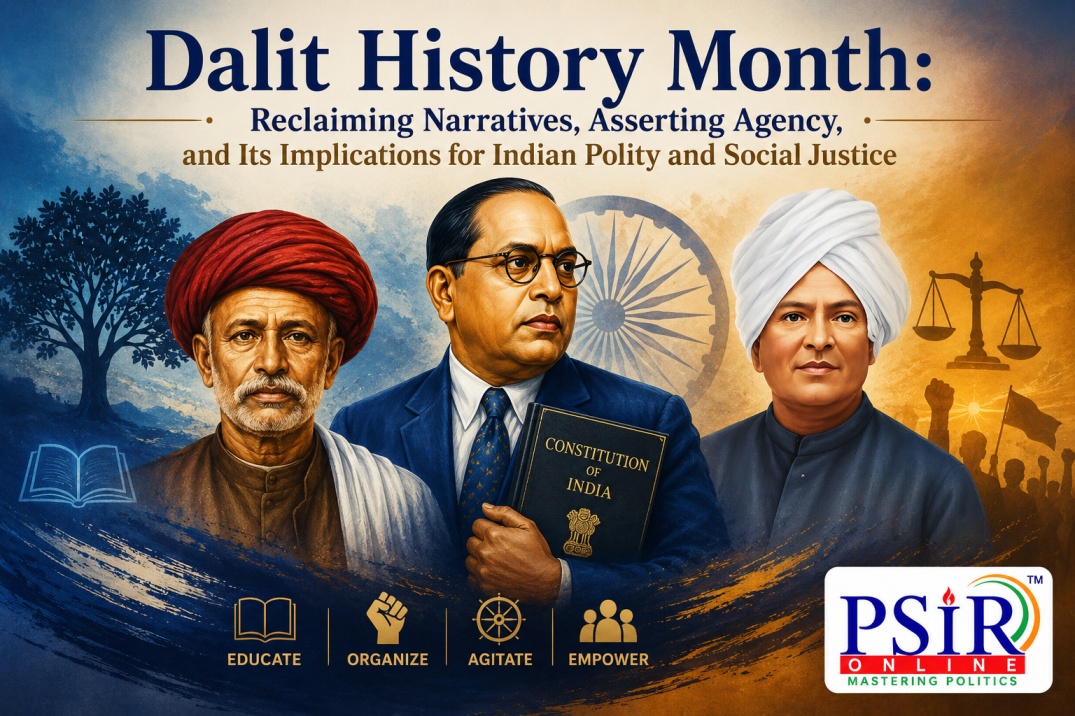
Dalit History Month, observed annually throughout April, has emerged as a significant socio-political and cultural phenomenon in contemporary India and the global Ambedkarite diaspora. Initiated in 2015 by the Dalit History Month Collective—a group of activists including Thenmozhi Soundararajan and others—it draws inspiration from movements like Black History Month. April holds symbolic importance as it marks the birth anniversaries of Dr. B.R. Ambedkar (April 14) and Jyotirao Phule (April 11), towering figures in the anti-caste struggle.
HISTORICAL AND IDEOLOGICAL FOUNDATIONS
The observance seeks to counter the epistemic erasure of Dalit (and broader Bahujan) contributions in mainstream historical narratives dominated by upper-caste perspectives. It celebrates resistance, cultural heritage, intellectual traditions, and political assertions of Scheduled Castes (and often Scheduled Tribes), while spotlighting persistent caste-based discrimination.
Key themes include:
· Ambedkarite Thought: Emphasis on constitutionalism, annihilation of caste, conversion (to Buddhism), and education as tools of empowerment.
· Pre-Ambedkar Reformers: Recognition of Phule, Savitribai Phule, Ayothee Doss Pandithar, and others who challenged Brahminical hegemony.
· Modern Icons: Figures like Kanshi Ram, Mayawati, and various Dalit writers, artists, and activists.
This aligns closely with Ambedkar's critique of social democracy without political and economic democracy, as articulated in his works like Annihilation of Caste.
OBSERVANCE AND ACTIVITIES
In India, Dalit History Month features a vibrant array of events organized primarily by Ambedkarite groups, civil society organizations, and student collectives:
· Talks, Lectures, and Seminars: Discussions on caste, intersectionality (caste-gender, caste-class), and Ambedkar's legacy.
· Rallies and Public Gatherings: Processions, especially around Ambedkar Jayanti on April 14, often in Delhi (at Ambedkar statues or Parliament) and other cities.
· Cultural Expressions: Art exhibits, screen printing workshops, literature festivals, music, and storytelling sessions highlighting Dalit life worlds, festivals, and resistance.
· Social Media Campaigns: Hashtags, digital storytelling, and sharing of marginalized histories amplify reach.
· Academic and Institutional Events: Universities and organizations host panel discussions; for instance, events in Chennai and Delhi in recent years focused on resilience, ongoing atrocities, and policy interventions.
Internationally, it has gained traction in the diaspora, with official recognition in places like British Columbia, Canada, underscoring the global dimension of caste discrimination, particularly in tech sectors and labor markets.
RELEVANCE FOR PSIR STUDENTS: CASTE, POLITICS, AND DEMOCRACY
For students of Political Science and International Relations, Dalit History Month offers rich analytical material across several core areas:
1. Identity Politics and Social Movements:
· It exemplifies how subaltern groups construct counter-publics to challenge hegemonic narratives. The rise of BSP under Kanshi Ram and Mayawati demonstrates the transition from social to electoral power, influencing coalition politics and federal dynamics in North India.
· Intersection with Mandal Commission (1990) and post-Mandal assertions highlights the politicization of caste, shifting from a "vote bank" approach to autonomous Dalit-Bahujan politics.
2. Constitutionalism and Social Justice:
· Ambedkar's role as Chairman of the Drafting Committee underscores the Constitution's transformative potential through Articles 15, 16, 17 (abolition of untouchability), 46, and reservations. Dalit History Month reinforces debates on the efficacy of affirmative action versus the need for broader annihilation of caste.
· Ongoing issues like atrocities (under SC/ST Atrocities Act), manual scavenging, and under-representation in higher judiciary and academia point to the gap between formal and substantive equality.
3. Comparative Politics and Global Human Rights:
· Parallels with anti-racism movements (Black Lives Matter) invite comparisons between caste and race. International campaigns against caste-based discrimination (e.g., at UN forums) link to India's soft power and diaspora politics.
· Diaspora assertions raise questions about transnational advocacy and how liberal democracies address non-Western forms of hierarchy.
4. Political Theory:
· Engagement with Ambedkar's ideas on democracy, state, and religion offers a powerful indigenous critique of liberalism and Marxism in the Indian context. It questions Rawlsian justice or Habermasian public sphere when filtered through caste realities.
5. Current Challenges and Debates:
· While celebrating contributions, the month highlights persistent discrimination, honor killings, and violence. It also sparks contestations: accusations of "divisiveness" versus claims of necessary historical correction. In an era of majoritarianism and cultural nationalism, such observances test the limits of pluralism and free speech.
CRITICAL REFLECTIONS
Dalit History Month is not merely commemorative; it is performative politics. It challenges the "sanskritization" model of mobility and promotes "Ambedkarization"—pride in Dalit identity and structural transformation. However, critics argue it risks essentializing identities or overlooking intra-Dalit hierarchies (e.g., among sub-castes). For PSIR scholars, this invites nuanced analysis: How does one balance recognition of group rights with the constitutional vision of a casteless society?
In conclusion, Dalit History Month serves as a powerful annual reminder of India's unfinished project of social democracy. It underscores that true political science in the Indian context must grapple with caste as a central axis of power, inequality, and resistance. For aspirants and students, engaging with it deepens understanding of how marginalized voices reshape democratic practice, policy, and national memory. As Ambedkar warned, political democracy without social democracy remains hollow. Observances like this push us closer to realizing the constitutional promise of justice, liberty, equality, and fraternity.
PRACTICE QUESTIONS FOR PSIR OPTIONAL
1. “Dalit History Month represents the transformation of caste from a social category into a politically assertive identity.” Critically examine this statement in the context of contemporary Indian democracy.
2. Discuss the relevance of Ambedkarite constitutionalism in addressing the limitations of formal equality in India. How does Dalit History Month revive debates on substantive democracy and social justice?
3. “The rise of Dalit assertion movements reflects both the deepening and the contradictions of Indian democracy.” Analyze with reference to Dalit History Month, identity politics, and caste-based mobilization in India.
4. Compare caste-based discrimination in India with race-based discrimination in Western democracies. How do transnational Dalit movements and Dalit History Month shape contemporary debates on human rights and global justice?