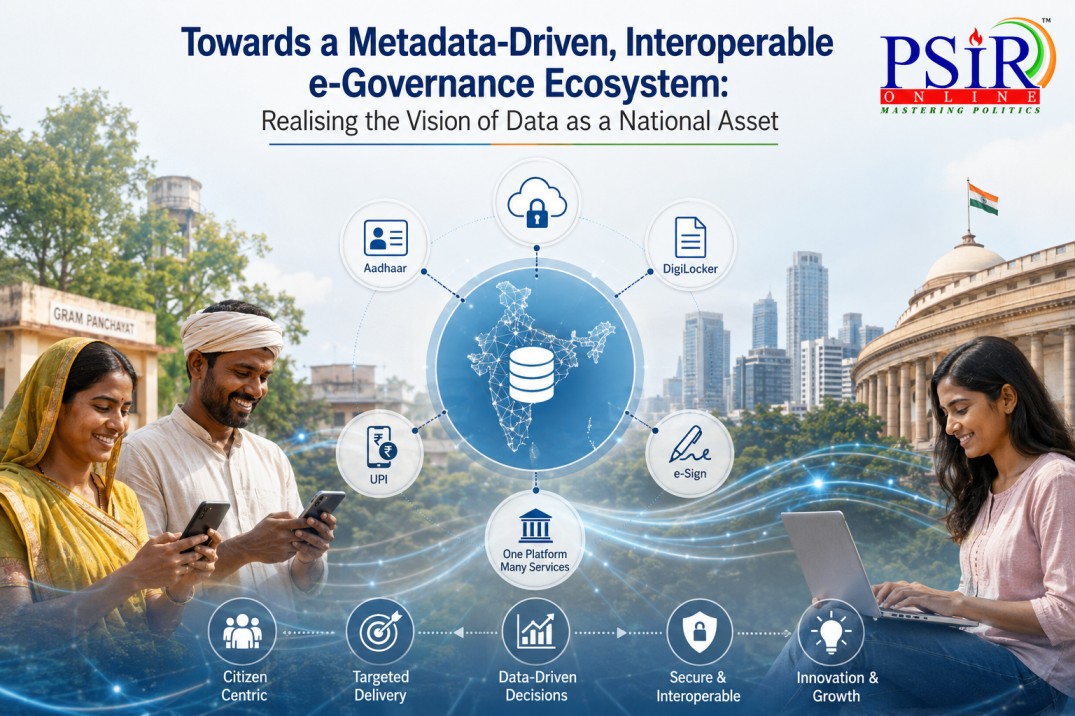
In a significant address to civil servants, Prime Minister Narendra Modi underscored the need to elevate e-governance beyond mere digitisation of services. He emphasised the development of an interoperable metadata framework, treating administrative data as a national economic asset, and the urgent dismantling of departmental data silos. This vision reflects a paradigm shift from fragmented, department-centric digital tools to a unified, intelligent, and citizen-centric governance architecture.
For UPSC aspirants, this holds relevance under GS-2 (Governance, e-governance applications, models, successes, limitations, and potential), aligning with Digital India, Mission Karmayogi, and the broader goal of Minimum Government, Maximum Governance.
UNDERSTANDING THE INTEROPERABLE METADATA FRAMEWORK
Metadata is "data about data" — it includes structured information on service rules, eligibility criteria, workflows, required documents, timelines, and integration points. A metadata-driven framework allows services to be configured dynamically through low-code/no-code (LCNC) platforms rather than rigid, custom-coded applications for each department.
Interoperability ensures that these services and underlying data systems can seamlessly communicate across ministries, states, and platforms using standardised protocols, APIs, and common data standards.
This approach transforms e-governance from static online portals (G2C transactions) to a flexible "service mesh" where data flows securely, enabling real-time analytics, predictive governance, and one-stop service delivery.
Practical implementation: serviceplus by nic
A prime example is ServicePlus, developed by the National Informatics Centre (NIC) under MeitY. Launched as part of the e-Panchayat Mission Mode Project, it is a metadata-based, LCNC e-service delivery framework. Key features include:
· Multi-tenancy: Departments configure services as per their needs without heavy coding.
· Integration with core digital public infrastructure (DPI) — Aadhaar, DigiLocker, e-Sign, payment gateways, etc.
· End-to-end service lifecycle: Application, processing, tracking, and grievance redressal on a single platform.
By mid-2025, ServicePlus had crossed 400 million applications, demonstrating its scalability across central, state, and local governments.
Administrative Data as a National Economic Asset
This echoes the National Data Governance Framework Policy (NDGFP) and ongoing efforts by MoSPI/NSO to harmonise administrative data. Data generated through citizen-government interactions (schemes, grievances, surveys) is no longer a byproduct but a strategic asset for:
· Evidence-based policymaking.
· Targeted welfare delivery and leakage reduction.
· AI/ML applications for predictive analytics (e.g., disaster management, resource allocation).
· Fostering innovation and economic growth (anonymised data as a public good).
Recent initiatives, such as the 2026 National Deliberative Summit on “Harmonizing Administrative Data for Governance,” aim to create interoperable, AI-ready datasets across states.
|
VERY SIMPLE PRACTICAL EXAMPLE: APPLYING FOR A BIRTH CERTIFICATE
Imagine a villager in Tamil Nadu wants a Birth Certificate for his child. Here's how the old way vs. the new interoperable metadata framework (like ServicePlus) works:
Old Traditional Way · The villager goes to the local Panchayat office. · Fills a paper form (different format in every district). · Officer manually checks records in a dusty register. · Sends a letter to the hospital for verification (takes weeks). · No tracking — he keeps visiting again and again. · If he also needs a ration card or scholarship, he repeats the whole process in different offices with the same documents.
Problem: Every department has its own software or register → data silos. Same information (name, address, parents' details) is entered again and again.
New Way with Interoperable Metadata Framework (ServicePlus) 1. One Portal / App (serviceonline.gov.in or ServicePlus mobile app) The citizen logs in with Aadhaar (or visits a Common Service Centre). 2. Metadata Magic (the “data about data” part) A Panchayat officer (no need for computer programmer) sits in front of the computer and configures the service in 1-2 days using simple drag-and-drop: a. What fields to show in the form? (Baby’s name, date of birth, parents’ names…) b. Which documents are needed? (Hospital record, Aadhaar) c. Who approves it? (Panchayat → Tehsildar) d. How many days? (Say, 15 days as per state rule) e. Automatic SMS alerts at every step. 3. All this information is stored as metadata — not hard-coded software. So changing a rule (e.g., adding new document) is just editing metadata. 4. Interoperability in Action (systems talk to each other) a. When the citizen uploads hospital record, it can automatically pull data from DigiLocker. b. Aadhaar verifies identity automatically. c. Payment (if any) goes through UPI. d. Once approved, the digital Birth Certificate is issued and can be directly used for ration card, school admission, or passport without uploading again. 5. Result for Citizen a. Applies from home or CSC in local language. b. Gets real-time tracking like “Your application is with Tehsildar”. c. Receives SMS + digital certificate. d. Same data is reused for other services automatically.
Real Impact (as of 2025) · Over 3,400+ different services (birth/death certificate, building permission, old-age pension, trade licence, etc.) are running on this same platform across India. · More than 400 million applications processed. · One officer can configure a completely new service in days instead of months. · Simple Analogy: Think of metadata framework like a Lego set. · Earlier: Every department built its own complete toy from scratch (expensive, no sharing). · Now: Government has one big Lego base plate + standard blocks. Any department can quickly build their service by arranging blocks (metadata). All toys (services) fit together and share pieces (data) easily.
|
LINKAGES WITH BROADER REFORMS
The interoperable metadata framework does not operate in isolation. It forms a critical layer in India’s larger digital governance ecosystem and directly complements several flagship reforms. This synergy is essential for moving from fragmented digitisation to holistic, data-driven governance.
1. PM Gati Shakti – Breaking Silos in Infrastructure Planning
PM Gati Shakti National Master Plan (launched 2021) is a GIS-based platform that integrates 1,600+ data layers from 57+ central ministries and all states/UTs for multi-modal infrastructure planning.
· How the metadata framework complements it: Just as Gati Shakti breaks physical infrastructure silos through a common geospatial platform, the metadata framework breaks administrative and service delivery silos.
· Both rely on standardised metadata (data about data) for discoverability and integration. For example, once a road or port project is planned on Gati Shakti, the metadata-driven service layer can automatically trigger related approvals (land acquisition, environmental clearance, utility shifting) through ServicePlus-like platforms.
· Result: Faster project execution, reduced delays, and real-time monitoring — turning “data as an asset” into practical infrastructure outcomes.
2. Mission Karmayogi – Building Data-Smart Civil Servants
Mission Karmayogi (National Programme for Civil Services Capacity Building) aims to shift civil servants from rule-based to role-based governance through continuous learning on the iGOT Karmayogi platform.
· Direct linkage: The metadata framework requires officers to think and work differently — configuring services via low-code tools, managing data quality, and using analytics for decision-making.
· Mission Karmayogi provides the human capital for this: modules on data governance, AI-driven analytics, metadata management, and digital service design are being integrated into iGOT courses.
· Officers trained under Karmayogi can effectively use the metadata platform to configure new services in days instead of months, and treat administrative data as a strategic asset rather than a departmental record.
This creates a virtuous cycle: better technology needs better-trained officers, and better-trained officers unlock the full potential of technology.
3. India Stack & Digital Public Infrastructure (DPI) – Foundational Layers for Interoperability
India Stack (Aadhaar + UPI + DigiLocker + Account Aggregator + ONDC + e-Sign, etc.) provides the foundational “rails” on which any advanced e-governance system runs.
|
India Stack Component |
Role in Metadata Framework |
|
Aadhaar |
Unique identity & authentication for every service |
|
DigiLocker |
Auto-fetching of documents (birth certificate, educational certificates, etc.) |
|
UPI / Payments |
Seamless, paperless payment integration |
|
e-Sign & Account Aggregator |
Consent-based, secure data sharing across departments |
|
ONDC & Other DPIs |
Enables extension to private sector services |
The metadata framework sits on top of these foundations. It uses India Stack to make services truly interoperable. For instance, once a citizen’s data is verified via Aadhaar and stored securely, the metadata rules decide how and when that data can be reused across 30+ different services without repeated submission.
This combination turns India Stack from “foundational identity & payments” into “intelligent, end-to-end governance”.
Overall Synergy
· PM Gati Shakti → Integrated planning
· Metadata Framework (ServicePlus) → Integrated service delivery
· Mission Karmayogi → Integrated capacity
· India Stack/DPI → Integrated foundations
Together they create a whole-of-government digital ecosystem where data flows securely, services are delivered seamlessly, and civil servants are equipped to use both effectively.
CHALLENGES IN IMPLEMENTATION
While the vision of an interoperable metadata framework is transformative, its successful rollout faces several structural, technical, human, and federal challenges. These must be addressed for the shift from basic digitisation to intelligent, data-driven governance.
1. Legacy Systems and Silos
Many ministries and departments continue to operate on outdated, custom-built applications developed over the last 15–20 years. These systems are often monolithic (rigid and non-modular), use different data formats, coding languages, and databases, making integration extremely difficult.
For example, land records (Bhulekh), health data (under Ayushman Bharat), and municipal services run on incompatible platforms. Migrating these to a metadata-driven system like ServicePlus requires massive data mapping, cleansing, and re-engineering — a costly and time-consuming process. Resistance from departments fearing loss of control over “their” data further slows progress.
2. Data Quality, Privacy & Security
Administrative data is often incomplete, inconsistent, duplicated, or outdated (e.g., wrong addresses, mismatched names with Aadhaar). Poor data quality leads to wrong decisions and failed service delivery.
The Digital Personal Data Protection (DPDP) Act, 2023 adds another layer of complexity. While it mandates consent, purpose limitation, and security safeguards, government departments (as major data fiduciaries) must now implement:
· Granular consent mechanisms
· Data minimisation
· Regular audits
· Grievance redressal
Challenges include:
· Balancing rapid data sharing for seamless services with privacy protection.
· Risk of data breaches (as seen in past Aadhaar leaks and CoWIN incidents).
· Capacity of the Data Protection Board to enforce rules effectively.
Without strong data quality standards and robust cybersecurity, the “national economic asset” can quickly become a liability.
3. Digital Divide: Last-Mile Connectivity and Digital Literacy
Despite BharatNet and CSC expansion, a significant urban-rural gap remains. Many rural areas still face:
· Unreliable electricity
· Poor or expensive internet
· Low smartphone penetration among elderly and marginalised groups
Digital literacy is low — a large section of citizens (especially in states like Bihar, Odisha, and parts of Tamil Nadu’s rural areas) cannot navigate portals independently. This forces continued physical visits, defeating the purpose of metadata-driven online services. Linguistic barriers (most platforms are not fully available in all 22 scheduled languages) further exclude citizens.
4. Capacity Gaps Among Civil Servants
Most officers are trained in traditional rule-based administration, not in:
· Metadata configuration
· Low-code platforms
· Data analytics
· AI-driven governance
Configuring a new service on ServicePlus or managing data as an asset requires new skills. Without widespread training, officers may continue manual processes or under-utilise the platform. Mission Karmayogi is addressing this, but scaling such capacity building across lakhs of officers remains a big challenge.
5. Federal Coordination: Centre-State-Local Alignment
India’s federal structure adds complexity. While the Centre develops frameworks like ServicePlus and India Stack, states have their own legacy systems, priorities, and political compulsions.
· Some states (e.g., Tamil Nadu, Karnataka, Telangana) are advanced.
· Others lag due to limited IT budgets or infrastructure.
Issues include:
· Lack of uniform metadata standards across states.
· Reluctance to share data with the Centre.
· Different timelines and funding patterns.
True interoperability requires strong coordination through bodies like the National e-Governance Division, but differing political alignments often create friction.
WAY FORWARD
To translate this vision into reality, India needs a focused, multi-pronged strategy that addresses legacy issues, builds institutional capacity, and leverages technology. The following actionable steps can accelerate the transition to a robust interoperable metadata-driven e-governance ecosystem:
1. Mandate Adoption of ServicePlus-like Frameworks with Standardised Metadata Schemas
All Central Ministries and Departments should be mandated to migrate or build new services on a common metadata-based platform such as ServicePlus (or its enhanced version).
· Develop and enforce national metadata standards (schemas for service rules, workflows, data fields, and integration points) so that every service follows uniform design principles.
· Set clear timelines — for example, 80% of citizen-facing services to be onboarded within 2–3 years.
· Provide viability gap funding and technical support from NIC/MeitY for states and smaller departments.
This will eliminate duplication, reduce development costs, and enable true plug-and-play interoperability across government levels.
2. Establish a Robust India Data Management Office (IDMO)
Create a dedicated India Data Management Office (IDMO) under the Digital India Corporation (MeitY) as originally envisaged in the draft National Data Governance Framework Policy.
Key responsibilities:
· Define data quality standards, metadata protocols, and secure sharing guidelines.
· Act as a central steward for non-personal and anonymised administrative datasets.
· Manage the “India Datasets Platform” for researchers, startups, and policymakers.
· Conduct regular audits and capacity-building workshops for ministries.
A strong IDMO will ensure administrative data is treated as a national economic asset — curated, discoverable, and reusable while maintaining trust and security.
3. Accelerate Capacity Building under Mission Karmayogi with Focus on Data Governance
Mission Karmayogi’s iGOT platform (which has already crossed 1.26 crore users) should prioritise data-related competencies.
· Introduce mandatory modules on:
o Metadata configuration and low-code platforms
o Data quality management and analytics
o AI applications in governance
o Privacy and consent management under DPDP Act
· Set annual learning targets (e.g., minimum 40–50 hours on digital governance topics) for all civil servants, especially field-level officers.
· Recognise and incentivise “Data Champions” in every department.
This will create a workforce capable of configuring services quickly and using data for evidence-based decisions rather than routine paperwork.
4. Promote Open APIs and Consent-Based Data Exchange while Safeguarding Privacy
· Adopt Open API standards across all government platforms to enable secure, real-time data exchange between departments.
· Fully implement consent-based architecture (building on Account Aggregator framework) so citizens can control which department can access their data and for what purpose.
· Ensure strict compliance with the Digital Personal Data Protection (DPDP) Act, 2023 through regular audits and grievance mechanisms.
This approach will allow seamless service delivery (e.g., auto-fetching documents) without compromising citizen privacy.
5. Leverage Emerging Technologies like AI for Automated Service Configuration and Anomaly Detection
· Integrate AI/ML tools into the metadata framework for:
o Automatic suggestion of service rules and workflows
o Real-time anomaly detection (e.g., detecting fake documents or suspicious patterns)
o Predictive analytics for grievance redressal and scheme targeting
· Use generative AI to help officers draft service configurations in natural language.
· Combined with IndiaAI Mission initiatives, this will make the system intelligent and future-ready.
Additional Supporting Measures
· Pilot Projects: Launch 5–6 high-impact national pilots (e.g., Birth/Death Certificate, Pension, Building Permission) in selected states to demonstrate success.
· Monitoring & Incentives: Create a national dashboard for tracking adoption and reward top-performing ministries/states.
· Public-Private Partnership: Engage industry for technology support while retaining sovereign control over data.
PM Modi’s emphasis on an interoperable metadata framework represents the next frontier of e-governance — moving from digitisation to digital transformation and ultimately to data-led intelligent governance. By treating administrative data as a national asset and dismantling silos, India can achieve transparent, efficient, and inclusive public service delivery. For civil servants and aspirants alike, this is not just a technological upgrade but a governance philosophy rooted in citizen-centricity and evidence-based administration. Successful implementation will be key to realising Viksit Bharat by 2047.
PRACTICE QUESTIONS FOR GS 2 MAINS
1. “India’s transition from digitisation to interoperable metadata-driven governance marks a paradigm shift in public administration.” Examine the significance of metadata frameworks like ServicePlus in achieving citizen-centric governance. Also discuss the major implementation challenges.
2. Administrative data is increasingly being viewed as a “national economic asset” in India’s governance ecosystem. Analyse the opportunities and risks associated with this approach in the context of the Digital Personal Data Protection Act, 2023.
3. Discuss how interoperable e-governance frameworks complement broader reforms such as PM Gati Shakti, Mission Karmayogi, and India Stack. How can this convergence improve governance outcomes in India?
4. “Technology alone cannot ensure successful digital governance reforms.” Evaluate this statement with reference to the capacity gaps, federal coordination issues, and digital divide challenges in implementing metadata-driven governance systems in India.