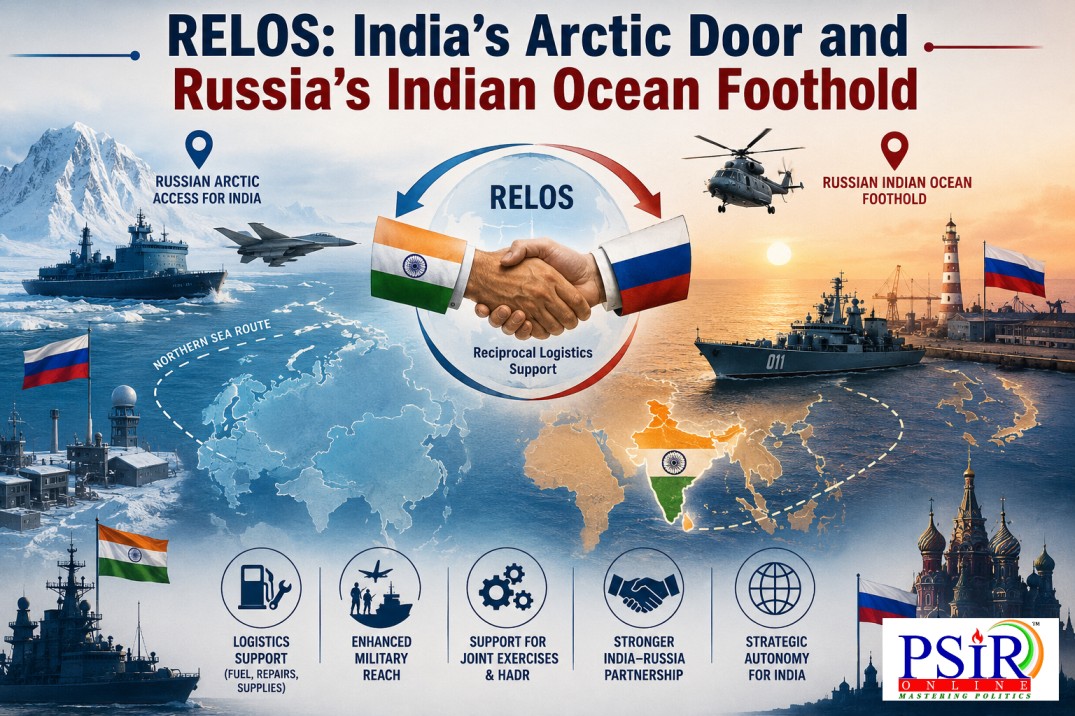
Reciprocal Exchange of Logistics Support (RELOS) is a bilateral military logistics agreement between India and Russia.
|
Key Details · Signed: February 18, 2025, in Moscow. · Ratified by Russia: December 15, 2025 (by President Vladimir Putin). · Entered into force: January 12, 2026 (initially for 5 years, renewable by mutual consent).
|
WHAT RELOS ALLOWS?
It establishes procedures for the reciprocal use of each other's military facilities, enabling smoother logistics for both countries' armed forces. Key provisions include:
· Deployment and access — Mutual stationing of up to 3,000 troops, 5 warships, and 10 military aircraft at any given time.
· Facilities — Access to ports, airbases, and related infrastructure (e.g., refueling, repairs, maintenance, supplies, accommodation, medical care, transport, water, electricity).
· Scope — Primarily for joint military exercises, training, port calls by warships, use of airspace/airfields, and Humanitarian Assistance and Disaster Relief (HADR) missions. It can extend to other mutually agreed scenarios (including in conflict, per some reports).
· Reimbursement — Services provided on a reimbursable basis with simplified procedures and rolling settlements to reduce paperwork.
|
It is not a full military alliance or basing agreement but a practical framework to facilitate operations and interoperability |
REACTIONS FROM MAJOR COUNTRIES
Reactions from major countries to the India-Russia RELOS agreement have been relatively muted in official terms, with most commentary coming from analysts, media, and indirect signals rather than strong public statements. The pact is often viewed through the lens of India's multi-alignment strategy amid shifting geopolitics (e.g., US pressure on Russia ties and perceived US tilt toward Pakistan).
United States
· No major official condemnation, but the agreement has raised eyebrows in Washington. It is seen as a sign of India's continued strategic autonomy and resistance to decoupling from Russia, especially under US sanctions pressure and tariffs.
· Analysts and commentators (e.g., Gordon G. Chang) linked it to US policy toward Pakistan, suggesting Washington's closer ties with Islamabad may be pushing India closer to Moscow.
· Some US perspectives view it pragmatically: It could indirectly serve US interests by keeping Russia from over-relying on China, while India maintains QUAD ties and LEMOA with the US. However, Russian access to the Indian Ocean is noted as a potential complication for US Indo-Pacific strategy.
· Overall, it's framed as India sending a signal that it cannot be taken for granted.
China
· Officially positive or neutral: China has welcomed broader India-Russia cooperation in the context of "Global South" ties and trilateral (RIC) engagement, emphasizing benefits for regional stability. No direct criticism of RELOS has been prominently reported.
· Underlying concerns: Analysts note potential unease. India's access to Russian Arctic/Far East bases could challenge China's Polar Silk Road ambitions, while Russian presence in the Indian Ocean might affect Beijing's Belt and Road maritime interests. Some see it as complicating China-Russia dynamics (Russia granting India access it likely wouldn't extend to China).
· Viewed in some quarters as a minor setback for China's regional influence, though not a major rupture.
Pakistan
· Strong negative sentiment: Pakistani media and commentators have expressed alarm, describing it as a "strategic nightmare" or setback. Concerns center on enhanced Indian military reach, potential Russian support/logistics for India in regional contingencies, and strengthened India-Russia defense interoperability.
· No formal government statement stands out, but public discourse frames it as tilting the regional balance further against Pakistan.
In summary, RELOS has not triggered a major diplomatic crisis. It reinforces perceptions of India's hedging/multi-alignment approach. Reactions are more analytical than confrontational, with the US expressing quiet concern, China maintaining diplomatic positivity with strategic reservations, and Pakistan showing visible unease. The low-key rollout (technical/administrative framing) has helped contain backlash.
REASONS FOR INDIA SIGNING RELOS
India signed the RELOS (Reciprocal Exchange of Logistics Support) agreement with Russia primarily for pragmatic, operational, and long-term strategic reasons — not as a direct “counter” to any single country or as leverage/blackmail against the US. It is an evolution of their decades-old defence partnership, framed officially as a technical/logistics pact to enable smoother military cooperation.
Here are the core drivers, in order of prominence across expert and media assessments:
1. Access to Russian Facilities in the Arctic, Pacific, and Far East This is the most frequently cited strategic benefit for India. RELOS gives Indian naval and air forces reliable logistics (refuelling, repairs, supplies) at Russian bases like Murmansk, Severomorsk (Arctic), and Vladivostok (Pacific/Far East).
a. India wants a footprint in the rapidly changing Arctic (new shipping routes, resources, minerals). The Northern Sea Route offers shorter, alternative paths to Europe/Asia.
b. It positions India as a stakeholder in a region where Russia and China are competing (China’s “Polar Silk Road”). This is about expanding India’s global operational reach and economic/security interests in the High North, not immediate combat posturing.
2. Sustaining and Supporting India’s Massive Russian-Origin Military Inventory Roughly 60–70% of India’s equipment (S-400 systems, Su-30MKI fighters, T-90 tanks, submarines, etc.) is Russian-made. Western sanctions on Russia have disrupted spares and maintenance. RELOS provides a streamlined, reimbursable framework for repairs, spares, and logistics support — reducing costs (estimates: 20–25%) and ensuring operational readiness. It shifts the relationship from “buyer-seller” to deeper operational cooperation.
3. Enhanced Operational Flexibility and Interoperability It simplifies joint exercises, training, port calls, airspace use, and Humanitarian Assistance/Disaster Relief (HADR) missions. Both sides can now deploy limited forces (up to 3,000 troops, 5 warships, 10 aircraft) for non-permanent, mutually agreed activities. This adds practical efficiency without creating permanent bases.
4. Strategic Autonomy and Multi-Alignment India is signalling that it will not fully decouple from Russia despite US/Western pressure (sanctions, tariffs, QUAD ties). It maintains balance in a multipolar world — keeping options open rather than choosing sides. The timing (operationalised amid perceived US “tilt” toward Pakistan under Trump) is seen by some analysts as New Delhi quietly reminding Washington that India has alternatives and cannot be taken for granted. This is hedging/autonomy, not blackmail.
In short: RELOS is a practical, win-win logistics upgrade that gives India Arctic reach, equipment sustainability, and operational ease while reinforcing its long-standing “Special and Privileged Strategic Partnership” with Russia. It fits India’s multi-alignment doctrine — cooperating with everyone without exclusive alliances. It is not framed as anti-anyone but as pro-India’s independent strategic interests.
REASONS FOR RUSSIA SIGNING RELOS
Russia signed the RELOS agreement primarily for pragmatic strategic and operational gains, with the most important benefit being reliable access to the Indian Ocean Region (IOR) through Indian naval and air bases.
Here’s a breakdown based on analyst assessments and reporting:
1. Strategic Foothold in the Indian Ocean (Biggest Driver) Russia has historically been a continental/Eurasian power with limited warm-water naval access. The Indian Ocean is one of the world’s most critical maritime highways (energy routes, trade chokepoints).
a. RELOS allows Russian warships, aircraft, and limited troops to use Indian ports/airbases for refueling, repairs, maintenance, supplies, and replenishment. This greatly increases deployment endurance without needing a large support fleet.
b. It gives Russia a low-cost way to project presence in a region long dominated by the US, China, and others — without permanent bases.
2. Countering Sanctions and Logistical Isolation Western sanctions after the Ukraine war have restricted Russia’s global operations (spares, maintenance, port access). RELOS provides a sanctions-resilient logistics channel with a trusted partner, helping sustain longer deployments and support for Russian-origin equipment.
3. Diversifying Partnerships and Hedging Against China Russia wants to avoid over-dependence on China. Access to India (a major buyer of Russian arms and a rising power) helps Moscow maintain influence in Asia and the Global South. It also gives Russia options in the Indo-Pacific without fully aligning with Beijing.
4. Strengthening the Long-Standing Partnership India remains one of Russia’s biggest defence customers. RELOS institutionalises cooperation for joint exercises, training, HADR missions, and maintenance — making the relationship more operational and future-proof.
In summary: For Russia, RELOS is a smart, low-risk way to gain a strategic southern foothold (Indian Ocean) in exchange for giving India northern access (Arctic/Pacific). It helps Moscow stay globally relevant amid sanctions, hedge against China, and deepen ties with a key partner — all while enhancing its naval flexibility. Like India’s reasons, it fits a broader multi-alignment and hedging strategy rather than a single anti-US or anti-anyone goal.
CAN RELOS CHANGE ASIAN POWER DYNAMICS?
Yes, the RELOS agreement has moderate potential to influence Asian power politics — more significantly in the long term than immediately. It is not a revolutionary alliance or game-changer on its own, but it adds a practical layer to multipolarity, expands operational geography, and subtly complicates major rivalries in the Indo-Pacific and beyond. Analyses from think tanks, media, and experts (as of May 2026, four months after it entered into force) describe it as a “geopolitical signal” or “strategic corridor” rather than an immediate disruptor.
Immediate Term (Next 1–3 Years): Limited but Symbolic Impact
· Primarily operational, not transformative: The pact enables smoother logistics for joint exercises, training, port calls, and HADR missions, with capped deployments (up to 3,000 troops, 5 warships, 10 aircraft). It has not yet led to large-scale or frequent use that shifts force postures dramatically. Many experts view it as “technical continuity” rather than a breakthrough, with its real effects depending on how actively both sides operationalize it.
· Signaling effect: It quietly reinforces India’s strategic autonomy and Russia’s global reach amid sanctions. This has prompted analytical commentary (especially in the US and China-watching circles) but no major diplomatic crises or policy U-turns so far.
· Regional reactions remain muted: No evidence of escalated tensions in South Asia or the broader Indo-Pacific directly attributable to RELOS. It adds a layer of complexity without altering core alliances (e.g., India’s QUAD ties or Russia-China partnership).
In short: Low immediate disruptive potential. It streamlines existing cooperation more than it rewires power balances right now.
Long Term (5–15+ Years In short:): Moderate to Notable Potential for Gradual Shifts
RELOS links two critical maritime theatres — the Arctic/Pacific (via Russian facilities like Murmansk and Vladivostok) and the Indian Ocean Region (IOR) — creating a “geopolitical corridor” that could influence future power distribution in Asia. Key ways it could matter:
· India’s expanded strategic footprint: Greater access to the Arctic (emerging Northern Sea Route, resources, minerals) positions India as a more global maritime player, not just a regional one. This supports long-term economic/security interests in new trade routes and counters China’s Polar Silk Road ambitions indirectly. It also bolsters India’s Indo-Pacific posture through easier Pacific access.
· Russia’s IOR presence: Gives Moscow a sanctions-resilient logistical foothold in a vital energy/trade chokepoint long dominated by the US and increasingly China. This enhances Russian naval endurance and multipolar projection without permanent bases.
· Effects on major players:
o China: Potential mild complication — India’s Arctic entry challenges Beijing’s near-monopoly on Polar Silk Road narratives; Russia’s IOR access adds another variable in Beijing’s maritime calculus.
o United States: Reinforces perceptions of India’s hedging, which could push Washington to deepen defense/tech cooperation with India (to reduce Russian dependence) while monitoring Russian IOR activity. It fits into a broader multipolar push that dilutes pure US-centric Indo-Pacific frameworks.
o Multipolarity & Global South: Strengthens the narrative of non-Western partnerships (BRICS angle) and shows how middle powers like India can build parallel logistics networks.
· Broader Asian dynamics: It contributes to a more “complicated balance of power” in the Indo-Pacific by institutionalizing India-Russia operational trust. However, its impact is constrained by factors like limited interoperability, India’s other logistics pacts (with US, France, etc.), and the fact that neither side seeks a formal military alliance.
Bottom line: RELOS is unlikely to “change” Asian power politics overnight, but over the longer horizon it has credible potential to incrementally reshape maritime access, resource competition (especially Arctic), and great-power calculations in favor of greater multipolarity and Indian strategic depth. It’s a pragmatic enabler that fits into — rather than single-handedly drives — the ongoing evolution of Asian geopolitics.
PRACTICE QUESTIONS FOR GS 2 MAINS
1. “India’s logistics agreements are increasingly becoming instruments of strategic autonomy rather than alliance politics.” Examine in the context of the India–Russia RELOS agreement.
2. Discuss how the RELOS agreement reflects the evolving nature of India’s multi-alignment strategy in a multipolar world order.
3. “The Arctic is emerging as a new theatre of geopolitical competition.” Analyse the strategic significance of India gaining access to Russian Arctic facilities through RELOS.
4. Evaluate the implications of the India–Russia RELOS agreement for Indo-Pacific geopolitics and Asian power dynamics.
PRACTICE QUESTIONS FOR PSIR OPTIONAL
1. “RELOS demonstrates the transition from territorial geopolitics to networked geopolitics based on logistics and connectivity.” Critically examine.
2. Analyse the RELOS agreement through the lens of Neo-Realism and Strategic Hedging in contemporary international relations.
3. “India’s foreign policy today reflects issue-based alignment rather than bloc-based alignment.” Discuss with reference to India’s simultaneous engagement with Russia, the QUAD, and the West.
4. Examine how the India–Russia RELOS agreement may contribute to the emerging multipolar order in Asia and the Indo-Pacific.