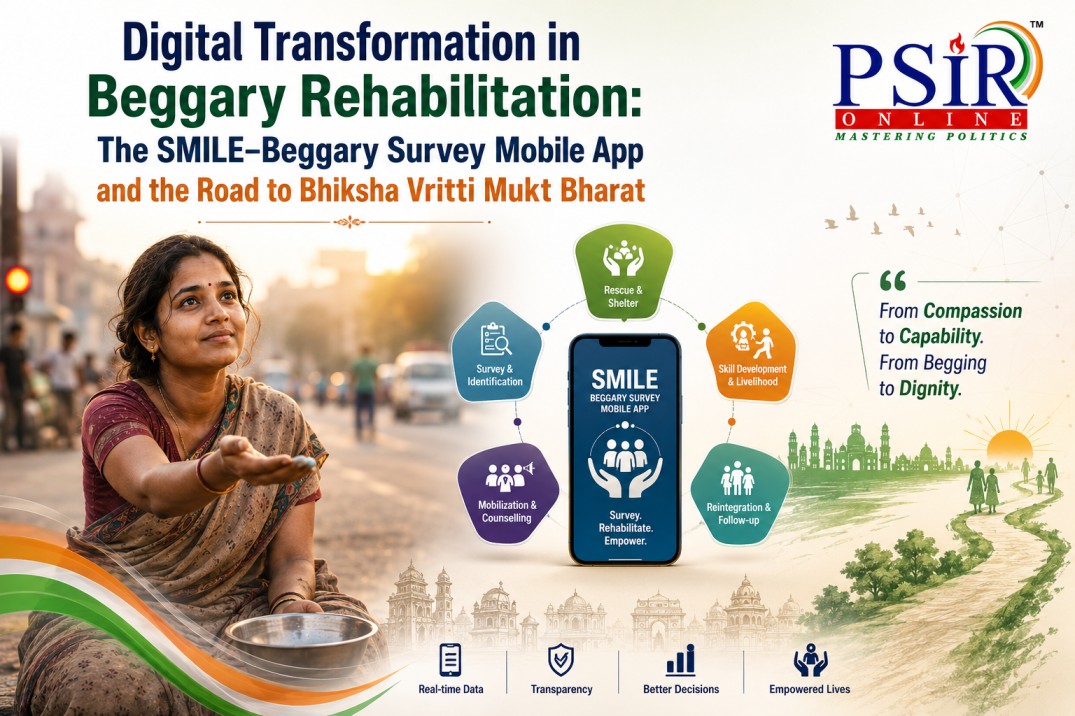
The SMILE–Beggary Survey Mobile Application is a digital tool launched on or around 25 April 2026 by India's Ministry of Social Justice and Empowerment during the Chintan Shivir (brainstorming workshop) with States/UTs in Chandigarh (24–26 April 2026).
It is not a new welfare scheme but a technological enhancement to improve implementation of the existing SMILE Scheme (specifically its Beggary sub-scheme).
BACKGROUND: THE SMILE SCHEME
· Full form: Support for Marginalized Individuals for Livelihood and Enterprise.
· Launched in February 2022 as a Central Sector (Umbrella) Scheme.
· It has two main sub-schemes:
o Comprehensive Rehabilitation for Welfare of Transgender Persons.
o Comprehensive Rehabilitation of Persons Engaged in the Act of Begging (the relevant one here).
CENTRAL SECTOR SCHEME FOR COMPREHENSIVE REHABILITATION OF PERSONS ENGAGED IN THE ACT OF BEGGING
The SMILE Scheme’s Beggary Sub-Scheme (officially the Central Sector Scheme for Comprehensive Rehabilitation of Persons Engaged in the Act of Begging) focuses on humane, multi-dimensional rehabilitation to achieve “Bhiksha Vritti Mukt Bharat” (Begging-Free India). It emphasizes rehabilitation over mere removal or punishment.
Core Objectives (from Official Guidelines)
· Comprehensive rehabilitation of persons engaged in begging.
· Provide shelter, medical care, counselling, education, skill development, and sustainable livelihood.
· Address root causes such as poverty, addiction, disability, family abandonment, and lack of skills.
· Ensure reintegration into mainstream society with dignity.
Step-by-Step Rehabilitation Process
The process follows a structured, sequential approach with strong convergence across government departments. The four main components are:
1. Survey & Identification
2. Mobilization
3. Rescue / Shelter Home Services
4. Comprehensive Resettlement & Reintegration (including follow-up)
1. Survey & Identification
· Local teams (Implementing Agencies — District Administration, Urban Local Bodies, Municipal Corporations, NGOs) conduct surveys in high-density areas: traffic signals, religious places, slums, transport stations, dumping yards, etc.
· Data collected includes: age, gender, family status, reasons for begging, substance abuse, disability, health issues, previous occupation, and geographic origin.
· Profiling helps categorize beneficiaries (children, women, elderly, disabled, addicts, families, etc.).
· The new SMILE–Beggary Survey Mobile App (launched April 2026) enables real-time digital data entry and geotagging.
2. Mobilization
· Outreach workers, volunteers, and police build trust with identified individuals.
· Spot counselling explains scheme benefits and encourages voluntary entry into rehabilitation.
· Awareness campaigns (IEC activities) are conducted via media and community outreach.
3. Rescue / Shelter Home Services
· Persons are brought (voluntarily or with support) to government or NGO-run Shelter Homes / Rehabilitation Centres (capacity typically 50–100 persons).
· Immediate services provided:
1. Primary hygiene, grooming, clothing, bedding, and nutritious food.
2. Registration and documentation (Aadhaar, ration card, bank account).
3. Primary health check-up and treatment.
4. Counselling (individual and group) and psychological support.
5. Linkage to de-addiction centres if needed.
6. Recreation, yoga, and basic life skills sessions.
· Separate arrangements for men, women, and children (with focus on education for children).
4. Comprehensive Resettlement & Reintegration
This is the longest phase, focusing on self-reliance:
· Health Care: Full medical support and linkages to government hospitals.
· Education: For children — linkage to schools, after-school tuitions.
· Skill Development & Livelihood:
1. Vocational training (tailoring, carpentry, cooking, security, e-rickshaw driving, gardening, sanitation, etc.).
2. Formation of Self-Help Groups (SHGs).
3. Linkages to banks for credit and micro-enterprises.
4. Placement support with industries or self-employment.
· Special Care: Linkages to Old Age Homes, disability welfare schemes, or long-term care for the sick/elderly.
· Family Reintegration: Efforts to trace and reunite with families where possible.
· Follow-up: Post-rehabilitation monitoring to prevent relapse.
The entire rehabilitation process in shelters is often designed for around 6 months, though it can vary based on individual needs.
Implementation Mechanism
· Central Nodal Agency: Ministry of Social Justice & Empowerment.
· Implementing Authorities: District Administration / Municipal Corporations / Urban Local Bodies.
· On-Ground Partners: NGOs, CBOs, and voluntary organizations selected through transparent processes.
· Funding: Central Sector Scheme (100% Central funding). Funds released in instalments based on performance.
· Monitoring: Through the SMILE-B National Portal (smile-b.dosje.gov.in) and the new mobile app for real-time tracking
WHAT IS THE SMILE–BEGGARY SURVEY MOBILE APPLICATION?
It is a field-level mobile app designed specifically for ground workers, implementing agencies (e.g., NGOs, municipal corporations, district officials), and shelter home operators.
Primary Purposes
· Enable real-time digital data collection during surveys (replacing or supplementing paper-based/manual processes).
· Improve accuracy, transparency, and timeliness of data.
· Strengthen monitoring, tracking, and performance evaluation across cities.
· Facilitate better coordination between field teams, districts, states, and the central ministry.
· Support evidence-based decision-making through data analytics.
Key Features
· Digital Survey Capture: Field teams can enter detailed beneficiary information on the spot (demographics, reasons for begging, health status, family details, skills, etc.) using standardized formats. This feeds directly into a centralized system.
· Real-time Reporting: Data syncs instantly, reducing delays and inconsistencies common in earlier manual systems.
· Monitoring Dashboard: Allows higher officials to track progress (e.g., number surveyed, rehabilitated, pending cases) across locations.
· Geotagging/Location Features (likely, as is common in such apps): Helps map high-density begging areas.
· Integration: Likely connects with the existing SMILE-Beggary National Portal for consolidated national-level data.
· User-friendly for Field Use: Designed for implementing agencies and district authorities working on the ground.
How It Fits into the Rehabilitation Process
The app primarily supports the first critical step — Survey & Identification — which is foundational for everything that follows:
1. Survey & Identification → (Now powered by the mobile app)
2. Mobilization to shelters
3. Rehabilitation (medical, counselling, skills)
4. Livelihood linkage & reintegration
5. Follow-up
By digitizing surveys, it reduces leakages, duplication, and delays, enabling faster and more targeted interventions.
|
ACHIEVEMENTS (AS ON 22ND MAY 2026)
BEGGARS IDENTIFIED: 31055 BEGGARS REHABILITATED: 9935 |
|
SUCCESS STORY (source: SMILE success stories Issue 01 V8)
Jyoti Prajapati- A Beacon of Hope Amidst Darkness
Background
Jyoti Prajapati’s life is a poignant testament to resilience and self-worth in the face of relentless adversity. Born into poverty at the age of 30, Jyoti’s early years were marked by hardship. Her marriage to Dinesh Rathore, from the small village of Raj Ganj Mandi near Tikamgarh, began with promise but quickly descended into turmoil. Dinesh’s battle with alcohol addiction and antisocial behavior brought severe strain to their lives, and Jyoti endured physical abuse that further compounded her suffering. In an act of profound bravery, Jyoti chose to separate from her husband and raise her children—Pooja, 13, and Golu, 7—on her own. This decision set her on a turbulent path filled with numerous challenges. A temporary refuge was provided by a friend of her husband, but this arrangement was unsustainable. Jyoti soon entered into a relationship with Om Prakash, a fellow villager, without formal marriage. Unfortunately, Om Prakash’s own struggles with alcohol and violence exacerbated their difficulties. The family relocated to Gwalior, but the harsh conditions continued, and the children’s education suffered. Faced with mounting despair, Jyoti moved to Bhopal, seeking to improve their lives through small ventures like selling bangles and bindis. However, her situation worsened as she fell victim to exploitation by a man named Kayyum, who threatened her children to manipulate her. One tragic night, Golu went missing at the Bhopal railway station, intensifying Jyoti’s agony. Jyoti moved to Indore with Pooja. She was not able to get any work hence they started begging outside ganpati temple.
Rescue and Rehabilitation
On February 28, 2024, Jyoti and her daughter Pooja were rescued by the “Sanstha PRAWES” organization, part of the SMILE Scheme. Jyoti was admitted to the Beggar Rehabilitation Center in Pardesipura. There, Jyoti received continuous counseling, and her daughter was brought in from the Child Welfare Committee to provide emotional support.
1. Intervention with her child: Pooja was placed in a child protection home, Pooja’s education was initiated, integrating her into the school system and offering her developmental opportunities.
2. Holistic healing: Jyoti’s transformation began with regular participation in yoga, meditation, music, and other activities designed to enhance her well-being and personality. The supportive environment and positive reinforcement played a crucial role in her recovery.
3. Livelihood intervention: By May 6, 2024, Jyoti had secured a position as a canteen helper at IMPETUS, a software company, earning a monthly salary of 9,000 rupees. This job marked a significant milestone in her journey towards regaining self-respect. Jyoti underwent 15 days of skill training in Operation and Management at the rehabilitation center of PRAWES, conducted by a skilled trainer. She was subsequently selected by IMPETUS for the canteen helper role and received an additional week of training from the company. Although she had also received training in handicraft, cooking, and incense stick making, she chose to pursue work in the canteen.
4. Access to entitlement: A bank account has been opened in her name, and she is in the process of registering for an Ayushman Bharat card and a Ration card. Additionally, efforts are underway to connect her with further government schemes to enhance her quality of life.
A New Beginning
Jyoti now plans to rent a room for herself and her children and is committed to continuing Pooja’s education. Jyoti expresses heartfelt gratitude to Honorable Prime Minister Narendra Modi for the “Beggar-Free India” campaign, which played a significant role in her transformation. Jyoti Prajapati’s story is a beacon of hope, illustrating how determination, courage, and the right support can lead to a brighter future. Her journey demonstrates that even in the darkest moments, with resilience and assistance, a new light can emerge, guiding one toward a path of self-respect and success
|
CHALLENGES IN THE SMILE SCHEME’S BEGGARY REHABILITATION
The scheme has made progress (identifying over 30,000 and rehabilitating around 10,000 by early 2026), but implementation faces several structural, behavioural, operational, and systemic hurdles.
1. Low Participation and Unwillingness of Beneficiaries
· Many individuals engaged in begging prefer it because they perceive higher immediate earnings compared to skilled labour or rehabilitation-linked jobs.
· Fear of economic loss during the rehabilitation period (typically ~6 months) leads to reluctance in joining shelter homes.
· Deep-rooted habits and distrust of authorities make building rapport difficult.
2. Complex Profiles and Special Needs
· A large proportion suffer from mental health issues, addiction, trauma, or disabilities, making approach, counselling, and rehabilitation challenging.
· Different categories (children, women, elderly, drug addicts, mentally ill) cannot be easily housed together due to safety and specialized care needs.
· Limited availability of dedicated mental health and de-addiction facilities.
3. Infrastructure and Capacity Constraints
· Limited shelter space — Many cities lack sufficient capacity to accommodate all identified persons.
· No funding for new shelter construction under the scheme; reliance on existing government/NGO shelters or rented spaces (with rent caps).
· Overcrowding and inability to rescue everyone who needs help.
4. Mafia and Exploitation Networks
· Strong resistance from special interest groups (traffickers, organized begging syndicates) who exploit vulnerable people for profit.
· These networks often discourage or prevent individuals from joining rehabilitation programmes.
5. Family Tracing and Reintegration Difficulties
· Lack of a centralized missing persons database.
· Beneficiaries often unwilling or unable (due to memory loss, dementia, long separation) to share accurate family details.
· Low priority given by local police in tracing families.
· Social stigma and family rejection make reintegration hard.
6. Implementation and Coordination Issues
· Inconsistent implementation across states and cities due to varying state/urban local body commitment.
· Delays in data reporting (partially addressed by the new 2026 mobile app).
· Weak convergence with other schemes (health, skill development, education) on the ground.
· Inadequate follow-up after rehabilitation, increasing risk of relapse into begging.
7. Societal and Awareness Gaps
· Inadequate public awareness about the negative impacts of giving alms (which sustains begging).
· Limited civil society and stakeholder engagement.
· Scale mismatch: 2011 Census recorded ~3.72 lakh beggars, but the scheme has covered only a fraction so far despite expansion to 181 cities.
8. Resource and Funding Limitations
· Budget constraints relative to the problem's magnitude.
· Dependence on NGOs and local bodies, which sometimes face capacity or motivation issues.
· Challenges in providing sustainable livelihood options that match beneficiaries’ skills, health, and local job markets.
MITIGATION STRATEGIES
The Ministry acknowledges several Risks & Challenges in the handbook and outlines practical, on-ground mitigation approaches. These strategies focus on trust-building, convergence, awareness, customization, and stronger monitoring.
1. Low Participation & Unwillingness of Beneficiaries (Fear of economic loss)
· Trust-building and friendly approach: Survey teams are trained to approach people in a friendly, non-threatening manner, starting with conversation and counselling rather than immediate rescue.
· Spot counselling and awareness: Explain benefits of rehabilitation (shelter, food, skills, income) and demonstrate success stories of rehabilitated individuals.
· Voluntary participation emphasis: The scheme prioritizes consent; forced removal is avoided.
· Economic incentives during transition: Provide immediate basic needs (food, clothing, hygiene) in shelters + skill training linked to sustainable livelihood options.
2. Complex Profiles (Mental Health, Addiction, Disabilities)
· Profiling and categorization: Detailed surveys identify vulnerabilities (mental illness, addiction, age, gender) for tailored placement.
· Specialized care pathways:
1. Mentally ill → Link to mental hospitals or specialized counselling.
2. Drug addicts → De-addiction centres with natural therapy and standard protocols.
3. Children → Child Welfare Committees / homes.
4. Elderly → Old age homes.
· Focused care in shelters: Extra counselling for trauma/depression, tailored skill programmes (shorter hours for lower productivity), special diets for malnourished individuals.
· Medical convergence: Linkages with National Health Mission, PMJAY, and dedicated medical camps.
3. Infrastructure & Capacity Constraints
· Utilization of existing resources: Prioritize government/NGO shelters and MoHUA shelters before new ones. Up to 4 rented shelters per implementing agency (with rent caps).
· Phased implementation: Expand city coverage gradually (currently 181+ cities) based on capacity.
· Cluster-based mobilization: Group beneficiaries appropriately to avoid overcrowding mixed profiles.
4. Resistance from Mafia / Exploitation Networks
· Coordination with law enforcement: Involve police and local administration for safe mobilization.
· Community and stakeholder engagement: Build broader public support to reduce the influence of exploitative groups.
· IEC Campaigns (Information, Education, Communication): Discourage public alms-giving to weaken the economic base of organized begging.
5. Family Tracing and Reintegration Difficulties
Suggested practices in the Handbook:
· Thorough counselling to extract location clues (landmarks, language, religion, eating habits).
· Police background verification and support.
· Use of local volunteers, social media, and community networks.
· Demographic profiling to narrow down origins.
· Documentation support (Aadhaar, ration cards) to facilitate reintegration.
6. Implementation, Coordination & Monitoring Gaps
· Convergence approach (core strategy): Strong linkages with schemes like:
1. DAY-NULM / NRLM (livelihoods)
2. Skill India / PM-DAKSH (vocational training)
3. Education and health schemes
· Digital tools: Use of the SMILE–Beggary Survey Mobile App (launched April 2026) and National Portal (smile-b.dosje.gov.in) for real-time data, geotagging, and monitoring.
· Capacity building: Training for nodal officers, survey teams, and NGOs.
· Performance-based funding: Instalments released based on progress reports and utilization certificates.
· Social audits and third-party evaluation: Regular field visits and end-term assessments.
7. Societal & Awareness Gaps
· IEC/Media Campaigns: National and local awareness drives on the harms of giving alms and the benefits of rehabilitation.
· Public & Civil Society Involvement: Engage volunteers, CBOs, and communities in surveys, mobilization, and follow-up.
· Success story dissemination: Highlight rehabilitated individuals to change public perception and encourage participation.
CONCLUSION
The SMILE Scheme’s Comprehensive Rehabilitation of Persons Engaged in Begging represents a significant shift in India’s approach to addressing one of the most visible and vulnerable forms of urban marginalization. Moving away from outdated enforcement-centric models, the scheme adopts a humanistic, rights-based, and rehabilitative framework aimed at restoring dignity and enabling sustainable reintegration into mainstream society.
Through a structured process — spanning survey and identification, mobilization, shelter-based care, skill development, and long-term follow-up — the initiative seeks to address not just the symptoms but the root causes of begging, including poverty, addiction, disability, and family disconnection. The recent launch of the SMILE–Beggary Survey Mobile Application in April 2026 marks an important digital milestone, promising real-time data capture, improved monitoring, transparency, and more responsive implementation at the field level.
PRACTICE QUESTIONS FOR GS 2 MAINS
1. The SMILE Scheme marks a paradigm shift from punitive approaches towards a rights-based rehabilitation model for persons engaged in begging. Critically examine the role of digital governance tools like the SMILE–Beggary Survey Mobile App in improving welfare delivery and social reintegration. (15 Marks)
2. “Begging in India is not merely a law-and-order issue but a manifestation of structural socio-economic vulnerabilities.” Discuss in the context of the Comprehensive Rehabilitation of Persons Engaged in the Act of Begging under the SMILE Scheme. (15 Marks)
3. Examine the major implementation challenges faced by the SMILE Scheme in achieving the objective of “Bhiksha Vritti Mukt Bharat.” Suggest suitable policy measures to ensure sustainable rehabilitation and reintegration of beneficiaries. (20 Marks)
4. Digital technologies are increasingly being integrated into welfare administration in India. Analyse how the SMILE–Beggary Survey Mobile Application reflects the broader trends of e-governance, data-driven policymaking, and inclusive social justice in India. (10 Marks)