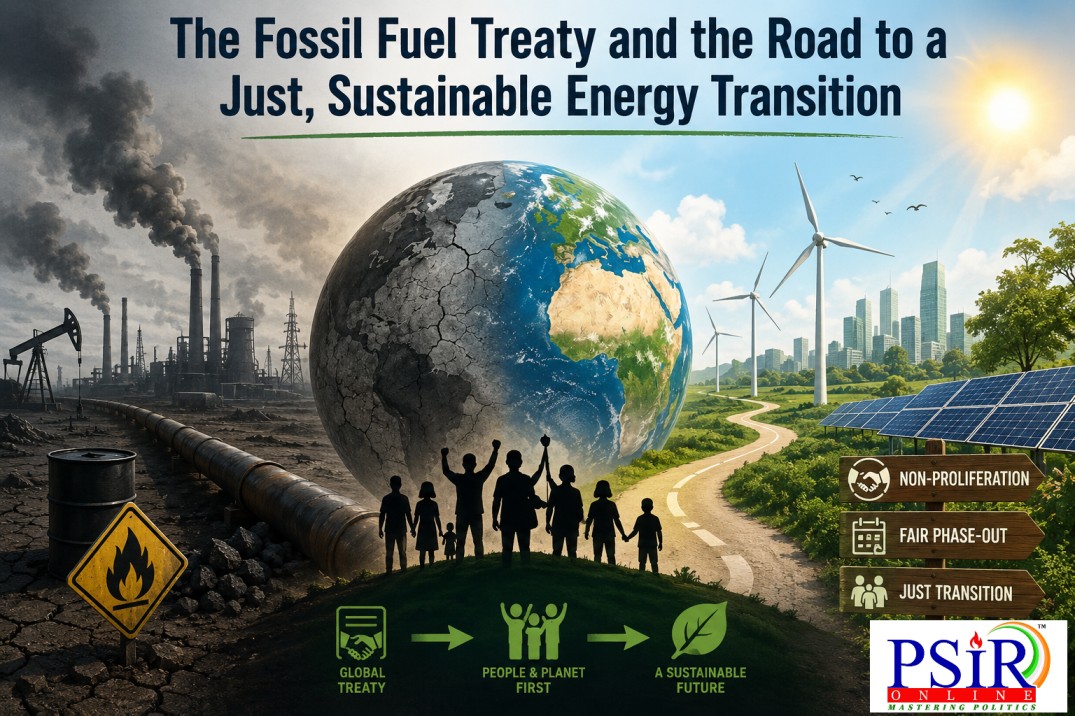
The Fossil Fuel Non-Proliferation Treaty (FFNPT) Initiative, often called the Fossil Fuel Treaty, is a global campaign for a new international legally binding agreement. It aims to complement the Paris Agreement by directly regulating the production and supply of fossil fuels (coal, oil, and gas), rather than just emissions.
ORIGINS AND PROPOSAL
· Initial Idea: Academics Peter Newell and Andrew Simms (University of Sussex) first publicly proposed a "Fossil Fuel Non-Proliferation Treaty" in an October 23, 2018, op-ed in The Guardian. They drew inspiration from the Nuclear Non-Proliferation Treaty (NPT) to address the climate crisis by stopping the expansion of fossil fuels.
· Earlier Roots: Calls for supply-side climate action (leaving fossil fuels in the ground) existed before, including at the 1988 Toronto Conference on the Changing Atmosphere. The 2018 proposal gained traction with support from figures like Naomi Klein, Bill McKibben, and others via open letters.
OFFICIAL LAUNCH AND STATUS
The initiative formally launched on September 25, 2020, during Climate Week NYC. Canadian environmental activist Tzeporah Berman (founder of Stand.earth) became its chair, with Alex Rafalowicz as director. It grew rapidly with funding from awards like the Climate Breakthrough Award.
Core Pillars
The proposed treaty rests on three main pillars:
1. Non-proliferation — End all new exploration and expansion of fossil fuel production.
2. Fair phase-out — Manage a global, science-based winding down of existing production in line with 1.5°C limits (wealthier nations leading faster).
3. Just transition — Provide support for workers, communities, and fossil fuel-dependent countries through funding, technology transfer, debt relief, and economic diversification toward renewables.
Current Status (as of May 2026)
· Governmental Support: 18 nations have formally joined the initiative and are actively discussing negotiations for a treaty. Early endorsers included Pacific Island states like Vanuatu and Tuvalu; others include countries from the Caribbean, Latin America, Africa, and Asia. Some producer countries are also involved.
· Major Milestone: Colombia and the Netherlands co-hosted the First International Conference on Transitioning Away from Fossil Fuels (also called the Phase-Out Conference) in Santa Marta, Colombia (April 24–29, 2026). It brought together ministers, officials, experts, and civil society from dozens of countries (over 50 participated in broader talks). The conference focused on practical pathways for phase-out, national roadmaps, trade, debt, and just transitions. It is the first in a planned series (next likely in Tuvalu in 2027).
· Broader Endorsements: Strong backing from:
o Over 4,200 organizations, institutions, and businesses.
o 194+ subnational governments and cities (e.g., Vancouver was the first).
o Thousands of scientists, 101+ Nobel laureates, health organizations (including WHO support), parliamentarians (including the European Parliament), Indigenous groups, faith leaders, and nearly 1 million individuals.
· Momentum: The initiative gained traction at COPs and UNGA sessions. At COP30 (2025), countries advanced the Belém Declaration calling for increased action on phase-out. It operates parallel and complementary to the UNFCCC process.
WHY FOSSIL FUEL IS DANGEROUS TO WORLD ENVIRONMENT?
Fossil fuel production, consumption, and proliferation (expansion) pose severe, interconnected dangers to the global environment. They are the primary driver of the climate crisis and cause widespread pollution, habitat destruction, and biodiversity loss.
1. Climate Change (The Biggest Threat)
Fossil fuels — coal, oil, and natural gas — account for around 68–75% of global greenhouse gas (GHG) emissions and nearly 90% of all carbon dioxide (CO₂) emissions.
· How it works: Burning them releases CO₂ and methane (CH₄), which trap heat in the atmosphere (the greenhouse effect). This has already caused ~1.1–1.2°C of global warming since pre-industrial times.
· Proliferation worsens it: New exploration and infrastructure "lock in" emissions for decades. The world is still planning to increase production (contrary to the needed 6% annual decline for 1.5°C limits).
· Consequences:
o More frequent/intense extreme weather (heatwaves, storms, droughts, floods).
o Sea-level rise (melting ice sheets/glaciers) threatening coastal areas.
o Ocean acidification (oceans absorb ~30% of CO₂), harming marine life.
o Tipping points (e.g., permafrost thaw releasing more methane, Amazon dieback).
Without rapid phase-out, warming could reach 2.3–2.8°C or more this century, with catastrophic impacts.
2. Air Pollution and Health/Environmental Damage
Burning fossil fuels releases not just CO₂ but toxic pollutants:
· Particulate matter (PM2.5), sulfur dioxide (SO₂), nitrogen oxides (NOₓ), mercury, and volatile organic compounds.
· Effects: Smog, acid rain, eutrophication (nutrient overload in water bodies), crop/forest damage, and respiratory/cardiovascular diseases. Air pollution from fossil fuels contributes to millions of premature deaths annually.
3. Production Impacts (Extraction Phase)
· Habitat destruction: Drilling, mining, fracking, and pipelines clear land, fragment ecosystems, and disrupt wildlife.
· Water pollution: Fracking fluids, coal ash, acid mine drainage, and oil spills contaminate groundwater and rivers. Oil spills (e.g., Deepwater Horizon) devastate marine areas.
· Methane leaks: Natural gas (mostly methane) leaks during production/transport are a potent short-term greenhouse gas (84x more warming than CO₂ over 20 years).
· Land degradation: Mountaintop removal for coal, tar sands mining, etc., leave scarred landscapes.
4. Broader Ecosystem and Biodiversity Loss
· Fossil fuels drive climate change (a top driver of biodiversity decline) + direct pollution and habitat loss.
· Up to 1 million species are threatened with extinction; coral reefs, wetlands, and forests are collapsing.
· Marine life suffers from acidification and oil pollution; land species from habitat conversion and extreme weather.
5. Why "Proliferation" (Expansion) Is Especially Dangerous
· New projects create stranded assets (infrastructure/reserves that become uneconomic or unusable under climate policies), but companies/governments often push them anyway, accelerating lock-in.
· They delay the shift to renewables and increase the risk of overshooting safe warming limits.
Scale of the Problem (Recent Data)
· Fossil CO₂ emissions continue rising (e.g., global GHG ~53 GtCO₂eq in 2024).
· Air pollution from fossil fuels reduces global life expectancy by ~2.2 years on average.
In short, fossil fuels create a cascade of harms: they destabilize the climate, poison air/water/soil, destroy habitats, and accelerate species loss. Transitioning away from them is essential for a livable planet. The science is clear — the longer production and consumption continue to expand, the more irreversible the damage becomes.
HOW FOSSIL FUELS ARE MANAGED CURRENTLY
Currently, fossil fuels (coal, oil, and natural gas) are primarily managed through a fragmented, market-driven system with limited global coordination. There is no binding international treaty limiting production or expansion. Management relies on national policies, voluntary international commitments, market forces, and some regional regulations.
1. International Level (Weak and Voluntary)
· Paris Agreement & UNFCCC: Countries set Nationally Determined Contributions (NDCs) for emissions reductions, but there are no direct limits on fossil fuel production or supply. The 2023 COP28 "UAE Consensus" called for "transitioning away from fossil fuels," but it is non-binding.
· COP30 (2025, Brazil): Over 80 countries supported a roadmap for fossil fuel transition, but no formal phase-out text was adopted due to opposition from producer nations. The presidency launched parallel roadmaps for transition and deforestation, with outcomes expected at COP31.
· Santa Marta Conference (April 2026): The first dedicated international meeting on transitioning away from fossil fuels (co-hosted by Colombia and the Netherlands). It involved 50+ countries (representing over half of global GDP) focusing on national roadmaps, finance, and coordination — but still voluntary.
2. National & Domestic Policies
· Production: Many countries continue licensing new oil/gas exploration and coal mines. Major producers (US, Russia, Saudi Arabia, etc.) prioritize energy security and revenue. Some nations (e.g., France, Colombia) have phase-out plans, but most do not.
· Consumption: Managed via taxes, regulations, efficiency standards, and renewable incentives. However, demand still grows in many regions, though at slower rates.
· Subsidies: A major ongoing support mechanism. Global fossil fuel subsidies (explicit + implicit) remain enormous — around $7 trillion (7% of GDP) in recent peaks, with explicit consumption subsidies near $1 trillion annually. Many governments expanded them in 2026 due to energy price shocks from geopolitical events.
o Explicit subsidies keep consumer prices low.
o Implicit subsidies fail to price in environmental and health costs.
WHY FOSSIL FUEL TREATY MATTERS: IS THIS A GAME CHANGER?
Current global agreements like the Paris Agreement focus on demand-side emissions reductions but do not directly limit fossil fuel supply. Proponents argue a dedicated treaty is essential to keep unburnable reserves in the ground, prevent lock-in of new infrastructure, ensure equity, and accelerate the shift to renewables amid escalating climate impacts.
It has the potential to be a significant game changer in global environmental management, but it is not one yet — and its success is far from guaranteed.
Why It Could Be Transformative
· Addresses the root cause directly: The Paris Agreement focuses on emissions reductions (demand side) but says almost nothing about limiting the production and supply of fossil fuels. A Fossil Fuel Treaty would explicitly stop new exploration/expansion, manage a science-based phase-out of existing production, and support a just transition. This supply-side approach could prevent "carbon lock-in" from new infrastructure and keep more reserves in the ground.
· Norm-shifting precedent: Like the Nuclear Non-Proliferation Treaty (NPT), it could reframe fossil fuels from "essential energy" to a globally managed risk. The NPT helped reduce nuclear stockpiles dramatically and stigmatized proliferation, even with imperfect compliance. Proponents argue this treaty could do the same for fossil fuels.
· Building a "coalition of the willing": With 18+ countries engaged (as of 2026), high-level conferences (e.g., Santa Marta in April 2026), endorsements from thousands of organizations, scientists, Nobel laureates, cities, and subnational governments, it creates political pressure and parallel diplomacy outside the slow UNFCCC consensus process.
· Complements existing tools: It pairs with the Paris Agreement, ICJ climate opinions, and national policies, potentially accelerating finance, technology transfer, and equity for developing nations.
If negotiated and ratified with strong participation, it could mark a shift from voluntary emissions pledges to coordinated global management of the fossil fuel industry — a major evolution in international environmental governance.
Why It Isn't (Yet) a Game Changer
· Still in early stages: No binding treaty exists. The 2026 Santa Marta conference advanced discussions and roadmaps but was not a formal negotiation. Momentum is growing, but formal talks have not begun.
· Missing the big players: Major fossil fuel producers and consumers (e.g., United States, China, Russia, Saudi Arabia, India, Australia, Canada) are not actively supporting it. Without them, effectiveness would be limited due to "distributive conflict" — winners and losers in the energy transition.
· Enforcement challenges: International treaties on contentious issues often face compliance issues, free-riding, and weak enforcement (as seen with some aspects of the NPT or climate pacts). Economic and political resistance from powerful industries remains enormous.
· Risks of dilution or fatigue: Critics note it could oversimplify complex issues or face treaty fatigue if negotiations drag on without results.
This initiative represents one of the most ambitious and focused efforts to tackle the supply side of the climate crisis since the Paris Agreement. It has real potential to become a game changer by creating new international norms, legal obligations, and coordinated action — especially if it gains traction from more countries and feeds into future COPs.
However, its impact will depend on whether it can translate growing civil society and "willing nation" support into a ratified treaty with meaningful participation from key economies. Right now, it's a promising catalyst rather than a proven transformation. The next few years (post-Santa Marta, leading into future conferences and COPs) will be decisive.
KEY NON-SUPPORTERS AND REASONS
Most major fossil fuel producers and large economies are not actively supporting the Fossil Fuel Non-Proliferation Treaty (FFNPT) Initiative. As of May 2026, only 18 countries are formally participating in discussions toward negotiating the treaty (primarily smaller or mid-sized nations, including many vulnerable Pacific Island states, Colombia, Timor-Leste, and others from the Caribbean, Africa, and Asia)
Major non-participants include:
· United States — Not attending key conferences like Santa Marta 2026. Reasons include domestic political divisions, powerful fossil fuel industry influence, ongoing production (including exports), and preference for technology-driven "net-zero" approaches over binding supply limits.
· China — The world's largest emitter and coal consumer/producer. Absent from phase-out talks. Prioritizes energy security, rapid industrialization, and its massive coal infrastructure. It views rapid phase-out as a risk to economic growth and stability.
· India — Major coal producer and consumer. Not supporting; focuses on energy access for development and poverty reduction. It sees fossil fuels as essential for growth and argues wealthy nations should lead deeper cuts first.
· Russia — Major oil and gas exporter. Strongly opposes binding phase-out language in UN processes. Relies heavily on fossil fuel revenues for its economy and geopolitical influence.
· Saudi Arabia (and other Gulf/OPEC states) — Leading opponents in COP negotiations. They block or weaken phase-out language. Their economies are almost entirely dependent on oil/gas exports; a rapid decline threatens budgets, reserves value, and social stability.
Other notable non-supporters or resisters:
· Large producers like Australia (attends some talks but is a major exporter), Canada, Norway, Brazil, and Nigeria (some attend conferences but are not core treaty supporters).
· Many high-income or emerging economies with significant fossil interests.
Why the Resistance?
· Economic dependence: Fossil fuels generate huge revenues (often 10–60%+ of exports/GDP in producer states). A supply-side treaty risks stranded assets, job losses, and fiscal crises without guaranteed alternatives.
· Energy security and development needs: Countries like China and India prioritize affordable, reliable energy for growth. They argue demand-side measures (e.g., Paris Agreement) are sufficient and that supply limits could cause shortages or higher prices harming the poor.
· Sovereignty over resources: Many view fossil fuels in their territory as sovereign assets. A treaty could be seen as infringing on the right to exploit natural resources.
· Geopolitical and industry power: Powerful lobbies and "petrostates" block progress in consensus-based forums like the UNFCCC. They prefer voluntary or technology-focused paths (e.g., carbon capture) over mandatory production caps.
· Equity concerns: Producer nations (especially developing ones) demand that wealthy historical emitters provide massive finance, technology, and debt relief first — which has been slow to materialize.
WAY FORWARD
The way forward for fossil fuel management is a managed, science-based global phase-out combined with massive investment in alternative clean energy sources. This dual approach halts new fossil fuel expansion, winds down existing production in line with 1.5°C limits, and accelerates the build-out of renewables and other low-carbon technologies to drive economic growth and reduce dependence on fossil fuels.
Core Principles
· Stop proliferation: End all new exploration and infrastructure for coal, oil, and gas.
· Fair phase-out: Differentiated timelines — wealthier nations and major producers lead faster; developing countries receive support.
· Scale alternatives aggressively: Invest heavily in clean energy to replace fossil fuels, boost energy security, create jobs, and fuel sustainable growth.
· Just transition: Support workers, communities, and economies through retraining, diversification, and finance.
Practical Steps (2026 Roadmap)
1. National Fossil Fuel Phase-Out Roadmaps Countries are developing concrete plans linking phase-out to clean energy expansion.
· Colombia targets a 90% reduction in fossil fuel use by 2050, projecting $280 billion in economic benefits from the shift.
· France, Chile, and others have set clear timelines for coal, oil, and gas phase-outs. These roadmaps must explicitly tie declining fossil production to rising renewable capacity.
2. Massive Investment in Alternative Fuels and Clean Technologies for Growth This is essential to reduce dependence on fossil fuels while powering economic development. Renewables are now cheaper than new fossil plants in most places, offering energy independence, lower long-term costs, and resilience against price shocks and geopolitical risks.
· Current Momentum: Global clean energy investment reached ~$2.2 trillion in 2025 (roughly double fossil fuel investment), with renewables alone attracting hundreds of billions. Solar leads, followed by wind, storage, grids, and EVs.
· Why It Drives Growth: Countries investing heavily (e.g., China leading with hundreds of billions annually, India building gigafactories for solar/batteries) gain manufacturing jobs, energy security, and export opportunities. Renewables shield economies from oil/gas volatility.
· Priority Areas:
o Triple renewable capacity by 2030 (solar, wind, geothermal, etc.).
o Scale battery storage, green hydrogen, and grid modernization.
o Electrify transport, industry, and heating.
o Support developing nations with concessional finance and technology transfer.
3. End Fossil Fuel Subsidies and Redirect Finance Governments still provide over $1 trillion annually in fossil subsidies. Phasing these out frees up funds for clean alternatives, making renewables even more competitive.
4. International Coordination The Santa Marta Conference (Colombia & Netherlands, April 2026) advanced practical pathways, including national roadmaps, finance reforms, and scaling clean energy investments. It emphasized redirecting public finance from fossils to renewables and building a “coalition of the willing.” Outcomes will inform future COPs.
5. The Role of a Fossil Fuel Treaty A binding treaty would formalize non-proliferation, fair phase-out, and support for scaling alternatives globally.
Challenges and Realism
· Financing Gaps: Developing countries need affordable capital; lack of funding remains a barrier.
· Big Players: Major producers/consumers must increase clean investments.
· Speed: Infrastructure lock-in makes rapid scaling of alternatives urgent.
The smartest path is not just managing decline of fossils but actively investing in abundant, cheap, and growing clean alternatives to replace them. This reduces dependence, drives economic growth, improves health and security, and stabilizes the climate. Countries that invest fastest in renewables and clean tech will lead the 21st-century economy. Momentum from Santa Marta 2026 shows this transition is already underway — policy certainty and scaled finance will determine how quickly and equitably it happens.
PRACTICE QUESTIONS FOR GS 2 MAINS
1. The proposed Fossil Fuel Non-Proliferation Treaty represents a shift from demand-side climate governance to supply-side regulation. Critically examine its significance for global climate governance and sustainable development.
2. “Climate justice requires differentiated responsibilities in fossil fuel phase-out.” Discuss in the context of the concerns of developing countries like India regarding the Fossil Fuel Treaty initiative.
3. Despite global commitments under the Paris Agreement, fossil fuel subsidies continue to rise across the world. Analyze the challenges in transitioning towards a just and sustainable energy order.
4. Evaluate the role of international cooperation, technology transfer, and climate finance in enabling a fair transition away from fossil fuels.
PRACTICE QUESTIONS FOR PSIR OPTIONAL
1. The Fossil Fuel Non-Proliferation Treaty initiative reflects the growing importance of “global environmental governance” beyond traditional state-centric diplomacy. Examine.
2. Critically analyze the Fossil Fuel Treaty initiative through the perspectives of Realism and Liberal Institutionalism in International Relations.
3. “The politics of climate change is deeply shaped by distributive conflicts between developed and developing nations.” Discuss with reference to the global debate on fossil fuel phase-out.
4. Discuss how the proposed Fossil Fuel Non-Proliferation Treaty may reshape international environmental norms, sovereignty debates, and North–South relations in global politics.