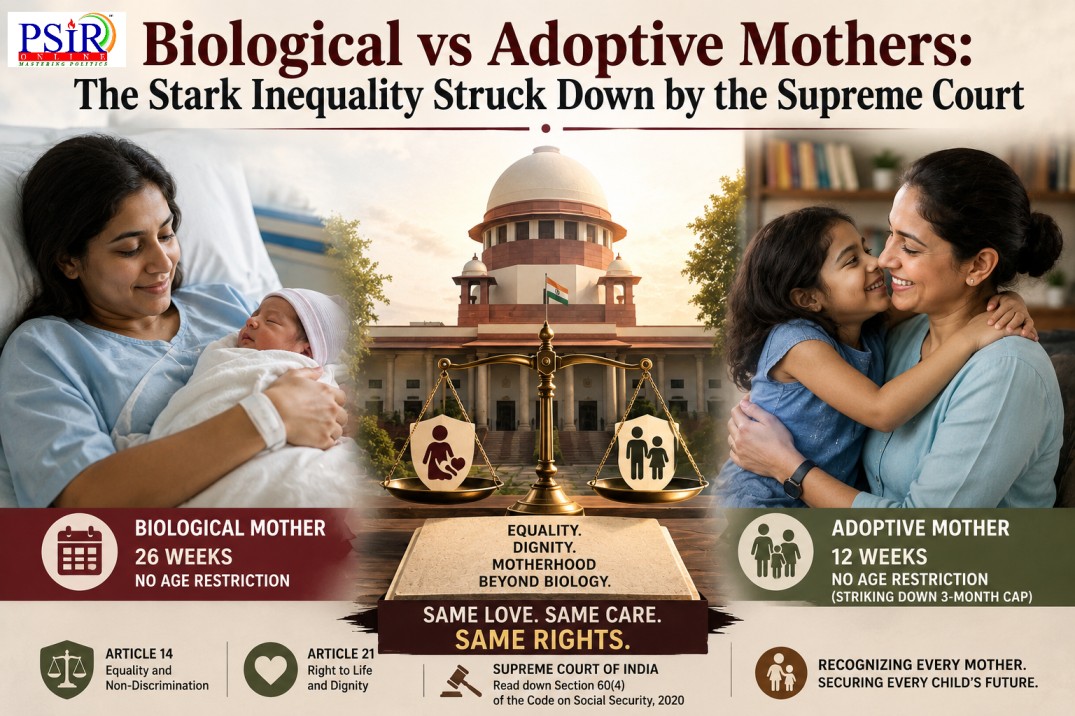
Hamsaanandini Nanduri v. Union of India (17 March 2026) is a landmark Supreme Court of India judgment (2026 INSC 246) that significantly expands maternity benefits for adoptive mothers.
BACKGROUND AND PETITIONER
Hamsaanandini Nanduri, an adoptive mother of two children, filed a writ petition under Article 32 of the Constitution. She challenged the restrictive provision in the Code on Social Security, 2020 (SS Code) — specifically Section 60(4) — which was pari materia (similar in substance) to the earlier Section 5(4) of the Maternity Benefit Act, 1961 (as amended in 2017).
The impugned provision originally stated:
“A woman who legally adopts a child below the age of three months or a commissioning mother shall be entitled to maternity benefit for a period of twelve weeks from the date the child is handed over...”
This age cap meant most adoptive mothers (who often receive children older than 3 months due to adoption process timelines) were excluded from benefits.
KEY HOLDINGS OF THE SUPREME COURT
· The 3-month age restriction was struck down (or "read down") as unconstitutional.
· It violates Article 14 (equality and non-discrimination) because the classification was arbitrary, under-inclusive, and lacked rational nexus with the law's objective. Adoptive mothers of children above 3 months are similarly situated in terms of caregiving needs, bonding, and child welfare.
· It also infringes Article 21 (right to life and dignity), as maternity benefits recognize the broader process of motherhood — emotional, nurturing, and caregiving — not just biological childbirth.
The Court "read down" Section 60(4) to read as:
“A woman who legally adopts a child or a commissioning mother shall be entitled to maternity benefit for a period of twelve weeks from the date the child is handed over to the adopting mother or the commissioning mother, as the case may be.” (No age restriction.)
Adoptive mothers (and commissioning mothers in surrogacy cases) are now entitled to 12 weeks of maternity benefits regardless of the child's age at handover.
REASONING OF THE COURT (BENCH: JUSTICES J.B. PARDIWALA AND R. MAHADEVAN)
· Motherhood is not limited to biology; it encompasses the nurturing bond and care. The judgment opened with a poignant poem emphasizing this emotional reality.
· The 3-month cap was "illusory" and impractical, as adoption processes (court orders, CARA procedures) often result in handover after the child is older.
· It discriminated against adoptive families and undermined the best interests of the child principle.
· Adoption is an expression of reproductive and decisional autonomy under Article 21.
· The Court urged the government to consider a robust paternity leave policy as part of social security.
POSITION BEFORE THIS JUDGEMENT
Before the Hamsaanandini Nanduri v. Union of India judgment (17 March 2026), maternity benefits for biological ("normal") mothers and adoptive mothers differed significantly under Indian law.
Legal Framework (Pre-Judgment)
· Biological Mothers: Governed by the Maternity Benefit Act, 1961 (as amended in 2017) and later the Code on Social Security, 2020 (SS Code).
· Adoptive Mothers: Covered under the same laws but with a restrictive clause — Section 5(4) of the Maternity Benefit Act (later Section 60(4) of the SS Code).
Key Differences
|
Aspect |
Biological Mothers |
Adoptive Mothers (Pre-2026 Judgment) |
|
Duration of Paid Leave |
26 weeks (for first two children) |
12 weeks only |
|
Eligibility Trigger |
From the date of delivery / expected delivery |
Only if the adopted child was below 3 months old at the time of handover |
|
Condition on Child's Age |
No restriction |
Strict 3-month age cap — older children = no benefits |
|
Starting Point of Leave |
Delivery date |
Date the child is handed over to the adoptive mother |
|
Applicability |
All covered establishments (10+ employees) |
Same, but highly restricted |
|
Commissioning Mothers (Surrogacy) |
Not directly applicable |
12 weeks (same as adoptive, with 3-month restriction) |
Practical Impact of the Differences
Other Notes
In short: Biological mothers enjoyed robust, age-unrestricted 26-week benefits focused on childbirth recovery. Adoptive mothers had only a narrow, often illusory 12-week window — available only for very young infants — which the Supreme Court now declared arbitrary and unconstitutional
IMPACT OF THE JUDGEMENT
1. Broader Recognition of Non-Biological Motherhood
The ruling fundamentally redefines motherhood in Indian law as encompassing emotional bonding, nurturing, and caregiving — not limited to biological childbirth. By opening the judgment with a poem on adoptive motherhood (“Not flesh of my flesh... But in it”), the Supreme Court signalled that the law must protect the experience of motherhood.
This shifts maternity benefits from a narrow “recovery from childbirth” model to a child-centric and care-based welfare provision. It aligns with constitutional values under Article 21 (dignity, reproductive and decisional autonomy) and reinforces that adoption itself is an exercise of reproductive choice.
2. Practical Applicability Across Establishments
· The judgment directly applies to all establishments covered under the Code on Social Security, 2020 (which consolidated the Maternity Benefit Act and other labour laws).
· Adoptive mothers (and commissioning mothers in surrogacy) are now entitled to 12 weeks of paid maternity benefit from the date the child is handed over — irrespective of the child’s age.
· Employers must update internal HR policies immediately. Continued reliance on the old 3-month restriction carries compliance risks, including potential litigation for denial of benefits.
3. Removes Major Barriers for Adoptive Families
· Statistical Reality: Only about 5% of adoptions in India are completed within the first three months due to lengthy CARA (Central Adoption Resource Authority) processes, court approvals, and matching timelines. The old rule rendered the benefit “illusory” for the vast majority of adoptive mothers.
· Particularly benefits women adopting older children, siblings, children with special needs, or those in inter-country adoptions — groups previously excluded.
· Promotes the best interests of the child principle, recognising that bonding and caregiving needs exist regardless of age.
4. Progressive Interpretation of Social Welfare Laws
The Court emphasised that labour and social security laws must be interpreted expansively and in line with constitutional goals of equality and dignity, rather than narrowly or literally. This sets a strong precedent for future challenges to under-inclusive welfare provisions.
5. Catalyst for Further Reforms
· The Bench explicitly urged the Central Government to introduce a robust paternity leave policy as part of social security, highlighting the need for gender-neutral and shared parenting responsibilities.
· Builds on the 2017 Maternity Benefit Amendment (which raised biological mothers’ leave to 26 weeks) but addresses its discriminatory gap for adoptive families.
· Encourages a move toward comprehensive parental leave frameworks, drawing from international best practices.
6. Broader Societal and Jurisprudential Impact
· Workplace Equality: Reduces discrimination against adoptive mothers in employment and strengthens women’s participation in the workforce.
· Family Rights: Reinforces adoption as a valid and equal family-formation route, combating societal stigma around non-biological parenting.
· Judicial Philosophy: Marks a progressive, empathetic approach — treating motherhood as a lived reality of care rather than a biological event. It will likely influence future cases on surrogacy, same-sex parenting, and other emerging family structures.
In essence, Hamsaanandini Nanduri v. Union of India is not merely a correction of one statutory clause — it is a transformative step toward inclusive, equality-driven family and labour rights in India. It cements the principle that a mother is a mother, regardless of how the child enters her life.
PRACTICE QUESTIONS FOR GS 2 MAINS
1. The Supreme Court in Hamsaanandini Nanduri v. Union of India redefined motherhood beyond biological childbirth. Examine the constitutional principles underlying the judgment and discuss its implications for gender justice and social welfare legislation in India.
2. “Social security laws must evolve with changing family structures and caregiving realities.” In the light of the recent Supreme Court judgment on maternity benefits for adoptive mothers, critically analyse the limitations of India’s existing parental welfare framework.
3. Discuss how the Supreme Court’s reading down of Section 60(4) of the Code on Social Security, 2020 strengthens the interpretation of Articles 14 and 21 of the Constitution. Do you think judicial activism was justified in this case?
4. The judgment in Hamsaanandini Nanduri v. Union of India may become a foundation for future debates on paternity leave, surrogacy, and non-traditional family structures. Evaluate.
PRACTICE QUESTIONS FOR PSIR OPTIONAL
1. “Equality under Article 14 is violated not only by hostile discrimination but also by under-inclusive classifications.” Examine this statement in the context of the Supreme Court’s judgment on maternity benefits for adoptive mothers.
2. Critically analyse the expanding judicial interpretation of Article 21 in India with reference to reproductive autonomy, dignity, and caregiving rights.
3. The judiciary in contemporary India increasingly interprets welfare legislation through the lens of substantive equality rather than formal equality. Discuss with suitable constitutional and judicial examples.
4. “Motherhood is a social and emotional institution as much as a biological phenomenon.” Examine the statement from feminist political theory and relate it to the evolving jurisprudence of the Indian Supreme Court on family and welfare rights.