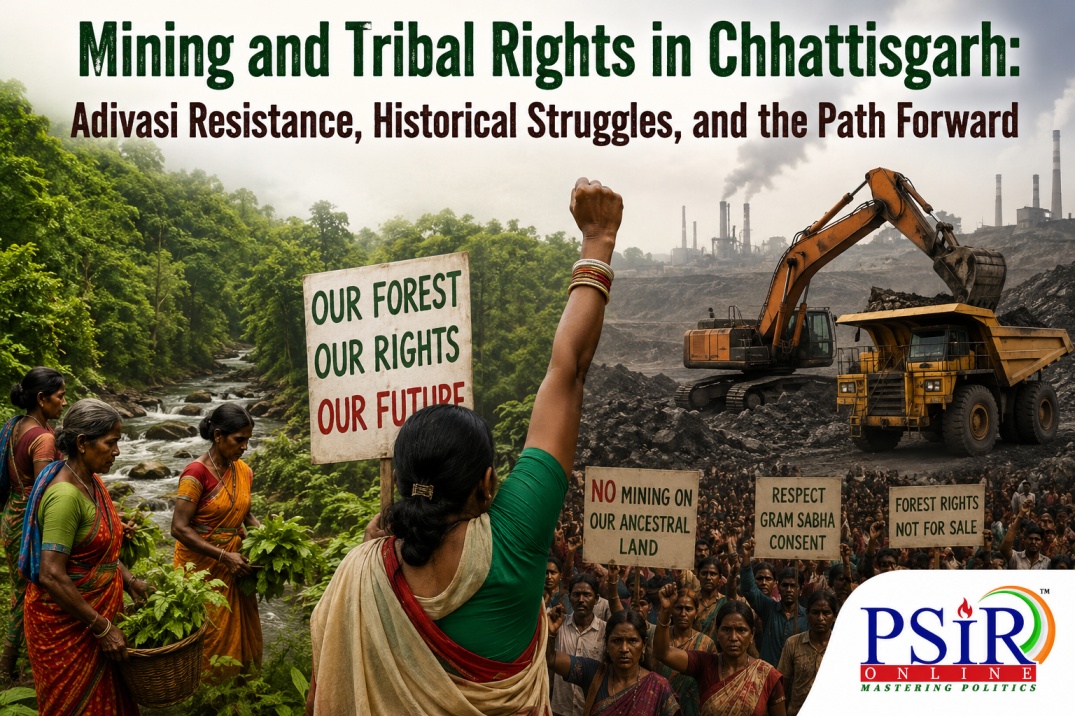
In April 2026, Oraon tribal communities in Raigarh district of Chhattisgarh launched renewed protests against the Gare Pelma Sector II coal mining project, marking the latest chapter in decades of resistance against resource extraction on tribal lands.
Protesters raised critical concerns about:
· Forced displacement of hundreds of families from their ancestral villages.
· Destruction of centuries-old forests that sustain their livelihoods and cultural identity.
· Environmental pollution from existing mines and thermal power plants in the Raigarh-Tamnar region.
· Blatant violation of the Forest Rights Act (FRA), 2006, due to absence of genuine gram sabha consent.
Community members reported:
· Contractors felling thousands of trees despite ongoing protests.
· Heavy police deployment to suppress resistance and intimidate villagers.
· Allegations of “secret,” rushed, or fabricated public hearings lacking transparency.
Earlier, in December 2025, villagers organized an economic blockade and indefinite sit-ins (dharnas), which pressured the administration to temporarily put the project on hold with promises of no further action without village support. These recent protests are not isolated incidents but part of a long-standing pattern of Adivasi resistance across Chhattisgarh, where mining projects repeatedly trigger widespread mobilization due to threats to land, forest, water, and identity.
The Gare Pelma protests highlight the enduring tension between India’s drive for energy security and industrial growth, and the constitutional obligations to protect indigenous rights and forest ecosystems.
WHY ARE TRIBAL COMMUNITIES FIGHTING?
Livelihood and Survival Dependence on Forests
Tribal communities in Chhattisgarh depend entirely on forests for their daily survival, including:
· Fuelwood for cooking and heating.
· Fodder for livestock.
· Minor forest produce such as tendu leaves (for bidis), mahua flowers, honey, gum, and medicinal plants.
· Subsistence agriculture on rain-fed or shifting cultivation lands.
· Water from forest streams and springs.
Mining destroys these livelihood bases by:
· Clearing vast tracts of forest.
· Polluting water sources with heavy metals and coal dust.
· Degradating soil quality, making agriculture impossible.
· Disrupting seasonal cycles that communities have followed for generations.
Cultural and Identity Attachment to Land
For Adivasis, land and forest are not merely economic assets but intrinsic to their:
· Cultural identity, religious practices, and ancestral memory.
· Community governance systems and social organization.
· Oral histories, folklore, and spiritual connection to specific trees, groves, hills, and rivers.
Mining projects are seen as existential threats because they:
· Erase sacred sites and ritual landscapes.
· Force relocation to resettlement colonies disconnected from traditional territories.
· Break intergenerational transmission of ecological knowledge and customs.
Violation of Constitutional and Legal Rights
Tribal communities demand honoring of legally guaranteed rights under:
· Fifth Schedule of the Constitution: Special protections for tribal lands and mandatory consultation with gram sabhas.
· PESA Act (1996): Empowers gram sabhas to decide on land acquisition, mining, and resource use in Scheduled Areas.
· Forest Rights Act (2006): Recognizes individual and community forest rights, including right to protect, regenerate, and govern forest resources.
Key grievances include:
· Gram sabha consent being forged, coerced, or obtained through fake public hearings.
· Forest rights claims being delayed, rejected, or later cancelled on technical grounds.
· Land diversion approved before FRA claims are fully verified.
· Administrative overrides that treat legal safeguards as mere formalities.
CORE DEMANDS OF TRIBAL COMMUNITIES
· Genuine gram sabha consent: No mining project without free, prior, and informed consent from affected villages.
· Recognition and protection of forest rights: Full implementation of FRA, including community forest rights that cannot be revoked for mining.
· No displacement without alternatives: Absolutely no forced relocation; if relocation is unavoidable, it must be with proper compensation, land-for-land, and sustainable livelihood options.
· Environment and health protection: Strict enforcement of environmental norms, compensation for pollution-related health damage, and restoration of degraded lands.
· Sustainable livelihood alternatives: Investment in agroforestry, community-managed forest produce, small-scale irrigation, and non-extractive economic development instead of destructive mining.
· Accountability for past harms: Compensation for families already displaced, health care for pollution-affected communities, and prosecution of officials who forged consent documents.
HISTORY OF TRIBAL PROTESTS IN CHHATTISGARH AGAINST MINING
Chhattisgarh, carved out of Madhya Pradesh in 2000, is one of India's most mineral-rich states, with vast reserves of coal, iron ore, bauxite, and other resources. A large portion of the state—particularly in the southern Bastar region and northern Surguja district—is inhabited by Adivasi (tribal) communities such as Gonds, Maria, Muria, and others, who have traditionally depended on forests for their livelihood, culture, and identity. Mining activities have repeatedly threatened their land, water, forests, and sacred sites, leading to a long history of resistance.
Early Tribal Resistance (Colonial Period)
Tribal protests against resource extraction in the region predate modern mining and trace back to colonial policies. British forest laws restricted Adivasi access to traditional resources, treating forests as state property for commercial exploitation (e.g., timber).
Key early movements include:
· Halba Rebellion (1842) and other uprisings against exploitative land and tax policies.
· Bhumkal Rebellion (1910) in Bastar, where tribals rose against British forest reservation policies that curtailed their rights.
These were part of broader resistance to colonial dispossession, setting a precedent for later struggles.
Post-Independence Era: Development vs. Displacement
After independence, the focus shifted to industrial development. Public sector companies like the National Mineral Development Corporation (NMDC) and Bhilai Steel Plant began large-scale mining, particularly iron ore in the Bailadila hills of Bastar. While mining brought some infrastructure, it often resulted in displacement, environmental degradation, and loss of forest rights without adequate consultation or compensation.
Protests intensified with economic liberalization in the 1990s and 2000s, as private and foreign companies entered the sector. Issues included violations of the Panchayats (Extension to Scheduled Areas) Act (PESA) 1996, the Forest Rights Act (FRA) 2006, and lack of genuine Gram Sabha (village assembly) consent.
Major Protests in the 2000s–2010s
Bastar Region (Iron Ore and Steel Plants):
· Nagarnar Steel Plant Protests (early 2000s): Tribals in Bastar opposed land acquisition for a steel plant by NMDC, citing forcible acquisition and police excesses.
· Essar Steel Plant Protests: Similar issues of coercion in Gram Sabha consultations were reported.
· Bailadila Iron Ore Protests: Ongoing resistance against NMDC expansions. In 2019, nearly 10,000 tribals protested against mining at Deposit-13, which they claimed housed sacred sites (deities like Pithod Rani and Nandaraj). Operations were temporarily halted.
· Rowghat Iron Ore Mine (SAIL/Bhilai Steel Plant): Protests since the late 2000s against mining in the Matla Reserve Forest (Narayanpur and Kanker districts). Tribals formed the Rowghat Bachao Sangharsh Samiti. Issues included lack of Gram Sabha consent, forest diversion, and militarization of the area. Protests continued into 2022, with clashes and blockades.
These movements sometimes intersected with Maoist insurgency, which drew support from tribal grievances over land and resources, though many protests remained peaceful and democratic.
Hasdeo Arand: The Longest and Most Prominent Struggle (2010s–Present)
The Hasdeo Arand (or Hasdeo Aranya) forests in northern Chhattisgarh (Surguja, Korba, and Surajpur districts) represent one of India's largest intact forest tracts and a biodiversity hotspot. It became the epicenter of anti-coal mining protests.

Tribals argue that mining destroys their jal, jungle, zameen (water, forest, land) and violates constitutional protections for Fifth Schedule areas.
WHY PROTESTS ARE FREQUENT?
Chhattisgarh has a unique social geography different from most Indian states. The key features are
· High Tribal Population: Scheduled Tribes constitute 30.6% of Chhattisgarh’s population (around 7.8 million people as per 2011 Census), one of the highest proportions in India.
· Concentration in Mineral-Rich Forests: Tribal communities are concentrated in:
· Southern Bastar division: Bastar, Dantewada, Bijapur, Sukma, Kanker, Narayanpur—rich in iron ore, bauxite, and limestone.
· Northern and north-central belt: Surguja, Balrampur, Surajpur, Koriya, Jashpur—rich in coal.
· Central coal belt: Korba, Raigarh, parts of Raipur and Bilaspur—major coal and power generation hubs.
· Fifth Schedule Overlap: Over 60% of the state’s area falls under the Fifth Schedule, where tribal land protections and gram sabha consent are legally mandated.
· Forest-Mineral Overlap: Dense forests like Hasdeo Arand (~170,000 hectares), which serve as elephant corridors and water catchments, sit directly atop massive coal deposits, creating inherent conflict between conservation and extraction.
This geographic reality means mining projects almost always happens on tribal lands and forests, making protests almost inevitable.
|
CHHATTISGARH AND NAXALISM
Chhattisgarh has been the epicenter of India's Naxalite-Maoist insurgency for over two decades. The densely forested Bastar region (including Dantewada, Sukma, Bijapur, Narayanpur, and Kanker districts) became a stronghold of the Communist Party of India (Maoist) after its formation in 2004. The Maoists, who follow a radical left-wing ideology inspired by the 1967 Naxalbari uprising, positioned themselves as protectors of Adivasi (tribal) rights against exploitation, displacement due to mining projects, and state neglect.
Deep-rooted issues like poverty, lack of development, forest rights violations, and police atrocities helped the Maoists gain local support. At its peak (2005–2013), the region witnessed intense violence, including major attacks like the 2013 Darbha Valley ambush that killed 27 Congress leaders. Chhattisgarh accounted for the highest number of Naxal-related deaths in India for many years.
Since 2014, particularly after the BJP government came to power in the state in 2023, security forces intensified operations (such as Operation Kagar/Black Forest). The strategy combined aggressive anti-Naxal campaigns, increased security camps, development works, and surrender policies.
By early 2026, the insurgency has been largely crushed. Hundreds of Maoists were killed or surrendered, top leaders eliminated, and violence dropped sharply. The government declared Bastar largely Naxal-free by March 2026, marking the end of a four-decade-long armed struggle, though challenges of tribal development and rehabilitation remain.
|
JUDICIAL INTERVENTIONS IN CHHATTISGARH’S MINING CONFLICTS
The National Green Tribunal (NGT) has played a significant role in checking environmental clearances for mining projects in Chhattisgarh. On January 15, 2024, the NGT quashed the environmental clearance granted to the Gare Pelma II coal mine, citing inadequate consultation with affected tribal communities, failure to assess cumulative environmental impacts, and serious procedural violations in the public hearing process.
The Tribunal has also intervened in multiple Hasdeo Arand cases, questioning clearances and demanding proper evaluation of forest loss and biodiversity impact. These rulings highlighted that procedural lapses can lead to the cancellation of project approvals, though enforcement of such orders often remains weak on the ground.
The Supreme Court has set important precedents that influenced tribal rights struggles in the state. The landmark 2013 Niyamgiri judgment (related to Vedanta’s bauxite mining in Odisha) empowered Gram Sabhas to decide on projects affecting their traditional lands and sacred sites. This ruling has been frequently cited by Chhattisgarh tribals in their resistance to mining. In the 2014 Coal Scam judgment, the Court cancelled 214 coal block allocations across the country for being arbitrary and illegal. While these decisions strengthened the legal position of tribal communities, the Supreme Court has generally tried to balance development needs with rights, often approving projects with conditions rather than imposing outright bans.
The Chhattisgarh High Court has delivered mixed outcomes. In the 2025 Ghatbarra case, the Court upheld the cancellation of community forest rights granted to villagers in Hasdeo Arand, ruling that the rights were granted by mistake since forest diversion approvals had come earlier. This decision was widely criticized for weakening the Forest Rights Act. Similarly, in 2025, the High Court upheld mining clearances for RRVUNL in Hasdeo on technical grounds. Overall, the state judiciary has shown a tendency to prioritize administrative decisions and mining projects while occasionally checking procedural irregularities.
GOVERNMENT ACTIONS AND REACTIONS: COMPENSATION, CONTINUATION, AND CONTRADICTIONS
The responses of Chhattisgarh governments to tribal protests against mining have shown a clear gap between political rhetoric and administrative action. Under the Congress government led by Bhupesh Baghel (until late 2023), some mining extensions in Hasdeo Arand were paused following large-scale protests in June 2022, and the assembly passed resolutions opposing mining in sensitive forest areas. However, several clearances were still granted, leading to accusations that the government was compromising tribal rights for political and economic gains.
After the BJP came to power in late 2023, the state restarted tree-felling activities in Hasdeo, drawing sharp criticism from activists and opposition parties. The BJP government has openly prioritized energy security and coal production targets, often facing allegations of favoring corporate interests over tribal consent and forest protection.
On the issue of compensation and rehabilitation, governments have repeatedly made promises of cash compensation for land and houses, new resettlement colonies with basic amenities, and employment opportunities for displaced families. In reality, however, the implementation has been poor. Compensation is frequently inadequate, delayed, or fails to reach genuine landowners. Rehabilitation colonies often lack proper livelihood support, clean water, and sanitation facilities. The few jobs offered are mostly low-skilled, temporary, or contractual in nature. Most importantly, the traditional forest-based livelihoods of tribals cannot be effectively replaced by mine-related wage labor, leaving many displaced families more impoverished and marginalized than before. This gap between promises and ground reality has continued to fuel resentment and sustained protests.
While protests have occasionally forced temporary halts in mining projects — such as in Hasdeo in 2022 and Gare Pelma II in late 2025 — most projects eventually resume under revised plans, new names, or renewed political support. Successive governments have shown a consistent long-term trend of favoring the continuation and expansion of mining operations, often citing national energy needs and central government backing. As a result, protests have succeeded in delaying projects but have rarely managed to stop them permanently.
WAY FORWARD: SUSTAINABLE SOLUTIONS FOR MINING, TRIBAL RIGHTS, AND FOREST PROTECTION
Strengthen Legal Implementation and Enforcement
· Treat gram sabha consent as a substantive, non-negotiable requirement, not a procedural formality.
· Ensure Forest Rights Act implementation is complete before any forest diversion is approved:
· Fast-track pending FRA claims.
· Prohibit cancellation of recognized community forest rights for mining.
· Establish independent monitoring committees with tribal representatives to oversee public hearings and consent processes.
· Criminalize forgery of gram sabha resolutions and hold officials accountable for coercion or manipulation.
Adopt Inclusive and Participatory Planning
· Involve tribal communities in site selection, impact assessment, and benefit-sharing from the outset.
· Conduct cumulative impact assessments for entire regions (not just individual projects) to understand total environmental and social burden.
· Ensure free, prior, and informed consent (FPIC) following international standards for indigenous peoples.
· Create community-led forest governance models where tribals manage and benefit from forest produce sustainably.
Develop Non-Extractive Livelihood Alternatives
· Invest in agroforestry, organic farming, and small-scale irrigation to strengthen agriculture-dependent livelihoods.
· Support community-managed minor forest produce value chains (tendu, mahua, honey, gum) with fair market access.
· Promote eco-tourism and cultural tourism managed by tribal communities.
· Provide skill development and education that does not require displacement from traditional territories.
Reform Mining Policy and Benefit-Sharing
· Ensure equitable benefit-sharing from mining revenues:
· Direct royalties to gram sabhas in affected areas.
· Fund local development (schools, hospitals, infrastructure) with tribal priority.
· Impose stricter environmental fines for pollution and habitat destruction.
· Mandate rehabilitation and restoration bonds that companies must deposit before starting mining.
· Prioritize coal phase-out timelines aligned with India’s climate commitments to reduce long-term extraction pressure.
Strengthen Judicial and Administrative Accountability
· Train judiciary and bureaucracy on tribal rights, FRA, and PESA to prevent technical interpretations that undermine rights.
· Establish fast-track courts for mining-related disputes involving tribal communities.
· Create ombudsman offices for tribal rights violations with power to investigate and recommend compensation.
· Ensure transparent disclosure of all clearances, contracts, and benefit-sharing agreements.
CONCLUSION
Chhattisgarh’s long-standing conflict between mining expansion and tribal rights has emerged as a national test case for indigenous justice and sustainable development in India. It reflects the country’s larger challenge of balancing the demands of energy security and industrial growth with its constitutional obligations to protect Adivasi communities and forest ecosystems. Tribal groups in the state are not opposing development itself, but are demanding a model that respects their rights, livelihoods, cultural heritage, and traditional ecological knowledge.
The persistent protests in Hasdeo Arand, Bailadila, Gare Pelma, and other regions highlight a troubling pattern: while legal safeguards such as the Forest Rights Act and PESA exist, they are frequently bypassed through procedural violations and political pressure. Although sustained resistance has succeeded in delaying several projects, it has rarely halted them permanently. This has created a paradox of “resource-rich but impoverished” regions, where massive mineral wealth coexists with deepening tribal marginalization.
Without stronger enforcement of tribal consent, genuine rehabilitation, and inclusive development models that prioritize jal, jungle, jameen (water, forest, and land), such protests are likely to continue and may intensify. The future of Chhattisgarh will ultimately determine whether India can reconcile its ambitious growth and energy transition goals with meaningful justice for its original inhabitants, or whether extraction will continue to prevail over indigenous rights and environmental sustainability.
PRACTICE QUESTIONS FOR PSIR OPTIONAL
1. “The conflict between mining-led development and tribal rights in Chhattisgarh reflects the limitations of India’s constitutional safeguards for Scheduled Areas.” Critically examine in the context of Hasdeo Arand and Gare Pelma protests.
2. Discuss the role of the Forest Rights Act (2006) and the PESA Act (1996) in protecting Adivasi communities against extractive industries in Chhattisgarh. Why have these safeguards often failed in practice?
3. “Resource-rich regions often become sites of political marginalization and ecological injustice.” Analyze this statement with reference to tribal resistance movements against mining in Chhattisgarh.
4. Examine the relationship between tribal alienation, mining expansion, and the rise of Naxalism in Chhattisgarh. Can sustainable and participatory governance reduce insurgency in mineral-rich tribal regions?