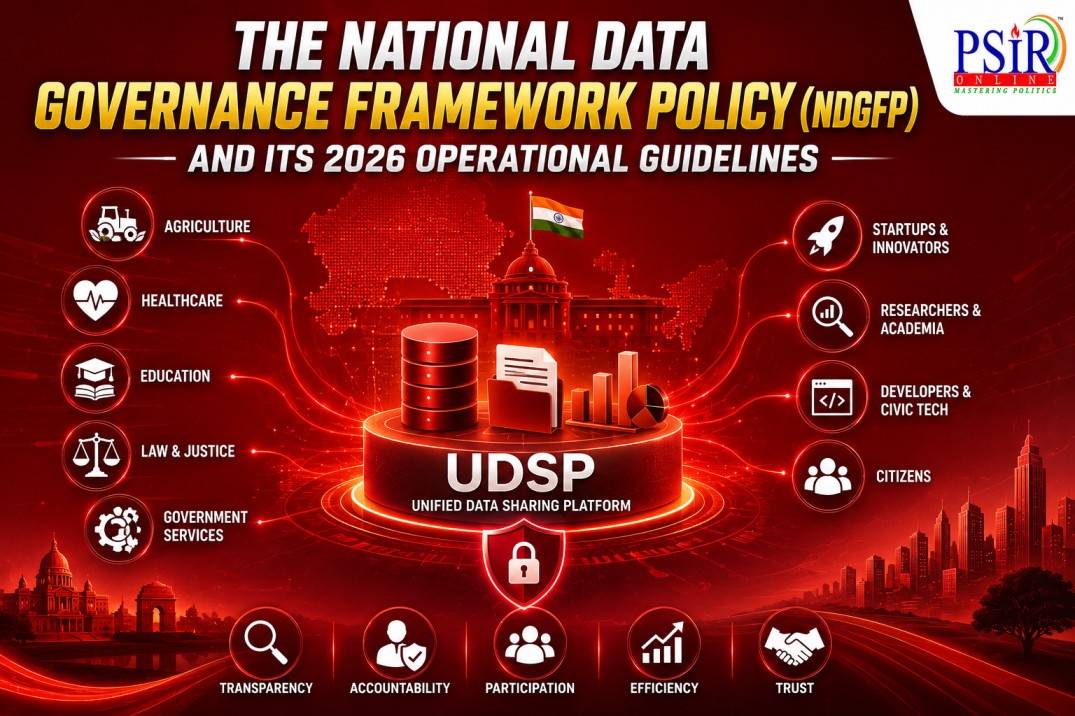
The National Data Governance Framework Policy (NDGFP) is India's key initiative to standardize the management, sharing, and use of government data—primarily non-personal and anonymized datasets—to boost e-governance, innovation, research, and startups while addressing privacy.
The original draft was released by MeitY in May 2022. In mid-April 2026, the Ministry of Electronics and Information Technology (MeitY) issued fresh, updated operational guidelines for the India Data Management Office (IDMO) to sharpen the execution of the NDGFP.
CORE ELEMENTS OF THE GOVERNANCE SHIFT
The policy mandates systematic cataloging of non-personal and anonymized datasets from central public-funded systems into a unified platform (referred to as the Unified Data Sharing Platform (UDSP) in the update, building on the earlier "India Datasets Programme" or similar national data exchange concepts).
· What qualifies? Non-personal data includes information that never related to identifiable individuals (e.g., weather patterns, supply chain metrics) or originally personal data that has been properly anonymized. Public non-personal data comes from government operations (e.g., anonymized land records, vehicle data, or service delivery metrics).
· Cataloging requirement: All relevant datasets from central ministries/departments must be inventoried, standardized (with metadata), and made available on the central platform. This creates a "whole-of-government" data ecosystem.
· Purpose: Enable data-led governance, AI development, and innovation by turning siloed government data into a national asset. Private entities are encouraged (not strictly mandated) to contribute similar datasets.
This shift moves from fragmented departmental data hoarding to centralized discoverability and sharing.
TRANSPARENCY & ACCOUNTABILITY MECHANISMS
To curb data monopolies and promote equitable access:
· Standardized request framework: Startups, Indian researchers, and innovators can formally request access to government-held metadata and datasets via the IDMO-managed platform. Requests are processed with clear rules, toolkits, and operational manuals.
· IDMO's role: Established under the Digital India Corporation (under MeitY), the IDMO develops rules, standards, and guidelines; manages the platform; ensures data quality/metadata standards; handles anonymization protocols; and oversees redressal. It coordinates with ministries (each having their own Data Management Units headed by Chief Data Officers) and states.
· Safeguards: Access is typically for non-commercial or research/innovation purposes, with privacy protections. The platform aims for secure, request-based sharing rather than open dumps.
This democratizes access previously limited to insiders, fostering an ecosystem for AI, research, and startups using India-specific datasets.
HOW THIS IS EXPECTED TO PROMOTE GOOD GOVERNANCE?
The NDGFP (and its 2026 operational guidelines for the IDMO and Unified Data Sharing Platform - UDSP) is explicitly designed to promote good governance by shifting from siloed, opaque data practices to a standardized, transparent, data-driven ecosystem. Good governance typically rests on principles like transparency, accountability, participation, efficiency/effectiveness, equity, and responsiveness — and this framework targets all of them.
1. Data-Driven Decision Making & Effectiveness
· Centralized cataloging of non-personal and anonymized datasets from central public-funded systems into the UDSP breaks down departmental silos.
· Policymakers and administrators gain access to high-quality, interoperable data for real-time insights, program evaluation, and evidence-based policies (e.g., in agriculture, healthcare, education, and law & justice).
· This reduces faulty decision-making caused by incomplete or inconsistent data and enables predictive analytics, resource optimization, and better service delivery.
· Expected outcome: More responsive and impactful governance, where interventions are targeted rather than generic.
2. Transparency & Anti-Monopoly Measures
· Standardized metadata and cataloging make government data discoverable.
· A formal framework allows startups, researchers, and innovators to request access, reducing "data monopolies" within bureaucracy.
· This promotes openness: citizens and external stakeholders can indirectly benefit through better apps, research, and services built on public data.
· The policy explicitly aims to promote transparency, accountability, and ownership in non-personal data access.
3. Accountability & Institutional Mechanisms
· The India Data Management Office (IDMO) acts as a central overseer: it sets rules, monitors compliance, builds capacity in ministries (via Data Management Units and Chief Data Officers), and handles grievances.
· Standardized anonymization protocols, data quality standards, and security guidelines create clear responsibility chains.
· Semi-annual consultations with states and industry ensure ongoing oversight and adaptability.
· This reduces arbitrary data handling and builds public trust in digital systems.
4. Citizen Participation & Inclusivity
· Easier access to data fuels innovation in civic tech, research, and startups, leading to citizen-centric tools (e.g., better apps for services).
· It supports greater citizen awareness and engagement by enabling data-backed public discourse and participatory governance.
· By aligning with broader Digital India goals, it aims for inclusive development, bridging digital divides through better e-governance.
5. Efficiency & Reduced Administrative Burden
· Whole-of-government approach standardizes processes across ministries and (ideally) states, cutting duplication and red tape.
· Automated cataloging and request workflows speed up internal data sharing and external innovation.
· This digitizes and automates civic functions, making governance leaner and more scalable.
6. Trust-Building Through Privacy & Security
· While focused on non-personal/anonymized data, the framework emphasizes robust safeguards (aligned with the Digital Personal Data Protection Act). Successful implementation builds citizen confidence in digital governance, which is foundational for good governance.
KEY CHALLENGES IN IMPLEMENTING THE NDGFP (AND ITS 2026 OPERATIONAL GUIDELINES FOR IDMO/UDSP)
The National Data Governance Framework Policy (NDGFP), originally drafted in 2022 and refined through mid-April 2026 operational guidelines, aims to create a robust, centralized system for non-personal and anonymized government data. However, experts, civil society groups, and analysts have highlighted several persistent and emerging challenges that could undermine its effectiveness, privacy protections, and governance goals.
1. Privacy and Re-Identification Risks (The Most Critical Technical Concern)
· Automated anonymization vulnerabilities: The policy relies on automated protocols to convert personal data into non-personal/anonymized datasets. However, these often lack uniform, robust verification—especially hardware-level checks—across diverse central and state-level servers.
· Re-identification threats: Advanced techniques (including AI/ML pattern analysis, cross-referencing with public or other datasets) can link "anonymized" data back to individuals. Quasi-identifiers (e.g., location patterns, demographics, or unique behaviors) make this easier in India's rich digital ecosystem.
· Heterogeneous infrastructure: State servers vary widely in capabilities, leading to inconsistent application of standards. A breach or weak link in one area could compromise the entire system.
· Consequence: Potential privacy violations, erosion of public trust, and legal risks under the Digital Personal Data Protection Act.
2. Implementation and Capacity Gaps
· Data silos and fragmentation: Breaking down entrenched departmental silos across ministries and states is a "monumental task." Many legacy systems lack standardization in format, quality, or metadata.
· Uneven state-level adoption: Central mandates face challenges in states with varying digital infrastructure, funding, and technical expertise. The 2026 guidelines push for a Unified Data Sharing Platform (UDSP), but coordination remains difficult.
· Capacity building: Ministries need Data Management Units (DMUs) and Chief Data Officers (CDOs), but training, resources, and cultural shifts (from data hoarding to sharing) are slow.
3. Institutional and Accountability Issues
· IDMO's structure: The India Data Management Office operates under the Digital India Corporation (a non-statutory body). Critics note insufficient clarity on its composition, independence, powers, and accountability mechanisms. It risks becoming another bureaucratic layer without strong enforcement teeth.
· Limited stakeholder consultations: While the policy calls for semi-annual consultations, these are often restricted to ministries, states, and industry—civil society and privacy experts feel underrepresented.
· Over-centralization risks: Excessive control under IDMO could stifle innovation or create new monopolies within government.
4. Lack of Comprehensive Legal Backing and Standards
· Absence of finalized supporting laws: NDGFP operates alongside (but not fully integrated with) the Digital Personal Data Protection Act. Clear, enforceable standards for anonymization, data quality, security, and intellectual property are still evolving.
· Discretionary powers: Ambiguities in access request processing, denial criteria, and grievance redressal could lead to arbitrary decisions.
· Voluntary private sector participation: The framework encourages (but does not mandate) private data contribution, limiting the richness of the UDSP ecosystem.
5. Balancing Utility, Innovation, and Security
· Data quality and utility loss: Over-aggressive anonymization can degrade data usefulness for AI/research, while lax approaches heighten risks.
· Resource and funding constraints: Building/maintaining the UDSP, ensuring cybersecurity, and scaling across thousands of government entities requires massive investment—competing with other digital priorities.
· Technological evolution: Rapid advances in AI make today's anonymization techniques obsolete quickly, requiring continuous updates.
6. Broader Socio-Political and Ethical Concerns
· Equity and access: Startups and researchers gain standardized request mechanisms, but smaller players or those without connections may face barriers. Rural/digital-divide issues could limit benefits.
· Potential for misuse: Centralized data platforms raise surveillance or political misuse concerns if safeguards weaken.
· Cultural resistance: Government officials accustomed to controlling data may resist sharing, slowing behavioral change
CONCLUSION
The 2026 guidelines likely focus on operationalizing the 2022 vision—e.g., detailed protocols for cataloging, platform features, request workflows, and verification standards—to make the UDSP functional. This fits India's push for data sovereignty, AI readiness, and responsible innovation.
In practice:
· For government: Better internal data use and citizen services.
· For innovators: Easier access to rich, India-relevant datasets (with approval).
· Risks to watch: Privacy breaches if anonymization falters, or uneven implementation creating new digital divides.
PRACTICE QUESTIONS FOR GS 2 MAINS
1. “The National Data Governance Framework Policy (NDGFP) marks a shift from departmental data silos to a whole-of-government data ecosystem.” Examine how the NDGFP can strengthen transparency, accountability, and evidence-based governance in India. Also discuss the major implementation challenges.
2. Discuss the role of the India Data Management Office (IDMO) under the National Data Governance Framework Policy (NDGFP). How can institutional mechanisms ensure both innovation and protection of citizen privacy in India’s digital governance ecosystem?
3. “Data is emerging as a strategic national asset in the age of Artificial Intelligence.” In this context, critically analyze the significance of the Unified Data Sharing Platform (UDSP) proposed under the National Data Governance Framework Policy (NDGFP).
4. The success of digital governance depends not only on technological capacity but also on public trust. Evaluate the privacy, ethical, and federal challenges associated with the implementation of the National Data Governance Framework Policy (NDGFP) in India.