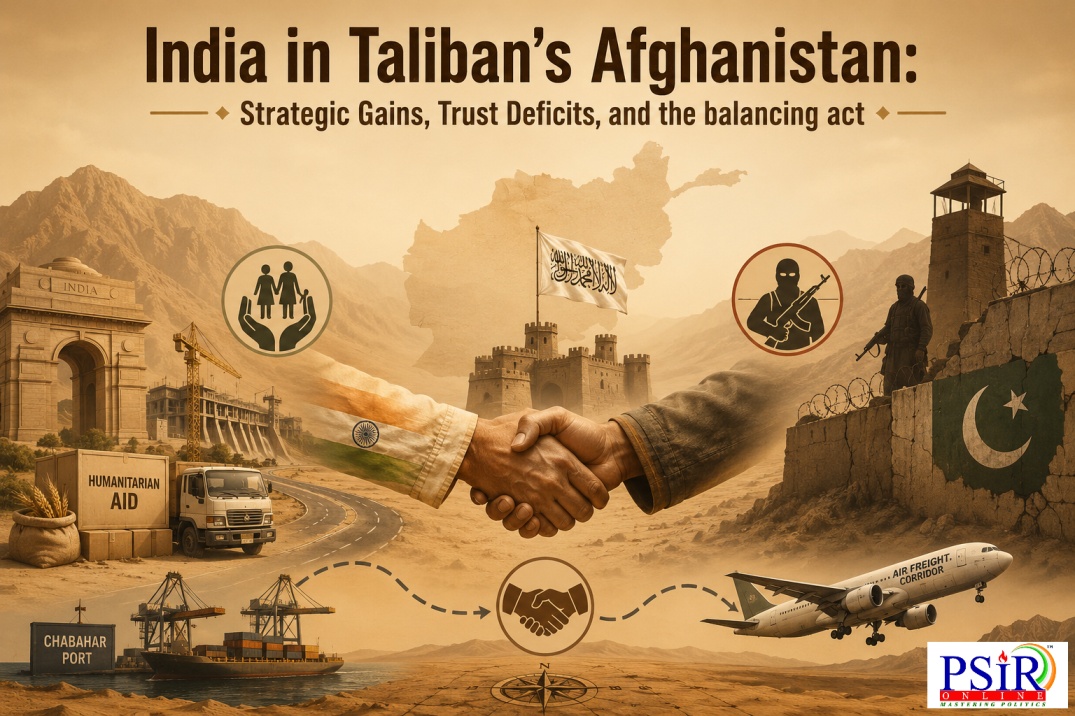
India's relationship with Afghanistan after the Taliban takeover in August 2021 has evolved from cautious disengagement and humanitarian focus to a pragmatic, incremental reset emphasizing security, economic interests, and regional strategy—without formal diplomatic recognition of the Taliban regime. This shift reflects New Delhi's "engage but not recognise" approach, driven by longstanding stakes (over $3 billion in pre-2021 investments) while navigating trust deficits, human rights concerns, and great-power rivalries. As of mid-2026, ties are at their most active level since 2021, marked by embassy reopening and trade initiatives, but remain conditional and reversible.
WHO IS TALIBAN?
The Taliban (Pashto for "students") is a predominantly Pashtun Islamist militant and political movement in Afghanistan. It follows a strict, ultra-conservative interpretation of Islamic law (Sharia), blending Deobandi Islamic fundamentalism with Pashtun cultural traditions and nationalism.
Origins and History
· Emerged in the mid-1990s in southern Afghanistan (around Kandahar) amid chaos after the Soviet withdrawal (1989) and the Afghan civil war.
· Mostly religious students (talibs) from madrasas in Afghanistan and Pakistan, many of whom fought in the anti-Soviet jihad.
· Gained rapid support by promising security, ending corruption and warlord abuses. Captured Kabul in 1996 and ruled most of the country until 2001 as the "Islamic Emirate of Afghanistan."
· Ousted by the U.S.-led invasion after sheltering al-Qaeda (responsible for 9/11).
· Regrouped in Pakistan, waged insurgency for 20 years, and retook Kabul in August 2021 as U.S./NATO forces withdrew.
Ideology and Governance
· Enforce a harsh version of Sharia: severe restrictions on women's rights (bans on most education/work/public life), destruction of non-Islamic heritage (e.g., Bamiyan Buddhas), corporal punishments, and limited freedoms.
· Led by a supreme leader (Amir al-Mu'minin or "Commander of the Faithful") with near-absolute authority, supported by a leadership council (Rahbari Shura).
· Current supreme leader (as of 2026): Hibatullah Akhundzada (since 2016), based in Kandahar. He is reclusive; day-to-day governance involves figures like Sirajuddin Haqqani (Interior Minister) and others, with some reported internal tensions.
The group is designated a terrorist organization by several countries (though not universally). Only Pakistan, Saudi Arabia, and UAE recognized their first regime; today, no country formally recognizes the Islamic Emirate, though pragmatic engagement occurs.
WHY INDIA STRONGLY OPPOSED THE TALIBAN TAKEOVER IN 2021?
India had deep reservations rooted in security, strategic, and ideological concerns. New Delhi actively supported the pre-2021 Afghan government and the Northern Alliance (anti-Taliban forces) for decades.
1. Security Threats and Terrorism Links:
· India viewed the Taliban as a proxy of Pakistan's ISI (Inter-Services Intelligence). Pakistan used the group for "strategic depth" against India.
· Historical hostility: During the 1990s regime, the Taliban sheltered anti-India militants. India blamed Taliban-linked groups (with Pakistani backing) for attacks on Indian assets in Afghanistan (e.g., 2008 Kabul embassy bombing, 2010 attacks killing Indians).
· Fear that a Taliban-ruled Afghanistan would again become a safe haven for groups like Jaish-e-Mohammed and Lashkar-e-Taiba, which target India (Kashmir attacks, etc.).
2. Loss of Strategic Investments and Influence:
· India invested over $3 billion in Afghan development (dams, roads, parliament, hospitals, education, electricity) — projects tied to the republican government.
· A pro-Pakistan Taliban regime threatened these assets and India's access to Central Asia (via Afghanistan for trade/energy routes).
· Strengthened the China-Pakistan axis in India's neighborhood.
3. Ideological and Human Rights Concerns:
· India's democratic values clashed with the Taliban's extremism, especially treatment of women, minorities (e.g., Hazaras, Sikhs/Hindus), and freedoms.
· Past incidents: Taliban forced Afghan Hindus to wear identifying badges; destroyed cultural sites; aligned with global jihadist elements.
4. Historical Alignment:
· India backed the Northern Alliance (non-Pashtun groups) against the Taliban in the 1990s and post-2001. The 2021 takeover was seen as a "body blow" to these ties.
In short, India saw a Taliban victory as empowering its adversary (Pakistan), endangering its citizens/projects, and creating a hostile, unstable neighbor — a direct threat to national security.
INDIA – TALIBANIC AFGHANISTAN RELATIONS
Initial Phase (2021–Early 2025): Humanitarian Lifeline and Minimal Presence
India closed its Kabul embassy and consulates immediately after the Taliban seized power, evacuating nationals amid chaos. It refused recognition, viewing the regime as illegitimate and linked to past threats (e.g., 1990s support for anti-India militants and the 1999 IC-814 hijacking).
Instead, New Delhi prioritized humanitarian aid to the Afghan people (not the regime): wheat shipments (via Pakistan initially, then Iran's Chabahar Port to bypass Islamabad), COVID vaccines, medicines, winter kits, and earthquake relief. A "technical mission" was deployed in Kabul in June 2022 to coordinate deliveries and monitor projects. Annual aid allocations continued (e.g., $25–27 million in early budgets), with emphasis on people-to-people ties like scholarships and medical visas (suspended initially but resumed selectively).
This phase safeguarded India's legacy footprint (e.g., Salma Dam, roads, hospitals, parliament building) while avoiding legitimizing the Taliban.
Pragmatic Reset (2025–2026): High-Level Engagement and Institutionalization
A clear thaw began in 2025 amid Taliban-Pakistan border clashes and Islamabad's accusations that Kabul harbors anti-Pakistan militants (TTP). Key milestones:
· January 2025: Foreign Secretary Vikram Misri met Taliban Acting FM Amir Khan Muttaqi in Dubai—highest-level contact since 2021.
· April–May 2025: India resumed Afghan visas (medical, student, etc.); EAM S. Jaishankar's phone call with Muttaqi (first political-level) thanked the Taliban for condemning a Kashmir terror attack.
· October 2025: Muttaqi's landmark visit to Delhi; India upgraded its Kabul technical mission to a full Embassy of India (effective October 2025, with chargé d'affaires initially). Joint statement committed to economic recovery, trade, and development.
· Late 2025–2026: Taliban Commerce Minister visits; launch of India-Afghanistan Air Freight Corridor (Kabul-Delhi/Amritsar routes) and enhanced Chabahar use; Taliban appoints Charge d'Affaires in New Delhi; India's 2026–27 budget hikes Afghan aid allocation. Trade discussions target mining, pharma, agriculture, and a joint chamber of commerce.
The Taliban has publicly called India a "significant regional and economic partner." India has not granted full recognition and aligns with the international community's stance on governance issues
ANALYSIS OF THEIR RELATIONSHIP
Security Dimension (Core Driver): India's top priority remains preventing Afghan soil from becoming a launchpad for groups like Jaish-e-Mohammed or Lashkar-e-Taiba. Engagement extracts assurances and monitoring access. Taliban condemnations of attacks on India (e.g., 2025 Kashmir incident) are noted positively, but skepticism persists due to historical ties and Pakistan's influence. Deteriorating Taliban-Pakistan relations (Durand Line clashes, refugee deportations, TTP attacks) have created space for India—Pakistan has even accused Kabul of becoming an "Indian colony." This indirectly benefits New Delhi by weakening the Pak-Taliban axis. Risks include ISKP threats and incomplete Taliban control.
Economic and Connectivity Angle: Protecting and reviving $3B+ investments is central. Pre-2021 projects (infrastructure, health, education) are being maintained or restarted. New focus: trade (Afghanistan runs a surplus with India; bilateral volume recovering toward $1B), air/sea corridors via Chabahar (bypassing Pakistan), and potential investments in resources. This supports Afghanistan's economy while giving India Central Asia access and soft-power leverage. Taliban offers (tax breaks, land for Indian firms) signal mutual interest.
Geopolitical and Strategic Calculus: India counters Pakistan and China's growing sway (BRI interest, Pakistan's "strategic depth" loss). Engagement diversifies India's neighborhood options amid tensions elsewhere (e.g., with Bangladesh, Nepal). It positions India as a reliable development partner in a vacuum left by Western withdrawal. Broader benefits include regional stability messaging at UNSC and goodwill in the Islamic world.
Humanitarian and People-to-People Ties: Aid remains the foundation—framed as support for Afghans, not the regime. Resumed visas, medical facilities (e.g., Thalassemia center upgrades), and refugee support build long-term affinity. This aligns with India's historical civilian-centric approach and contrasts with more transactional players.
Diplomatic and Normative Trade-offs: India walks a tightrope: pragmatic engagement (embassy, talks) without recognition preserves leverage on counter-terrorism and avoids endorsing the Taliban's repressive governance (women's rights restrictions, minority treatment). Critics note India has de-emphasized human rights publicly for strategic gains. Taliban gains legitimacy and economic breathing room; India gains presence. This "middle path" has drawn international accommodation (e.g., UN sanctions waivers for visits).
INDIA-AFGHANISTAN-PAKISTAN TRIANGULAR RELATIONS (2021–MID-2026):
The relationship between India, Afghanistan, and Pakistan has been defined by deep strategic rivalries, with Afghanistan serving as a proxy battleground. After the Taliban's 2021 takeover, initial India-Afghanistan disengagement gave way to pragmatic Indian re-engagement (2025 onward), precisely as Taliban-Pakistan ties collapsed into open conflict. India has positioned itself as a supporter of Afghan sovereignty without direct military involvement, leveraging the rift to weaken Pakistan's influence while advancing its own economic and security interests. No formal alliances exist, but the dynamics reflect classic realpolitik: Pakistan's loss of "strategic depth" in Afghanistan has become India's strategic gain.
The Afghanistan-Pakistan Conflict (2024–2026): Escalation into "Open War"
Tensions exploded after 2021 when the Tehrik-i-Taliban Pakistan (TTP, or Pakistani Taliban)—a separate but ideologically aligned group—surged in attacks inside Pakistan. Islamabad accuses the Afghan Taliban of providing safe havens, training, and cross-border support to TTP fighters. Kabul denies this, calling it Pakistan's internal problem rooted in its own militancy and the disputed Durand Line border (2,600 km, never fully accepted by Afghanistan).
Key Phases:
· Build-up (2024–early 2025): Rising TTP attacks; Pakistani cross-border strikes in Dec 2024; border closures and mass Afghan refugee deportations.
· October 2025 Escalation ("Operation Khyber Storm"): Pakistan launched airstrikes on alleged TTP targets in Kabul, Khost, Jalalabad, and Paktika (Oct 9). Afghan forces retaliated with ground attacks on Pakistani border posts, killing dozens on both sides. Fierce clashes along the Durand Line (esp. Spin Boldak). A tenuous ceasefire followed international mediation, but low-level fighting persisted.
· February–March 2026 ("Open War" / Operation Ghazab lil Haq): Afghan cross-border offensive (Feb 26) prompted Pakistani airstrikes and ground operations on Kabul, Kandahar, and border areas. A major controversy erupted on March 16 when Pakistan struck what it called a military site (former US base/Camp Phoenix) but Afghanistan labeled a Kabul drug-rehab hospital, claiming 400+ civilian deaths. Temporary Eid al-Fitr truce (mid-March) brokered by Qatar, Saudi Arabia, and Turkey; sporadic violations and shelling continued into April–May 2026 (e.g., Chaman sector clashes).
· Status (May 2026): Fragile ceasefires and talks in China (April 2026); border largely closed; trade halted; hundreds of casualties (military + civilian) and thousands displaced. UN experts urge lasting peace.
Pakistan frames the conflict as counter-terrorism; Afghanistan sees it as sovereignty violation and aggression.
India's Stand: Condemnation of Pakistan + Accelerated Taliban Engagement
India has remained non-belligerent but vocal and opportunistic. Its policy is "engage but not recognise" the Taliban regime, framed around Afghan people, counter-terrorism assurances, and economic stakes.
Key Elements of India's Position:
· Strong Public Condemnation of Pakistani Actions: India repeatedly condemned Pakistani airstrikes as violations of Afghan sovereignty, citing civilian casualties (including women/children) and "externalising internal failures." MEA statements highlighted Pakistan's history of sponsoring terrorism while blaming neighbours. India reaffirmed commitment to Afghanistan's territorial integrity and independence.
· Strategic Timing of Reset with Taliban: The Pak-Taliban rift created space for India. Milestones include:
o Oct 2025: Taliban Acting FM Amir Khan Muttaqi's visit to Delhi; India upgraded its Kabul technical mission to full Embassy.
o Air freight corridor, trade initiatives, and Taliban chargé d'affaires in New Delhi.
o Continued humanitarian aid and development focus.
· Pakistan's Reaction: Islamabad has accused the Taliban of turning Afghanistan into an "Indian colony" or proxy, viewing India's outreach (timed with Taliban FM's India visit) as encirclement. This has heightened Pakistan's paranoia amid its own security and economic crises.
Strategic Calculus: (Why India does so?)
· Security: India gains monitoring access and Taliban condemnations of anti-India terror (e.g., Kashmir attacks). Reduces risk of Afghan soil being used against India by Pakistan-backed groups.
· Geopolitical: Weakens the China-Pakistan axis; counters Pakistan's traditional dominance in Afghanistan. Positions India as a reliable development partner in the vacuum left by the West.
· Economic/Connectivity: Protects $3B+ past investments; opens Central Asia routes via Chabahar (bypassing Pakistan).
· Normative: India balances realpolitik with public emphasis on sovereignty and civilian protection—contrasting with its earlier human-rights silence on Taliban governance.
· Risks: Potential backlash if Taliban duplicity on terror emerges; optics of engaging an extremist regime; escalation spillover.
The Afghan-Pak conflict has transformed the triangle in India's favour. Pakistan's "STRATEGIC DEPTH" doctrine has backfired spectacularly, while India has converted a 2021 setback into a 2025–26 opportunity through calibrated diplomacy. Ties remain fluid—dependent on Taliban behaviour, TTP containment, and great-power mediation—but India's "enemy's enemy" approach has strengthened its regional footprint without overcommitment. As of mid-2026, the conflict simmers, and India continues to hedge effectively for long-term stability and influence.
|
Pakistan's "Strategic Depth" Doctrine is a long-standing military and foreign policy concept aimed at using Afghanistan as a strategic buffer and fallback zone against a potential Indian military offensive. In military terms, "strategic depth" refers to the geographical space and time a defender gains to absorb an enemy attack, retreat if necessary, regroup forces, and launch a counter-offensive. For Pakistan, its narrow geography (especially the populated Punjab heartland close to the Indian border) makes it vulnerable to a rapid Indian advance. The doctrine envisions a friendly or pliable regime in Kabul that would: · Allow Pakistani forces, leadership, or assets to retreat westward into Afghanistan. · Provide rear bases for regrouping and sustained resistance. · Deny India (or any adversary) influence in Afghanistan, preventing a two-front threat. · Act as a launchpad for proxy operations ("bleed India through a thousand cuts") and secure land access to Central Asia. It also includes preventing Afghan irredentism over the disputed Durand Line border and countering Pashtun nationalism that could threaten Pakistan's unity.
|
CHALLENGES AND RISKS FOR INDIA'S AFGHANISTAN POLICY (POST-2021, WITH FOCUS ON 2025–MID-2026 ENGAGEMENT)
India’s pragmatic re-engagement with the Taliban — upgrading its Kabul mission to a full embassy, high-level visits, air freight corridors, and expanded trade — offers strategic gains but carries substantial downsides. New Delhi continues its “engage but not recognise” approach, yet the risks remain real and multifaceted.
1. Trust Deficit: Taliban-Pakistan History and Potential Duplicity on Terrorism
The Taliban’s deep historical ties with Pakistan’s ISI create a persistent credibility gap. Many senior Taliban leaders were nurtured in Pakistani sanctuaries, and the group has long been seen as Islamabad’s proxy. Despite public condemnations of anti-India attacks (e.g., in Kashmir), doubts linger about the Taliban’s willingness or ability to fully sever links with groups like Jaish-e-Mohammed (JeM) and Lashkar-e-Taiba (LeT).
· The Taliban has not taken decisive action against anti-India networks, citing ideological or internal cohesion concerns.
· Pakistan’s accusations that Afghanistan has become an “Indian colony” highlight how the current Taliban-Pakistan rift (driven by TTP safe havens) could reverse if relations improve.
· Risk: A sudden shift in Taliban priorities could expose Indian personnel, projects, or intelligence-sharing to renewed threats. UN reports continue to flag terrorism risks emanating from Afghan soil, including potential collaboration between TTP, Al-Qaeda affiliates, and ISKP.
2. Security for Personnel and Projects
Even with Taliban assurances of protection, the ground situation remains volatile. India’s $3 billion+ legacy projects (dams, roads, hospitals, parliament building) and new initiatives (mining, pharma, agriculture) need physical security.
· ISKP (Islamic State-Khorasan Province) remains a potent threat and has targeted foreign interests in the past.
· Residual anti-Taliban resistance groups and factional violence add layers of unpredictability.
· Indian diplomats, aid workers, and business delegations operate in a high-risk environment. Past attacks on Indian assets (pre-2021) serve as a reminder that security guarantees from the Taliban may prove unreliable during internal power struggles or external pressures.
3. Sustainability: Regime Isolation, Internal Factions, and Economic Desperation
The Taliban regime faces severe structural weaknesses that could undermine long-term cooperation with India.
· International isolation — No country has granted formal recognition. Sanctions and banking restrictions limit economic recovery, making the Taliban heavily dependent on humanitarian aid and selective partners.
· Internal fissures — Differences between the Kandahar-based supreme leader Hibatullah Akhundzada’s hardliners and more pragmatic Doha/Kabul-based figures (e.g., Sirajuddin Haqqani) can lead to inconsistent policy implementation.
· Economic desperation — Afghanistan’s collapsed economy (millions in need of aid, restricted women’s workforce participation) pressures the Taliban to seek quick wins, but also makes them prone to over-promising and under-delivering. If isolation deepens or factional fighting intensifies, Indian investments could stall again.
4. Domestic and International Optics: Balancing Values with Realpolitik
India’s democratic credentials and global image as a defender of pluralism face scrutiny due to its engagement with one of the world’s most repressive regimes.
· Women’s rights silence — The Taliban’s systematic rollback of women’s and girls’ rights (bans on secondary/university education, most employment, public participation, and severe mobility restrictions) has drawn global condemnation. India’s low-key approach on this issue during high-level visits (including controversies over women journalists’ exclusion in Delhi press events) has sparked domestic criticism from media, opposition parties, and women’s groups.
· Critics argue New Delhi is prioritising anti-Pakistan strategy over human rights, potentially eroding soft power among Afghan civilians (especially non-Pashtun groups and urban populations who remember India’s earlier support for the republican government).
· Internationally, closer ties risk straining relations with Western partners who maintain stricter conditions on Taliban engagement.
5. External Spoilers: China-Pakistan Coordination and Great-Power Shifts
Geopolitical headwinds could disrupt India’s gains.
· China-Pakistan axis — Beijing is actively mediating between Kabul and Islamabad while pushing CPEC extension into Afghanistan. China offers economic alternatives (Gwadar access, BRI projects) and security guarantees, explicitly urging the Taliban to reduce reliance on India. Successful trilateral coordination could sideline Indian connectivity initiatives (e.g., Chabahar-based routes).
· U.S./Western policy shifts — A more isolationist or transactional U.S. approach, or renewed Western focus on counter-terrorism waivers, could alter the diplomatic space. Sudden changes in sanctions or aid could strengthen or weaken the Taliban’s leverage vis-à-vis India.
· Other players (Iran, Russia, Central Asian states) have their own agendas that may not align with New Delhi’s interests.
Overall Assessment: These challenges make India’s policy inherently reversible and calibrated. New Delhi mitigates risks through incremental steps, heavy emphasis on humanitarian and economic deliverables, and constant security vetting. However, the fluid nature of Taliban governance, the volatile Af-Pak conflict, and great-power competition mean that today’s pragmatic gains could face serious tests in the coming years.
Success depends on extracting verifiable counter-terrorism commitments, diversifying engagement beyond the Taliban leadership, and maintaining flexibility without over-investment.
PRACTICE QUESTIONS FOR GS 2 MAINS
1. “India’s Afghanistan policy after the Taliban takeover reflects a shift from ideological caution to strategic pragmatism.” Critically examine India’s “engage but not recognise” approach towards Taliban-ruled Afghanistan.
2. Discuss the strategic implications of the deteriorating Taliban–Pakistan relationship for India’s regional security and foreign policy objectives.
3. Humanitarian engagement without diplomatic recognition has become a key feature of India’s Afghanistan policy. Analyse the opportunities and limitations of this approach.
4. Examine how connectivity initiatives such as Chabahar Port and the India–Afghanistan Air Freight Corridor strengthen India’s geopolitical interests in Central Asia and Afghanistan.
PRACTICE QUESTIONS FOR PSIR OPTIONAL
1. Using the concept of “Strategic Depth,” analyse Pakistan’s historical Afghanistan policy and explain how recent Taliban–Pakistan tensions have altered South Asian regional geopolitics.
2. India’s evolving engagement with the Taliban demonstrates the dominance of realist considerations in contemporary foreign policy. Discuss with suitable theoretical perspectives.
3. Evaluate the role of Afghanistan in the India–Pakistan strategic rivalry. How has the post-2021 regional order reshaped this triangular relationship?
4. Critically analyse India’s balancing act between normative concerns (democracy, women’s rights, human rights) and strategic interests in its engagement with Taliban-led Afghanistan.