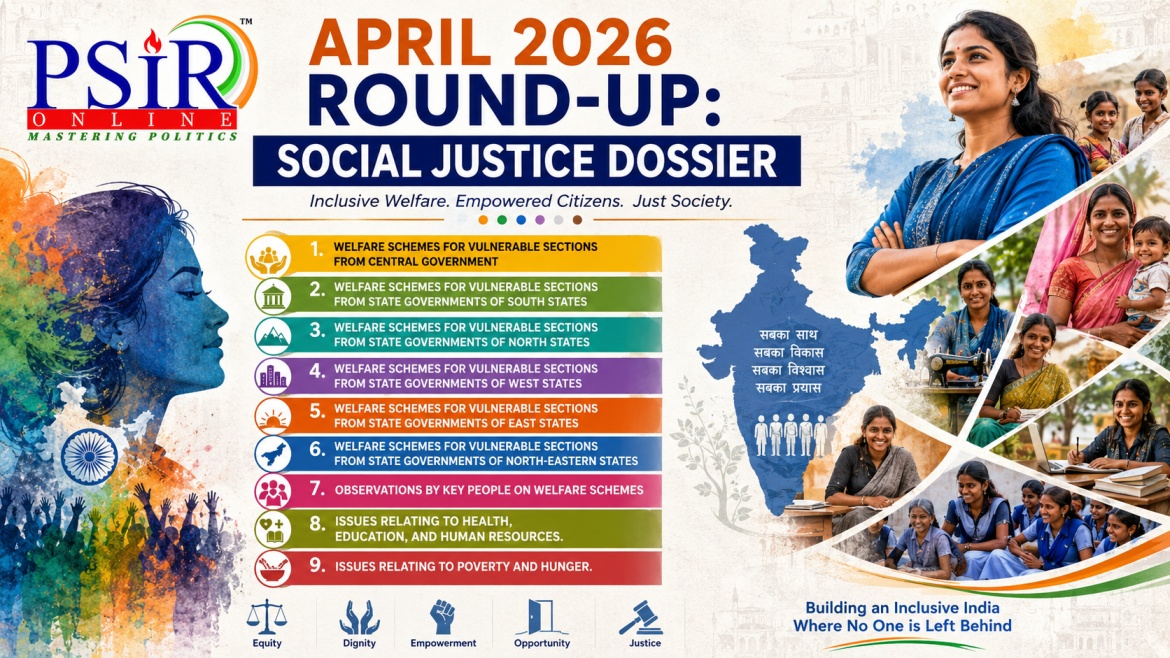
1. WELFARE SCHEMES FOR VULNERABLE SECTIONS FROM CENTRAL GOVERNMENT
No major entirely new Central Government welfare schemes specifically for vulnerable sections (e.g., SC/ST/OBC, minorities, women, children, elderly, disabled, or other marginalized groups) were launched in April 2026. Most activity involved ongoing schemes, extensions, budget implementations (from the Feb 2026 Union Budget), administrative updates, and digital tools.
Notable April 2026 Development
· SMILE–Beggary Survey Mobile Application (launched ~25 April 2026 during the Ministry of Social Justice & Empowerment’s Chintan Shivir in Chandigarh, 24–26 April): This is a new digital tool under the existing SMILE Scheme (Support for Marginalized Individuals for Livelihood and Enterprise). It supports real-time data collection, monitoring, and rehabilitation for persons engaged in begging (a highly vulnerable group). It enhances field-level implementation but is not a brand-new welfare scheme.
Other Relevant April 2026 Updates (No New Schemes)
· Chintan Shivir (24–26 April 2026):
· The National Chintan Shivir on Social Justice (April 24–26, 2026, Chandigarh), organized by the Ministry of Social Justice and Empowerment, was a landmark Centre-State collaborative meeting focused exclusively on improving delivery of existing social justice schemes—not launching new ones.
· Under the theme "Antyodaya ka Sankalp, Amrit Kaal ka Pratibimb – Viksit Bharat@2047", it brought together States and Union Territories to address implementation gaps.
· Key focus areas included scholarships (simplified via the new SETU App), de-addiction (strengthened Nasha Mukt Bharat Abhiyaan 2.0 App), senior citizen support (welfare and community-based assistance), disability inclusion (accessibility standards, hassle-free certification, universal design), and NSAP pensions (ensuring timely disbursement with simplified documentation).
· The Shivir emphasized last-mile delivery, raising awareness among beneficiaries, and simplification of processes to reduce delays and documentation burdens. Digital platforms like SAMAVESH Portal, SETU App, SMILE App, and NMBA 2.0 App were launched/launched to streamline services.
· The outcome was time-bound, actionable recommendations adopted by all States/UTs, including PM-AJAY area-based interventions, universal accessibility standards by 2027–28, stronger grievance redressal, and enhanced capacity building for engineers/architects on accessibility.
· National Overseas Scholarship (NOS) updates: Guidelines and results for SC/etc. candidates for 2026-27 (applications opened around late April).
· Routine implementation of Budget 2026-27 announcements (e.g., skill/employment focus for Divyangjan, women caregivers, SHG support) started taking effect, but no fresh launches in April.
Key Ongoing/Recently Strengthened Central Schemes for Vulnerable Sections
These continue to be the main ones (many with expansions or higher allocations post-Budget 2026-27):
· SC/ST/OBC/Minorities: PM-AJAY (Pradhan Mantri Anushuchit Jaati Abhyuday Yojana), Stand-Up India (loans for SC/ST/women entrepreneurs), PMJVK, scholarships (Pre/Post-Matric, Top Class, NOS).
· Women/Children: PM Matru Vandana Yojana, Beti Bachao Beti Padhao, Poshan Abhiyan, Ujjwala.
· Elderly: Indira Gandhi National Old Age Pension (NSAP), PM Vaya Vandana, Rashtriya Vayoshri Yojana (aids/devices).
· Disabled (Divyangjan): ADIP (aids/appliances), scholarships, reservations, Divyangjan Kaushal Yojana & Divyang Sahara (from Budget announcements – skilling & assistive devices).
2. WELFARE SCHEMES FOR VULNERABLE SECTIONS FROM STATE GOVERNMENTS OF SOUTH STATES
No major brand-new welfare schemes specifically for vulnerable sections (SC/ST, women, children, elderly, disabled, minorities, etc.) were launched by South Indian state governments in April 2026. Most activity involved rollouts, expansions, or implementations of schemes announced earlier (often in state budgets or late 2025/early 2026), along with routine pension disbursements and administrative updates.
Andhra Pradesh
· Universal Health Coverage Scheme rollout began/effective from April 1, 2026: Provides health insurance/cover to all citizens (previously announced). It offers up to ₹2.5 lakh (or higher up to ₹25 lakh for the poor in some variants) for medical treatment, covering thousands of procedures. This benefits vulnerable groups broadly, including low-income families, elderly, and disabled.
· Routine implementation of pensions (old age, widows, disabled) and other ongoing schemes (e.g., YSR Pension Kanuka, Divyang-related) continued, with possible April-specific disbursements.
Telangana
· No specific new launches reported in April 2026. Focus remained on implementing 2026-27 Budget announcements (e.g., Indiramma Family Life Insurance Scheme from June 2026, Cheyutha pension expansions, breakfast/mid-day meal extensions). Welfare push continued for women, employees, and poor families.
Karnataka
· No major new April 2026 launches for vulnerable sections. Ongoing schemes like Gruha Lakshmi (₹2,000/month to women) and others from previous guarantees/budgets continued. Emphasis on implementation and minority welfare via central schemes.
Tamil Nadu
· No entirely new schemes launched in April 2026. Pre-election welfare expansions (e.g., pensions, women’s assistance, school meals) were prominent, but major rollouts or announcements occurred earlier. Focus remained on existing programs like Kalaignar Magalir Urimai Thittam and pensions for elderly/disabled.
Kerala
· Assured Pension Scheme (APS) for government employees became effective from April 1, 2026: Employees (existing and new) can opt for this assured/guaranteed pension (up to 50% of last drawn salary + DR) instead of or alongside NPS. This primarily benefits government employees and pensioners but strengthens social security.
· Broader welfare (social security pensions, elderly care) saw ongoing implementation from the 2026-27 Budget.
3. WELFARE SCHEMES FOR VULNERABLE SECTIONS FROM STATE GOVERNMENTS OF NORTH STATES
No major entirely new welfare schemes specifically for vulnerable sections (SC/ST, women, children, elderly, disabled, etc.) were launched by North Indian state governments in April 2026. Activity mainly involved implementation, disbursements, pension releases, and rollouts of schemes from earlier state budgets (Feb/March 2026) or ongoing programs.
Uttar Pradesh
· No brand-new scheme launches in April 2026. Focus on welfare scheme saturation and disbursements.
· CM Yogi Adityanath emphasized reaching every eligible beneficiary (e.g., housing, medical aid) during Janata Darshan events in early April.
· Ongoing: Social Security Pensions (₹1,000/month for elderly/widows/disabled), Divyangjan support, and mass marriage grants (enhanced in Budget 2026-27). Large allocations continued from the Feb 2026 Budget (₹14,953 Cr for social welfare).
Rajasthan
· No new April launches reported. Emphasis on pension enhancements and disbursements (e.g., ₹1,005 Cr transferred to 51+ lakh pensioners in phases around this period).
· Key ongoing: Mukhyamantri Vriddhjan Samman Pension, Ekal Nari Samman Pension, Vishesh Yogyajan Pension (for disabled), with recent increases (up to ₹1,450/month in some categories).
Punjab
· No new welfare schemes for vulnerable groups in April. Routine pension disbursements and early salary/pension releases (e.g., April payments advanced for holidays).
· Focus remained on existing pensions and employee-related reforms.
Haryana
· Dayalu Scheme disbursements highlighted (e.g., ₹298 Cr to 7,875 families around 10 April 2026) — financial assistance for vulnerable families.
· On 26 April 2026, CM announced direct transfers under 29 welfare schemes to workers' accounts (housing, healthcare, education benefits for vulnerable sections).
· These were implementations rather than brand-new launches.
Delhi
· No specific April 2026 launches. Ongoing expansions (e.g., health cover eligibility for widows/disabled pensioners under PM-JAY variants) from earlier announcements.
Himachal Pradesh, Uttarakhand, J&K
· Primarily pension disbursements (e.g., Uttarakhand CM released April pensions worth ₹111+ Cr to ~7.57 lakh beneficiaries in early May, covering April dues).
· No new scheme announcements in April.
4. WELFARE SCHEMES FOR VULNERABLE SECTIONS FROM STATE GOVERNMENTS OF WEST STATES
No major brand-new welfare schemes specifically for vulnerable sections (SC/ST, women, children, elderly, disabled/Divyangjan, etc.) were launched by West Indian state governments in April 2026. Activity focused on implementations, disbursements, pension/honorarium enhancements, and rollouts from earlier budgets (e.g., 2026-27 state budgets announced in Feb/March 2026).
Maharashtra
· No entirely new schemes launched in April 2026.
· Emphasis on ongoing programs like Sanjay Gandhi Niradhar Anudan Yojana (₹1,500/month for destitute, widows, disabled, aged 18-65) and Shravanbal Seva State Pension for elderly. Recent enhancements (e.g., pension increases) continued from 2025 decisions.
· Mukhyamantri Majhi Ladki Bahin Yojana (₹1,500/month to women) and other women/elderly schemes saw routine DBT and saturation drives.
· Focus remained on implementation of social justice department schemes for SCs, Divyangjan, and senior citizens.
Gujarat
· No new April 2026 launches reported for vulnerable groups.
· Continued implementation of pensions (e.g., old age, widow/Ganga Swarupa, disability) and schemes like Kunverbai no Mameru (for girls' marriage) and social security pensions. Enhanced allocations from the 2026-27 budget were rolled out.
· Emphasis on SC/ST sub-plans, centralized kitchens for nutrition, and PM-JAY integrations for health cover to poor/elderly.
Goa
· No brand-new welfare schemes in April, but notable implementations effective April 1, 2026:
o Anganwadi Workers & Helpers Honorarium Increase: Revised pay (Workers: ₹15,000–₹23,000; Helpers: ₹8,500–₹11,500 based on service) — benefits grassroots child/women nutrition and vulnerable family support.
o Routine Griha Aadhar and Dayanand Social Security Scheme disbursements (e.g., April payments to lakhs of beneficiaries for elderly/widows).
· Social Welfare Department allocations (from Budget 2026-27) supported Divyang Kaushalya Yojana, Atal Asra, and schemes for marginalized groups, with focus on implementation
5. WELFARE SCHEMES FOR VULNERABLE SECTIONS FROM STATE GOVERNMENTS OF EAST STATES
No major entirely new welfare schemes specifically for vulnerable sections were launched by East Indian state governments (West Bengal, Odisha, Bihar, Jharkhand) in April 2026. Most activity involved budget implementations, pension disbursements, food security enhancements, and administrative updates/rollouts from earlier announcements (e.g., 2026-27 state budgets).
West Bengal
· No brand-new scheme launches in April 2026. Focus was on ongoing programs (e.g., Lakshmir Bhandar cash transfers to women, Swasthya Sathi health cover, Kanyashree for girls) and preparations for post-election changes.
· Note: Major shifts (e.g., Annapurna Bhandar scheme offering ₹3,000/month to eligible women, free bus travel for women) were announced/rolled out from June 2026 under the new government, along with ending religion-based schemes. These were not April launches.
Odisha
· Mukhyamantri Hastatanta Bikasha Yojana (approved in April 2026): ₹589 crore outlay for handloom sector development, including infrastructure, technology, skill training, and marketing support for weavers (many from vulnerable/rural backgrounds). This indirectly benefits artisans and marginalized communities.
· Mukhyamantri Annapurna Yojana (MAPY) rollout/implementation: Additional 5 kg free rice per person per month for NFSA/SFSS beneficiaries (covering ~3.28 crore people) to boost food security for the poor and vulnerable. Cabinet clearances around early April supported this.
· Ongoing: Madhu Babu Pension Yojana, Sweekruti (for transgender persons), and PVTG-focused efforts (despite CAG noting gaps in coverage).
Bihar
· No specific new launches reported in April 2026. Preparations for 2026-27 schemes (e.g., enhanced SC/ST support, inter-caste marriage incentives, overseas scholarships) were underway but announced/implemented later.
· Emphasis on routine disbursements under Mukhyamantri Vriddhajan Pension, Kanya Utthan Yojana, and other ongoing social security programs.
Jharkhand
· No new April 2026 launches for vulnerable groups. Focus on Sarvajan Pension Scheme, Maiya Samman, and pension/fund releases (e.g., ₹10,263 Cr allocated for pensions in FY 2026-27, with disbursements continuing).
· Budget 2026-27 implementations (e.g., women farmers' support via Mahila Khushhali Yojana) were in progress.
6. WELFARE SCHEMES FOR VULNERABLE SECTIONS FROM STATE GOVERNMENTS OF NORTH-EASTERN STATES
No major entirely new welfare schemes specifically for vulnerable sections (SC/ST, women, children, elderly, disabled, etc.) were launched by North East Indian state governments in April 2026. Activity primarily involved routine pension disbursements, enhancements to existing schemes, budget implementations, and administrative updates from earlier announcements.
Assam
· Routine pension disbursements (e.g., Old Age/Bridha Pension) continued, with April 2026 payments credited between ~5th–12th April (₹200–500/month depending on age, plus state top-ups).
· Focus remained on ongoing flagship programs like Orunodoi (cash transfers to women, with earlier expansions to more beneficiaries) and youth/graduate support schemes (e.g., Jibon Prerana). No new April launches.
Meghalaya
· Meghalaya Non-Government Schools & Colleges Employees Centralised Provident Fund Scheme, 2026: Implementation and stakeholder meetings progressed in April (announced earlier). It benefits aided institution employees with structured PF benefits (not a direct vulnerable-section scheme but supports education-sector workers).
· CM-INSPIRE Scheme (for UPSC aspirants) was launched around 21 April 2026 — this aids youth empowerment but is more education-focused than traditional vulnerable-group welfare.
· Variable Dearness Allowance enhancements for muster roll workers (effective from 1 April) and routine welfare continued.
Manipur
· Unified Pension Scheme (UPS) adoption notified/implemented effective 1 April 2026 for state government employees (joining on/after 2005). This strengthens social security for employees and families but is not targeted at broader vulnerable populations like elderly or disabled.
Other NE States (Tripura, Mizoram, Nagaland, Arunachal Pradesh, Sikkim)
· Primarily pension payments, DA/DR enhancements, and routine social welfare disbursements (e.g., old age, widow, disability pensions under NSAP and state schemes). No brand-new scheme announcements reported in April 2026.
· Arunachal Pradesh and others saw DA/DR revisions with arrears for Jan–April 2026 paid in cash.
7. OBSERVATIONS BY KEY PEOPLE ON WELFARE SCHEMES
No highly detailed judgements, expert-style performance evaluations, or specific “best performing/underperforming” analyses of individual welfare schemes (e.g., NSAP pensions, ADIP, PM-AJAY, SMILE, women’s cash transfers, or PVTG programs) were made by the Prime Minister, President, or Vice President in April 2026.
Statements remained largely general, affirmative, and philosophical, emphasizing the government’s overall commitment to Antyodaya (upliftment of the last person), social justice, poverty reduction, and inclusive development for vulnerable sections (poor, women, SC/ST, Divyangjan, senior citizens, etc.).
Prime Minister Narendra Modi
· Address to the Nation (18 April 2026): Focused heavily on the failed Women’s Reservation Bill amendment. PM Modi apologized to “mothers and sisters,” reiterated commitment to women’s empowerment, and defended the government’s broader welfare philosophy. He highlighted a human-centric, non-discriminatory approach to the poor and vulnerable, without naming specific schemes. He referenced the government’s track record of lifting people out of poverty and empowering the marginalized.
· Ambedkar Jayanti (14 April 2026): Paid floral tributes at Prerna Sthal, Parliament. General reaffirmation of Dr. Ambedkar’s ideals of equality and social justice for Dalits, tribals, and marginalized groups. No granular observations on scheme performance.
President Droupadi Murmu
No major April 2026 speeches or events featured specific observations on welfare schemes. Earlier 2026 addresses (e.g., Budget Session) praised the expansion of social security to ~95 crore citizens and poverty reduction (~25 crore lifted out), framing these as steps toward true social justice for women, Dalits, tribals, and vulnerable groups. No fresh April mentions.
Vice President (Shri C. P. Radhakrishnan)
18th Civil Services Day (21 April 2026, Vigyan Bhawan): Delivered the keynote address. He highlighted transformative progress under PM Modi’s leadership — nearly 25 crore people lifted out of poverty, over 4 crore houses built for the poor, and women’s empowerment via initiatives like Lakhpati Didis and Namo Drone Didis. He stressed Sabka Saath, Sabka Vikas, citizen-centric governance, and the need for welfare schemes to reach deserving beneficiaries efficiently while reducing leakages through technology. He urged civil servants to consider local realities in implementation.
Overall Tone in April 2026: Positive and broad — crediting the government’s welfare architecture for inclusive growth and social justice, aligned with Ambedkar’s vision and Antyodaya principles. No critical remarks on underperformance from these constitutional authorities. Routine events like Ambedkar Jayanti reinforced ideological commitment rather than providing scheme-specific data or expert judgements.
8. ISSUES RELATING TO HEALTH, EDUCATION, AND HUMAN RESOURCES.
NEW POLICY/PROGRAMS/SCHEMES
No major entirely new central policies, programs, or schemes specifically for Health, Education, or Human Resources (skilling/employment) were launched in April 2026. Most activity involved implementation and rollouts of announcements from the Union Budget 2026-27 (presented in February 2026), along with events, digital tools, and best-practice sharing.
Health
· 10th National Summit on Innovation and Inclusivity – Best Practices Shaping India's Health Future (30 April–1 May 2026, Chandigarh): Organized by the Ministry of Health & Family Welfare under the National Health Mission (NHM). It focused on sharing replicable innovations, best practices, and a compendium of successes. Key launches included a Best Practices Compendium, the 17th Common Review Mission Report, and the Swasth Bharat initiative. No brand-new scheme, but emphasis on strengthening existing programs like NHM components.
· SMILE–Beggary Survey Mobile App (launched ~25 April 2026 during Social Justice Chintan Shivir): A digital tool for real-time data on persons in begging, supporting rehabilitation (includes health linkages under the existing SMILE Scheme).
· Routine implementation of Budget 2026-27 priorities continued (e.g., Allied Health Professionals expansion, Regional Medical Value Tourism Hubs, NIMHANS-2 planning, Biopharma SHAKTI, caregiver training targets).
Education
· No new national schemes launched in April.
· Ongoing focus on NEP 2020 implementation, PM SHRI Schools, NIPUN Bharat (foundational literacy target by 2026-27), and digital initiatives.
· Minor events and administrative updates (e.g., appointments, Yuva Sangam phases) occurred, but nothing groundbreaking.
Human Resources / Skilling / Employment
· Skills Outcomes Fund and related skilling pushes highlighted in mid-April updates (e.g., 14 April Newsbytes): Outcomes-based financing for employment-linked skilling, apprenticeship growth under NAPS, and sector-specific training (healthcare, AI, etc.). These built on Budget 2026-27 directions rather than new launches.
· UNESCO Chair on Gender Inclusion and Skill Development launched on 24 April 2026 in Pune (by MoS for Skill Development).
· Continuation of Skill India Programme components (PMKVY 4.0, etc.) with progress reports (e.g., 27+ lakh trained under PMKVY 4.0 by March 2026).
Overall Context (April 2026)
· Emphasis remained on Budget 2026-27 execution: Allied health workforce expansion (1 lakh professionals over 5 years), caregiver training (1.5 lakh), medical tourism hubs, Biopharma education/research, and skilling aligned with services/employment.
· Digital and monitoring tools (apps, portals) saw launches to improve delivery of existing programs.
· World Health Day (7 April) and other global observances focused on themes like "Stand with Science" but did not trigger new Indian schemes.
LEGISLATIONS/ JUDGEMENTS/ OBSERVATION BY KEY PEOPLE
No major new national legislations, comprehensive policies, or flagship schemes were launched in April 2026 specifically for Health, Education, or Human Resources. Activity focused on implementation of Union Budget 2026-27 announcements, administrative reforms, and events.
Key New/Important Development: Legislation
· Jan Vishwas (Amendment of Provisions) Bill, 2026 (Passed by Parliament in early April 2026; hailed by PM Modi): This amends ~80 central Acts (including several health-related ones like Drugs & Cosmetics Act 1940, Pharmacy Act 1948, Food Safety & Standards Act 2006, Clinical Establishments Act 2010, and National Commission for Allied & Healthcare Professions Act 2021). It decriminalises minor offences, replaces imprisonment with civil penalties/warnings, and promotes trust-based compliance for Ease of Doing Business and Ease of Living. It streamlines regulations in health, pharmaceuticals, and allied sectors without compromising public health safeguards.
Observations & Statements by Leadership (April 2026)
President Droupadi Murmu
· First Convocation of AIIMS Rajkot (13 April 2026): The President addressed graduating doctors, emphasising that skilled and socially conscious doctors can drive profound societal change. She highlighted the growing role of advanced technologies in medicine but stressed that human empathy remains irreplaceable in healthcare. She urged graduates to serve with dedication and lead innovation while remaining grounded in ethical, patient-centric care.
Prime Minister Narendra Modi
· World Health Day (7 April 2026): PM Modi extended greetings, expressed gratitude to healthcare workers, and reaffirmed the government’s commitment to building a healthier and more inclusive society. He highlighted collective efforts to strengthen healthcare systems. No new scheme was announced, but the message aligned with ongoing Budget priorities (preventive care, Ayushman Bharat expansion, holistic wellness).
No detailed scheme-specific judgements (e.g., performance reviews of Ayushman Bharat, NEP 2020, or skilling initiatives) from the PM in April speeches on national days.
Vice President (Shri C. P. Radhakrishnan)
· Participated in events like Civil Services Day (21 April 2026), focusing on governance and citizen-centric service delivery. No prominent April observations specifically on health, education, or HR schemes were reported.
Broader Context & Expert/Implementation Notes (April 2026)
· Focus remained on Budget 2026-27 rollouts: Allied Health Professionals expansion (target: 1 lakh new professionals), caregiver training (1.5 lakh), Biopharma SHAKTI, medical tourism hubs, and skilling aligned with emerging sectors (AI, healthcare, care economy).
· Events like the National Summit on Innovation in Health (late April) emphasised best practices under existing National Health Mission frameworks.
· No major expert critiques or performance judgements from constitutional authorities in April; discourse was affirmative and implementation-oriented.
9. ISSUES RELATING TO POVERTY AND HUNGER.
NEW POLICY/PROGRAMS/SCHEMES
No major new central government policies, programs, or flagship schemes specifically targeting poverty alleviation or hunger were launched in April 2026. Activity focused on implementing ongoing initiatives like PM Garib Kalyan Anna Yojana (PMGKAY) (free food grains extended till December 2028 for ~81 crore beneficiaries), National Food Security Act (NFSA), and Budget 2026-27 rollouts.
Notable State-Level Development (Odisha)
Mukhyamantri Annapurna Yojana (MAPY) (Approved/Launched in early April 2026): The Odisha Cabinet approved this scheme to strengthen food security. It provides an additional 5 kg of free rice per person per month (over and above existing NFSA/State Food Security Scheme entitlements) to ~1 crore families (~3.28 crore people).
· Implementation: From FY 2026-27.
· Estimated monthly distribution: ~1.64 lakh metric tonnes of rice. This directly addresses hunger and nutritional needs for NFSA/SFSS beneficiaries (poor and vulnerable households).
Other Relevant April 2026 Updates (No New Schemes)
· Mission Poshan 2.0 enhancements: Integration of an IT-enabled Home Visit Scheduler with the Poshan Tracker App (April 2026) to improve nutrition monitoring and last-mile delivery for vulnerable groups (children, women, elderly).
· Routine disbursements and digital improvements under PMGKAY, Antyodaya Anna Yojana (AAY), and Public Distribution System (PDS) continued, with emphasis on transparency and coverage.
· Broader poverty reduction efforts (e.g., via housing, livelihoods, and skilling under existing schemes like PMAY-G, DAY-NRLM) saw implementation focus rather than new launches.
Overall Trend: Central efforts in April 2026 emphasized execution, digital monitoring, and saturation of existing food security and poverty programs rather than new announcements. State-level innovations (like Odisha’s MAPY) supplemented national efforts for targeted hunger relief.
LEGISLATIONS/ JUDGEMENTS/ OBSERVATION BY KEY PEOPLE
No major new legislations, amendments, or flagship national policy programmes specifically addressing poverty and hunger were introduced or passed in April 2026. Focus remained on implementation and extension of existing schemes, particularly PM Garib Kalyan Anna Yojana (PMGKAY) (free food grains to ~81 crore beneficiaries, extended till December 2028) and state-level enhancements.
Key Leadership Observations (April 2026)
Prime Minister Narendra Modi
· Election Rally in Bishnupur, West Bengal (19 April 2026): PM Modi highlighted ongoing welfare support for the poor, prominently mentioning free ration under PMGKAY, housing aid (PMAY), ₹5 lakh health cover, and women’s financial support. He positioned these as proven tools against poverty and contrasted them with opposition governance, promising stronger implementation if BJP formed the state government. This was a practical reaffirmation of the government’s Garib Kalyan model rather than a detailed performance review.
· General tone in April (including Ambedkar Jayanti tributes on 14 April) emphasised Antyodaya (upliftment of the last person), social justice, and poverty reduction through direct benefit transfers and food security, without granular expert-style judgements on specific schemes.
President Droupadi Murmu & Vice President
· No specific April 2026 speeches or observations on poverty/hunger schemes from the President or Vice President were reported. Earlier 2026 addresses (e.g., Budget Session) praised the lifting of ~25 crore people out of poverty and expanded social security coverage to ~95 crore citizens via welfare programmes. April events (e.g., Ambedkar Jayanti) focused on constitutional ideals of equality and justice for the marginalised.
Broader Expert/Implementation Context (April 2026)
· Discourse remained affirmative on the Indian model of welfare + development (food security + digital delivery), with PMGKAY frequently cited for preventing hunger spikes. No prominent expert critiques or “underperforming” assessments emerged from constitutional authorities.
· State-level action (e.g., Odisha’s Mukhyamantri Annapurna Yojana for additional free rice) supplemented central efforts for hunger relief.