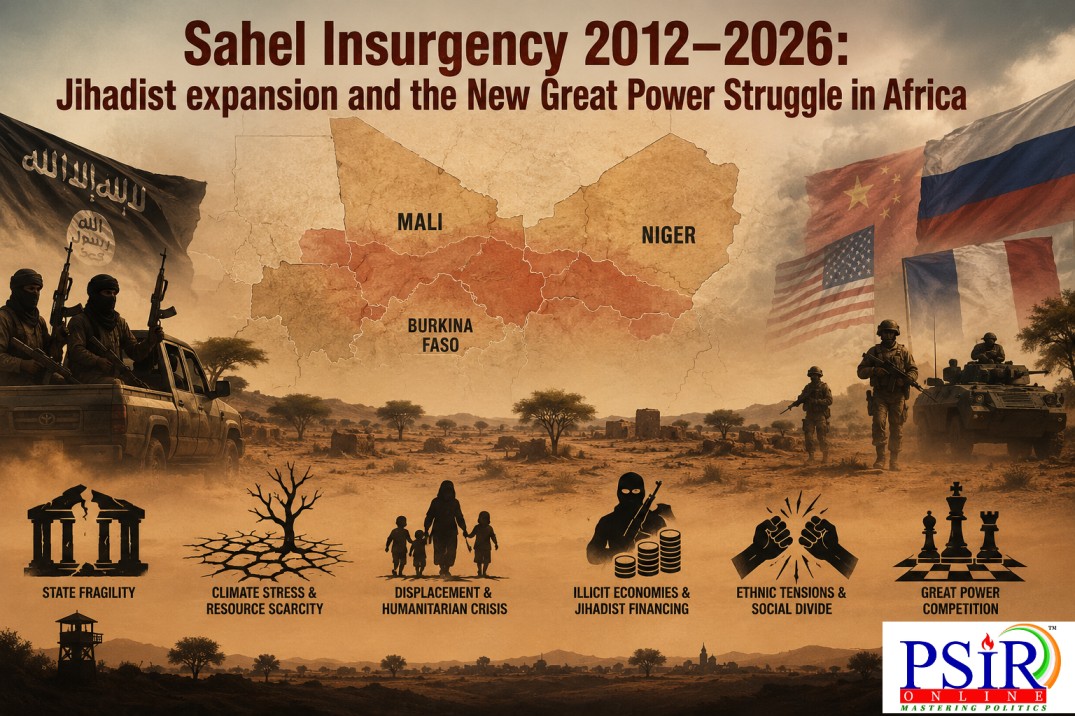
The Sahel insurgency refers to the ongoing jihadist conflict in the Sahel region of West Africa, primarily centered in Mali, Burkina Faso, and Niger (the "Central Sahel" or Liptako-Gourma tri-border area). It has expanded since around 2012 and is one of the world's most active and deadly theaters of militant Islamist violence.
CURRENT SITUATION (AS OF MID-2026)
The insurgency has intensified despite (or partly because of) military coups in the three core countries, the withdrawal of Western forces (e.g., French Operation Barkhane and UN MINUSMA), and shifts toward Russian/Africa Corps support. Jihadist groups control or heavily influence large rural areas, with governments struggling to hold territory.
· Deadliest region globally for terrorism: The Sahel accounted for ~51% of global terrorism-related deaths in 2024 (around 3,885 out of ~7,555 worldwide), with nearly tenfold increase in fatalities since 2019. Burkina Faso often ranks #1 worldwide, followed by Mali and Niger.
· Total militant Islamist-linked deaths in Africa exceeded 20,000–24,000 annually in recent years, with the Sahel contributing a massive share.
· Humanitarian impact: Millions displaced (e.g., ~5 million in need across the region), severe food insecurity, and widespread civilian targeting, including by state forces and militias.

The map above show jihadist operational zones (JNIM in red/pink shades, ISSP/ISGS in grey/black) as of late 2024–early 2025, illustrating heavy coverage across Mali, Burkina Faso, and Niger borders.
MAIN ACTORS
· Jama’at Nusrat al-Islam wal-Muslimin (JNIM): Al-Qaeda affiliate, dominant force. Coalition including groups like Ansar Dine, Macina Liberation Front. Strong in central/southern Mali, expanding in Burkina Faso and toward coastal states (Benin, Togo, etc.). Known for sophisticated, coordinated attacks, blockades (e.g., around Bamako), and economic disruption.
· Islamic State Sahel Province (ISSP / ISGS): Islamic State affiliate. Active in tri-border area, Tillabéri (Niger), and parts of Burkina Faso. Competes with JNIM; clashes have intensified.
· Other: ISWAP (Lake Chad links), local/self-defense militias (e.g., VDP in Burkina Faso), Tuareg separatists in northern Mali, and Russia-linked Africa Corps (formerly Wagner) supporting juntas.
JNIM has shown growing reach with attacks on capitals' outskirts, sieges, and expansion westward/southward.
KEY FACTORS BEHIND THE RISE OF SAHEL INSURGENCY
The rise of the Sahel insurgency—a jihadist-led conflict centered in Mali, Burkina Faso, and Niger (the Liptako-Gourma tri-border zone), with spillover into coastal West Africa—stems from a mix of deep-rooted structural weaknesses, historical triggers, and policy failures. It began intensifying around 2012 and has since become the world's deadliest terrorism theater, accounting for over half of global terrorism-related deaths in recent years. Jihadist groups like JNIM (Al-Qaeda affiliate) and ISSP/ISGS (Islamic State affiliate) have exploited these conditions to recruit, govern, and expand.
The factors are interconnected: jihadists do not create the problems but thrive on them by offering alternative governance, protection, and economic opportunities in areas where states have failed.
1. Weak Governance, State Fragility, and Rural Marginalization (Core Driver)
Sahel states rank among the world's most fragile, with chronic corruption, elite-centric policies favoring urban/southern areas, and near-total neglect of vast rural peripheries. Governments have historically failed to deliver basic services, justice, or security outside capitals. This creates "ungoverned spaces" where jihadists embed themselves, provide shadow governance (taxes, dispute resolution, protection), and recruit from disillusioned populations.
Security forces' abuses (extrajudicial killings, massacres) further erode legitimacy and drive communities toward insurgents. Ethnic marginalization—e.g., of Tuareg in the north or Fulani herders—fuels resentment.
2. The 2011 Libya Spillover and 2012 Tuareg Rebellion (Critical Catalyst)
The fall of Gaddafi's regime flooded the region with weapons, battle-hardened Tuareg fighters (many former Libyan mercenaries), and returnees. This reignited long-simmering Tuareg grievances over neglect and autonomy, leading to the 2012 MNLA rebellion in northern Mali. Jihadists (AQIM and allies like Ansar Dine) temporarily allied with rebels, then turned on them, seizing territory after Mali's 2012 coup created a power vacuum. This marked the modern insurgency's ignition point.
3. Climate Change, Resource Scarcity, and Farmer-Herder Conflicts
Rising temperatures (1.5x the global average), desertification, and droughts intensify competition over land, water, and grazing routes. This has worsened ethnic clashes, especially between Fulani (Muslim herders) and sedentary farming groups (e.g., Dogon, Mossi). Jihadists exploit and inflame these tensions for recruitment and local alliances, though governance failures—not climate alone—amplify the violence.
4. Socio-Economic Grievances and Youth Bulge
Extreme poverty, food insecurity, high unemployment, rapid population growth, and inequality leave rural youth with few options. Jihadists offer salaries, status, and purpose. Illicit economies (smuggling, artisanal mining, kidnapping) fund operations and provide livelihoods under insurgent control.
5. Political Instability: The "Coup Belt" and Security Vacuum (2020–2023 Acceleration)
Military coups in Mali (2020/2021), Burkina Faso (2022), and Niger (2023) were often justified by governments' failure against jihadists—but they worsened the crisis. Juntas expelled Western partners (French Barkhane, UN MINUSMA, U.S. forces), withdrew from ECOWAS, and formed the Alliance of Sahel States (AES) with Russian/Africa Corps support. This created immediate security gaps that jihadists rapidly filled. Junta reliance on local militias (e.g., Burkina's VDP) and reported abuses further escalated civilian targeting and inter-jihadist rivalry.
6. Failures of Prior Counter-Terrorism and Jihadist Adaptation
International operations (French-led, G5 Sahel) emphasized "kill/capture" tactics without addressing root causes, allowing jihadists to regroup in rural areas. Groups evolved: AQIM → JNIM (coordinated, governance-focused); ISGS → ISSP (aggressive expansion). Rivalry between JNIM and ISSP has intensified fighting, while both adapt with drones, blockades, and economic warfare.
These factors have created a self-reinforcing cycle: insurgency weakens states further, coups deepen vacuums, and jihadists consolidate control over territory and populations. Violence has spilled southward, threatening coastal states. Without governance reforms, service delivery, and inclusive security approaches, the trajectory remains bleak despite military efforts
IMPACTS OF SAHEL INSURGENCY
The Sahel insurgency (driven by JNIM and ISSP/ISGS jihadists in Mali, Burkina Faso, and Niger) is dramatically reshaping African politics—especially in West Africa—and injecting multipolar rivalries into global geopolitics. As of mid-2026, it has accelerated democratic backsliding, fractured longstanding regional institutions, enabled foreign influence shifts, and risked broader continental spillovers. The insurgency itself has not been defeated; instead, it has exposed and deepened governance failures while creating new alliances and rivalries.
Impacts on African Polity (Primarily West Africa)
The insurgency has triggered a cascade of political fragmentation, authoritarian consolidation, and security reconfiguration:
· Breakup of ECOWAS and Rise of the AES Bloc: In January 2025, Mali, Burkina Faso, and Niger formally withdrew from the Economic Community of West African States (ECOWAS) after a one-year notice period, forming the rival Alliance of Sahel States (AES)—initially a defense pact, now evolving into a confederation with its own Unified Force (expanded to 15,000 troops by April 2026). This has cost ECOWAS over 17% of its population, a massive land area, and significant GDP, undermining its legitimacy and collective security mechanisms. ECOWAS has responded with negotiation offers and plans for a 1,650-person Rapid Deployment Force in 2026, but coordination with AES remains stalled amid mutual accusations of meddling. The split risks interstate tensions (e.g., Burkina Faso–Côte d’Ivoire, Niger–Benin) and even broader regional conflict.
· Democratic Backsliding and the "Coup Belt": The juntas in the AES countries (in power via coups in 2020–2023) have prioritized regime survival over elections, citing the insurgency. This has reinforced a regional pattern of military rule, eroded civilian governance, and weakened institutions like the African Union. AES leaders frame their bloc as anti-colonial and sovereign, gaining domestic nationalist support but isolating them from broader African integration efforts.
· Jihadist Spillover into Coastal West Africa: Violence has spread southward from the Liptako-Gourma tri-border zone into Benin, Togo, Côte d’Ivoire, Ghana, and parts of Nigeria. JNIM and ISSP use border areas for logistics, recruitment, and proto-governance, exploiting local grievances. This threatens previously stable coastal economies and could destabilize the entire sub-region, with attacks increasingly sophisticated (drones, blockades).
· Humanitarian and Economic Strain: Millions displaced, food insecurity worsened, and trade routes disrupted (e.g., JNIM fuel blockades in Mali affecting prices and supply chains). This weakens state legitimacy across West Africa and hampers intra-African trade and development goals.
Overall, the insurgency has shifted West Africa from multilateral cooperation toward minilateral, militarized blocs, prioritizing short-term security over long-term governance reforms.
Impacts on Global Politics
The crisis has turned the Sahel into a theater of great-power competition, eroding Western dominance and amplifying multipolarity:
· Decline of Western (France/U.S.) Influence and Rise of Russia/China: France’s Operation Barkhane and U.S. bases withdrew post-coups, creating vacuums filled by Russia’s Africa Corps (successor to Wagner). Moscow provides military support, propaganda, and resource access in exchange for political loyalty—helping juntas “coup-proof” while extracting minerals (gold, uranium). China focuses on infrastructure and lending, deepening economic ties without direct security entanglement. This has weakened traditional Western counter-terrorism partnerships and forced the U.S. to pivot toward coastal states (e.g., training in Benin/Côte d’Ivoire).
· Multipolar Rivalry and Proxy Dynamics: The Sahel now hosts competing external actors—Russia vs. West, plus Turkey, Gulf states, and others jockeying for influence. AES’s anti-Western stance aligns with Russian narratives, while ECOWAS retains some Western backing. Analysts warn of a “new Cold War” dynamic in West Africa, where global powers instrumentalize local rifts. This complicates UN/AU peacekeeping and risks escalation if AES–ECOWAS tensions boil over.
· Global Security and Migration Risks: The Sahel accounts for over half of global terrorism deaths in recent years. Jihadist proto-states and networks raise fears of spillover threats beyond Africa (e.g., to Europe via migration routes or ideological export). Instability disrupts access to critical minerals and trade corridors, affecting global supply chains. Europe faces heightened migration pressures from displacement.
· Broader Geopolitical Precedents: The insurgency challenges liberal international norms (e.g., ECOWAS’s democratic standards) and sets examples for other fragile regions. It underscores Africa’s agency in rejecting perceived external overreach while highlighting limits of military-first approaches.
In summary, the Sahel insurgency has accelerated fragmentation within Africa (weakening ECOWAS, empowering juntas via AES) while fueling global multipolarity (Russia/China gains at Western expense). Recent AES joint operations (e.g., April 2026 airstrikes in Mali) show the bloc adapting, but without addressing root causes like governance and poverty, the cycle of violence and realignment is likely to continue. The situation remains fluid—cooperation between AES and ECOWAS could stabilize things, but current trends point toward deeper divisions.
PRACTICE QUESTIONS FOR GS 2 MAINS
1. The rise of military juntas in the Sahel region has exposed the limitations of regional organizations in Africa. Critically examine the challenges faced by ECOWAS in addressing the Sahel crisis.
2. “Counter-terrorism strategies that ignore governance deficits often deepen instability.” Examine this statement in the context of the Sahel insurgency.
3. Discuss how climate change and resource scarcity have contributed to the expansion of extremist movements in the Sahel region.
4. The growing Russian presence in the Sahel reflects the changing nature of global power politics in Africa. Analyse the implications for India and the Global South.
PRACTICE QUESTIONS FOR PSIR OPTIONAL
1. The Sahel crisis demonstrates the failure of the post-colonial African state in ensuring legitimacy and political order. Discuss with reference to theories of state fragility and neo-patrimonialism.
2. Examine the emergence of the Alliance of Sahel States (AES) as a challenge to regionalism in Africa. How does it alter the balance between sovereignty and collective security?
3. “The Sahel has become a theatre of New Great Power Competition.” Analyse the statement in the context of changing patterns of multipolarity and proxy geopolitics.
4. Critically evaluate the effectiveness of military-led counter-terrorism approaches in the Sahel using perspectives from Critical Security Studies and Human Security theory.