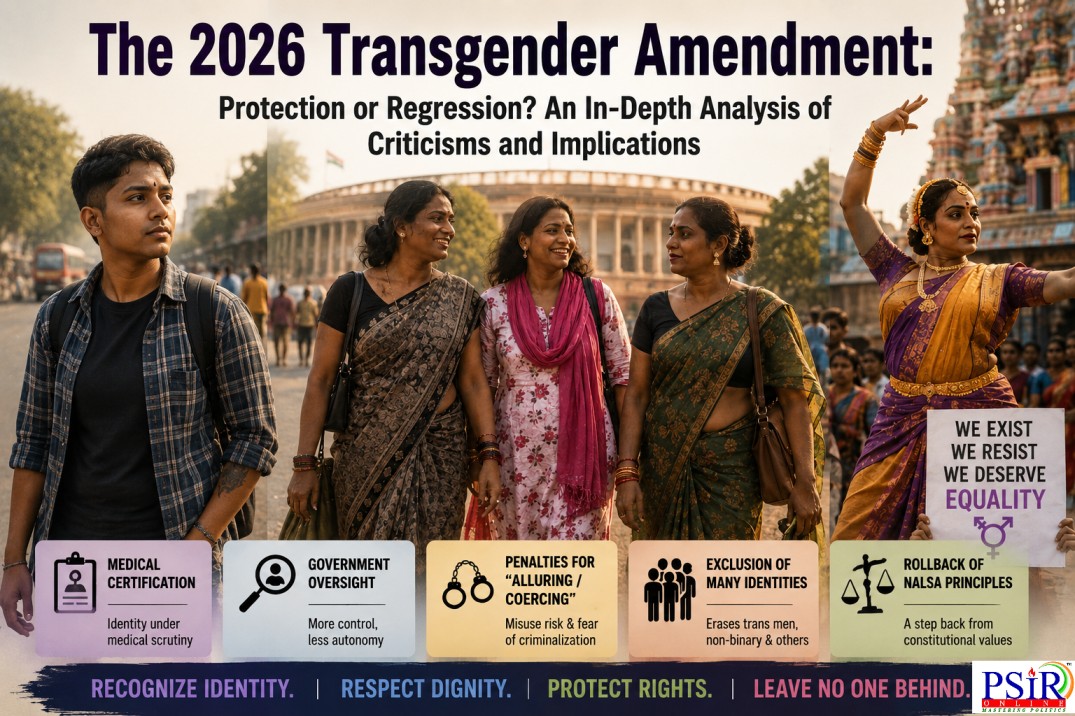
The Transgender Persons (Protection of Rights) Amendment Bill/Act, 2026 represents a significant rollback of key elements from India's earlier transgender rights framework, particularly the self-identification principle established by the Supreme Court. It was introduced in the Lok Sabha on 13 March 2026 by Union Minister for Social Justice and Empowerment Virendra Kumar Khatik, passed by voice vote in the Lok Sabha on 24 March and Rajya Sabha on 25 March, and received presidential assent from Droupadi Murmu around 30 March 2026.
BACKGROUND AND CONTEXT
The original Transgender Persons (Protection of Rights) Act, 2019 aimed to provide legal recognition, prohibit discrimination, and outline welfare measures for transgender persons. It defined a "transgender person" broadly as someone whose gender does not match the one assigned at birth, explicitly including trans men, trans women, genderqueer individuals, those with intersex variations, and socio-cultural identities like hijra, kinner, aravani, and jogta.
This built on the landmark 2014 NALSA v. Union of India Supreme Court judgment, which recognized transgender people as a "third gender," affirmed their right to self-perceived gender identity (as male, female, or third gender) rooted in Articles 14 (equality), 19(1)(a) (freedom of expression), and 21 (life and personal liberty/dignity) of the Constitution. The Court directed governments to grant legal recognition without mandatory surgery and provide affirmative action.
The 2026 Amendment narrows this framework substantially.
KEY PROVISIONS OF THE 2026 AMENDMENT
Narrowed Definition of "Transgender": The Bill restricts recognition to:
· Specific socio-cultural identities (e.g., hijra, kinner, aravani, jogta, eunuch).
· Persons with certain intersex variations (congenital differences in sex characteristics like chromosomes, genitalia, hormones, etc.; intersex is now grouped under transgender rather than separate).
· Individuals "compelled" to present as transgender through force, allurement, mutilation, castration, or similar procedures.
It explicitly excludes self-perceived identities, different sexual orientations, trans men/transmasculine persons, trans women, and many gender non-binary or fluid identities unless they fit the above narrow categories. Critics argue this erases large parts of the community.
Removal of Self-Perceived Gender Identity: It deletes Section 4(2) of the 2019 Act, which explicitly granted the right to self-perceived gender identity. This directly reverses aspects of the NALSA judgment.
Medical Certification and Scrutiny: Legal recognition now requires certification by a medical board (often headed by a Chief Medical Officer) to verify identity based on biological/physiological criteria. The District Magistrate's role expands with greater oversight. Hospitals must report gender-affirming surgeries to authorities. This adds bureaucratic and medical hurdles, moving away from the affidavit-based process in the 2019 rules.
Penalties for "Alluring/Coercing": New or expanded offenses criminalize compelling, forcing, alluring, or inducing someone (especially minors) to present as transgender, with graded punishments up to life imprisonment in severe cases (e.g., involving harm or abduction). Supporters frame this as protection against exploitation; critics fear it could target supportive families, communities, medical providers, or kinship networks (e.g., hijra gharanas).
Other Changes: Provisions for name changes in documents based on the new certificate; some welfare entitlements retained but tied to stricter verification. A retrospective clause in some interpretations raises concerns about revoking existing certificates.
|
KEY TERMS ASSOCIATED WITH TRANSGENDER IDENTITIES (INDIAN CONTEXT) To understand the concerns, here are clear definitions grounded in both global standards and Indian socio-cultural realities: · Transgender person (broad umbrella term): Someone whose gender identity does not align with the sex assigned at birth. The 2019 Act used an inclusive definition; the 2026 Amendment narrows it significantly. · Trans woman (transfeminine): Assigned male at birth but identifies and lives as a woman. May or may not undergo medical transition. · Trans man (transmasculine): Assigned female at birth but identifies and lives as a man. Often highlighted as particularly erased by the new law. · Genderqueer / Non-binary / Gender fluid: Identities that are neither exclusively male nor female, or that shift over time. These fall outside the new narrow categories. · Queer: An umbrella term (reclaimed from earlier derogatory use) for anyone whose gender or sexuality does not fit societal norms. Often includes non-binary, pansexual, and other fluid identities; used politically for solidarity. · Intersex: A person born with sex characteristics (chromosomes, hormones, genitals) that do not fit typical male/female binaries. This is a biological/sex variation, not the same as gender identity. The 2026 Bill groups certain intersex variations under “transgender,” which many intersex advocates reject as inaccurate. · Hijra / Kinner / Aravani / Jogta / Eunuch (socio-cultural identities): Traditional Indian “third gender” communities with centuries-old history. Hijras often form gharanas (kinship networks), may undergo nirvan (castration) rituals, and are recognized in Hindu mythology and cultural performances. The new law privileges these groups but many within them oppose the medical gatekeeping and exclusion of others.
|
GOVERNMENT'S STATED JUSTIFICATION
In the Statement of Objects and Reasons of the Bill and statements by the Minister for Social Justice and Empowerment (Virendra Kumar), the government argued:
· The 2019 Act’s broad definition (including self-perceived gender identity) was “vague” and made it difficult to identify the “genuinely oppressed” beneficiaries — i.e., those facing severe discrimination due to biological reasons (intersex variations, traditional hijra/kinner communities, or forced cases).
· The original law was never intended to cover “every class of persons with diverse gender identities, self-perceived sex/gender identities, or gender fluidities.”
· The wide definition created practical problems, making certain criminal, civil, and personal laws “unworkable” and incompatible with other statutes.
The focus was on protecting traditional socio-cultural groups and preventing alleged misuse or “allurement/coercion,” especially involving minors. No independent study, data report, or expert committee report is publicly cited as the direct basis for these specific changes
LACK OF EXPERT CONSULTATION AND STAKEHOLDER INPUT
The Transgender Persons (Protection of Rights) Amendment Act, 2026, has been widely criticised for being pushed through Parliament with minimal expert backing, inadequate stakeholder consultation, and in direct opposition to available institutional advice. Unlike the process leading to the 2019 Act, the 2026 changes lacked any supportive expert committee report or broad consensus.
Supreme Court-Appointed Advisory Committee (Justice Asha Menon Panel)
In October 2025, while hearing a case involving discrimination against a transgender woman (Jane Kaushik v. Union of India), the Supreme Court constituted an Advisory Committee headed by retired Delhi High Court judge Justice Asha Menon. The eight-member panel was tasked with formulating an Equal Opportunity Policy for transgender persons, reviewing implementation gaps in the 2019 Act, suggesting measures for reasonable accommodation, inclusive medical care, grievance redressal, and other reforms.
· The committee met on or around 20 March 2026 and passed a formal resolution strongly urging the Union Government to withdraw the Amendment Bill.
· On 25 March 2026 (the same day the Rajya Sabha passed the Bill), Justice Asha Menon wrote directly to Union Minister for Social Justice and Empowerment, Virendra Kumar, conveying the panel’s concerns.
· Key arguments in the resolution and letter:
o Removing the right to self-perceived gender identity directly violates the binding principles laid down in the 2014 NALSA judgment.
o The Bill would cause a “tremendous setback” to efforts to mainstream transgender communities.
o The government must engage in meaningful consultation with transgender persons and communities before making such far-reaching changes.
This intervention by a Supreme Court-constituted body made the government’s decision to proceed particularly controversial, as it highlighted that the amendment was moving against judicial guidance rather than being supported by expert review.
Parliamentary Opposition and Demand for Scrutiny
Opposition MPs from parties such as Congress, TMC, DMK, and others repeatedly raised objections during the brief debate:
· They demanded that the Bill be referred to a Standing Committee or Select Committee for detailed examination, wider stakeholder consultations, and public feedback.
· Concerns were expressed about the hasty timeline — introduced on 13 March, passed in Lok Sabha on 24 March and Rajya Sabha on 25 March by voice vote — leaving almost no time for meaningful discussion.
· Several MPs argued that a law affecting fundamental rights and an entire marginalised community deserved rigorous scrutiny, especially given the Supreme Court panel’s objections. These demands were not accepted, and the Bill was fast-tracked.
Contrast with Earlier Expert Processes
The 2019 Transgender Persons Act itself was shaped by more consultative processes:
· The 2013 Expert Committee constituted by the Ministry of Social Justice and Empowerment conducted an in-depth study of issues faced by transgender persons. Its recommendations strongly supported a broad, inclusive definition aligned with the NALSA judgment’s emphasis on self-identification and dignity.
· This fed into the NALSA judgment and the eventual 2019 legislation.
In contrast, no new official expert committee or fresh study was cited by the government as the basis for the 2026 rollback. The Statement of Objects and Reasons of the Bill relied on the government’s internal view that the 2019 definition had become “vague” and “unworkable,” without referencing any data, survey, or committee report endorsing the narrowed definition, medical certification, or new coercion clauses
Critics argue that bypassing expert advice and community consultation not only weakens the legitimacy of the law but also increases the likelihood of successful constitutional challenges in the Supreme Court. The absence of rigorous pre-legislative scrutiny is seen as particularly problematic for legislation that directly impacts Articles 14, 19(1)(a), and 21 rights
REACTIONS OF TRANSGENDER ASSOCIATIONS AND ACTIVISTS
No transgender association, welfare sangam, akhara, or major community organization in India has publicly welcomed or endorsed the Transgender Persons (Protection of Rights) Amendment Bill/Act, 2026.
· Laxmi Narayan Tripathi (prominent hijra/kinner activist, NALSA petitioner, Kinnar Akhada leader) called it a “dagger” into the community’s chest, trampling the NALSA judgment and erasing trans men/non-binary people. She joined protests and vowed to fight in courts and streets.
· Kalki Subramaniam (trans activist, former National Council for Transgender Persons member) initially hoped for a positive step but resigned in protest along with others, calling the process exclusionary.
· Akkai Padmashali and other activists (Karnataka coalition, Grace Banu, Rituparna Neog) condemned it as “erasure” and “criminalization.”
· Kinnar Samaaj (Madhya Pradesh/Delhi) and multiple hijra gharanas publicly protested, emphasizing chosen family and unity across the community.
Collective community action:
· Over 88 public statements and 100,000+ emails to MPs demanded repeal within days of introduction.
· Protests in Delhi (Jantar Mantar), Mumbai, Kolkata, and other cities involved trans, queer, and allied groups.
· Supreme Court-appointed Advisory Committee (with trans representation) passed a resolution urging withdrawal and consultation.
· National Council for Transgender Persons members resigned in protest; several coalitions (e.g., Samyuktha Samara Samithi Keralam, Karnataka State Gender and Sexuality Minorities Coalition) called it unconstitutional.
CRITICISMS AND CONSTITUTIONAL CONCERNS
Human rights organizations (Amnesty International, Human Rights Watch, People’s Union for Civil Liberties – PUCL), transgender activists, opposition parties, legal experts, and international bodies like the UN Human Rights Office have mounted strong, unified opposition to the 2026 Amendment. They describe it as a regressive rollback that directly contradicts the Supreme Court’s 2014 NALSA v. Union of India judgment and undermines core constitutional protections.
Below is a detailed breakdown of the main concerns.
1. Violation of Fundamental Rights (Articles 14, 19(1)(a), and 21)
· Article 14 (Equality before the law): The narrowed definition creates arbitrary and exclusionary classification. By limiting recognition to specific socio-cultural groups (hijra, kinner, aravani, jogta, eunuch), certain intersex variations, or cases of forced/coerced transition, the law excludes trans men, trans women, genderqueer, and non-binary persons who do not fit these categories. Critics argue this is indirect discrimination within the community itself.
· Article 19(1)(a) (Freedom of speech and expression): Gender identity and expression are forms of personal expression. Removing self-perceived gender identity forces people to conform to state-approved categories, chilling free expression of identity.
· Article 21 (Right to life and personal liberty, including dignity, privacy, and autonomy): Self-identification was explicitly recognized in NALSA as an “inviolable aspect of personhood” and personal autonomy. The new medical-board certification + District Magistrate scrutiny invades bodily privacy, imposes humiliating verification processes, and pathologizes identity. Amnesty International called it a “dangerous precedent” that “denies transgender and gender diverse people the right to self-identify.” HRW labelled it a “major reversal of hard-won rights.” PUCL termed the entire Bill “unconstitutional” and demanded immediate withdrawal.
Legal petitions have already been filed in the Supreme Court arguing that a statute cannot override a Constitution Bench judgment like NALSA without compelling justification.
2. Exclusionary and Medicalizing Approach
The amendment shifts from an inclusive, rights-based model (2019 Act + NALSA) to a narrow, biological/medicalized one. It explicitly deletes the clause granting “self-perceived gender identity” and ties recognition to medical verification (often involving physical examination or records of surgery/hormones).
· Transgender communities’ concerns: Activists like Laxmi Narayan Tripathi (hijra/kinner leader and NALSA petitioner), Akkai Padmashali, Aryan Pasha (trans man activist), Grace Banu (Dalit trans activist), and Harish Iyer have called it “erasure” of entire sections of the community. Trans men feel particularly invisible (“born into a patriarchal society… we thought we had achieved self-identification”). Many traditional hijra gharanas and kinner groups have protested alongside modern trans and non-binary people, rejecting the artificial divide the law creates. They argue it fractures community solidarity and denies welfare, reservations, and legal documents to those who do not match the new criteria.
· Human rights groups’ view: HRW and Amnesty say it “pathologizes” identity, treating being transgender as a medical condition requiring state approval rather than a matter of dignity and autonomy. This echoes colonial-era criminalization and contradicts international standards (Yogyakarta Principles) that affirm self-determination.
3. Lack of Consultation and Hasty Passage
· The Bill was introduced on 13 March 2026, passed by voice vote in both houses within days, and received assent around 30 March — without referral to a Standing Committee or meaningful stakeholder consultation.
· The Supreme Court-appointed Advisory Committee (with transgender representation) passed a resolution urging withdrawal just before passage.
· National Council for Transgender Persons members resigned in protest. Over 100,000 emails and 88+ public statements from trans, queer, intersex, and allied groups flooded MPs. Protests erupted in Delhi (Jantar Mantar), Mumbai, Kolkata, Belgaum, Jamshedpur, and more.
· Amnesty India’s Aakar Patel: “A law that directly affects fundamental rights was pushed through without consulting with the very people it affects most.”
4. Potential for Misuse of “Coercion/Allurement” Clauses
New graded penalties (including up to life imprisonment in severe cases) criminalize “compelling, forcing, alluring, or inducing” anyone — especially minors — to present as transgender.
While this is framed as protection against exploitation, critics fear:
· Without ‘self-identification of transgender identity’ clause, the people who tries to help a transgender person to get a meaningful life could be termed as ‘criminals who try to force a person to look like transgender’ by the police personals or bureaucrats if they wish so (because of the vague phrasing in the amendment).
· It could target gender-affirming care, supportive families, hijra gharanas (chosen-family kinship systems), or community rituals.
· PUCL explicitly warned these clauses “could be used to criminalize support systems of transgender persons.”
5. Retrogression and Setback for South Asia
· The law is seen as a major reversal after years of progress (NALSA 2014 → 2019 Act). The UN Human Rights Office stated it “risks setting back hard-won rights.”
· It sends a troubling signal regionally, where India was once a leader in third-gender recognition.
In summary, the transgender community and human rights groups view the 2026 Amendment not as protection but as state erasure of self-determination, increased surveillance, and potential criminalization of community life. Multiple Supreme Court challenges are underway, and implementation (rules, medical boards) will determine the real-world impact. The unified protests reflect a rare cross-section of traditional and modern trans voices standing together against what they call a law that “doesn’t amend rights — it erases us.”
PRACTICE QUESTIONS FOR GS2 MAINS
1. “The Transgender Persons (Protection of Rights) Amendment Act, 2026 marks a shift from a rights-based approach to a medicalized framework.” Critically examine in the light of Articles 14, 19, and 21 of the Indian Constitution.
2. Discuss the significance of the 2014 NALSA judgment in advancing transgender rights in India. How does the 2026 Amendment challenge the principles laid down by the Supreme Court?
3. “Legislative haste and lack of stakeholder consultation weaken democratic legitimacy.” Examine this statement with reference to the passage of the Transgender Amendment Act, 2026.
4. Human rights organizations and transgender associations have described the 2026 Amendment as a “regressive rollback.” Analyse the constitutional, social, and governance concerns associated with the law.
PRACTICE QUESTIONS FOR PSIR OPTIONAL
1. Examine the tension between individual autonomy and state regulation in the context of gender identity debates in contemporary democracies. Discuss with reference to India’s Transgender Amendment Act, 2026.
2. “Recognition politics is central to modern identity-based movements.” Analyse the transgender rights movement in India through the lens of recognition theory and constitutional morality.
3. Critically evaluate the role of the judiciary in protecting minority rights in India. How does the conflict between the NALSA judgment and the 2026 Amendment reflect the judiciary-legislature dynamic?
4. Discuss how the concepts of dignity, identity, and citizenship intersect in contemporary debates on transgender rights. Substantiate your answer with suitable constitutional and political theory perspectives.