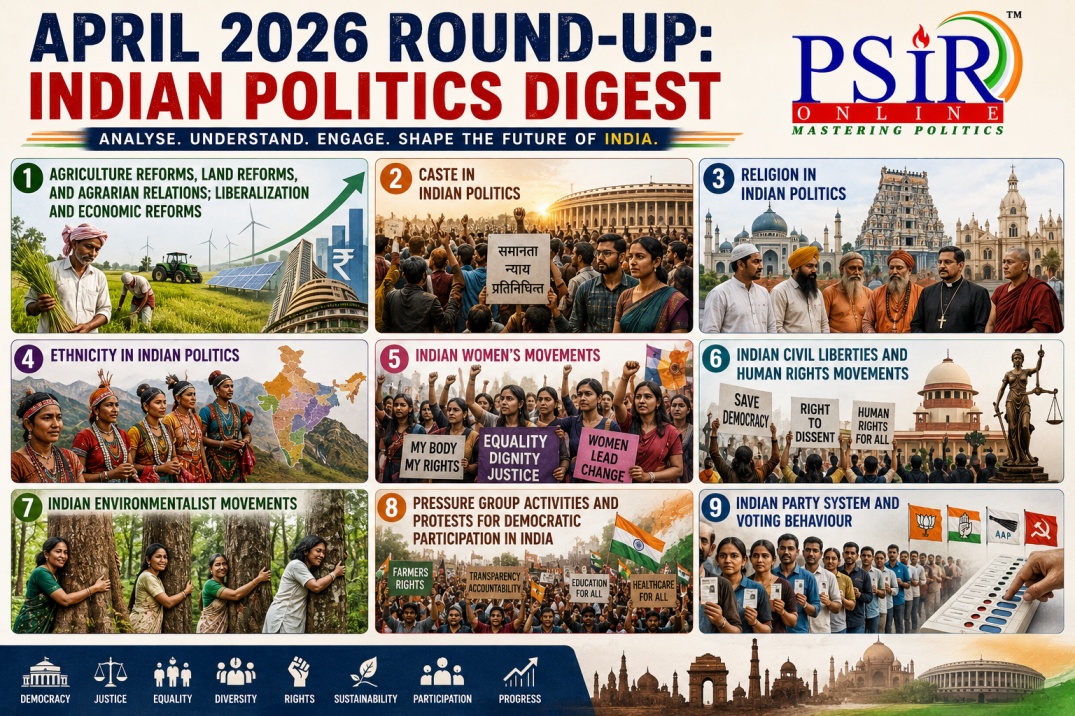
1. AGRICULTURE REFORMS, LAND REFORMS AND AGRARIAN RELATIONS; LIBERALIZATION AND ECONOMIC REFORMS.
In April 2026, there were no major new national-level land reforms, comprehensive agrarian restructuring, or sweeping liberalization measures in Indian agriculture. Activity focused on incremental policy tweaks, stakeholder consultations, state-level protests, and preparations for the 2026-27 agricultural budget.
Agriculture Reforms & Inputs (Pesticides & Technology)
· Draft Pesticides Management Bill: On or around April 24, 2026, CropLife India (an industry body) urged the Ministry of Agriculture to strengthen the Draft Pesticides Management Bill (intended to replace the outdated 1968 Insecticides Act). Key demands included faster registration of newer, safer molecules to combat pest resistance, reduce crop losses (estimated at ₹2 lakh crore annually), address climate risks, and curb illegal trade. This reflects ongoing efforts to modernize input regulations for better farmer access to technology while aligning with export standards.
· Emphasis was placed on science-based regulation and innovation to help farmers amid rising pest pressures. No final bill passage occurred in April.
State-Level Farmer Protests & Pressure Group Activity
· Haryana (April 11, 2026): Farmers staged widespread demonstrations, including road blockades (e.g., near Landhari-Chikanwas toll plaza in Hisar), against new state government rules for crop procurement. These rules were seen as burdensome by farmers.
Broader farmer concerns in April tied into trade negotiations (e.g., potential India-US deals) and fears of import competition affecting domestic prices.
Land Reforms & Agrarian Relations
· No significant new central or state legislation on land ceilings, tenancy reforms, or redistribution emerged in April 2026.
· Discussions remained academic or historical, referencing past successes (e.g., Kerala, West Bengal) and ongoing challenges like digitization of records and women’s land rights.
Liberalization & Economic Reforms Context
· April fell between the Union Budget (typically February) and monsoon season, so focus was on implementation rather than new announcements.
· Ongoing national discourse centered on structural reforms for growth (e.g., deregulation, ease of doing business, manufacturing push), with expectations for 2026 as a potential "reform moment." However, agriculture-specific liberalization remained cautious due to political sensitivities.
· Budget 2026-27 preparations: The Ministry of Agriculture and Farmers Welfare saw allocations around ₹1.33 lakh crore (up ~5.4% from prior revised estimates), with emphasis on farmer welfare schemes, research, and inputs.
· External pressures (e.g., global commodity prices, Middle East tensions affecting fertilizers) prompted calls for urgent farm reforms and contingency planning.
2. CASTE IN INDIAN POLITICS
In April 2026, caste remained a central axis in Indian politics, with major developments tied to the launch of the national census (including caste enumeration for the first time since 1931), ongoing debates on reservations, sub-categorization, and women's quota implementation.
Key Development: Launch of the 2027 Census with Caste Enumeration
· The nationwide census began on April 1, 2026, in two phases (house listing and population enumeration). For the first time in over 90 years, it includes caste data collection alongside other demographic details. Phase 2 (population enumeration with caste) is in February 2027.
· This digital exercise (under the Census Act, 1948) aims to provide updated, uniform data amid varying state-level surveys. The reference date is March 1, 2027 (with adjustments for snow-bound areas).
· Political implications: Expected to influence reservation policies, delimitation of constituencies, women's reservation rollout, and welfare targeting. Opposition parties (especially Congress OBC wings) pushed for using the data to ensure "quota within quota" for OBCs/SC subgroups and to prevent any dilution of existing benefits.
· The BJP-led government framed it as promoting "data justice" and transparency, while critics warned of deepened divisions or politicization.
Pressure Group Politics & Movements
· Dalit History Month (entire April): Widely observed with talks, rallies, lectures, art exhibits, and social media campaigns by Ambedkarite groups. Events celebrated Dalit resistance, culture, and contributions, while highlighting ongoing discrimination. Celebrations occurred in Delhi, Chennai, and internationally.
· Protests on sub-categorization: On April 27, 2026, Ambedkarite groups organized a large march in Aurangabad (Maharashtra) against proposed sub-categorization within Scheduled Castes. Demands included canceling sub-categorization, conducting a robust caste census, filling backlog vacancies, extending reservations to private sectors/judiciary, and increasing SC quotas.
· OBC mobilization: Congress's OBC wing held meetings and planned nationwide pushes for OBC sub-quotas within the women's reservation law, insisting on implementation only after full caste census data.
Intra-Party & Electoral Dynamics
· Congress internal debates: OBC leaders urged a "quota within quota" for OBC women in the 33% women's reservation and linkage to census data. This created some tension within the party on timelines versus data-first approaches.
· Broader opposition (Congress, regional parties) emphasized protecting OBC/SC interests amid delimitation fears post-census.
· Cultural/academic angles: Discussions on persistent caste in urban India, judiciary (e.g., a Dalit officer highlighting subtle biases on April 15), and digital spaces
Summary
April 2026 was marked by institutional momentum (census launch) and mobilizational activity (Dalit History Month, targeted protests) rather than large-scale nationwide violence or unified "Bharat Bandh"-style actions. Pressure groups (caste associations, Ambedkarite organizations, party OBC wings) remained active in pushing for data-driven social justice, while resisting perceived dilutions. The census outcome is poised to shape politics for years ahead, particularly around reservations and representation.
3. RELIGION IN INDIAN POLITICS
In April 2026, religion continued to play a prominent role in Indian politics, intersecting with the launch of the national census (including religion data), state-level regulatory moves on minority institutions, and pressure group mobilizations. Tensions reflected ongoing majoritarian vs. minority rights debates, without large-scale nationwide communal violence peaking that month.
Census Launch and Religious Data Collection
· The nationwide census began on April 1, 2026, collecting data on caste and religion for the first time in decades (First time since 1931 (96-year gap) for caste ; religion data was collected in 2011 census too, but sect/sub-religion detail is new). This digital exercise raised concerns among religious minorities (Muslims and Christians) about potential misuse for targeting, welfare exclusion, or reinforcing majoritarian policies (e.g., links to CAA/NRC).
· Critics feared it could deepen religious cleavages or enable data-driven discrimination, while the government positioned it as promoting transparency and better governance.
Pressure Group Activity: Madrasa Regulations in Uttarakhand
· A major flashpoint was the Uttarakhand government's push to abolish the state Madrasa Board, mandating all madrasas to register with the government educational board and follow the state curriculum from July 2026.
· On April 27, 2026, the All India Muslim Personal Law Board (AIMPLB) and other Muslim organizations (Jamiat Ulama-i-Hind, Jamaat-e-Islami Hind, etc.) issued a joint statement condemning it as an attack on religious freedom (Articles 25-26 & 30) and minority identity. They vowed legal challenges, including in the Supreme Court.
· This was framed by opponents as part of broader efforts to control Islamic seminaries and undermine minority educational autonomy.
Christian Community Mobilizations
· Christians protested against anti-conversion/"Freedom of Religion" laws in states like Arunachal Pradesh (April 30 protests against APFRA rules implementation) and Chhattisgarh (opposition to the 2026 Act).
· Dalit Christians highlighted exclusion from Scheduled Caste benefits, tying into census concerns and ongoing demands for equal protections.
Cultural & Festival-Related Dynamics
· Dalit History Month (throughout April) overlapped with religious politics, as Ambedkarite and Dalit Christian groups emphasized caste-religion intersections and resistance to discrimination.
· Ram Navami (around late March/early April depending on the calendar) saw localized tensions and processions in some states, but April itself was quieter on large-scale clashes compared to prior years. Hindu nationalist groups remained active in cultural assertions.
Broader Political Context
· Hindu majoritarian discourse persisted, with critiques from opposition and minority groups about institutional shifts. International reports (e.g., USCIRF) noted ongoing concerns over minority conditions.
· No sweeping new central legislation on religion dominated April, but state actions and the census kept the issue alive in pressure group politics and media.
Summary: April 2026 featured institutional (census) and regulatory (madrasa/anti-conversion laws) developments driving minority mobilization, alongside cultural observances. Pressure groups like AIMPLB and Christian forums were vocal but operated within legal/protest frameworks. Religious polarization remained a live undercurrent, amplified by upcoming political timelines. Developments were more about policy friction and advocacy than mass violence.
4. ETHNICITY IN INDIAN POLITICS
In April 2026, ethnicity in Indian politics remained prominent, primarily through ongoing ethnic violence in Manipur, tribal pressure group mobilizations for land and forest rights, the launch of the national census (with implications for Scheduled Tribes and ethnic data), and identity-based electoral dynamics in states like West Bengal.
Manipur Ethnic Conflict Escalation
· The long-running Meitei vs. Kuki-Zo ethnic conflict (since May 2023) saw a fresh flare-up. On April 7, 2026, a bomb/rocket attack in Tronglaobi village (Bishnupur district) killed two young children (from the Meitei community) and injured their mother.
· This triggered widespread protests in the Imphal Valley, torch rallies, clashes with security forces (including CRPF camps), arrests, and additional fatalities. Protests lasted for weeks, highlighting persistent distrust, buffer zones, and demands for justice.
· By April 2026, the conflict had displaced over 58,000 people, killed 217 to 260 people since 2023, with deep ethnic segregation and accusations of bias in governance. Pressure groups from both communities organized rallies and memorials, keeping ethnic fault lines alive in national discourse.
Tribal Movements & Pressure Group Politics
· Forest Rights Act (FRA) 2006 protests: Tribal groups in Maharashtra (and echoes in other states) conducted long marches (e.g., thousands walking 55+ km) demanding stronger implementation of individual and community forest rights, land titles, and livelihood security. These built on historical demands, criticizing slow bureaucratic processes and evictions.
· Bharat Tribes Fest 2026: The Ministry of Tribal Affairs event (originally March 18–30) (Organized by TRIFED in collaboration with Ministry of Tribal Affairs) was extended till April 5, 2026, at Sunder Nursery, Delhi. It showcased tribal art, crafts, cuisine, and entrepreneurship from across states, aiming to boost market access and cultural visibility. It served as a government-led cultural-political platform for tribal empowerment.
· Broader Adivasi assertions focused on habitat rights for Particularly Vulnerable Tribal Groups (PVTGs) and resistance to mining/developmental projects affecting traditional lands.
Census and Ethnic Data Implications
· The nationwide census launched on April 1, 2026 (Phase I (house listing) began April 1, 2026, but population enumeration with caste occurs Feb 2027; reference date is March 1, 2027), includes detailed caste enumeration (first since 1931) alongside religion and other demographics. For ethnic/tribal groups (especially STs), this data is expected to influence reservation policies, delimitation, welfare targeting, and political representation.
· Northeast ethnic groups and Adivasis viewed it with a mix of hope (for better recognition) and concern (potential for politicization of identities).
Other Regional Ethnic Dynamics
· West Bengal: Ahead of assembly elections, ethnic identity blocs (Kudmis, Santal Adivasis, Rajbongshis, Matuas) gained visibility with demands for ST status, religious recognition, and citizenship issues. These "transactional" identity groups influenced constituency-level politics amid broader Bengaliness vs. Hindutva narratives.
· Persistent concerns over racism faced by Northeast ethnic communities in mainland India continued in public discourse.
Summary: April 2026 featured a mix of violent ethnic conflict (Manipur), mobilizational protests (tribal land rights), cultural assertion (tribes fest), and institutional processes (census) shaping ethnic politics. Pressure groups (tribal organizations, community associations) were active but fragmented, often state-specific. No single nationwide ethnic movement dominated, but these issues underscored ongoing challenges of identity, autonomy, and inclusion in India's diverse polity
5. INDIAN WOMEN’S MOVEMENTS
In April 2026, Indian women’s movements centered heavily on the push for operationalizing the 33% Women’s Reservation (Nari Shakti Vandan Adhiniyam), alongside related mobilizations on political representation.
Women's Reservation Bill Developments (Core Focus)
· The original Women’s Reservation Act (106th Constitutional Amendment, 2023) was notified and brought into force on April 16, 2026, via a gazette notification. However, actual implementation (33% seats in Lok Sabha and state assemblies) remains pending the next census and delimitation exercise (likely post-2029).
· The government convened a special three-day Parliament session (April 16–18) and introduced the Constitution (131st Amendment) Bill, 2026, along with related bills on delimitation and seat expansion (aiming to increase Lok Sabha seats significantly to accommodate the quota without reducing existing ones).
· On April 17, 2026, the 131st Amendment Bill failed to secure the required two-thirds majority in the Lok Sabha due to opposition from the INDIA bloc and others. Critics argued it was tied to controversial delimitation that could disadvantage certain states and lacked sub-quotas for OBC/SC/ST women.
· This sparked intense political blame game, with the BJP accusing the opposition of blocking women’s empowerment, while opponents called it a “delimitation trap.”
Pressure Group Politics & Protests
· Nari Shakti Vandan Sammelan (April 13, 2026): PM Narendra Modi addressed a major national gathering in New Delhi, attended by women achievers, framing the reservation as a historic step for Nari Shakti. It served as a launchpad for the parliamentary push.
· Sikkim/Gangtok Mobilization (April 17–18): Thousands of women (reports of over 30,000) held a massive rally and protests in Gangtok supporting the reservation bill. They targeted the Congress and opposition for alleged obstruction, with slogans and marches backing immediate implementation.
· Similar smaller protests occurred in other states (e.g., Assam), with women’s groups and BJP-aligned organizations criticizing the opposition.
· Broader women’s organizations and feminist groups (e.g., collectives of 1,500+ NGOs) held press conferences and advocacy pushes earlier in the month, demanding time-bound implementation and sub-quotas for marginalized women.
Other Women’s Movement Activity
· Ongoing advocacy on women’s safety, cybercrimes, and gig worker rights continued, but April’s spotlight was dominated by the reservation debate.
· Intersectional voices (including Dalit, Adivasi, and OBC women) emphasized the need for “quota within quota” to avoid elite capture of the seats.
· Transgender and broader gender rights groups remained active on related issues (e.g., concerns over the Transgender Amendment Bill), but these were secondary to the reservation focus.
Summary: April 2026 was a high-mobilization month for women’s political representation, driven by government initiatives and counter-mobilizations. While the core 2023 Act was notified, the failure to fast-track via amendments highlighted deep partisan divides. Pressure groups (women’s NGOs, state-level women’s fronts, and party-affiliated bodies) were highly visible, especially in symbolic rallies like in Sikkim. The developments kept Nari Shakti as a central political narrative, with expectations of renewed pushes ahead of future elections.
6. INDIAN CIVIL LIBERTIES AND HUMAN RIGHTS MOVEMENTS
In April 2026, Indian civil liberties and human rights movements focused on resistance to expanded digital censorship, regulatory pressures on NGOs, documentation of hate crimes, and institutional scrutiny of bodies like the NHRC. Activity combined advocacy by NGOs, opposition protests, and international reporting rather than massive nationwide street mobilizations.
Digital Censorship and Online Freedoms
· Proposed IT Rules Amendments: On or around April 17, 2026, Human Rights Watch (HRW) strongly criticized draft amendments to the Information Technology (Intermediary Guidelines and Digital Media Ethics Code) Rules. These would extend regulatory oversight to ordinary social media users posting on "news and current affairs," enable faster content takedowns, and increase executive control over platforms. Critics, including Amnesty International, warned of risks to free expression, privacy, and self-censorship. Public comments were invited until late April.
· Civil liberties groups and digital rights organizations (e.g., Internet Freedom Foundation) mobilized advocacy campaigns urging withdrawal of the rules, highlighting threats to independent journalism, satire, and dissent.
FCRA Amendments and NGO Regulations
· Opposition parties and civil society protested the Foreign Contribution (Regulation) Amendment Bill, 2026 (introduced in late March). Protests peaked in early April, including outside Parliament on April 1–2, with slogans against alleged targeting of NGOs, minority institutions, and civil society. The government paused the bill amid backlash, citing concerns over asset seizures and overreach.
· Christian organizations and minority rights groups expressed fears of impacts on educational and charitable institutions.
NHRC and Institutional Developments
· National Human Rights Commission (NHRC) activities included an online hearing on April 16 regarding bonded labour in Uttar Pradesh brick kilns and presenting awards for a human rights short film competition on April 7.
· International pressure continued on NHRC reforms via the Global Alliance of National Human Rights Institutions (GANHRI), with decisions on accreditation postponed.
Other developments
· Broader international assessments also intensified scrutiny of India’s democratic and human rights environment in 2026. Amnesty International, in its State of the World’s Human Rights 2026 report released in April, highlighted shrinking civic space, restrictions on dissent, digital censorship, and growing pressure on journalists and activists. Freedom House continued to classify India as “Partly Free,” citing concerns over civil liberties, media freedom, and treatment of minorities. Similarly, Human Rights Watch pointed to increasing constraints on civil society and protest movements, reinforcing wider global concerns regarding democratic freedoms in India
Summary: April 2026 saw heightened advocacy around digital rights and regulatory overreach, with pressure groups (APCR, digital rights NGOs, opposition-linked forums) actively documenting violations and protesting. Movements remained largely institutional and legal rather than mass protest-driven, amid the ongoing census and women's reservation debates. International scrutiny added weight to domestic calls for safeguarding freedoms.
7. INDIAN ENVIRONMENTALIST MOVEMENTS
In April 2026, Indian environmentalist movements blended advocacy events, localized protests against development projects, and policy signals on climate diplomacy. Activity was more institutional and issue-specific than featuring massive nationwide mobilizations.
Key Policy & Diplomatic Signal
· India withdraws COP33 hosting bid: In early April 2026, the government withdrew its offer to host the 2028 UN Climate Conference (COP33). This followed a review of commitments and reflected shifting priorities amid global uncertainties and domestic energy demands. Environmental groups viewed it as a cautious move, while some activists expressed disappointment over reduced global leadership on climate.
Earth Day & Sustainability Events (April 22)
· Save the Earth Conclave 2026: Held on April 22 at Constitution Club of India, New Delhi. Organized by the Indian Chamber of Food and Agriculture (ICFA) and partners, it focused on scaling climate solutions, sustainability in agriculture, and bamboo's role in resilient development. Union Minister Nitin Gadkari was the chief guest. It served as a platform for policy-industry dialogue rather than pure activism.
· Broader environmental observances in 2026, including Earth Day and World Environment Day campaigns, featured awareness drives, plantation activities under initiatives such as ‘Ek Ped Maa Ke Naam,’ and discussions on sustainability and the green economy.”
Protests & Grassroots Movements
· Indigenous protests against coal mining (Chhattisgarh): Around April 9, Oroan tribal communities protested the Gare Pelma Sector II coal project by a major conglomerate. Concerns included forced displacement, loss of ancestral forests, environmental pollution, and violation of Forest Rights Act (no gram sabha consent). This highlighted ongoing tensions between resource extraction and Adivasi rights.
· Anti-tree felling actions: Innovative protests erupted in several states against widespread tree cutting for infrastructure from march 2025. Groups carried branches of felled trees or adopted Chipko-style tactics in places like Uttarakhand and Rajasthan. Comprehensive reports of such local movements were highlighted by major new dailies in April 2026. These echoed historical environmentalism amid rapid urbanization.
Broader Context
· Environmental movements intersected with energy security debates amid reports of severe power challenges. Youth and civil society groups continued advocacy on pollution, forest rights, and climate justice, often linking to tribal and farmer issues.
· No single unifying national campaign dominated April, but localized actions and conclaves kept pressure on issues like forest diversion, coastal/mangrove protection, and sustainable agriculture.
Summary: April 2026 featured a mix of constructive engagement (Earth Day conclave, government campaigns) and resistance (anti-mining, anti-deforestation protests). Pressure groups (tribal organizations, citizen collectives, NGOs) remained active at the grassroots, while high-level signals like the COP33 withdrawal shaped the broader narrative.
8. PRESSURE GROUP ACTIVITIES AND PROTESTS FOR DEMOCRATIC PARTICIPATION IN INDIA
In April 2026, pressure group activities and protests centered on enhancing democratic participation focused primarily on the contentious push for operationalizing the 33% Women’s Reservation in legislatures, alongside concerns over electoral delimitation and regulatory curbs on civil society. These reflected broader debates on representation, federal balance, and civic space.
Women's Reservation and Delimitation Protests (Dominant Theme)
· A special three-day Parliament session (April 16–18, 2026) was convened to advance implementation of the 2023 Women’s Reservation Act. The government introduced the Constitution (131st Amendment) Bill, 2026, linking the quota to seat expansion (potentially to ~850 Lok Sabha seats) and post-census delimitation.
· The bill failed to secure the required two-thirds majority in the Lok Sabha on April 17, with opposition (INDIA bloc, including DMK, Congress) uniting against it. Critics argued it was a “delimitation trap” that could disadvantage southern states (due to population control success) and alter federal representation.
· Protests and Mobilizations:
o Pro-government side: Massive women’s rallies, notably in Sikkim (Gangtok on April 17), where over 10,000–30,000 women marched in support of immediate implementation. Similar protests occurred in other states, with BJP’s Mahila Morcha and NDA allies accusing the opposition of an “anti-women” stance. Post-failure, BJP organized district-level protests nationwide.
o Opposition side: DMK and southern leaders (e.g., MK Stalin) held black-flag protests and burned bill copies, framing it as an attack on democracy and states’ rights. Women’s groups and civil society voiced demands for sub-quotas (OBC/SC/ST women) and delinking from delimitation.
This episode highlighted pressure group politics, with party-affiliated women’s fronts, regional ethnic/linguistic groups, and civil society actively engaging on issues of representation and electoral fairness.
Civil Society and Regulatory Pushback (FCRA Amendments)
· Early April saw opposition MPs and civil society protest the Foreign Contribution (Regulation) Amendment Bill, 2026 (introduced late March). Concerns included expanded government powers over NGO assets, potential targeting of minority and rights-based organizations, and threats to civic autonomy.
· Protests outside Parliament (April 1–2) and statements by groups like PUCL and minority organizations forced the government to pause the bill. This tied into wider worries about shrinking democratic space for NGOs and advocacy.
Broader Context
· Activities remained largely institutional, parliamentary, and state-specific rather than a single nationwide mass movement. They intersected with the ongoing census (launched April 1) and its implications for future delimitation and representation.
· Civil society emphasized transparency, inclusive participation, and resistance to perceived central overreach in electoral reforms.
Summary: April 2026 was marked by intense partisan and civil society mobilization around women’s political representation and associated democratic reforms. While pro-reservation protests showcased grassroots support for enhanced participation, opposition actions underscored federal and equity concerns. These dynamics kept democratic deepening (or perceived erosion) at the forefront of pressure group politics. No large-scale violent unrest tied directly to these issues was widely reported that month.
9. INDIAN PARTY SYSTEM AND VOTING BEHAVIOUR
In April 2026, Indian politics was dominated by a special parliamentary session on women's reservation and delimitation, alongside preparations and campaigns for key state assembly elections held in April. These events highlighted ongoing shifts in coalition dynamics, regional party assertions, and ideological contestations.
National and Regional Political Parties + Ideological/Social Bases
· BJP and NDA: The BJP continued its Hindu nationalist mobilization, emphasizing majoritarian themes. It maintained dominance at the center (despite no absolute majority post-2024) through coalition management. Its social base remained strong among upper castes, urban middle classes, and increasingly OBCs and certain regional groups.
· Congress and INDIA Bloc: The opposition focused on social justice, federalism, and caste census demands. Its base drew from minorities, certain OBC/SC groups, and southern/regional allies. Internal cohesion faced challenges.
· Regional Parties:
o Strong assertions in Tamil Nadu (Dravidian parties like DMK) and West Bengal (TMC) reflected regional identity and linguistic/cultural bases.
o Newer entrants like Tamilaga Vettri Kazhagam (TVK) (led by actor Vijay) gained traction on anti-establishment and youth appeals.
· Ideological polarization (Hindu nationalism vs. secular/social justice narratives) persisted, with religion and caste intersecting with regional identities.
Patterns of Coalition Politics
· The special Parliament session (April 16–18, 2026) centered on the Constitution (131st Amendment) Bill, 2026, and related Delimitation Bill. These aimed to expand Lok Sabha seats (from 543 toward ~850) and implement the 33% women's reservation post-delimitation (based on 2011 Census data).
· The bill failed in the Lok Sabha on April 17 (short of two-thirds majority, e.g., ~298 in favour vs. required ~352). Opposition (Congress, DMK, etc.) opposed it as a "delimitation trap" that could favour northern states and alter federal balance.
· This exposed coalition fractures: NDA pushed for unity on "Nari Shakti," while INDIA bloc emphasized sub-quotas (OBC/SC/ST women) and protecting southern interests. It underscored the post-2024 reality of coalition dependence for the BJP.
Trends in Electoral Behaviour
· Campaigns for state assembly elections (Tamil Nadu, West Bengal, Assam, Kerala, Puducherry) intensified in April. Key trends included:
o Anti-incumbency against long-ruling regional parties (e.g., TMC in WB, DMK in TN).
o Rise of personality-driven or new parties (e.g., TVK in TN).
o Voter mobilization around welfare, identity, governance failures, and majoritarian appeals.
· Results (declared in May 4) showed major upsets: BJP's exceptional victory in West Bengal (207 seats), TVK's breakthrough in Tamil Nadu (108 seats). This indicated shifting voter preferences away from traditional Dravidian/Cultural regionalism toward new alternatives.
Changing Socio-Economic Profile of Legislators
· No major new nationwide data or reforms on legislator profiles emerged specifically in April 2026. Broader trends continued:
o Increasing wealth and education levels among MPs/MLAs.
o Gradual rise in representation from intermediate castes/OBCs over decades, though upper castes still influential in many parties.
o Women's representation remained low (~14% in 18th Lok Sabha) pending full quota implementation.
· The failed delimitation/women's quota push in April highlighted debates on how future seat redistribution and reservations could diversify profiles (e.g., more women, better regional balance).
Summary: April 2026 was a month of institutional maneuvering (Parliament session) and electoral buildup, reinforcing coalition compulsions and regional-national tensions. The delimitation controversy amplified north-south and federal debates, while state polls signalled evolving voter behaviour and challenges to established regional parties.