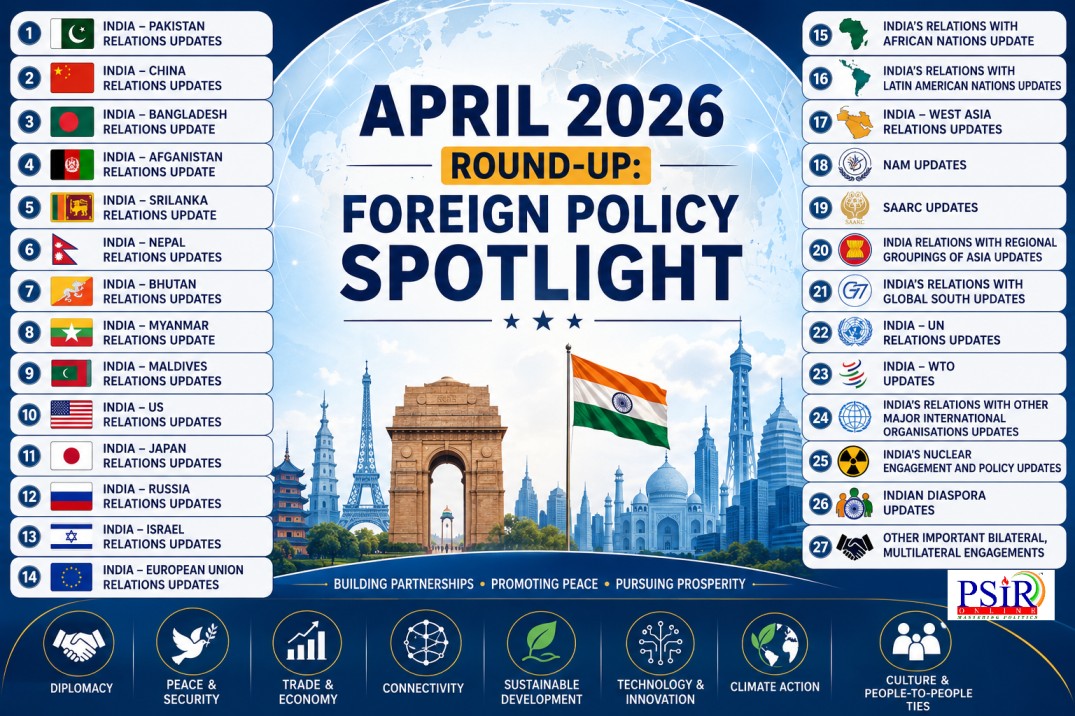
1. INDIA – PAKISTAN RELATIONS UPDATES
No major breakthroughs or escalations occurred in India-Pakistan relations during April 2026. Ties remained strained and largely frozen, one year after the April 2025 Pahalgam terror attack (which killed 26 people, mostly Hindu tourists in Indian-administered Kashmir) and the subsequent May 2025 military clashes (India's Operation Sindoor).
Key Developments in April 2026
· Anniversary reflections and ongoing tensions: Media and officials on both sides marked the one-year point of the 2025 crisis. India reiterated its resolve against terrorism and its "ecosystem," while Pakistan denied involvement in the Pahalgam attack and accused India of unsubstantiated claims. No new major incidents along the Line of Control (LoC) were widely reported.
· Backchannel/Track 1.5-2 talks: Reports emerged of at least four unofficial backchannel meetings between Indian and Pakistani sides (involving former officials, experts, and non-officials) in venues like London, Muscat, Thailand, and Doha. These were low-key confidence-building efforts with no official confirmation or shift to formal dialogue. Public/political engagement, high-level visits, or a formal peace process remained absent.
· Rhetoric and warnings:
o Indian Defence Minister Rajnath Singh (early April) warned of "unprecedented action" if Pakistan attempted any misadventure, referencing Operation Sindoor.
o Pakistani Defence Minister Khawaja Asif responded that any Indian action would face a "swift, calibrated, and decisive" reply.
· Technical/diplomatic frictions: India-Pakistan airspace restrictions (in place since the 2025 conflict) were extended in April.
· Broader context: Pakistan played a visible role in mediating the US-Iran ceasefire/talks in Islamabad (April 2026), which some Indian voices (e.g., Mehbooba Mufti) linked to potential India-Pakistan dialogue opportunities — but this did not materialize into direct progress.
Overall Situation
Relations are in a "frozen conflict" state: the Trump-mediated ceasefire from May 2025 has held with no major border clashes, but deep distrust persists over Kashmir, cross-border terrorism allegations, and core disputes. Rivalry continues at forums like the UN, with no resumption of comprehensive talks.
US think-tanks had earlier (late 2025) flagged a moderate risk of renewed conflict in 2026 due to potential terror activity, but April itself stayed relatively quiet on that front.
Bottom line: Cautious, unofficial contacts happened behind the scenes, but public relations stayed frosty with no de-escalation or new agreements. The situation remains stable but fragile.
2. INDIA – CHINA RELATIONS UPDATES
No major breakthroughs or escalations occurred in India-China relations during April 2026. Ties continued their cautious thaw that began in late 2024–2025 (following the 2020 Galwan crisis and partial LAC disengagement/patrolling agreements), with emphasis on economic engagement and stability while core disputes (border, Arunachal Pradesh) persisted.
Key Developments in April 2026
· Business Delegation Visit (March 29–April 4): For the first time in over five years, a delegation of eight Indian companies visited China (Shanghai, Zhejiang, Wuxi) to explore cooperation in EVs, batteries, renewables, and other sectors. Chinese Embassy spokesperson called it evidence that “the thaw is real.” This was seen as a practical step amid global supply chain shifts and energy disruptions (e.g., from the Iran conflict).
· Arunachal Pradesh Naming Dispute (mid-April): China published new names for places in Arunachal Pradesh (which it calls “South Tibet”). India strongly rejected this as an attempt to push “baseless narratives.” China responded that its policy to improve relations with India remains unchanged, describing bilateral ties as “generally stable.” This exchange highlighted ongoing friction but did not derail broader engagement.
· SCO Bilateral Consultations (April 16–17): The two sides held their first bilateral SCO consultations, discussing implementation of SCO decisions and future cooperation. This built on earlier momentum from 2025 leader-level meetings.
· Broader Context:
o Relations remained in a phase of “cautious calibration” — stabilising the border (LAC situation described as sensitive but stable post-2024 disengagement at Depsang/Demchok) while expanding selective economic and people-to-people ties.
o Trade continued to grow, with China as one of India’s top partners, though a large deficit persisted.
o No high-level political visits or major border incidents were reported in April.
Overall Situation
India-China ties are in a fragile but continuing normalisation phase. Progress is incremental and focused on de-risking (economic cooperation, trade, visas, flights) rather than resolving core issues like the full boundary dispute or strategic mistrust. Both sides prioritise stability amid global uncertainties (e.g., US-China dynamics, BRICS/SCO activities — India holds BRICS presidency in 2026).
Bottom line: Positive signals on the economic and diplomatic track in April, tempered by routine territorial sparring. The relationship remains carefully managed, with no return to pre-2020 hostility but also no rapid warming. Expect continued slow-moving engagement through the rest of 2026.
3. INDIA – BANGLADESH RELATIONS UPDATE
No major crises, but a cautious reset and diplomatic re-engagement defined India-Bangladesh relations in April 2026. Ties had been strained after the 2024 political upheaval in Bangladesh (ousting of Sheikh Hasina) and the February 2026 elections that brought the BNP-led government under Prime Minister Tarique Rahman to power.
Key Developments in April 2026
· High-Level Foreign Minister Visit (April 7–9): Bangladesh’s Foreign Minister Dr. Khalilur Rahman visited New Delhi — the first such ministerial-level engagement with the new Bangladeshi government. He met External Affairs Minister S. Jaishankar, Petroleum Minister Hardeep Singh Puri, and National Security Adviser Ajit Doval.
o Discussions covered trade, energy cooperation, connectivity, water-sharing, visa services, and people-to-people ties.
o Bangladesh sought increased diesel and fertiliser supplies from India (amid global energy disruptions). India responded positively, with supplies to be considered favourably.
· Jaishankar’s Message: India reiterated its desire to engage constructively with the new government and deepen bilateral ties based on mutual respect and shared interests.
· Other Diplomatic Engagements:
o Outgoing Indian High Commissioner Pranay Verma called on PM Tarique Rahman (April 6) and discussed people-centric cooperation in health, trade, investment, technology, power, and energy.
o Meetings between Indian officials and Bangladeshi ministers on information & broadcasting, civil aviation, tourism, and media exchanges to boost people-to-people ties.
· High-Profile Appointment: India appointed senior BJP leader and former Union Minister Dinesh Trivedi (from West Bengal) as the next High Commissioner to Bangladesh — a political rather than career-diplomat choice, signalling strong intent to repair ties.
Ongoing Issues & Cautious Tone
· Border & Migration Tensions: Concerns over alleged “push-ins” (pushbacks) along the border, especially in West Bengal, persisted. Bangladesh warned it would respond if undocumented entries increased.
· Structural Challenges: Trade imbalance, water-sharing (e.g., Teesta), and lingering sensitivities around Sheikh Hasina (still in India) remained unresolved.
· Analysts described the approach as “cautious reset” — positive gestures but no rapid warming, with both sides focusing on practical cooperation while managing domestic political sensitivities.
Overall Situation
India-Bangladesh relations showed tentative improvement in April 2026 after a period of strain. The focus was on stabilising ties through high-level dialogue, energy/trade cooperation, and restoring normalcy (e.g., visas). However, deep-rooted issues and political transitions kept the engagement measured rather than transformative.
Bottom line: A constructive but careful re-engagement phase. Momentum appears positive on the diplomatic track, with more meetings expected in the coming months. The relationship remains important for both but is still navigating post-2024 political realities.
4. INDIA – AFGANISTAN RELATIONS UPDATE
No major diplomatic breakthroughs occurred in India-Afghanistan relations during April 2026. The relationship continued its pragmatic, gradual engagement with the Taliban administration (without formal recognition), focusing on humanitarian assistance, trade, and people-to-people ties that built on 2025 momentum (e.g., embassy upgrades and ministerial visits).
Key Development in April 2026
· Humanitarian Aid Dispatch (April 5): India sent a fresh consignment of Humanitarian Assistance and Disaster Relief (HADR) materials to Afghanistan. This supported people affected by recent floods and an earthquake. Supplies included kitchen sets, hygiene kits, plastic sheets, tarpaulins, sleeping bags, and other essentials.
o MEA Spokesperson Randhir Jaiswal stated that India stands in solidarity with the Afghan people and remains committed to extending support during challenging times.
This reflected India’s consistent role as a provider of development and emergency aid to Afghanistan, even under Taliban rule.
Broader Context (Ongoing Trends)
· Diplomatic & Economic Engagement: Ties built on earlier steps like the upgrade of India’s mission in Kabul to a full embassy (late 2025), handover of the Afghan embassy in New Delhi to Taliban representatives (early 2026), and high-level Taliban ministerial visits to India. Trade reached around USD 1 billion in 2025, with efforts toward air freight corridors and investment in sectors like pharmaceuticals and agriculture.
· No High-Profile Visits or New Agreements in April specifically. Focus remained on practical cooperation amid Afghanistan’s internal challenges and regional dynamics (e.g., Taliban-Pakistan tensions).
· Sports & People-to-People: Afghanistan’s cricket team was scheduled for a tour of India later in 2026, indicating continued cultural links.
Overall Situation
India-Afghanistan relations stayed in a cautious but warming pragmatic phase. India prioritised humanitarian support, trade connectivity, and strategic interests (countering terrorism, regional stability, and countering influence from rivals) without endorsing the Taliban’s governance model. The relationship is driven by mutual economic needs and India’s long-term investments in Afghan infrastructure.
Bottom line: April 2026 was relatively quiet on the political front, dominated by timely humanitarian gestures. The slow thaw from 2025 continued without disruption, with expectations of further incremental steps in trade and aid throughout the year.
5. INDIA – SRILANKA RELATIONS UPDATE
Strong positive momentum marked India-Sri Lanka relations in April 2026, highlighted by a high-profile bilateral visit and continued focus on development cooperation, energy, connectivity, and people-to-people ties.
Key Development: Vice President C.P. Radhakrishnan’s Historic Visit (April 19–20)
· This was the first-ever bilateral visit by an Indian Vice President to Sri Lanka.
· He met President Anura Kumara Dissanayake, Prime Minister Harini Amarasuriya, and other leaders.
· Key outcomes and announcements:
o Handover of the final batch of 4,000 houses under Phase-III of the Indian Housing Project (part of India’s broader support of ~50,000+ houses for estate workers and others).
o Expansion of the CEWET Scholarship Scheme and simplified OCI card processes for 5th and 6th generation Indian-origin Tamils.
o Discussions on an energy hub in Trincomalee, a proposed oil pipeline, and accelerated energy cooperation (with India stressing “no time to lose”).
o Several MoUs signed, including projects in health (medical ward in Mullaitivu, premature baby unit, etc.).
o Emphasis on connectivity, trade, tourism, investment, and post-disaster support (building on India’s role after Cyclone Ditwah).
Broader Context
· The visit reinforced India’s Neighbourhood First policy and Vision MAHASAGAR (maritime strategy).
· Ties remained warm following earlier high-level engagements (e.g., PM Modi’s 2025 visit and President Dissanayake’s 2024 visit to India).
· Trade continued to grow, with India as a major partner and source of tourism/investment.
· No major irritants or tensions were reported in April.
Overall Situation
India-Sri Lanka relations are in a constructive and deepening phase, with strong emphasis on economic recovery support, strategic energy projects, and cultural/people-to-people links. The relationship is viewed as one of India’s most stable and positive in the neighbourhood amid regional uncertainties.
Bottom line: April 2026 delivered a significant diplomatic boost through the Vice President’s landmark visit, delivering tangible outcomes in housing, scholarships, energy, and connectivity. Momentum is clearly upward and expected to continue.
6. INDIA – NEPAL RELATIONS UPDATES
Positive diplomatic momentum with some underlying border friction characterized India-Nepal relations in April 2026. Ties remained close overall (open border, deep people-to-people links, and strong economic/energy cooperation), but the Lipulekh/Kalapani dispute saw renewed attention.
Key Developments in April 2026
· High-Level Preparations for Visits:
o Following Nepal’s March 2026 elections and the formation of a new government under Prime Minister Balendra (Balen) Shah, India extended an official invitation for a visit to New Delhi. Preparations intensified in April for this key trip (date not finalized by end-April).
o Indian Foreign Secretary Vikram Misri planned a visit to Kathmandu (announced for May 11–12) to discuss priorities and prepare for upcoming high-level exchanges (PM and Foreign Minister levels).
· Energy & Economic Cooperation:
o Discussions advanced on long-term power trade, cross-border transmission lines, and renewable energy. A landmark power trade agreement and petroleum pipeline expansion were highlighted as part of deepening ties.
o The India–Nepal Economic Cooperation Forum 2026 was held on April 15–16 in Birgunj and Hetauda, focusing on trade and investment.
· Development Projects:
o India continued grant assistance: MoUs signed for High Impact Community Development Projects (education, health, agriculture). Foundation stones laid for projects like the Ilam Hospital Emergency Block (April 24) and others in Darchula.
· Border Dispute (Lipulekh/Kalapani):
o Nepal reiterated its territorial claims and raised concerns over the resumption of the Kailash Mansarovar Yatra via Lipulekh Pass (announced by India for June–August 2026 in coordination with China). Nepal sent diplomatic notes protesting lack of consultation.
o India rejected Nepal’s claims as historically unfounded, stating the route has been used since 1954 and remains open to dialogue.
Overall Situation
Relations stayed in a pragmatic and cooperative phase under Nepal’s new leadership, with emphasis on practical areas like energy exports, trade, connectivity, and development aid. Preparations for high-level visits signaled intent to strengthen ties. The traditional “roti-beti” (food and familial) bond and open border continued as core strengths.
The Lipulekh issue created some diplomatic noise but did not derail broader engagement, with both sides committing to resolve it through dialogue.
Bottom line: April 2026 was largely constructive, focused on groundwork for deeper cooperation in energy and infrastructure amid routine border sensitivities. Momentum toward high-level visits points to continued stability in bilateral ties.
7. INDIA – BHUTAN RELATIONS UPDATES
Strong and positive momentum continued in India-Bhutan relations during April 2026, with a major focus on hydropower cooperation and energy security — the cornerstone of their bilateral partnership. Ties remained exceptionally warm, rooted in deep trust, cultural links, and mutual strategic interests.
Key Developments in April 2026
· High-Level Visit by Union Minister Manohar Lal (April 9–12): Union Minister for Power and Housing & Urban Affairs Shri Manohar Lal paid a four-day official visit to Bhutan. He met King Jigme Khesar Namgyel Wangchuck, Prime Minister Tshering Tobgay, and Energy Minister Lyonpo Gem Tshering.
· Major Agreements Signed:
o Protocol to the Agreement on the Punatsangchhu-II Hydroelectric Project (1,020 MW) export tariff.
o Methodology for reactive power accounting (effective from May 1, 2026) to improve grid stability and power trade.
· Key Milestone at Punatsangchhu-I Project: The minister attended the first concrete pour ceremony for the 1,200 MW Punatsangchhu-I Hydroelectric Project dam on April 10, marking significant construction progress.
· Customs Cooperation: The 7th Joint Group on Customs (JGC) Meeting was held on April 20–21 in Munnar, Kerala. Discussions focused on coordinated border management, digitization of customs processes, anti-smuggling, and Electronic Cargo Tracking System.
Overall Situation
India-Bhutan relations are at a very high level of comfort and cooperation. Hydropower projects (Punatsangchhu series and others) dominate the agenda, providing clean energy to India while driving Bhutan’s revenue and development. Other areas like connectivity, trade, development assistance, and people-to-people ties remain strong and steady.
No irritants or controversies were reported in April 2026. The relationship is often described as a model of successful neighbourhood diplomacy.
Bottom line: April 2026 reinforced the deep strategic and economic partnership, especially in the energy sector, with tangible progress on flagship hydropower initiatives. Ties continue to be exceptionally close and forward-looking.
8. INDIA – MYANMAR RELATIONS UPDATE
Cautious but active engagement defined India-Myanmar relations in April 2026. Ties focused on strategic interests (border security, connectivity, countering China’s influence), development cooperation, and pragmatic dealings with Myanmar’s military-led government amid ongoing internal conflict.
Key Developments in April 2026
· High-Level Visit by MoS Kirti Vardhan Singh (April 8–11): Minister of State for External Affairs Kirti Vardhan Singh visited Myanmar. He attended the inauguration of Senior General Min Aung Hlaing as the new President (elected by parliament in early April). This was a significant signal of India’s willingness to engage with the military government.
o India expressed support for Myanmar’s development, stability, and a “Myanmar-led, Myanmar-owned” peace process through dialogue.
· Focus on Stepped-Up Engagement: Indian officials reiterated commitment to strengthening bilateral ties under Neighbourhood First and Act East policies. Discussions covered trade, economic cooperation, connectivity projects, and border management.
· Border & Security Context: Ongoing challenges included insurgent activities affecting border fencing, cross-border movements, and ethnic armed groups controlling parts of the frontier. Reports highlighted ground realities in borderlands (especially Mizoram-Chin State linkages) beyond official policy.
· Project Updates: Progress continued on the Kaladan Multimodal Transit Transport Project (Sittwe Port operational; road segments advancing despite delays due to conflict). Other development assistance in health, education, and infrastructure remained active.
Overall Situation
India follows a two-track policy — engaging the de facto government in Naypyidaw while maintaining sensitivity to ethnic and border dynamics. Relations are driven by:
· Security concerns (insurgency, refugees, Free Movement Regime adjustments).
· Connectivity ambitions (Trilateral Highway, Kaladan).
· Countering external influence in the region.
No major breakthroughs or crises occurred in April, but the ministerial visit and engagement with the new presidential setup marked a practical push to deepen cooperation amid Myanmar’s internal complexities.
Bottom line: April 2026 showed steady, pragmatic advancement in India-Myanmar ties with emphasis on high-level diplomacy and project implementation. The relationship remains important for India’s eastern neighbourhood strategy but is tempered by security and humanitarian challenges.
9. INDIA – MALDIVES RELATIONS UPDATES
Steady and constructive engagement continued in India-Maldives relations during April 2026, building on the significant thaw and reset that began in mid-2025 (following PM Modi’s visit as Guest of Honour for Maldives’ Independence Day). Ties focused on economic support, financial assistance, trade, and essential supplies.
Key Developments in April 2026
· Essential Commodities Export Quota Renewed (April 1): India approved and renewed export quotas of essential items to the Maldives for FY 2026–27 under the long-standing 1981 agreement. This included rice, sugar, wheat flour, dal, potatoes, onions, eggs, and construction materials (sand, stone aggregates). This ensures uninterrupted supplies critical for the Maldivian economy and daily needs.
· SAARC Currency Swap Support (April 23–24): India approved the first withdrawal of ₹30 billion (approx. USD 350 million) for the Maldives under the SAARC Currency Swap Framework. Maldives welcomed this support and also settled its previous USD 400 million bilateral swap facility. This provided crucial liquidity amid ongoing foreign exchange needs.
These moves reinforced India’s role as a key economic and financial partner, especially in helping Maldives manage debt pressures and economic stability.
Broader Context
· Relations remained on a positive trajectory after the July 2025 high-level reset, which included a large Line of Credit, debt relief, multiple MoUs, and progress toward a Free Trade Agreement (FTA negotiations advancing).
· Focus areas continued to include infrastructure, tourism (India remains one of the top source markets), defence/maritime cooperation, and development projects.
· No major political irritants, high-level visits, or controversies were reported in April. Cooperation stayed pragmatic and mutually beneficial.
Overall Situation
India-Maldives ties are in a stable, supportive, and warming phase, with emphasis on practical economic and financial assistance. The relationship reflects India’s Neighbourhood First policy and strategic interests in the Indian Ocean, while Maldives benefits from reliable support for its development and stability needs.
Bottom line: April 2026 featured quiet but meaningful economic gestures (commodity supplies and currency swap support), reinforcing the positive momentum without any major new political initiatives. Expect continued steady cooperation through the rest of 2026.
10. INDIA – US RELATIONS UPDATES
India-US relations in April 2026 showed strong institutional momentum in trade, defence, and strategic cooperation, despite a notable diplomatic irritant from a Trump social media post. Overall ties under the Trump administration and PM Modi remained pragmatic and forward-moving, focused on economic reciprocity and Indo-Pacific alignment.
Key Developments in April 2026
· Trade Negotiations (April 20–23): An Indian delegation led by Additional Secretary Darpan Jain held in-person talks in Washington, D.C. — the first face-to-face round since late 2025. Discussions covered the Interim Trade Agreement (framework announced in February 2026) and progress toward the broader Bilateral Trade Agreement (BTA).
o Topics: Market access, non-tariff measures, technical barriers, customs facilitation, investment, economic security, and digital trade.
o Both sides described the meetings as "constructive and positive" and agreed to maintain momentum.
· Defence and High-Level Engagements:
o Indian Army Chief Gen. Upendra Dwivedi visited the Pentagon (around April 20–23), advancing military-to-military ties.
o Indian Air Force Chief Air Chief Marshal A.P. Singh held talks in the US (early April) with his US counterpart, focusing on interoperability, joint training, and strategic discussions at Peterson Space Force Base.
o Foreign Secretary Vikram Misri visited Washington (April 8–10), meeting senior US officials including Under Secretary of War Elbridge Colby on defence industrial cooperation, technology, supply chains, and regional issues (Indo-Pacific & West Asia).
· Diplomatic Friction: President Trump reposted comments by podcaster Michael Savage referring to India (and China) as a “hellhole” in the context of birthright citizenship debates. India’s MEA described the remarks as “uninformed, inappropriate, and in poor taste,” but the reaction was measured and did not derail official engagements.
Overall Situation
· Relations are in a pragmatic reset phase following the February 2026 interim trade framework (which reduced certain US tariffs on Indian goods and included Indian purchase commitments). High-level visits in both directions underscore sustained political will.
· Core pillars — defence co-production, technology (iCET), critical minerals, and Quad cooperation — continued advancing steadily.
· Challenges remain around tariffs, trade imbalances, and occasional rhetorical differences, but institutional engagement stayed robust.
Bottom line: April 2026 was a month of quiet, constructive progress on trade and defence tracks, with the relationship remaining strategically important for both sides amid global uncertainties. Momentum toward deeper economic and security ties is expected to continue.
11. INDIA – JAPAN RELATIONS UPDATES
Strong, steady momentum continued in India-Japan relations during April 2026. The Special Strategic and Global Partnership advanced particularly in technology, defence, and economic security — building on the “Japan-India Joint Vision for the Next Decade” from 2025. No major irritants were reported.
Key Developments in April 2026
· Inaugural India-Japan AI Strategic Dialogue (April 21–22): Held in Mumbai and Bengaluru, this was the first dedicated high-level dialogue on Artificial Intelligence. It focused on AI research, innovation, governance, and practical collaboration (leveraging India’s talent pool and Japan’s hardware/precision strengths). Co-chaired by senior officials from both sides.
· Defence Cooperation Boost: India welcomed Japan’s decision to ease its “Three Principles on Transfer of Defence Equipment and Technology”. MEA described it as a move that would significantly expand bilateral defence industrial collaboration and technology ties.
· 8th Army-to-Army Staff Talks (April 22–24): Held in Tokyo, these talks strengthened military-to-military cooperation and interoperability.
· Diplomatic & Political Engagements:
o External Affairs Minister S. Jaishankar held a telephone conversation with Japanese Foreign Minister Toshimitsu Motegi on April 10, discussing developments in West Asia, shipping safety in the Strait of Hormuz, and bilateral priorities.
o Indian Ambassador Nagma Mallick met Japan’s Liberal Democratic Party (LDP) Vice President Taro Aso in Tokyo on April 16 to discuss strengthening ties.
· Institutional Moves:
Japan’s Ministry of Foreign Affairs established a dedicated Japan-India Economic Affairs Division (effective early April) to streamline investment and economic security cooperation.
Overall Situation
India-Japan ties remain on a consistently upward trajectory, with deep trust and alignment on Indo-Pacific stability, supply chain resilience, critical minerals, semiconductors, clean energy, and emerging technologies. Defence and security cooperation, people-to-people ties, and infrastructure/investment projects (including in India’s Northeast) continued advancing steadily. Both countries are preparing for the 75th anniversary of diplomatic relations in 2027.
Bottom line: April 2026 was highly productive, marked by the launch of the AI dialogue, defence policy easing, and sustained high-level coordination. The partnership is one of India’s most stable and forward-looking relationships. Expect continued focus on technology and economic security through the rest of 2026.
12. INDIA – RUSSIA RELATIONS UPDATES
Steady and robust engagement continued in India-Russia relations during April 2026, anchored in their Special and Privileged Strategic Partnership. Focus areas included energy security (especially oil and LNG amid global disruptions), defence cooperation, trade diversification, and preparations for high-level visits.
Key Developments in April 2026
· Anniversary of Diplomatic Relations (April 13): Both sides marked the 79th anniversary with reaffirmations of deep ties across political, defence, energy, nuclear, space, and economic domains. Record trade turnover and high-level engagement were highlighted.
· High-Level Visit by Russian First Deputy PM Denis Manturov (early April): Manturov visited New Delhi for meetings with PM Narendra Modi, EAM S. Jaishankar, NSA Ajit Doval, and Finance Minister Nirmala Sitharaman. Discussions focused on defence, energy, trade, and security cooperation. Russia offered to significantly increase supplies of crude oil and LNG to India.
· Energy Cooperation Push: Russia expressed readiness to ramp up oil and LNG exports to help India manage volatility from West Asia tensions. This built on Russia’s position as a top crude supplier.
· Defence & Logistics: Reports noted progress on the Reciprocal Exchange of Logistics Support (RELOS) agreement (operationalised earlier), allowing mutual military logistics access.
· Parliamentary & Other Ties: Meetings between Indian and Russian parliamentarians aimed at deepening people-to-people and legislative cooperation.
Broader Context
· Ties remained strong despite global pressures, with both sides navigating multipolar dynamics through BRICS, SCO, and bilateral channels.
· Preparations advanced for PM Modi’s visit to Russia later in 2026 (following Putin’s December 2025 visit to India).
· Russian FM Sergey Lavrov was scheduled to visit India in May 2026 for BRICS Foreign Ministers’ meeting and bilateral talks.
Overall Situation
India-Russia relations stayed in a stable, high-comfort phase, with emphasis on practical cooperation in energy, defence, and trade amid global uncertainties. The partnership continues to serve as a key pillar for both countries’ strategic autonomy and economic interests.
Bottom line: April 2026 featured constructive high-level diplomacy and energy-focused engagements, reinforcing the long-standing trust-based relationship with no major disruptions. Momentum toward deeper economic and defence ties is expected to continue.
13. INDIA – ISRAEL RELATIONS UPDATES
Steady consolidation of the upgraded strategic partnership marked India-Israel relations in April 2026. No new high-level visits occurred, but both sides continued implementing outcomes from PM Narendra Modi’s landmark February 2026 state visit to Israel, which elevated ties to a “Special Strategic Partnership for Peace, Innovation and Prosperity.”
Key Developments in April 2026
· Strategic Reflections and Analysis (April 6–14): Israeli and Indian analysts published pieces highlighting the deepening partnership. A notable BESA Center Perspectives Paper (April 14) described India as Israel’s “Strategic Rear,” noting a shift from buyer-seller defence ties to joint systems integration and co-production. A Jerusalem Post article (April 6) emphasized expanding people-to-people and societal links beyond defence.
· Regional Diplomacy: On April 17, India welcomed the Israel-Lebanon ceasefire (announced by the US) and reiterated support for steps that de-escalate tensions in West Asia.
· Ongoing Implementation: Work continued on the 17 agreements signed during Modi’s visit (defence co-development, AI, cybersecurity, trade, agriculture, etc.) and progress toward a Free Trade Agreement (FTA). Defence industrial cooperation (joint production, technology transfer) remained a core focus.
Overall Situation
India-Israel ties are at an all-time high and in a phase of deepening institutionalization. The February 2026 upgrade (including Modi’s address to the Knesset) has solidified cooperation in:
· Defence (co-production, drones, missiles, precision systems)
· Technology (AI, cybersecurity, semiconductors, quantum)
· Trade & Investment (FTA push)
· Innovation, agriculture, and water management
The relationship is driven by shared interests in counter-terrorism, strategic autonomy, and regional stability amid West Asian uncertainties. No major irritants surfaced in April.
Bottom line: April 2026 was a month of quiet, positive consolidation following the February strategic reset. The partnership continues its upward trajectory with strong momentum expected in defence-tech and economic domains through the rest of 2026.
14. INDIA – EUROPEAN UNION RELATIONS UPDATES
India-EU relations in April 2026 were in a strong implementation and consolidation phase following the landmark India-EU Free Trade Agreement (FTA) and the broader Comprehensive Strategic Pact signed in January 2026 during the 16th EU-India Summit in New Delhi. Ties focused on operationalising the FTA, advancing defence/security cooperation, critical technologies, green transition, and supply chain resilience.
Key April 2026 Developments (EU Level)
· No major new summit, but steady progress on FTA implementation (tariff reductions, regulatory alignment, and market access) with both sides emphasising early gains in goods, services, and investment.
· Continued coordination on global issues (West Asia stability, Indo-Pacific, multilateral reform) and technology/security partnerships.
Bilateral Relations with Major EU Member States
India-Germany (Very Active)
· Foreign Office Consultations (April 14, Berlin): Co-chaired by Foreign Secretary Vikram Misri and German Foreign Minister Dr. Johann Wadephul. Both sides reviewed the full spectrum of ties and agreed to deepen cooperation in critical & emerging technologies, defence industrial collaboration, digital governance, renewable energy, green hydrogen, and third-country projects.
· Defence Minister Rajnath Singh visited Germany (around April 21) and addressed German parliamentarians, pushing for enhanced defence industrial partnerships under Atmanirbhar Bharat.
· Ties marked the 75th anniversary of diplomatic relations in 2026, building on the 25th anniversary of the Strategic Partnership (2025).
India-France (Strong Momentum)
· Foreign Office Consultations (April 13, Paris): Co-chaired by Foreign Secretary Vikram Misri and French Secretary-General Martin Briens. Comprehensive review of the upgraded Special Global Strategic Partnership (elevated during President Macron’s February 2026 visit to India). Focus areas included defence, civil nuclear, space, Indo-Pacific, counter-terrorism, and West Asia.
· Ongoing implementation of outcomes from Macron’s visit and the India-France Year of Innovation.
Other Notable EU Members
· India-Italy: Defence Minister-level talks led to the unveiling of a Military Cooperation Plan 2026–27, focusing on co-production, advanced technologies, and Coast Guard collaboration.
· India-Spain: Activities under the Spain-India Dual Year 2026 (70th anniversary of diplomatic ties) continued in culture, tourism, and AI.
· India-Netherlands: Discussions advanced toward elevating ties to a full Strategic Partnership, with focus on trade, AI, and semiconductors.
Overall Situation
India-EU and key bilateral ties with Europe showed pragmatic deepening in 2026 — driven by the new FTA, diversification away from over-reliance on certain markets, and alignment on strategic autonomy, technology, and security. The relationship is viewed as increasingly important amid global shifts.
Bottom line: April 2026 was a month of steady, high-level diplomatic and sectoral engagement rather than dramatic announcements, with strong focus on implementation and defence/tech cooperation. Momentum remains firmly positive.
15. INDIA’S RELATIONS WITH AFRICAN NATIONS UPDATE
Positive momentum and high anticipation defined India's relations with African nations in April 2026. The month was dominated by intensive preparations for the Fourth India-Africa Forum Summit (IAFS-IV), signaling a renewed push to strengthen ties after a decade-long gap since the last summit.
Major Development: Launch of IAFS-IV Preparations
· On April 23, 2026, External Affairs Minister S. Jaishankar officially unveiled the logo, theme, and website (www.iafs2026.in) for IAFS-IV in New Delhi.
· Summit Details:
o Scheduled for May 28–31, 2026 in New Delhi (main leaders’ event on May 31).
o Hosted in collaboration with the African Union Commission.
o Theme: “IA SPIRIT – India Africa Strategic Partnership for Innovation, Resilience, and Inclusive Transformation.”
o Focus areas: Co-creation, joint innovation, technology, trade, infrastructure, health, sustainable development, and Global South cooperation.
· Preparatory events included briefings across Indian missions in Africa and an India-Africa Dialogue 2026 curtain-raiser in New Delhi (late April), bringing together diplomats, policymakers, and industry leaders.
This summit is seen as a strategic reset, aiming to elevate the partnership amid shifting global dynamics.
Broader Context and Other Activities
· India continued its emphasis on capacity building, trade, technology transfer (e.g., India Stack digital solutions), and development projects across the continent.
· Bilateral fact sheets and relation documents were updated in April 2026 for several countries (e.g., Ethiopia, Kenya, Nigeria, South Africa).
· Ongoing cooperation in areas like peacekeeping, agriculture, pharmaceuticals, and renewable energy remained active, though no new major bilateral breakthroughs were widely reported in April itself.
Overall Situation
India-Africa relations are entering a “new and decisive phase”, with the upcoming summit expected to deliver a comprehensive roadmap for the next decade. Trade, investment, and strategic partnerships continue to grow steadily, supported by India’s image as a reliable development partner without conditionalities.
Bottom line: April 2026 was primarily a preparatory and momentum-building month centered on IAFS-IV. The relationship remains warm, broad-based, and forward-looking, with expectations of significant outcomes from the May summit.
16. INDIA’S RELATIONS WITH LATIN AMERICAN NATIONS UPDATES
Steady, low-key consolidation characterized India's relations with Latin American nations in April 2026. No major high-level bilateral visits or new agreements were announced, but momentum continued in trade expansion, critical minerals, and economic diplomacy, building on the strong push seen in 2025 (PM Modi's visits to Argentina, Brazil, and Trinidad & Tobago).
Key Developments in April 2026
· Trade & Economic Outlook Emphasis: Reports and analyses highlighted growing India-Latin America trade, which reached ~USD 18 billion in the first nine months of FY 2025-26. Focus remained on diversifying supply chains, critical minerals (lithium from the Lithium Triangle), pharmaceuticals, agriculture, and renewable energy.
· Preparatory & Business Engagement:
o Launch of the India-Latin America-Unexplored Partnership series and related discussions involving ambassadors from Uruguay, Ecuador, Cuba, Chile, Guatemala, Paraguay, and Argentina (mid-April).
o Preparations advanced for the India–Latin America & Caribbean Business Conclave (Edition 3) scheduled for June 6, 2026, in Indore, expected to bring together 300+ companies and diplomats from over 20 countries.
· Ongoing Negotiations:
o Continued efforts to expand the India-MERCOSUR Preferential Trade Agreement (PTA) (covering Brazil, Argentina, etc.), aiming to increase tariff lines and address non-tariff barriers.
o Progress toward a Comprehensive Economic Partnership Agreement (CEPA) with Chile and exploratory talks with Peru and others.
Overall Situation
India's engagement with Latin America and the Caribbean (LAC) remains driven by:
· Economic diversification (trade, investment, critical minerals, energy).
· Global South solidarity via forums like BRICS, G20, and CELAC.
· Strategic interests (countering over-reliance on certain partners and securing resources).
The relationship is in a pragmatic expansion phase — strong on trade and business tracks, with institutional deepening but without dramatic new political breakthroughs in April. High-level momentum from 2025 continued to yield incremental results.
Bottom line: April 2026 was a quiet but constructive month focused on groundwork for future deals and business events. Ties are steadily strengthening, with expectations of more visible outcomes in trade negotiations and the June business conclave. The partnership is viewed as having significant untapped potential.
17. INDIA – WEST ASIA RELATIONS UPDATES
India's relations with West Asia (excluding Israel) in April 2026 were dominated by intensive crisis diplomacy amid the aftermath of the US-Israel-Iran conflict (which began in late February 2026 with strikes on Iran and Iranian retaliatory attacks on Gulf states). India maintained a balanced, pragmatic approach focused on energy security, protecting its large diaspora (~9 million in the Gulf), safeguarding shipping lanes (especially the Strait of Hormuz), and deepening ties with Gulf Cooperation Council (GCC) countries.
Key Developments in April 2026
· High-Level Diplomatic Outreach to GCC:
o Petroleum Minister Hardeep Singh Puri visited Qatar (April 9–10) to secure energy supplies. Qatar reaffirmed its commitment as a reliable LNG supplier to India amid disruptions.
o External Affairs Minister S. Jaishankar visited the UAE (April 11–12), meeting President Sheikh Mohamed bin Zayed, the Crown Prince, and Foreign Minister. Discussions focused on energy security, regional stability, support for the Indian community, and strengthening the Comprehensive Strategic Partnership.
o Commerce Minister Piyush Goyal held virtual engagements with GCC Secretary-General, conveying solidarity and discussing supply chain continuity for food and essentials.
· Ceasefire Management and Statements:
o India welcomed the US-Iran ceasefire (and its extension) announced in early April, calling for lasting peace, dialogue, and unimpeded navigation through the Strait of Hormuz.
o Inter-ministerial briefings (late April) addressed impacts on oil supplies, shipping, and citizen safety. India co-sponsored UNSC resolutions condemning Iranian attacks on Gulf states while maintaining engagement with all parties.
· Broader Engagements:
o National Security Adviser Ajit Doval visited Saudi Arabia (mid-April) for strategic talks.
o Focus on long-term diversification of energy sources and supply chain resilience.
Overall Situation
· GCC (UAE, Saudi Arabia, Qatar, etc.): Ties remained exceptionally strong and strategic. The Gulf is India's largest trading partner, top energy supplier, and major remittance source. India-GCC FTA negotiations (relaunched earlier) continued progressing in the background.
· Iran: India maintained pragmatic engagement (historical ties, Chabahar Port) while prioritising Gulf security concerns. It avoided strong condemnation of any side, emphasising diplomacy and BRICS channels (as 2026 BRICS chair).
· Other Countries (Egypt, Jordan, etc.): Coordination on stability, trade, and Indian diaspora welfare.
Bottom line: April 2026 was a month of proactive Gulf-focused diplomacy to mitigate risks from the regional crisis. Relations with key Arab Gulf partners deepened further through high-level visits and energy/security cooperation. India's balanced stance helped protect core interests without major disruptions. The situation remains fluid but stabilising post-ceasefire, with expectations of continued high-level engagement through the rest of 2026.
18. NAM UPDATES
No major summit-level developments occurred for the Non-Aligned Movement (NAM) in April 2026. The movement (currently chaired by Uganda until 2027) remained active through its parliamentary and thematic tracks, with a focus on climate, urbanization, and Global South coordination.
Main Event: 5th Conference of the NAM Parliamentary Network
· Date & Venue: April 15, 2026, in Istanbul, Türkiye.
· Theme: “The Role of Parliaments in Ensuring Climate-Resilient Urbanization in the NAM Area.”
· Participation: Around 200 participants (or ~130–150 delegates in some reports) from 44–50 delegations, including Speakers and Deputy Speakers of national parliaments, plus inter-parliamentary organizations.
Key Outcomes:
· Adoption of the Istanbul Declaration.
· Decision to establish the headquarters of the NAM Parliamentary Network in Baku, Azerbaijan.
· Granting observer status to the Arab Parliament.
· Strong emphasis on parliamentary roles in addressing housing crises, sustainable cities, and climate adaptation in developing countries.
The conference was opened by Sahiba Gafarova (Speaker of Azerbaijan’s Milli Majlis and Chairperson of the NAM Parliamentary Network), who highlighted the 65th anniversary of NAM (founded in 1961) and the growing relevance of the movement.
Other Activities
· Disarmament & Thematic Work: The NAM Disarmament Database was updated in April 2026, compiling statements on IAEA and related issues.
· UN Engagements: NAM issued statements in UN forums (e.g., UN Disarmament Commission) on global issues.
· Analytical Discourse: Articles discussed the evolution of “new non-alignment,” where Global South countries leverage strategic autonomy and resource power in a multipolar world.
· 71st Anniversary of Bandung Conference: Marked around April 18–24 in various forums, reflecting on NAM’s historical roots.
Overall Situation
NAM continues to function as a platform for Global South solidarity on issues like climate change, sustainable development, multilateral reform, and strategic autonomy. While large leader-level summits are infrequent, the Parliamentary Network has become an active and expanding arm of the movement. Preparations for future events (e.g., World Urban Forum in Baku, May 2026) were also linked to NAM themes.
Bottom line: April 2026 was a constructive month focused on parliamentary diplomacy and climate-urbanization issues, with institutional strengthening (Baku HQ decision). The movement remains relevant in a fragmented global order but operates more through thematic and sub-group activities than headline summits.
19. SAARC UPDATES
SAARC remained largely dormant at the political summit level in April 2026, with no foreign ministers’ or leaders’ meetings held. However, functional and technical activities continued, alongside growing calls (especially from Bangladesh) for revitalization.
Key Developments in April 2026
· Second Meeting of the SAARC Inter-Governmental Expert Group on Poverty Alleviation (Malé, Maldives — 22–23 April): This was the most notable official event. The group finalized the First SAARC Development Report (SDR 2025) with the theme “Shaping the Future Together for a Resilient SAARC.”
o Hosted by Maldives with support from the SAARC Secretariat and Asian Development Bank (ADB).
o Delegations from member states (including a strong Bangladesh delegation) emphasized revitalization of SAARC, deeper regional collaboration, resilience, and inclusive growth. Bangladesh actively pushed the revitalization agenda.
· SAARC CCI (Chamber of Commerce and Industry) Presidency Handover (Islamabad — 18/19 April): Leadership transitioned from Bangladesh’s Md. Jashim Uddin to Nepal’s Chandi Raj Dhakal for the 2026–2028 term. Pakistan’s FPCCI President became Senior Vice President. This business-level event highlighted continued private-sector engagement.
· SAARC Talk Series 2026 (First Session — 7 April): Virtual event organized by the SAARC Cultural Centre in Sri Lanka on “Cultural Diplomacy and Soft Power: The Role of Independent Cinema in South Asia.”
Overall Situation
· SAARC continues to function through technical committees, expert groups, cultural activities, and business forums, but remains paralyzed at the highest political level due to India-Pakistan tensions (no summit since 2014).
· There is visible momentum for revival, particularly driven by Bangladesh’s new government and supported by countries like Nepal and Maldives. Analysts and officials repeatedly stressed the need for a leaders’ summit to address shared challenges (climate, poverty, trade, connectivity).
· No breakthrough on resuming high-level dialogue occurred in April.
Bottom line: April 2026 saw modest but meaningful technical and business-level activity, with renewed diplomatic emphasis on revitalizing the organization. Real progress depends on political will for a summit, which remains elusive. Expect continued low-key activities and calls for revival in the coming months.
20. INDIA RELATIONS WITH REGIONAL GROUPINGS OF ASIA UPDATES
India maintained active and constructive engagement with major Asian regional groupings (excluding SAARC) in April 2026, with a strong emphasis on ASEAN, SCO, and BIMSTEC. These platforms served as key vehicles for India's Act East Policy, Indo-Pacific strategy, and multilateral diplomacy.
1. ASEAN (Association of Southeast Asian Nations)
Most prominent activity in April.
· 28th ASEAN-India Senior Officials’ Meeting (SOM) — Held on April 9, 2026, in Manila, Philippines. Co-chaired by India’s Secretary (East) Periasamy Kumaran and Philippines Undersecretary Leo M. Herrera-Lim.
o Reviewed implementation of decisions from the October 2025 ASEAN-India Summit.
o Reaffirmed commitment to the ASEAN-India Comprehensive Strategic Partnership (CSP) and the Plan of Action (2026–2030).
o Designated 2026 as the ASEAN-India Year of Maritime Cooperation — focus on blue economy, maritime security, and sustainable ocean governance.
o Discussed regional developments and ways to strengthen connectivity, trade, and people-to-people ties.
· Broader context: Steady progress on the CSP amid ongoing challenges like the large trade deficit and slow FTA review. India continues to position itself as a strategic partner for ASEAN centrality in the Indo-Pacific.
2. SCO (Shanghai Cooperation Organisation)
Active defence and bilateral track engagement.
· India-China Bilateral SCO Consultations — Held in New Delhi on April 16–17, 2026. Discussed implementation of SCO leaders’ decisions and the future direction of the organisation.
· SCO Defence Ministers’ Meeting — Held in Bishkek, Kyrgyzstan (around April 28, 2026). Defence Minister Rajnath Singh led the Indian delegation.
o Held bilateral meetings with counterparts from Kyrgyzstan, Kazakhstan, and others to strengthen defence cooperation.
o Discussed regional security with Chinese Defence Minister on the sidelines.
India used the SCO platform for practical cooperation with Central Asian countries while managing its complex relationship with China and Pakistan (full SCO member).
3. BIMSTEC (Bay of Bengal Initiative for Multi-Sectoral Technical and Economic Cooperation)
Youth and technical-level focus.
· BIMSTEC Youth Leadership Exchange Programme — Hosted by India from April 25–30, 2026. Involved over 70 young leaders from the seven member countries (Bangladesh, Bhutan, India, Myanmar, Nepal, Sri Lanka, Thailand). Aimed at fostering people-to-people ties and future leadership collaboration.
· Other activities: BIMSTEC Permanent Working Committee meeting (early April in Dhaka) and various expert group meetings on mountain economy, MSMEs, etc.
BIMSTEC continues to serve as India’s preferred platform for sub-regional cooperation bypassing Pakistan-related issues in SAARC.
Other Groupings
· East Asia Summit (EAS) and IORA (Indian Ocean Rim Association): Preparatory work continued, but no major April-specific events. India (current IORA Chair 2025–27) was preparing to possibly host a leaders’ summit later in 2026 to mark the 30th anniversary.
Overall Situation
India’s engagement with these groupings in April 2026 was pragmatic and multi-layered — combining senior official-level diplomacy (ASEAN), defence/security cooperation (SCO), and people-centric initiatives (BIMSTEC). The focus remained on maritime security, connectivity, economic resilience, and strategic autonomy amid global uncertainties.
Bottom line: April was a month of steady, functional progress rather than headline summits. Momentum is building toward larger events later in 2026, with ASEAN and maritime cooperation receiving special emphasis throughout the year.
21. INDIA’S RELATIONS WITH GLOBAL SOUTH UPDATES
India continued to position itself as a prominent voice and bridge-builder for the Global South in April 2026. Activities focused on multilateral advocacy, preparations for major summits, and South-South cooperation amid global challenges like West Asia tensions, UN reforms, and economic resilience.
Key Developments in April 2026
· Launch of 4th India-Africa Forum Summit (IAFS-IV) Preparations (April 23): External Affairs Minister S. Jaishankar unveiled the logo, theme, and website (www.iafs2026.in) for IAFS-IV, scheduled for May 28–31, 2026 in New Delhi.
· Theme: “IA SPIRIT – India Africa Strategic Partnership for Innovation, Resilience, and Inclusive Transformation.”
· This was a major milestone for India-Africa ties (a key pillar of India’s Global South outreach), with emphasis on development initiatives, capacity building, education, technology, and climate action. Preparatory briefings were held across Indian missions in Africa.
· Push for Global South Representation in UN Reforms: India strongly advocated for UN Security Council (UNSC) expansion and greater voice for the Global South in permanent and non-permanent seats. This was highlighted during ECOSOC Forum on Financing for Development and Intergovernmental Negotiations (IGN) meetings (around April 20–22). India aligned with African and other developing nations’ demands for equitable global governance.
· BRICS 2026 Presidency Activities: Under India’s chairship (theme: “Building for Resilience, Innovation, Cooperation and Sustainability”), several events advanced. Notably, BRICS Deputy Foreign Ministers and Special Envoys on the Middle East and North Africa met in New Delhi on April 24, discussing regional stability. India used the platform to amplify Global South priorities like economic cooperation and multipolarity.
· Other Engagements and Conferences:
· Academic and policy events, such as “The Global South Speaks: India’s Leadership in BRICS and Beyond” at IIFT (late April), discussed India’s role in global governance and South-South ties.
· Continued emphasis on climate, technology, AI, and development cooperation with Global South partners.
Overall Situation
India’s approach combined pragmatic diplomacy (energy security, trade diversification) with normative leadership — championing reforms in global institutions, amplifying developing nations’ concerns, and offering practical partnerships (e.g., digital public goods, capacity building, and innovation). This built on India’s G20 presidency legacy and its current BRICS role.
Bottom line: April 2026 was a preparatory and advocacy-focused month, highlighted by the high-profile IAFS-IV launch and sustained UN/BRICS efforts. India’s Global South engagement remains robust and multi-dimensional, with major deliverables expected from the May Africa Summit and later BRICS events. The momentum reflects New Delhi’s long-term strategy of strategic autonomy and inclusive multilateralism.
22. INDIA – UN RELATIONS UPDATES
India’s engagement at the United Nations remained highly active and reform-oriented in April 2026. The focus was on UN Security Council (UNSC) reform, Global South representation, global financing, and multilateral strengthening amid ongoing global challenges.
Key Developments in April 2026
· Strong Push for UNSC Reform (mid-April): India (as part of the G4 — India, Brazil, Germany, Japan) firmly opposed a “two-tier” permanent membership system and supported a compromise proposal to defer veto power for new permanent members for 15 years. India’s Permanent Representative Ambassador Parvathaneni Harish cautioned against further delays and advocated expanding the UNSC from 15 to 25–26 seats, with enhanced representation for Africa and Asia-Pacific. India emphasized that reform without expanding the permanent category (with veto) would be incomplete.
· High-Level Engagements in New York (April 21–23):
o Secretary (West) Sibi George delivered India’s national statement at the 2026 ECOSOC Forum General Debate (April 21), calling for sweeping reforms in global financial architecture and greater voice for the Global South.
o On April 23, he met UN Secretary-General António Guterres and reiterated India’s commitment to multilateralism and the India-UN Development Partnership Fund.
· UNGA President’s Visit to India (April 27–28): UN General Assembly President Annalena Baerbock (Germany) visited New Delhi. She held bilateral talks with External Affairs Minister S. Jaishankar, met the UN Country Team, and discussed AI governance, multilateral cooperation, and UN reforms. She described India as an “important partner” and highlighted the role of the Global South.
· Other Notable Activities:
o India won elections by acclamation to four key ECOSOC subsidiary bodies (e.g., re-election of Ambassador Preeti Saran to CESCR).
o India submitted updated climate action pledges (NDCs) to the UNFCCC, with conditions on finance and technology transfer.
o Continued advocacy on peacekeeping, development, and countering misuse of UN platforms.
Overall Situation
India maintained a proactive and consistent stance at the UN, championing multilateral reform, equitable global governance, and Global South priorities. Its messaging aligned with its current BRICS 2026 chairship and preparations for the India-Africa Forum Summit. No major controversies or setbacks were reported.
Bottom line: April 2026 was a month of steady, high-visibility diplomacy at the UN, with clear emphasis on Security Council expansion and development financing. India continues to project itself as a responsible global player and leading voice of the Global South. Momentum on reform issues is expected to build further in the coming months.
23. INDIA – WTO UPDATES
No major breakthroughs occurred in India-WTO relations during April 2026. The month followed the 14th Ministerial Conference (MC14) held in Yaoundé, Cameroon (March 26–29/30, 2026), with India focusing on implementation, technical notifications, and dispute management while maintaining its core defensive positions on agriculture, food security, and multilateralism.
Key Developments in April 2026
· Post-MC14 Follow-up & Implementation:
o India continued to highlight its successful defence of developing country interests at MC14, particularly on public stockholding for food security, fisheries subsidies, and opposition to the plurilateral Investment Facilitation for Development (IFD) Agreement.
o Discussions on WTO reforms, dispute settlement revival, e-commerce moratorium, and agriculture remained ongoing without new resolutions in April.
· Technical & Trade Defence Notifications:
o April 24: India notified the WTO Committee on Safeguards about its safeguard investigation on imports of soda ash (initiated on March 16, 2026).
o April 1: India notified new definitions and amendments under the Food Safety and Standards (Packaging) Regulations.
· Dispute Settlement Activity:
o April 21: The WTO Dispute Settlement Body (DSB) agreed to India and Taiwan’s (Chinese Taipei) joint request to defer the adoption of a panel ruling on India’s import duties on certain ICT products until October 2026, to allow time for bilateral resolution.
o Ongoing monitoring of other disputes (e.g., batteries & electric vehicles with China).
· Regular Committee Work:
o India participated in standard WTO committee meetings, including the Committee on Anti-Dumping Practices (April 28), where its actions were reviewed alongside other members.
Overall Situation
India’s stance at the WTO remained consistent and defensive:
· Strong emphasis on food security, policy space for developing countries, and consensus-based decision-making.
· Resistance to plurilateral agreements that could undermine multilateralism.
· Push for meaningful WTO reform, especially revival of the Appellate Body.
Relations are stable but continue to reflect tensions between developed countries’ push for new issues (e-commerce, investment) and India’s focus on traditional development concerns.
Bottom line: April 2026 was a quiet, technical follow-up month after the high-intensity MC14. India focused on safeguard measures, notifications, and dispute management while preparing for future negotiations. No dramatic shifts occurred, and the core divergences on agriculture, fisheries, and reforms persist. Expect continued activity in regular WTO bodies through the rest of 2026.
24. INDIA’S RELATIONS WITH OTHER MAJOR INTERNATIONAL ORGANISATIONS UPDATES
India engaged actively with several major international organisations in April 2026, particularly through its BRICS Chairship and participation in global forums on health, finance, and energy. Activities focused on multilateral reform, Global South priorities, and practical cooperation amid West Asia tensions and economic uncertainties.
1. BRICS (Key Focus Area)
India’s 2026 BRICS Chairship (theme: “Building for Resilience, Innovation, Cooperation and Sustainability” — “Humanity First” approach) saw significant momentum in April.
· BRICS Deputy Foreign Ministers & Special Envoys Meeting (New Delhi, April 23–24): Focused on the Middle East situation. The meeting ended without a joint statement due to differences over the Iran conflict, Israel-Palestine language, and India’s balancing approach. This highlighted internal challenges for India’s presidency.
· BRICS Health Working Group (First Meeting, mid-April, New Delhi): Launched priorities on healthy lifestyles, mental health, and inclusive health cooperation.
· BRICS Academic Forum (April 17–18, New Delhi): Inaugural convening by ORF and partners, discussing the four pillars of India’s chairship.
· Other tracks: Energy Officials Meeting (April 16–17) and MSME cooperation push.
2. IMF & World Bank
· India engaged in IMF-World Bank Spring Meetings and related forums, focusing on responses to West Asia energy disruptions.
· India supported calls for coordinated emergency support and highlighted its strong growth resilience (despite global headwinds). The World Bank released its India Development Update in April, projecting robust but moderated growth.
3. WHO & Global Health
· World Health Day 2026 (April 7): India actively participated under the theme “Together for Health. Stand with Science.” Emphasis on One Health, science-based collaboration, and climate-health linkages.
4. International Solar Alliance (ISA)
· ISA (co-led by India and France) continued steady operations despite the US withdrawal (announced earlier). Focus remained on scaling solar in developing countries, with governance meetings scheduled later in 2026.
Overall Situation
India used these platforms to:
· Amplify Global South voices.
· Push reform of global governance.
· Advance practical cooperation in health, energy, and economic resilience.
No major controversies or setbacks occurred, though BRICS faced internal divergences on West Asia issues.
Bottom line: April 2026 was a month of active chairship-driven diplomacy (especially BRICS) and steady engagement in financial and health organisations. India continued projecting itself as a bridge-builder and responsible global player. Momentum is building toward the BRICS Summit later in 2026 and other ministerial tracks.
25. INDIA’S NUCLEAR ENGAGEMENT AND POLICY UPDATES
India’s nuclear policy and engagements in April 2026 remained consistent with its long-standing principles: credible minimum deterrence, No First Use (NFU), non-use against non-nuclear weapon states, and a commitment to global nuclear disarmament through a universal, non-discriminatory framework. India continued to stay outside the NPT (as a non-signatory nuclear weapons state) while strengthening its civil nuclear programme and responsible non-proliferation record.
Major Domestic Milestone
· Prototype Fast Breeder Reactor (PFBR) at Kalpakkam attains First Criticality (April 6, 2026): The indigenously designed 500 MWe PFBR achieved a self-sustaining nuclear chain reaction on April 6. This marks India’s official entry into the second stage of its three-stage nuclear programme (envisioned by Dr. Homi Bhabha).
o It will use plutonium-uranium mixed oxide fuel and eventually help convert thorium-232 into uranium-233 for the third stage.
o This is a significant step toward long-term energy security and reducing dependence on imported uranium.
Civil Nuclear Cooperation & Energy Push
· Parliament was briefed on the positive impact of the 2008 India-US Civil Nuclear Agreement and subsequent NSG waiver, which enabled fuel imports and boosted nuclear power generation (from ~17,000 MU in 2007-08 to over 56,000 MU in 2024-25).
· Ongoing cooperation with partners like France, Canada (long-term uranium supply), Russia, and South Korea continued. India signed or advanced several civil nuclear agreements.
Position on Nuclear Non-Proliferation & Disarmament
· India maintained its traditional stance: It supports complete, verifiable, and non-discriminatory nuclear disarmament and has called for a Nuclear Weapons Convention.
· India is not a party to the NPT and does not intend to join as a non-nuclear weapon state. It continues to advocate for criteria-based approaches rather than discriminatory regimes.
· NSG Membership: No breakthrough reported in April 2026. India’s bid (pending since 2016) remains blocked primarily by China, linked to its non-NPT status. India continues to meet high non-proliferation standards through IAEA safeguards on civilian facilities and strong export controls.
Context of the 2026 NPT Review Conference
· The 11th NPT Review Conference began on April 27, 2026, at the UN (running into May). India (as a non-party) was not a formal participant but closely followed proceedings. The conference occurred amid heightened global tensions, including the recent West Asia conflict and concerns over rising nuclear risks.
Overall Policy Position (Unchanged)
· Credible Minimum Deterrence with No First Use.
· Strong emphasis on responsible behaviour and non-proliferation (India has an excellent track record of not proliferating technology).
· Support for FMCT negotiations (Fissile Material Cut-off Treaty) on the basis of CD/1299.
· Focus on expanding peaceful uses of nuclear energy to meet India’s clean energy and Viksit Bharat goals.
Bottom line: April 2026 was highlighted by a major indigenous technological achievement (PFBR criticality), reinforcing India’s self-reliant nuclear journey. Policy remained steady — responsible nuclear power with a long-term vision for disarmament and expanded civilian nuclear cooperation. No shifts in doctrine or major proliferation-related controversies emerged.
26. INDIAN DIASPORA UPDATES
India’s official engagement with its diaspora in April 2026 focused on policy simplification, administrative reforms, and strategic outreach through diplomatic channels. No large-scale Pravasi Bharatiya Divas (PBD) convention took place (as it is held biennially; the last was in 2025 in Bhubaneswar).
Key Highlights in April 2026
· Major OCI Card Reforms (Effective April 2026): The Ministry of Home Affairs (MHA) and Bureau of Immigration introduced significant updates to the Overseas Citizenship of India (OCI) scheme:
o Removal of the 6-month continuous stay requirement in India for eligible applicants (effective ~April 8).
o Revised fee structure (effective April 1).
o Discontinuation of postal applications (applicants must apply in person at VFS or Indian missions for biometrics).
o Introduction of e-OCI (electronic card) option alongside physical cards.
o New timelines for passport/OCI updates and penalties for delays.
These changes aim to make the process easier, faster, and more accessible for the ~35+ million-strong Indian diaspora.
· 11th Heads of Missions Conference (April 28–30, New Delhi): Prime Minister Narendra Modi addressed Indian Ambassadors and High Commissioners, stressing the need to “deepen the connect with our diaspora” as a core pillar of India’s global engagement. Discussions focused on leveraging the diaspora for trade, technology, tourism, and strategic partnerships toward Viksit Bharat 2047. External Affairs Minister S. Jaishankar also addressed the envoys on expanding diaspora outreach.
· Other Engagements: Indian missions worldwide continued routine diaspora welfare activities, Know India Programme (KIP) follow-ups, and regional events. Several embassies/high commissions organized smaller diaspora meets and cultural programmes.
Overall Situation
India’s diaspora policy in April 2026 emphasized ease of engagement (especially through OCI simplification) and strategic integration of overseas Indians into India’s development and global diplomacy. The diaspora is viewed as a vital bridge for economic, cultural, and knowledge partnerships.
Bottom line: April was a month of practical, behind-the-scenes reforms and high-level directional guidance rather than mega events. The OCI changes are the most tangible benefit for diaspora members this month. Expect continued focus on diaspora-centric initiatives in the coming months, including preparations for future regional PBD events and the next full convention in 2027.
27. OTHER IMPORTANT BILATERAL, MULTILATERAL ENGAGEMENTS
Here are the notable India foreign policy updates from April 2026 that were not covered in our previous discussions:
1. India–South Korea (ROK) Relations — Major Highlight of the Month
State Visit by South Korean President Lee Jae Myung (April 19–21, 2026) — This was the most significant bilateral development in April.
· Key Outcomes:
o Adoption of the Joint Strategic Vision for India-ROK Special Strategic Partnership (2026–2030).
o Reaffirmation of the $50 billion bilateral trade target by 2030 (nearly doubling current levels).
o Multiple MoUs and agreements signed (~16 documents) covering semiconductors, shipbuilding, AI, defence, critical minerals, MSMEs, space, and clean energy.
o Launch of a Comprehensive Framework on Shipbuilding & Maritime Cooperation.
o Agreement to upgrade the existing CEPA and establish new working groups on space (ISRO–KASA) and MSMEs.
· Both sides described the partnership as moving from “trusted” to “futuristic,” with strong emphasis on supply chain resilience amid global uncertainties.
This visit stood out as a proactive step in India’s diversification strategy in East Asia.
2. Quad (Quadrilateral Security Dialogue)
· No leaders’ summit was held (the 2025 summit was also postponed).
· India continued preparations to host the Quad Foreign Ministers’ Meeting in New Delhi in late May 2026.
· Focus areas discussed in April: Indo-Pacific stability, critical minerals, supply chain resilience, and maritime security. The grouping remained active at the working and ministerial level despite lower public visibility.
3. Australia
· Australian High Commissioner to India, Philip Green, stated on April 25 that India-Australia ties are at their “highest point ever”.
· Emphasis on Quad alignment, Indo-Pacific vision, economic complementarity, and the strong people-to-people bridge (over 1 million Indians in Australia).
No major new agreements were announced in April, but the tone remained very positive.
4. UK, Canada & Others
· No major bilateral breakthroughs or high-level visits specifically in April 2026.
· Relations with the UK continued implementation of the earlier Comprehensive Economic and Trade Agreement.
· Canada saw continued low-key technical and academic engagement (e.g., lectures on India’s strategic autonomy), but no headline political reset in April.
· Overall, India’s engagement with these countries remained steady within the broader framework of trade diversification and technology/security cooperation.
Overall Foreign Policy Tone in April 2026
India focused on pragmatic diversification — deepening ties with middle powers like South Korea, consolidating existing gains (EU, UK, US interim trade framework), and preparing for major upcoming events (India-Africa Summit in May, BRICS and Quad ministerial meetings).
Bottom line: The standout event was the successful South Korea summit, which added concrete momentum to India’s Indo-Pacific economic and technology partnerships. Other relationships (Australia, Quad) showed continuity and quiet progress rather than dramatic new announcements.