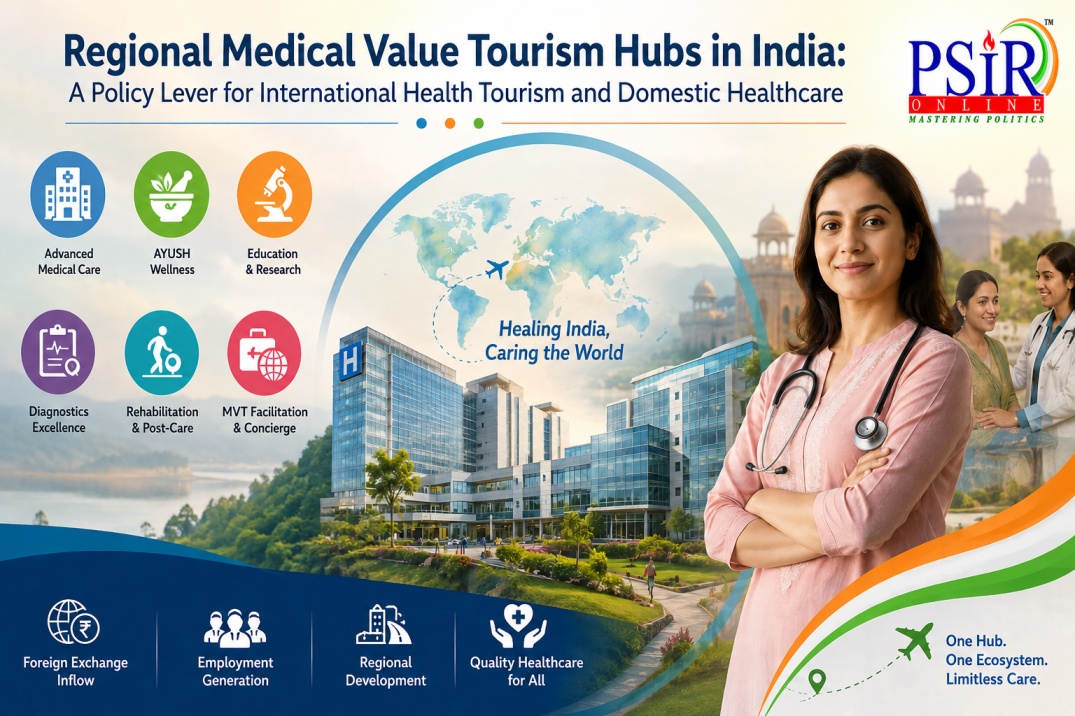
The Union Budget 2026–27 announcement of five Regional Medical Hubs marks a significant step in India’s ambition to position itself as a leading global destination for Medical Value Tourism. Under this scheme, the Centre will support states in establishing integrated healthcare complexes in public–private partnership, combining advanced medical services, education and research, AYUSH centres, Medical Value Tourism facilitation centres, diagnostics, post‑treatment care, and rehabilitation under one roof.
KEY DETAILS
The core idea is to package treatment, recovery, and support services into one ecosystem so that India becomes more attractive for both domestic and international patients. The private-sector partnership is important because the model depends on capital, specialist services, and operational efficiency that are hard to build through public infrastructure alone.
Through the Union Budget 2026–27 and the corresponding PIB release, the government has said the five hubs will be integrated healthcare complexes combining:
· medical services (hospitals, specialists),
· education and research (including opportunities for AYUSH research and allied‑health skilling),
· AYUSH centres,
· Medical Value Tourism Facilitation Centres (visa, forex, insurance, concierge‑type services),
· advanced diagnostics,
· post‑treatment care and rehabilitation units.
The explicit goal is to position India as a global Medical Value Tourism (MVT) destination while also generating employment for doctors, AHPs, paramedics, and wellness‑care professionals.
|
WHY GOVERNMENT IS EMPHASISING “MEDICAL VALUE TOURISM”?
The government emphasises “Medical Value Tourism” (MVT) instead of just “medical tourism” because it shifts the focus from cheap treatment to high‑quality, value‑for‑money healthcare services, which better suits India’s economic and strategic goals.
1. It’s about value, not just low cost “Value tourism” means international patients get advanced care, safety, and outcomes at a fraction of the cost seen in Western countries, not just “anything cheap”.
2. It fits India’s competitive advantage · India has high‑end hospitals, English‑speaking doctors, and strong diagnostics, plus Ayurveda, yoga, and wellness options. · MVT leverages this whole “healing ecosystem” to attract richer, longer‑stay patients who need multi‑disciplinary care, AYUSH‑integrated treatment, and wellness‑linked recovery.
3. It’s an export‑style service sector MVT is treated much like software or engineering services: · It earns foreign exchange (USD inflows) without exporting physical goods. · It creates high‑skilled jobs (doctors, paramedics, AYUSH professionals, hospitality staff) and supports local infrastructure.
4. It aligns with schemes like “Heal in India” The “Heal in India” framework and the National Strategy for Medical and Wellness Tourism explicitly use “medical value travel” to signal that India is building a branded, regulated, high‑quality MVT sector, not just random medical‑tourism pockets.
|
HOW THE HUBS ARE STRUCTURED?
Government documents emphasise three key design elements:
1. Public–Private Partnership (PPP): The Centre will “support States” in setting up these hubs with the private sector, implying funding and regulatory support from the Union, but land and local planning will be state‑driven.
2. Integrated “healing ecosystem”: Each hub is meant to be a one‑stop node for treatment, diagnostics, AYUSH‑integrated care, and rehabilitation, reducing fragmentation for international patients.
3. Regional coverage: Each hub is envisaged to serve a region (possibly multiple states), not just one city, thereby de‑congesting major metros and spreading MVT‑linked benefits across the country
HOW THE PROPOSED REGIONAL MEDICAL HUBS DIFFER FROM EXISTING MEDICAL‑TOURISM?
The proposed Regional Medical Hubs differ from existing medical‑tourism areas mainly in explicit design, integration, and policy‑level institutionalisation, even though both cater to medical‑tourism‑type patients.
1. Degree of integration
· Existing areas (e.g., Delhi‑NCR, Chennai, Mumbai, Bengaluru): These are clusters of private hospitals, diagnostic chains, and wellness centres that have grown organically around demand; there is no single “hub‑level” architecture putting AYUSH, education, research, diagnostics, and rehab in one integrated complex.
· Proposed hubs: Government explicitly defines them as integrated healthcare complexes combining medical services, education‑cum‑research, AYUSH centres, diagnostics, post‑care, and rehabilitation in one ecosystem.
2. Governance and PPP structure
· Existing areas: Primarily run by private operators, with only indirect state support (e.g., tourism promotion, ease‑of‑doing‑business). There is no central “hub‑specific” scheme or dedicated PPP framework at the regional‑hub level.
· Proposed hubs: They are covered under a central scheme to support states, with an explicit PPP‑based model; the Centre will back states in land, planning, and possibly financing, making these hubs a planned, state‑level project rather than a spontaneous cluster.
3. Formal MVT infrastructure
· Existing areas: Have ad hoc facilitation (hospital‑level concierge, visa assistance, package deals), but not a standardised Medical Value Tourism Facilitation Centre at the regional level.
· Proposed hubs: Each hub is to have a dedicated Medical Value Tourism Facilitation Centre offering services like visa‑on‑arrival support, forex, insurance coordination, and patient‑care coordination, almost like an “airport‑style” single‑window for international patients.
4. Regional vs city‑centric coverage
· Existing areas: Mostly metro‑centric (Delhi, Mumbai, Chennai, Bengaluru, Hyderabad, etc.), often serving patients from within the city and neighbouring areas.
· Proposed hubs: Designed as regional centres intended to serve multiple states in a zone, so that patients from a whole region can access them instead of crowding only a few metros.
5. Systematic job‑creation and skilling
· Existing areas: Employment is generated but not explicitly tied to a nation‑level employment‑cum‑skilling strategy for MVT.
· Proposed hubs: Government openly links them to job opportunities for doctors and allied‑health professionals (AHPs), including those in AYUSH and rehabilitation, making employment generation a core stated objective.
HOW THIS WILL STRENGTHEN INDIA'S DOMESTIC HEALTH CARE NEEDS AND DOMESTIC HEALTH TOURISM?
The proposed Regional Medical Hubs will strengthen both India’s domestic healthcare system and domestic health tourism, even though they are announced under the banner of Medical Value Tourism (MVT).
Impact on domestic healthcare
1. Upgraded infrastructure for all patients
The hubs will bring together modern medicine, AYUSH, diagnostics, and rehabilitation in one complex, which will also be used by poor and middle‑class Indians, not just foreign patients. This improves access to advanced diagnostics and post‑care that are often missing in tier‑2 and tier‑3 cities.
2. More doctors and AHPs for the system
The scheme explicitly aims to create job and skilling opportunities for doctors and allied‑health professionals (AHPs); these professionals will also serve the domestic population, thereby easing the shortage of paramedics and specialists in public‑health and private‑care settings.
Impact on domestic health tourism
1. Structured regional medical‑tourism nodes
Many Indians already travel within the country for better treatment (e.g., from North‑East to South India), but this is currently unplanned and fragmented. The regional hubs will act as formal referral centres for domestic patients, reducing travel chaos and improving coordination between primary, secondary, and tertiary care.
2. Rehabilitation and wellness‑linked care
Domestic “health tourism” often overlaps with wellness and geriatric care (e.g., Ayurveda‑based recuperation, geriatric rehab). By including AYUSH, post‑care, and rehabilitation, the hubs will attract domestic patients who want holistic or long‑term recovery, not just one‑time surgery.
HOW THIS IS LIKELY TO BOOST INDIA’S SHARE IN INTERNATIONAL HEALTH TOURISM?
The proposed Regional Medical Hubs are expected to boost India’s share in international health tourism by making it a more reliable, branded, and seamless destination for foreign patients.
1. Positioning India as a global MVT hub
· The five hubs are explicitly framed as tools to position India as a “global healthcare destination”, not just a low‑cost outlier among medical‑tourism countries.
· Experts say this will help increase India’s brand value in global medical‑tourism rankings, alongside Thailand, Malaysia, Turkey, and Singapore.
2. Smoother experience for international patients
· Each hub will have a Medical Value Tourism Facilitation Centre dealing with visas (e‑visa coordination), forex, insurance, hotel‑hospital tie‑ups, and language support, which are currently fragmented and hospital‑specific.
· This reduces logistical friction and makes India more attractive to patients from West Asia, CIS countries, Africa, and ASEAN, who already form a major pool of existing medical tourists.
3. Higher‑quality, diversified treatment packages
· The integrated design (modern medicine + AYUSH + diagnostics + rehabilitation) lets India offer “holistic care” packages—for example, surgery in a tertiary hospital followed by Ayurveda‑based recovery and wellness stays.
· Studies on international health tourism show that destinations offering specialised treatment clusters (cardiac, oncology, cosmetic, fertility, orthopaedics) plus recovery‑linked tourism grow fastest.
4. Visibility and organised data‑driven targeting
· The government’s push—along with the “Heal in India” branding and steps like e‑visas and medical tourism boards—will encourage hospitals to maintain centralised data on patients by country, disease, and city, helping to target marketing and pricing.
· This is expected to raise India’s share of global medical‑tourism revenue, with sector estimates projecting the MVT market to cross ₹4.3 lakh crore by 2034
WHAT ARE THE CHALLENGES IN IMPLEMENTING THE SCHEME?
The Regional Medical Hubs scheme faces several implementation challenges relating to coordination, regulation, and infrastructure, even though the concept is strong on paper.
1. Coordination between Centre, States, and private sector
· The hub‑building model is PPP‑based and state‑implemented, so overlapping mandates between Union ministries (Health, Tourism, AYUSH, Home for visas) and state governments can delay land acquisition, approvals, and funding flow.
· States may also lack experience in managing large‑scale medical‑tourism‑centric PPPs, leading to weak contract‑design and risk‑allocation.
2. Data, targeting, and pricing issues
· As experts point out, India currently lacks a robust database on international patients (countries, procedures, routes, spending), which is needed to decide hub locations and specialities such as liver, kidney, oncology, or cosmetic‑surgery‑centred clusters.
· Fixing transparent, ethical, and competitive tariffs for foreign patients—without creating two‑tier pricing that harms domestic patients—is another major governance challenge.
3. Logistics and visa‑tourism ecosystem
· Despite e‑visas, medical‑tourism‑centric visa liberalisation is still seen as lagging behind Thailand, Turkey, and Malaysia; restrictive or slow‑processing categories push patients away.
· The healthcare–tourism linkage (hospitals, hotels, transport, translation, insurance) is poorly integrated, so patients often face a fragmented experience, especially in non‑metro regions.
4. Ensuring quality and ethics
· Scaling up MVT can encourage “medical‑package tourism” driven by revenue, raising risks of unnecessary procedures, over‑commercialisation, and uneven quality control across hubs.
· A strong regulatory‑cum‑accreditation mechanism (like NABH‑MVT‑plus, or a dedicated medical‑tourism board) is needed to maintain standards and trust among international patients.
5. Skilling and manpower pressure
· The scheme promises to absorb doctors and allied‑health professionals (AHPs), but there is a national shortage of specialists and paramedics, especially in tier‑2 and tier‑3 areas where hubs may be located.
· Without parallel investments in training and incentives, hubs risk becoming “islands of excellence” that drain talent from public‑sector hospitals and rural posts.
CONCLUSION
India’s proposed Regional Medical Value Tourism Hubs represent a strategic attempt to convert medical tourism from a fragmented, ad‑hoc service into a structured, high‑quality export‑oriented health ecosystem. If implemented with strong regulation, ethical pricing, and genuine integration of domestic healthcare needs, these hubs can elevate India’s global health‑tourism profile while strengthening access, skills, and infrastructure for its own population.
PRACTISE QUESTIONS FOR GS 2 MAINS
1. “The proposed Regional Medical Value Tourism Hubs represent a shift from fragmented medical tourism to an integrated healthcare ecosystem.” Examine the significance of this initiative for India’s healthcare sector and economy. (15 Marks)
2. Why has the Government of India preferred the term “Medical Value Tourism” over “medical tourism”? Discuss its implications for India’s global healthcare positioning and service-export strategy. (10 Marks)
3. Discuss how the proposed Regional Medical Hubs can strengthen domestic healthcare infrastructure and promote domestic health tourism in India. Also analyse the associated implementation challenges. (15 Marks)
4. Public–Private Partnership (PPP) models are increasingly being used in India’s healthcare sector. In the context of the proposed Regional Medical Value Tourism Hubs, critically evaluate the opportunities and risks of PPP-led healthcare expansion. (20 Marks)