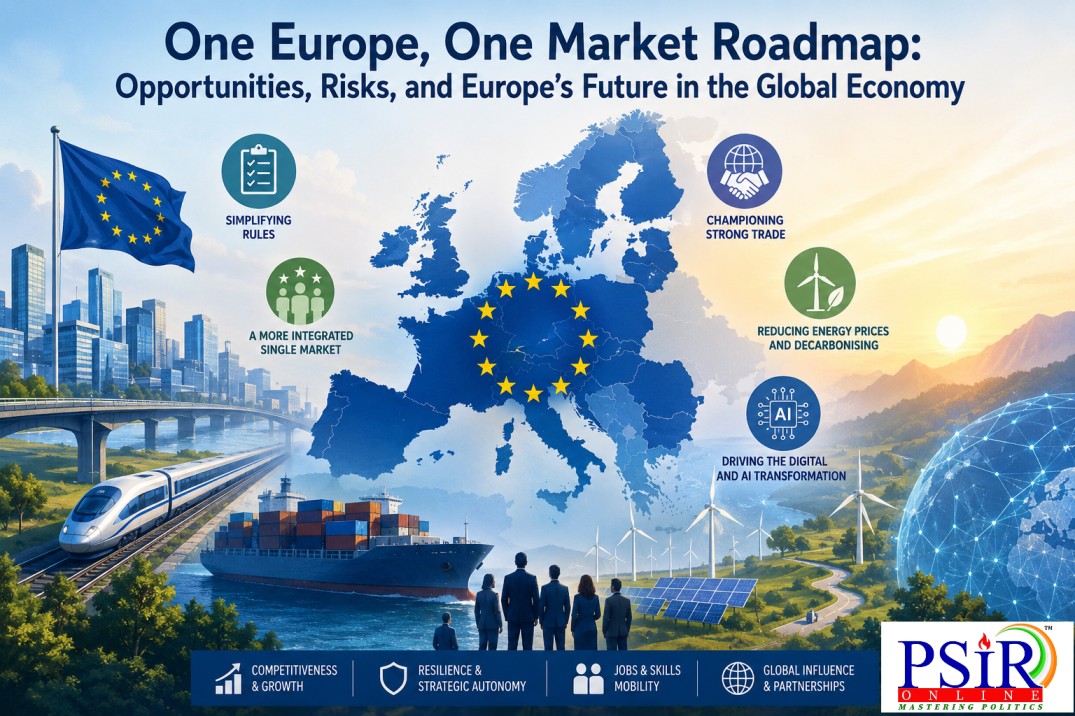
"One Europe, One Market" Roadmap is a joint political and operational commitment signed on 24 April 2026 by the Presidents of the European Parliament, Council of the EU, and European Commission.
It aims to strengthen the EU's Single Market, boost competitiveness, and enhance resilience amid geopolitical tensions, technological disruption, and economic uncertainty. The goal is decisive progress in 2026 and full achievement by the end of 2027 at the latest.
BACKGROUND AND OBJECTIVES
EU leaders endorsed the broader "One Europe, One Market" agenda at the European Council in March 2026. The roadmap translates this into concrete actions with timelines.
It builds on three mutually reinforcing pillars:
· A stronger, fairer, and more integrated Single Market.
· A trade policy that diversifies partnerships and reduces dependencies.
· An industrial policy that supports production, innovation, and competition (while respecting social rights and ensuring a just transition).
The initiative addresses the EU's competitiveness gap with the US and China, reduces fragmentation across 27 member states, simplifies rules, and promotes growth, innovation, and strategic autonomy.
Five Strategic Building Blocks
The roadmap organizes actions around these five areas, each with specific legislative and policy initiatives plus target dates for proposals and agreements:
1. Simplifying Rules Focus: Reduce administrative burdens and regulatory complexity without lowering standards (e.g., health, safety, environment). Key actions: Omnibus packages for simplification (across general rules, digital/AI, taxation, and energy); favoring regulations over directives; sunset clauses; limiting gold-plating by member states.
2. More Integrated Single Market (including removing the "ten most harmful barriers" or "Terrible Ten") Focus: Eliminate barriers to cross-border operations, especially for SMEs and startups. Key actions: "EU Inc." for easier scaling; public procurement reforms; critical raw materials center; circular economy rules; labor mobility and skills portability; banking and financial integration measures.
3. Championing Strong Trade Focus: Diversify partnerships and counter unfair practices. Key actions: Finalizing and implementing trade deals (e.g., with Mexico, Mercosur, India, Australia, Indo-Pacific/Gulf countries); revised FDI screening; addressing supply chain dependencies.
4. Reducing Energy Prices and Decarbonising Focus: Affordable, secure, and green energy. Key actions: European Grids package and Energy Highways; ETS review; energy efficiency and renewable frameworks; governance of the Energy Union.
5. Driving the Digital and AI Transformation Focus: Technological sovereignty and innovation. Key actions: Digital Euro; European Business Wallet; Digital Networks Act; Cloud and AI Development Act; Chips Act 2; Quantum Act; AI Gigafactories; Cybersecurity Act.
CURRENT STATUS
It is one market on paper, but many fragmented markets in reality.
· The EU has one official Single Market (since 1993), but it is not fully unified.
· There are still 27 different national markets in practice.
· Every country controls and regulates its own market separately in many areas.
· Goods move relatively freely, but services, capital, digital, and labour face many barriers.
· National rules, bureaucracy, and "gold-plating" (extra national requirements) create fragmentation.
· Companies often have to follow 27 different sets of rules to operate across the EU.
· This makes it hard for businesses (especially SMEs) to expand across Europe.
IMPACT OF “ONE EUROPE ONE MARKET” IN EUROPEAN ECONOMY
The "One Europe, One Market" Roadmap (signed 24 April 2026) is a high-ambition, time-bound plan to complete and deepen the EU Single Market by end-2027. It directly targets trade and market dynamics through barrier removal, rule simplification, new trade agreements, energy cost reduction, and digital/AI acceleration. Below is a balanced assessment of its likely positive and negative impacts on intra-EU markets, external trade, and overall economic performance. These are based on the roadmap's stated goals, early analyses, and historical context of similar EU initiatives. Full effects will depend heavily on actual implementation.
Positive Impacts
The roadmap is designed to unlock the Single Market's full potential — currently fragmented into 27 national markets — and position the EU as a more competitive global player.
1. Deeper Internal Market Integration and Cost Reduction
a. Removing the "Terrible Ten" most harmful barriers (e.g., regulatory red tape, fragmented standards, tax/discriminatory procurement issues, services hurdles) will significantly lower non-tariff barriers to intra-EU trade.
b. Businesses (especially SMEs and startups) gain easier scaling via "EU Inc.", better public procurement access, labor/skills mobility, and financial/capital markets integration.
c. Expected outcomes: Higher intra-EU trade volumes (historical studies suggest 4–14% gains from deeper goods/services integration), lower operating costs, increased competition, innovation, and productivity. This could deliver measurable GDP and welfare gains (Single Market already adds ~3–4% to EU GDP; further completion could amplify this).
2. Stronger and More Diversified External Trade
a. "Championing strong trade" pillar accelerates finalization and implementation of deals with Mercosur, Mexico, India, Indonesia, Australia, Thailand, Malaysia, Gulf/Indo-Pacific partners, plus Switzerland.
b. Tools like revised FDI screening and supply-chain dependency measures reduce reliance on single countries (e.g., China).
c. Benefits: New export markets for EU goods/services, more resilient supply chains, protection against unfair practices, and better terms for EU exporters. This diversifies trade flows and mitigates geopolitical risks.
3. Energy and Digital Transformation Boost
a. Affordable, secure energy (via grids, Energy Highways, ETS review) lowers production costs for energy-intensive industries.
b. Digital/AI acts (Cloud & AI Development Act, Chips Act 2, Digital Networks Act, etc.) create new high-value tradeable sectors and technological sovereignty.
c. Overall effect: Enhanced industrial competitiveness, attraction of investment, and stronger export performance in green and digital technologies.
Net macroeconomic upside: Officials and analysts expect higher growth, investment, productivity, and resilience to global shocks. Retailers, business groups, and competitiveness-focused voices see it as a long-overdue alignment of agendas.
Negative Impacts and Risks
Critics highlight implementation gaps, potential trade-offs, and historical precedents where similar plans delivered limited results.
1. Implementation and Enforcement Challenges
a. Extremely tight timeline (decisive progress in 2026, full delivery by end-2027) with 42 specific actions. Past Single Market efforts have repeatedly failed due to member-state resistance, weak enforcement, and "gold-plating" of rules.
b. Risk of a "roadmap to nowhere" or multi-speed/two-speed Europe if enhanced cooperation is used (some countries advance while others lag), deepening rather than eliminating fragmentation.
c. Early feedback noted a rushed process, stripped ambitions, and diplomatic annoyance — raising doubts about real political ownership.
2. Short-Term Costs and Transition Burdens
a. Regulatory changes, green/digital compliance, and new infrastructure require upfront investment — potentially raising costs for businesses (especially SMEs) in the next 1–2 years.
b. Decarbonization and energy reforms could cause temporary price volatility or sector-specific adjustment pains before benefits materialize.
c. Simplification efforts risk uneven rollout or insufficient depth if they clash with existing high standards (environment, safety, labor).
3. Trade-Offs in External Trade and Competition
a. New FTAs (e.g., Mercosur) may hurt sensitive domestic sectors (agriculture, certain manufacturing) through increased competition and imports.
b. More assertive tools (FDI screening, supply-chain rules, industrial policy) could be perceived as protectionist, triggering retaliation from trading partners (US, China) and raising global trade tensions.
c. Merger/competition policy shifts toward "resilience" raise concerns about reduced competition, fewer players, higher prices for consumers, and "resilience-washing" of anti-competitive deals.
4. Uneven Distribution of Benefits
a. Larger, more competitive firms and core EU economies may capture most gains; peripheral regions or smaller players could lag.
b. Services, taxation, and certain labor rules remain politically sensitive and hard to fully harmonize.
c. Non-EU exporters may face a more unified but potentially stricter internal market (higher barriers in practice due to enforcement).
IMPACT OF “ONE EUROPE ONE MARKET” IN WORLD ECONOMY
In the shorter run, it is unlikely to fundamentally change the world economic outlook in the near term (2026–2027), but it could provide a modest positive tailwind for global growth and trade if successfully implemented.
But in the longer run, that is, in the longer run (2030–2040 and beyond), successful implementation of the "One Europe, One Market" Roadmap could meaningfully improve the EU's economic trajectory and exert a modest but positive influence on the global economic outlook. It would not dramatically reshape the world economy on its own, but it could help slow or partially reverse Europe's relative decline, strengthen multipolarity, and support higher global growth and resilience.
Long-Term Potential for the EU
The roadmap targets deeper Single Market integration (removing barriers, especially in services, capital markets, energy, and digital), rule simplification, energy cost reduction, and accelerated digital/AI transformation. Historical and modeling studies suggest substantial cumulative gains:
· GDP and Productivity Boost: Completing remaining Single Market elements could add 0.8–2%+ to EU GDP annually in ambitious scenarios, with cumulative effects compounding over time. Broader estimates (including services, capital markets, and digital) range from 1–2% (modest) to 5–9% higher GDP levels in the long term compared to a fragmented baseline. IMF analysis indicates that closing structural gaps with the US in labor/product markets could raise European productivity by ~20%, with output per person potentially 35% higher over a decade.
· Key Drivers: Lower costs for businesses (especially SMEs), better capital allocation, innovation spillovers from AI/digital rules, cheaper/secure energy, and scale for green/tech sectors.
· Broader Benefits: Higher investment, job creation (millions in digital/research), stronger resilience to shocks, and better ability to finance defense, green transition, and social needs.
Without this, baseline projections show the EU growing slowly (~1–1.5% annually), with its global GDP share continuing to shrink (e.g., IMF estimates around 13% by 2030, down from higher historical levels, vs. rising shares for China and stable US influence).
Impacts on the World Economic Outlook
· Global Growth Tailwind: A stronger EU (15–16% of world GDP) would increase demand for imports from Asia, Latin America, Africa, and the US, boost exports of high-value goods/services (green tech, pharma, machinery), and support supply chain stability. This could add a small uplift to global GDP growth (perhaps 0.1–0.3 percentage points annually over the 2030s in optimistic scenarios) via trade and productivity spillovers.
· Trade and Standards: New FTAs and a unified market would reshape flows (e.g., more Mercosur/Indo-Pacific integration) and potentially make EU standards more globally influential in digital, green, and AI rules — benefiting compliant exporters while challenging others.
· Geopolitical and Resilience Effects: A more competitive, autonomous EU acts as a stronger pole in a multipolar world, potentially stabilizing global trade rules, reducing fragmentation risks, and countering over-dominance by US/China blocs. This supports a more balanced (and possibly higher-growth) global economy less prone to extreme shocks.
· Innovation and Technology: Success in AI, chips, quantum, and green tech could accelerate global technological progress and diffusion.
Limitations and Risks (Longer Run):
· Implementation is Key: Many past Single Market initiatives under-delivered due to national resistance. If the roadmap achieves only partial success, gains shrink significantly.
· Relative vs. Absolute: Even with success, the EU is projected to remain the third-largest economy behind China and the US. Global growth will still be driven mainly by emerging Asia and tech/AI productivity worldwide.
· Potential Downsides: Protectionist elements or retaliation could increase global trade fragmentation (IMF estimates fragmentation already costs ~7% global GDP in extreme cases). Uneven benefits within Europe could fuel internal tensions.
· External Factors Dominate: US policy, China’s trajectory, AI breakthroughs, demographics, and climate/energy shocks will have larger effects on the world outlook.
Yes, in the longer run, this could positively alter Europe's place in the world economic outlook — making the EU a more dynamic, resilient player rather than a slow-growth laggard. This would provide a supportive (not transformative) boost to global growth, trade, and stability into the 2030s–2040s. The difference between success and failure is large: full delivery helps close competitiveness gaps with the US/China; failure reinforces decline narratives.
POTENTIAL OF “ONE EUROPE ONE MARKET” IN MAKING EUROPEAN UNION AS AN ALTERNATIVE TO USA IN WORLD POWER POLITICS
The "One Europe, One Market" Roadmap alone might not make the EU a full alternative to the USA in world power politics in the longer run (2030–2040+). It will, however, meaningfully strengthen the EU’s strategic autonomy and economic leverage, helping it become a more independent and influential pole in a multipolar world — rather than a rival superpower replacing the US.
Why It Strengthens the EU (Positive Trajectory)
The roadmap explicitly frames deeper Single Market integration as a tool for strategic autonomy, economic security, and global influence amid geopolitical rivalry with the US and China.
· Economic and Technological Foundation: Successful delivery (by ~2027–2030) could add 0.8–2%+ to annual EU GDP in the long term through barrier removal, capital markets union, energy cost cuts, and AI/digital leadership. This compounds into greater investment capacity, innovation, and resilience.
· Reduced Dependencies: New trade deals, supply-chain diversification, and industrial policy measures lower reliance on US/Chinese tech, energy, and critical inputs. This gives the EU more room to set its own standards (digital, green, regulatory) and wield “soft power” through market access and norms.
· Geopolitical Spillover: A more competitive EU can better fund dual-use technologies, green transition, and global partnerships (especially with the Global South). Think tanks describe this as building the structural conditions for Europe to act more sovereignly in trade, climate, and tech governance.
In a best-case scenario with strong follow-through (and parallel progress on defense via the separate Defence Readiness Roadmap 2030), the EU becomes a credible third pole — offering an alternative model of multilateral, rules-based, socially oriented power. This is already visible in how the roadmap is presented: “not just economic policy — it’s about strategic autonomy and Europe’s global influence.”
Why It Falls Short of Being a True “Alternative” to the USA
World power politics requires hard power (military projection, alliances), unified foreign policy, and global leadership capacity — areas where the roadmap has limited direct impact:
· Hard Power Gap Persists: The EU remains heavily dependent on the US for defense (≈60% of European military equipment is US-sourced) and NATO security guarantees. The roadmap is purely economic; defense autonomy is handled in separate initiatives that are advancing but still face fragmentation and funding hurdles. Without a true European Defence Union or fiscal capacity (e.g., Eurobonds for military spending), the EU cannot project power independently at the scale of the US.
· Political and Structural Limits: Even with economic gains, the EU’s 27-member structure creates persistent fragmentation (risk of “multi-speed” or “three-speeds” Europe). Long-term GDP projections show the EU’s global share continuing to shrink (to ~13% by 2030 and beyond) while the US and China maintain or grow relative weight. Demographics, innovation gaps in frontier tech, and slower productivity growth further constrain catch-up.
· Alliance vs. Rivalry Dynamic: Official EU rhetoric and analyses emphasize becoming less dependent on the US while staying a close partner — not replacing America. Transatlantic tensions (trade, tech, security) may rise, but the roadmap is designed for resilience within the Western alliance, not against it.
Bottom Line for the Longer Run
· Modest but real upgrade: By the 2030s–2040s, a successfully implemented roadmap makes the EU more autonomous and influential — better able to hedge risks, shape global rules, and act independently when US and EU interests diverge (e.g., on China policy, climate, or digital regulation). It slows Europe’s relative decline and enhances its weight in multipolar politics.
· Not a superpower shift: It does not turn the EU into an alternative to the USA in the sense of rival global hegemon or military peer. The US will likely retain dominance in hard power, dollar-based finance, and cutting-edge tech leadership. The EU’s strength lies in its regulatory and normative influence, not replacing American power projection.
Success depends on execution, political unity, and complementary reforms (defense, fiscal, foreign policy). Without them, the roadmap’s geopolitical payoff remains limited. In short: it equips Europe to stand taller on its own feet — but still side-by-side with, not instead of, the United States.
PRACTICE QUESTIONS FOR GS 2 MAINS
1. The “One Europe, One Market” Roadmap seeks to deepen the European Union’s Single Market integration and strategic autonomy. Discuss its implications for global trade, multilateralism, and India–EU relations.
2. “Economic integration without political cohesion produces structural contradictions.” Examine this statement in the context of the European Union’s “One Europe, One Market” initiative.
3. Critically analyse how the European Union’s efforts toward digital sovereignty, energy security, and supply-chain resilience reflect changing trends in contemporary global governance.
4. The European Union increasingly seeks to emerge as an autonomous pole in world politics. Evaluate the extent to which the “One Europe, One Market” Roadmap can strengthen Europe’s geopolitical role in a multipolar world order.
PRACTICE QUESTIONS FOR PSIR OPTIONAL
1. “Regional economic integration can evolve into strategic and geopolitical influence.” Discuss this proposition with reference to the European Union’s “One Europe, One Market” Roadmap.
2. Examine the “One Europe, One Market” initiative through the lens of Neo-functionalism and Intergovernmentalism. Which theory better explains the future trajectory of European integration?
3. Critically evaluate whether the European Union’s pursuit of strategic autonomy represents a challenge to Atlanticism and the existing transatlantic order.
4. The European Union is often described as a “normative power” rather than a traditional military power. Analyse this statement in the context of the EU’s digital, trade, and regulatory policies under the “One Europe, One Market” framework.