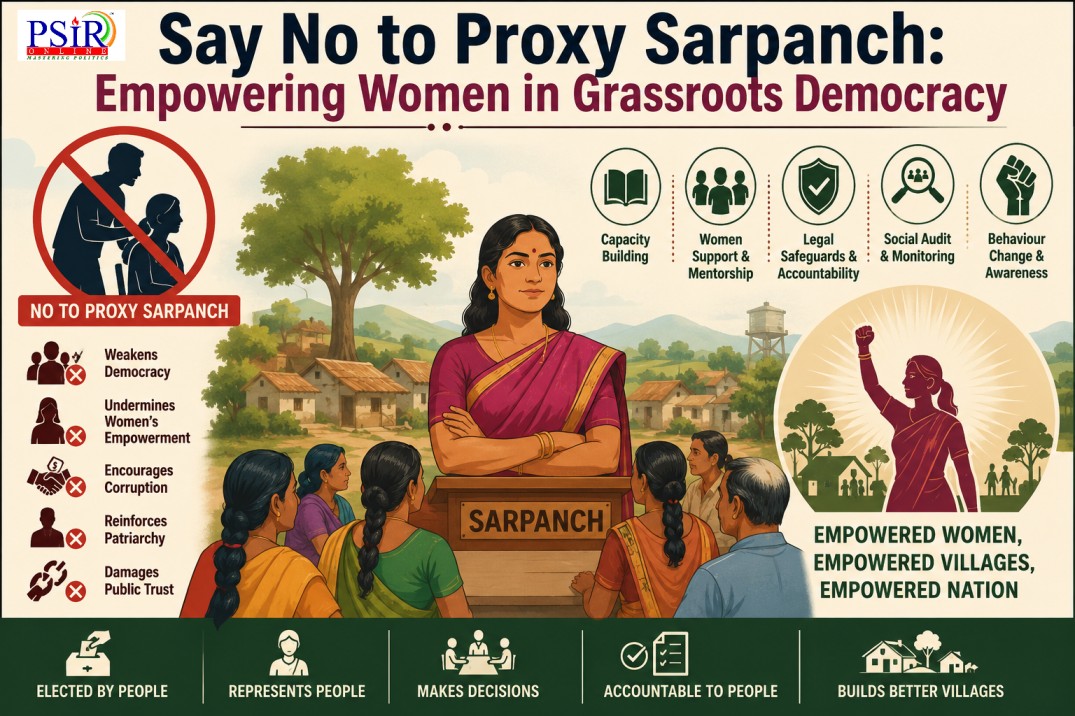
The launch of the “Say No to Proxy Sarpanch” campaign by the Ministry of Panchayati Raj on 8 March 2026, International Women’s Day, is more than a symbolic communication exercise. It is a reminder that democratic inclusion is not complete unless elected women representatives in Panchayati Raj Institutions can exercise real authority, make decisions independently, and be held accountable for those decisions.
The campaign, which runs until 18 March 2026, directly challenges the entrenched practice of proxy governance in villages, where male relatives often act in place of elected women representatives.
MEANING OF PROXY SARPANCH
The phrase “proxy sarpanch” refers to a situation in which a woman is elected to a panchayat office, but her husband, father-in-law, brother, or another male relative effectively controls the office. This is popularly described as the “Sarpanch Pati,” “Pradhan Pati,” or “Mukhiya Pati” culture, depending on the region.
In such cases, the formal vote of the people remains intact, but the real authority shifts away from the elected woman to an unelected male proxy. That creates a gap between constitutional representation and actual governance.
CONSTITUTIONAL BASE
The issue must be understood in the context of the 73rd Constitutional Amendment Act, 1992, which gave constitutional status to Panchayati Raj Institutions and introduced a three-tier structure of rural local self-government.
Article 243D provides for reservation of seats for Scheduled Castes, Scheduled Tribes, and women in panchayats, with not less than one-third reservation for women in directly elected seats and chairperson posts.
Several states have gone beyond this minimum and provided 50% reservation for women in their respective Panchayati Raj laws.
The real challenge, therefore, is not merely numerical representation but substantive empowerment.
WHY PROXY GOVERNANCE PERSISTS
Proxy representation survives because social norms still treat public authority as male territory in many rural settings. Even where women are elected, they may face low literacy, limited mobility, family pressure, or lack of confidence to assert themselves in public institutions.
Patriarchal structures, informal control over finances, and dependence on male family members can make the elected woman a ceremonial presence rather than a decision-maker.
In many cases, this problem is reinforced by local political networks that prefer to negotiate with men who are not formally accountable to law or voters.
DISADVANTAGES OF PROXY SARPANCH
Proxy sarpanch weakens democracy, reduces women’s real power, and harms local governance. It turns an elected woman representative into a figurehead while an unelected relative makes the decisions.
Main disadvantages
· Erodes democratic accountability because the person using power is not the one voters elected.
· Undermines women’s empowerment by denying elected women real authority and political experience.
· Weakens grassroots governance because decisions are filtered through family control instead of public responsibility.
· Encourages corruption or informal influence, since unelected proxies operate outside formal scrutiny.
· Reduces administrative efficiency when the elected representative lacks confidence, training, or access to information.
· Reinforces patriarchy by normalizing the idea that women can hold office only in name.
· Damages public trust in panchayats because citizens cannot clearly identify who is accountable.
· Prevents the emergence of future women leaders by blocking independent leadership development at the village level.
SUPREME COURT INTERVENTION
Acting on the issue of women pradhans being represented by male relatives, the Ministry of Panchayati Raj constituted an Advisory Committee in September 2023 on the direction of the Supreme Court.
The committee submitted its report in February 2025, and the Government accepted its recommendations.
The broader judicial background matters because the Supreme Court has recognized that women’s participation in political life is an evolutionary process, even while acknowledging the reality of proxy practices in some cases.
THE ADVISORY COMMITTEE REPORT
The committee proposed a multi-pronged strategy to reduce proxy leadership in PRIs. These measures include legal safeguards, capacity building, women ombudspersons, public oath-taking by elected representatives, mentorship by women leaders, social audits, and penal provisions for proven cases of proxy control.
Its logic is simple: if proxy governance is sustained by weak enforcement and social tolerance, then reform must combine law, training, monitoring, and behavioural change.
The Ministry later constituted a Task Force on 17 April 2025 to facilitate practical implementation of these recommendations.
ROLE OF CAPACITY BUILDING
One of the most promising responses to proxy representation is training women representatives to become institutionally confident and administratively capable.
The Ministry has already been working under the Revamped Rashtriya Gram Swaraj Abhiyan (RGSA) and the Sashakt Panchayat-Netri Abhiyan, launched on 4 March 2025, to strengthen leadership and governance skills among Women Elected Representatives.
By the end of 2025–26, the Ministry reported training 7,18,434 WERs, while 1,21,512 representatives, including master trainers, were capacitated through the module “Championing Change: Empowering Women Leaders in Local Governance and Beyond”.
THE CAMPAIGN’S IMMEDIATE PURPOSE
The “Say No to Proxy Sarpanch” campaign is primarily an awareness and behavioural-change initiative. It uses social media and public messaging to draw attention to proxy participation and encourage citizens to respect the elected authority of women representatives.
It also seeks to normalize the idea that women are not symbolic beneficiaries of reservation but legitimate political leaders.
In that sense, the campaign is as much about changing mindsets as it is about changing institutions.
Link with Model Panchayats
The campaign gains depth when read alongside the Government’s wider work on women-friendly local governance. The Ministry has identified 744 Model Women-Friendly Gram Panchayats across 32 States and Union Territories, with dashboards tracking indicators such as governance participation, health and nutrition, education, economic opportunity, and safety.
These initiatives matter because representation becomes meaningful only when women can influence priorities, budgets, and delivery systems.
A panchayat that responds to women’s needs in sanitation, drinking water, health, school access, and livelihoods is more likely to reflect democratic inclusion in practice.
WHAT MORE IS NEEDED
The strongest response would combine law, training, and monitoring. Legal provisions against proxy interference should be backed by complaint mechanisms, social audits, and local accountability structures.
Women representatives also need mentoring, peer networks, and institutional support so that they can resist pressure from family or local elites.
The state-level dimension is crucial because local government is a State subject, and panchayat administration depends heavily on state legislation and enforcement.
CONCLUSION
The “Say No to Proxy Sarpanch” campaign is a timely intervention in India’s democratic decentralisation journey. It highlights the fact that political reservation is necessary but not sufficient for women’s empowerment.
For grassroots democracy to be meaningful, elected women must become genuine decision-makers, not placeholders for male authority.
The campaign, together with capacity-building programmes and institutional reforms, can help transform panchayats from sites of symbolic inclusion into arenas of real gendered power.
PRACTICE QUESTIONS FOR GS 2 MAINS
1. The “Say No to Proxy Sarpanch” campaign highlights the gap between constitutional representation and substantive empowerment of women in local governance. Examine.
2. Despite constitutional reservations under the 73rd Constitutional Amendment, proxy governance continues to persist in Panchayati Raj Institutions. Analyse the structural and social factors responsible for this phenomenon.
3. Discuss the role of capacity building and behavioural change initiatives in strengthening women’s leadership in grassroots democracy.
4. “Political reservation alone cannot ensure democratic empowerment.” Evaluate this statement in the context of women’s participation in Panchayati Raj Institutions.
PRACTICE QUESTIONS FOR PSIR OPTIONAL
1. Examine the relationship between democratic decentralisation and gender justice in India with special reference to Panchayati Raj Institutions.
2. “Numerical representation without substantive participation weakens democratic legitimacy.” Critically analyse in the context of women’s political participation in India.
3. Discuss how patriarchal social structures affect the functioning of local self-government institutions in India.
4. Analyse the significance of the 73rd Constitutional Amendment in deepening participatory democracy in India. Has it succeeded in creating autonomous grassroots leadership among women?