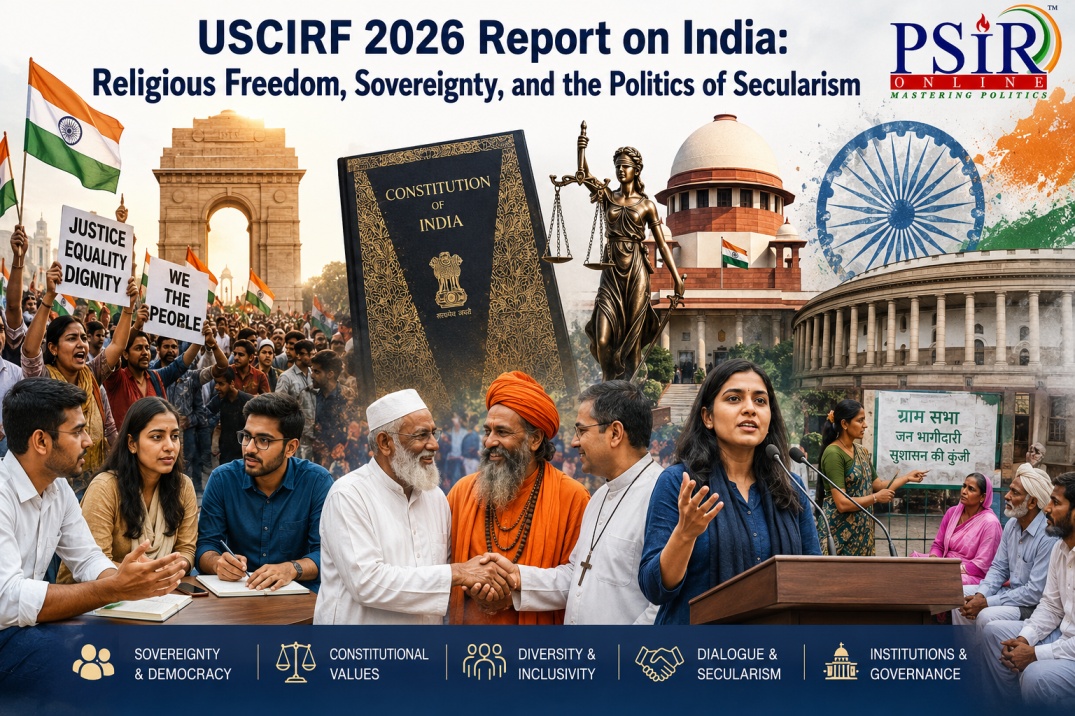
The United States Commission on International Religious Freedom (USCIRF) 2026 Annual Report has once again placed India under the “Country of Particular Concern” category for religious freedom, marking the seventh consecutive year it recommends Washington to designate New Delhi as a CPC for “systematic, ongoing, and egregious” violations of religious freedom. For students of Indian Politics and Public Policy, the report is not merely a foreign‑governmental comment; it is a political document that reflects a specific ideological and geopolitical framing of India’s polity and secularism. lets engage with the substantive claims of USCIRF, the Indian state’s rebuttal, and the constitutional and institutional reality of religious freedom in India, without slipping into either apologetics or uncritical endorsement of the report.
WHAT THE USCIRF 2026 REPORT SAYS ON INDIA
For the 2025 calendar year, USCIRF portrays India’s religious‑freedom situation as deteriorating, and recommends:
· Designation of India as a “Country of Particular Concern” under the International Religious Freedom Act (IRFA‑1998).
· Targeted sanctions (asset freezes and entry bans) against individuals and entities, including the Rashtriya Swayamsevak Sangh (RSS) and Research and Analysis Wing (R&AW), for alleged tolerance of severe violations.
· Linking U.S. security assistance and bilateral trade with India to concrete improvements in religious‑freedom indicators.
· Passage of a Transnational Repression Reporting Act to monitor Indian government actions against religious minorities abroad.
Core allegations in the India chapter (2026) include:
· New or tightened laws allegedly targeting minorities, such as:
o Citizenship‑related laws and procedures (CAA‑plus‑NRC‑like mechanisms).
o Anti‑conversion laws in over a dozen states, with harsher penalties and expanded definitions of “inducement”.
o Cow‑slaughter legislation and related enforcement, often invoked in majoritarian assaults.
· State toleration and even facilitation of:
o Vigilante attacks by Hindu‑nationalist groups on Muslims and Christians.
o Harassment and detention of religious minorities, including Rohingya refugees and Bengali‑speaking Muslims from Assam.
· Co‑option or control of religious institutions, such as:
o Efforts to bring madrasas and minority‑education bodies under stricter state control (e.g., Uttarakhand’s education‑board reforms).
o Amendments to Waqf property management, allowing non‑Muslims into governing boards.
· Land and property disputes where majority‑community groups claim religious sites (e.g., disputes around Sufi shrines, mosques, or tombs) and tensions over heritage sites such as the Aurangzeb tomb.
In sum, USCIRF presents India as a majoritarian‑democratic state that is drifting away from liberal secularism, with the executive and legislature at national and state levels either directly enacting discriminatory laws or turning a blind eye to vigilante majoritarianism.
INDIAN STATE’S RESPONSE: SOVEREIGNTY, BIAS, AND DIPLOMACY
The Ministry of External Affairs (MEA) and the BJP‑led Union Government have consistently rejected USCIRF reports as “motivated,” “biased,” and “politically coloured”, with the 2026 version being no exception.
Key government counter‑arguments:
· Interpretation of secularism:
o The Indian state insists that India follows “positive secularism”—state support for all religions, neutrality among them, and protection of minority rights—distinct from Western secularism that often stresses separation of religion and state.
· Domestic legal and constitutional safeguards:
o The government highlights Articles 25–28 of the Constitution (freedom of conscience, free profession, practice and propagation of religion, religious denominational rights, and freedom from religious instruction in state institutions).
o It also points to judicial decisions that have struck down arbitrary property seizures, protected minority educational institutions, and invalidated discriminatory practices.
· Law‑and‑order as a domestic matter:
o New Delhi asserts that communal violence, mob attacks, and local law‑and‑order issues are internal matters, and that foreign commissions should not treat isolated incidents as systemic indicators.
· Selective targeting of India:
o Officials argue that USCIRF is inconsistent in its focus, often singling out India and other democracies while being relatively muted on religious‑freedom crises in certain autocratic states with which the U.S. has strategic interests.
· Geopolitical motive:
o Sections of the Indian establishment view USCIRF as a tool of U.S. domestic politics, reflecting the concerns of specific evangelical and minority‑rights lobbies rather than a neutral, objective assessment.
In diplomatic terms, the Indian response is a calibrated, assertive resistance: it does not deny the existence of communal tensions or isolated incidents of violence, but it rejects the systemic framing and the policy recommendations (especially sanctions). This stance is crucial for PSIR students because it reflects India’s evolving posture on sovereignty, human‑rights sovereignty, and hedging against Western‑centred norm‑setting.
CONSTITUTIONAL AND INSTITUTIONAL FRAMEWORK: INDIA’S FORMAL REGIME OF RELIGIOUS FREEDOM
Before evaluating USCIRF’s claims, it is essential to outline the constitutional architecture that theoretically governs religious freedom in India.
Core Constitutional Provisions
· Article 25:
o Guarantees freedom of conscience and free profession, practice and propagation of religion, subject to public order, morality, health, and other fundamental rights.
· Article 26:
o Grants religious denominations the right to manage their own religious affairs, including property and institutions.
· Article 27:
o Prohibits taxation for promotion or maintenance of any particular religion.
· Article 28:
o Regulates religious instruction in state‑funded or recognized educational institutions.
These provisions are supplemented by:
· Article 15: Prohibition of discrimination on grounds of religion (among others).
· Article 16: Equal opportunity in public employment.
· Article 29–30: Protection of minority language and cultural rights, and minority educational institutions.
Supreme Court and Secularism
The judiciary has repeatedly affirmed that secularism is part of the basic structure of the Constitution (e.g., S.R. Bommai v. Union of India, 2015 Puttaswamy privacy judgment mentioning secularism). The Court has:
· Struck down majoritarian attempts to communalize education.
· Protected minority institutions’ rights to administer their endowments.
· Emphasized that state neutrality does not mean indifference to minorities but positive protection against discrimination.
Formally, therefore, India’s legal architecture is robust and pluralistic. Problem‑solving must hence move from law‑on‑paper to law‑in‑practice, and from high‑court doctrine to ground‑level socio‑legal reality.
EVIDENCE OF DETERIORATION: USCIRF’S CLAIMS AND GROUND‑LEVEL INDICATORS
From a balanced analysis, the USCIRF report must be treated as a primary source of claims, to be cross‑checked against Indian data, civil‑society reports, and media‑based documentation. The following indicators are often cited in the literature:
1. Legislative Trends and Statutory Frameworks
· Anti‑conversion laws in 13–14 states, including recent amendments with longer prison terms, higher fines, and expanded definitions of “forced/induced” conversions—often framed as curbing “love jihad” or “mass conversions”.
· Cow‑protection and cow‑slaughter laws used in mob‑violence cases, where lower courts sometimes delay relief or acquit accused despite prima‑facie evidence.
· Citizenship and NRC‑related anxieties:
o The Citizenship Amendment Act (CAA), while excluding Muslims, is presented as discriminatory by USCIRF, though the Indian state argues it is meant to protect persecuted co‑ethnics from neighbouring countries.
o Fears of statelessness for Bengali‑speaking Muslims in Assam, even when they are Indian citizens, have been documented by Indian civil‑rights groups.
These developments suggest a tightening of the legal envelope around minority identity and religious practice, which USCIRF interprets as a “downward trajectory” of religious liberty.
2. Vigilante Violence and Impunity
Reports from USCIRF, Indian NGOs, and international monitors repeatedly highlight:
· Mob lynching and attacks on Muslims and Christians, often justified by cow‑protection or “conversion” narratives, with low conviction rates.
· Police inaction or delayed FIR registration in cases involving majoritarian groups.
· Selective investigation where minorities are scrutinized more stringently than majoritarian perpetrators.
Such patterns feed into USCIRF’s narrative that state authorities tolerate majoritarian excesses, even if they occasionally prosecute some actors.
3. Control Over Religious Institutions and Properties
· Waqf property reforms that allow non‑Muslims into management boards, raising minority fears of encroachment.
· State oversight of madrasas and minority educational bodies (e.g., Uttarakhand’s USAME Act), which proponents defend as quality and regulation measures, while critics see them as hegemonic control over minority spaces.
· Refusal to entertain minority claims to certain religious sites, while facilitating majority‑community claims via executive policy or judicial referrals (e.g., disputes around Ayodhya, Gyan‑Vapi, Mathura Shahi Idgah).
These cases are central to PSIR analysis of state–religion–identity politics, where the apparatus of governance is deployed to re‑order symbolic capital among religious communities.
4. Refugees, Migrants, and “Illegal Foreigners”
· Detention and expulsion of Rohingya and other Muslim refugees, often justified on national‑security and citizenship grounds.
· Deportation of Bengali‑speaking Muslims from Assam, despite Supreme Court and High Court orders cautioning against arbitrary eviction.
· Use of “foreigner detention camps”, long‑term detention without due process, and denial of bail on grounds of alleged terrorism or foreign links.
COUNTER‑EVIDENCE AND NUANCES: INDIA’S PLURALISTIC REALITY
Before coming to a conclusion, several counter‑arguments and empirical nuances must be weighed:
· India remains a multi‑party, competitive democracy with:
o Free elections at national and state levels.
o Vibrant civil society, including minority‑led organizations, lawyers, and journalists.
o High‑profile minority representation in legislatures, judiciary, bureaucracy, and corporate leadership.
· Judicial pushback:
o Courts have struck down arbitrary Waqf reforms, stayed some anti‑conversion amendments, and directed protection of minority rights.
o The Supreme Court has repeatedly upheld secularism and minority educational rights.
· Variation across states:
o States like Kerala, Tamil Nadu, and Karnataka show different patterns of religious co‑existence and minority protection compared with Uttar Pradesh, Bihar, or Assam, where identity politics is more salient.
· Majority communities also face localized violence:
o In some regions, Hindus in border areas or minority communities in the Northeast also suffer from violence, though the scale and narrative differ.
· International context:
o Several Western democracies have faced religious‑freedom controversies (e.g., burqa bans, mosque‑construction bans) yet are not consistently labelled CPCs, which raises questions about selective application of USCIRF standards.
Thus, while communal tension and discrimination exist, India’s institutional resilience, democratic alternation of power, and judicial activism complicate the picture drawn by USCIRF.
THEORETICAL AND CONCEPTUAL ISSUES FOR PSIR OPTIONAL
From a PSIR lens, the USCIRF 2026 report invites reflection on several key themes:
1. Secularism: Liberal vs. Positive Models
· Western secularism often emphasizes state neutrality and separation.
· Indian secularism is “positive”—state support and protection of all religions, with extra safeguards for minorities.
· USCIRF implicitly applies a liberal‑secular standard, which may not fully capture the Indian constitutional imagination.
2. State, Society, and Vigilantism
· PSIR students must distinguish between:
o State‑sanctioned discrimination (e.g., discriminatory laws).
o Societal violence tolerated by the state.
· The Indian case is often of lax enforcement and selective justice, rather than systematic, top‑down persecution.
3. Sovereignty vs. International Norm‑Setting
· USCIRF recommendations (sanctions, conditionality) reflect norm‑policymaking by external actors.
· India’s rejection is part of a broader non‑Western resistance to “human‑rights as a tool of foreign policy”, especially from post‑colonial states wary of neo‑imperial tutelage.
4. Religion, Nationalism, and Identity Politics
· The USCIRF report reflects concerns about religious nationalism in India.
· PSIR students can situate this within global debates about right‑wing populism, majoritarian nationalism, and minority insecurity.
CONCLUSION
The USCIRF 2026 report on India reflects a deeper global debate over religious freedom, secularism, and democratic accountability in an era of rising identity politics. While several concerns raised in the report—such as communal polarization, vigilante violence, selective law enforcement, and the growing politicization of religious identity—deserve serious democratic introspection, the report’s broader characterization of India as systematically undermining religious freedom remains contested within India’s constitutional and political discourse. India continues to possess a robust constitutional framework guaranteeing religious liberty, an active judiciary, competitive electoral politics, and vibrant civil society institutions that continue to mediate and challenge excesses of state power.
At the same time, the Indian state’s rejection of external assessments also highlights the persistent tension between national sovereignty and international human-rights norm-setting. For PSIR students, the debate is therefore not merely about religious freedom alone, but about how democratic states negotiate pluralism, institutional legitimacy, nationalism, and global scrutiny in a rapidly changing political order. Ultimately, the strength of Indian democracy will depend not only on constitutional guarantees in theory, but also on the consistent and impartial protection of rights in practice.
PRACTISE QUESTIONS FOR PSIR OPTIONAL
1. “The debate surrounding the USCIRF 2026 report reflects the larger tension between international human-rights norm-setting and state sovereignty.” Critically examine in the context of India–US relations and contemporary global politics.
2. Discuss the constitutional foundations of religious freedom in India. To what extent do recent debates on anti-conversion laws, CAA, and minority rights challenge the idea of Indian secularism?
3. “The Indian model of secularism differs fundamentally from the Western liberal model.” Analyse this statement with reference to the USCIRF report and the Indian state’s response.
4. Examine the relationship between religious nationalism, vigilantism, and democratic legitimacy in contemporary India. How far do these developments affect India’s constitutional vision of pluralism?