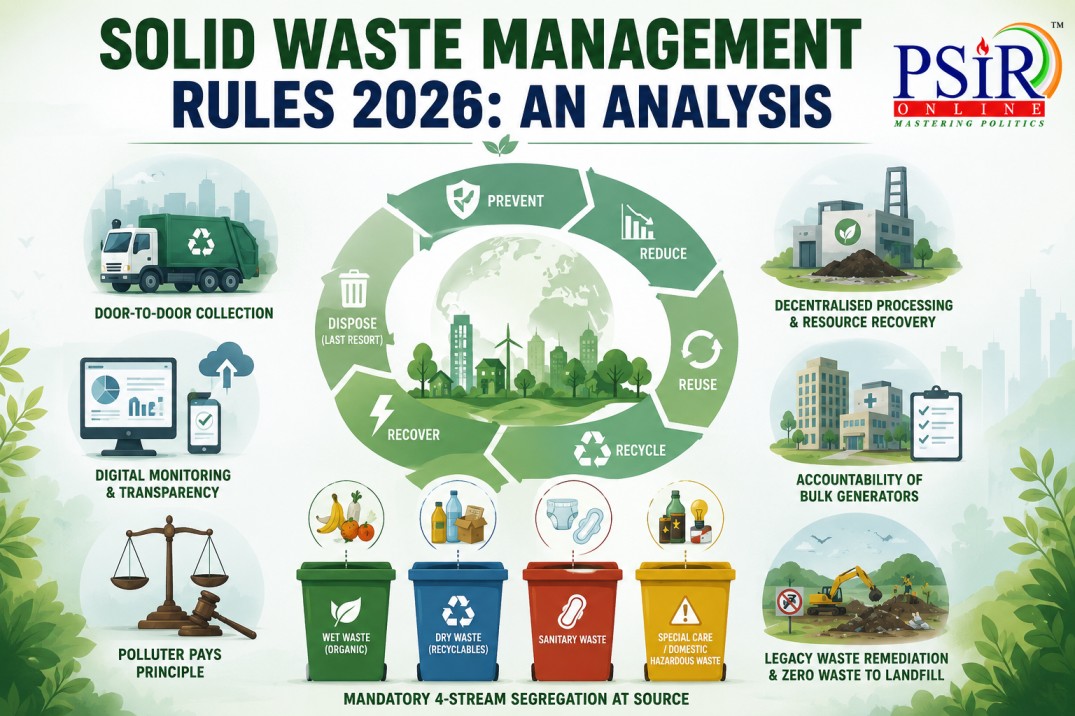
Solid Waste Management (SWM) Rules, 2026 are India's updated national framework for handling municipal solid waste. Notified by the Ministry of Environment, Forest and Climate Change (MoEFCC) on January 27/28, 2026 (via S.O. 388(E)), they supersede the SWM Rules, 2016 and come into full effect from April 1, 2026.
These rules apply across urban and rural local bodies, all waste generators (households, institutions, businesses), special zones (SEZs, ports, airports, railways, defence areas), and more. They emphasize a circular economy, source segregation, accountability (especially for bulk generators), digital tracking, reduced landfilling, and the "polluter pays" principle.
KEY OBJECTIVES
· Achieve zero waste to landfill (as much as possible) by prioritizing prevention, reduction, reuse, recycling, recovery, and only then disposal.
· Enforce source segregation and decentralized processing.
· Shift responsibility from solely local bodies to shared accountability (generators, local bodies, industries, etc.).
· Use technology for transparency via a central online portal.
· Remediate legacy dumpsites and minimize environmental harm.
MAJOR CHANGES FROM 2016 RULES

The 2026 rules are stricter, more enforceable, and detailed compared to the advisory tone of 2016.
|
Aspect |
SWM Rules 2016 |
SWM Rules 2026 |
|
Applicability |
Mainly urban local bodies |
Urban + rural; all generators, institutions, special areas |
|
Segregation |
3 streams (biodegradable, non-biodegradable, domestic hazardous) |
Mandatory 4 streams at source |
|
Waste Hierarchy |
Not explicitly detailed |
Prevention → Reduction → Reuse → Recycling → Recovery → Disposal |
|
Bulk Generators |
Recognized but limited enforcement |
Clear thresholds + Extended Bulk Waste Generator Responsibility (EBWGR) |
|
Monitoring |
Limited |
Centralized online portal for tracking, reporting, audits |
|
Landfilling |
Allowed with standards |
Restricted to true residuals/inerts; higher fees for mixed waste |
|
Penalties |
Limited |
Environmental compensation (polluter pays) |
|
Legacy Waste |
Addressed broadly |
Time-bound biomining/bioremediation with reporting |
Mandatory 4-stream segregation at source
This is the biggest practical change. Every waste generator (homes, offices, hotels, hospitals, etc.) must separate waste into:
· Wet waste (organics): Kitchen waste, vegetable/fruit peels, flowers, meat — process via composting or biomethanation.
· Dry waste (recyclables): Plastic, paper, metal, glass, wood, rubber — send to Material Recovery Facilities (MRFs) for sorting/recycling.
· Sanitary waste: Diapers, sanitary pads, tampons, condoms — wrap securely and handle separately.
· Special care / Domestic hazardous waste: Paints, bulbs, batteries, medicines, thermometers — deposit at authorized collection points.
Local bodies must provide door-to-door collection of segregated waste and set up supporting infrastructure (e.g., MRFs).
Bulk Waste Generators (BWGs) and Extended Responsibility
BWGs are clearly defined (e.g., buildings >20,000 m², water use >40,000 litres/day, or waste generation >100 kg/day). This includes large residential societies, commercial complexes, hospitals, universities, airports, government offices, etc.
· They must process wet waste onsite (as far as possible) or get an EBWGR certificate.
· Account for ~30% of urban waste — so big impact expected.
· Advance intimation for large events; user fees may apply.
Digital Governance and Enforcement
· Centralized online portal (by CPCB within 6 months) tracks waste from generation to disposal, registrations, audits, and legacy waste progress. Publicly accessible data.
· Annual reporting mandatory.
· Environmental compensation for violations (e.g., no segregation, false reporting, improper disposal) — levied by State Pollution Control Boards.
· Audits of processing facilities and landfills required.
· Higher landfill fees for unsegregated/mixed waste (more expensive than proper processing).
Landfilling, RDF, and Legacy Waste
· Landfills only for non-recyclable, non-recoverable, inert residuals. No wet waste or construction debris.
· Refuse Derived Fuel (RDF): Industries (cement plants, etc.) must gradually increase use of RDF from waste (target substitution up to 15% over time).
· Legacy dumpsites: Map by Oct 2026, time-bound biomining/bioremediation, quarterly reporting. Fresh dumping banned during remediation.
Special Provisions
· Hilly areas & islands: User fees on tourists, regulated inflows, decentralized processing.
· Rural areas: Roles for Gram/District Panchayats.
· Informal sector: Continued recognition of waste pickers, though integration details are limited.
· Carbon credits: Local bodies encouraged to generate them.
How this is different from old rules?
· Notable Shifts
· Responsibility: 2016 focused mainly on local bodies. 2026 shares accountability across waste generators, bulk generators, producers, and local bodies.
· Approach: From "collection and disposal" mindset → Resource recovery and zero waste to landfill focus.
· Sanitary & Hazardous Waste: Weakly handled earlier → Now separate dedicated streams with clear handling protocols.
· Informal Sector: Both recognize waste pickers, but 2026 emphasizes better integration via formal systems.
· Implementation Timeline: 2016 was phased but poorly enforced in many places. 2026 has stricter timelines, audits, and central oversight.
· Summary of Philosophy Change
· 2016: Introduced the concept of segregation and scientific management but remained largely advisory with implementation gaps.
· 2026: More prescriptive, enforceable, and technology-driven. It treats waste as a resource and uses economic disincentives (fines, higher fees) for non-compliance.
INTENDED CONSEQUENCES (POSITIVE OUTCOMES) OF SWM RULES 2026
The Solid Waste Management Rules, 2026 are designed to transform India's waste system from a "collect-and-dump" model into a resource-efficient, circular economy framework. The core goal is "Zero Waste to Landfill" (as much as practically possible), treating waste as a valuable resource rather than a burden.
Here are the main intended consequences:
1. Environmental Benefits
· Drastically reduce landfill use — Only true non-recyclable, inert residuals will go to landfills. This cuts methane emissions (a powerful greenhouse gas from decomposing organic waste), prevents soil and groundwater contamination from leachate, and reduces the need for new landfill sites.
· Lower pollution and health risks — Better segregation of sanitary and hazardous waste minimizes disease spread, air/water pollution, and long-term environmental damage.
· Climate action support — Promotes carbon credits for local bodies, supports India's net-zero goals, and aligns with global circular economy efforts.
· Legacy dumpsite cleanup — Time-bound biomining and bioremediation will rehabilitate old garbage mountains, reclaim land, and stop ongoing pollution.
2. Resource Recovery & Circular Economy
· Higher recycling and recovery rates — Clean 4-stream segregation improves the quality of recyclables (plastic, paper, metal, glass) and organics (for compost/biogas). This turns waste into wealth — compost for agriculture, RDF (Refuse Derived Fuel) for industries like cement plants, and raw materials for recycling industries.
· Waste-to-resource shift — Encourages prevention, reduction, reuse, and recovery before disposal. Industries must increase use of processed waste (RDF targets up to 15% substitution).
· Reduced virgin resource consumption — More recycled materials mean less mining, plastic production, etc.
3. Improved Public Health & Urban Cleanliness
· Cleaner streets, better door-to-door collection, and decentralized processing reduce open dumping, stray animals at dumps, and vector-borne diseases.
· Safer handling of sanitary waste protects sanitation workers and the public.
4. Economic & Governance Outcomes
· Shared accountability — Shifts burden from just municipalities to all generators (especially bulk ones like societies, hotels, hospitals). This reduces pressure on cash-strapped urban local bodies.
· Transparency & enforcement — Centralized digital portal enables real-time tracking, audits, and data-driven decisions. Public can access information.
· Polluter Pays in action — Fines (environmental compensation) make non-compliance more expensive than proper management, encouraging investment in infrastructure.
· Job creation & formalization — Boosts recycling industry, Material Recovery Facilities (MRFs), composting units, and integrates informal waste pickers more effectively.
· Faster infrastructure development — Provisions for quicker land allocation for processing plants.
5. Broader National Goals
· Supports Swachh Bharat, Viksit Bharat 2047, and sustainable urban development.
· Addresses challenges in rural areas, hilly regions, and islands (e.g., tourist fees to manage seasonal waste).
· Prepares India for growing waste volumes (projected to rise sharply with urbanization).
In simple terms: The rules aim to make waste management systematic, accountable, profitable (through recovery), and sustainable — leading to cleaner cities, healthier environment, economic gains from waste, and reduced climate impact.
KEY CONCERNS AND CHALLENGES IN IMPLEMENTING SWM RULES 2026
The Solid Waste Management Rules, 2026 (effective April 1, 2026) are ambitious and stricter than the 2016 version, but experts, officials, and analyses highlight several practical hurdles. Many of these echo issues from the previous rules, where good policies faced poor on-ground execution.
1. Infrastructure and Capacity Gaps
· Urban Local Bodies (ULBs) and rural panchayats often lack sufficient staff, vehicles, Material Recovery Facilities (MRFs), composting units, and processing plants.
· Only ~28-60% of waste is currently treated scientifically; the rest goes to landfills or open dumps. Scaling up for 4-stream segregation and higher recovery rates requires massive investment.
· Legacy dumpsites (over 3,000 across India, ~1 billion tonnes) need time-bound biomining, but space constraints in dense cities and technical/funding issues slow progress.
· RDF (Refuse Derived Fuel) uptake remains low (~5% vs. targeted 15%), due to inconsistent supply and quality concerns from industries.
2. Low Segregation at Source and Behavioural Change
Low Public Participation: Many households and bulk generators (apartments, offices, hotels) continue to mix waste. Segregation rates in urban India often hover below 50% in practice, despite policy mandates. Slums, high-rise buildings (limited space for multiple bins), and rural areas face even bigger practical barriers.
Lack of Awareness About Benefits: A large section of the population does not fully understand or internalize the personal and societal benefits of segregation. Many view it as “extra work for the government” rather than something that:
· Reduces landfill burden and methane emissions
· Produces good-quality compost for gardens/farms
· Generates income through better recycling
· Lowers disease spread and improves neighbourhood cleanliness
· Helps avoid future environmental compensation fines
Without seeing these direct links, motivation remains weak.
Poor Knowledge of Waste Categories: People often struggle to identify “which waste goes where.” Confusion is common with:
· Wet vs. dry items contaminated by each other
· Sanitary waste (diapers, pads) vs. dry recyclables
· Borderline items (plastic bags with food residue, coconut shells, etc.)
· New 2026 categories (Special Care/Domestic Hazardous like batteries, medicines, bulbs)
Inconsistent colour codes, changing local instructions, and unclear messaging across cities/states add to the confusion. Many residents simply don’t know the exact classification.
Time, Effort, and Civic Responsibility Gap: Segregation requires daily time, space, and discipline — washing containers, storing multiple bins, remembering rules. Many people see it as a civic virtue they are not willing to invest in consistently. Busy urban lifestyles, lack of immediate consequences, and the attitude “someone else will handle it” reduce personal ownership. In Local languageNadu and similar states, past campaigns showed initial enthusiasm that faded without sustained follow-up.
Convenience and Trust Deficit: Even motivated households often ask: “We segregate — but the collector mixes everything anyway?” Or “Where does it really go after collection?” Inconsistent door-to-door systems, irregular collection, and poor downstream processing break the feedback loop needed for long-term behaviour change
3. Institutional and Enforcement Weaknesses
· Understaffed and under-resourced ULBs/SPCBs: Many municipalities struggle with basic operations, let alone digital reporting and audits.
· Self-reporting on the centralized portal risks inaccurate or inflated data (under-reporting remains common).
· Enforcement of "polluter pays" fines and Extended Bulk Waste Generator Responsibility (EBWGR) may face resistance, especially from bulk generators (societies, hotels, hospitals).
· Coordination gaps between central (CPCB), state, and local levels, plus overlapping responsibilities.
4. Financial and Economic Challenges
· High costs for infrastructure, collection, and processing. ULBs have limited budgets and user fees are politically sensitive.
· Bulk generators may push back against onsite processing mandates.
· Informal waste pickers (1.5–4 million people) recover significant recyclables but lack clear integration, rights, or social protection — risking livelihood loss or lower recycling rates.
5. Digital and One-Size-Fits-All Issues
· The centralized portal assumes digital literacy and reliable connectivity, which may not exist in smaller towns or rural areas.
· Uniform national rules may not suit diverse geographies (hilly areas, islands, coastal regions, tribal areas).
· Excessive reporting could burden local bodies more with paperwork than actual waste processing.
6. Other Concerns
· Federalism tension: More centralization via CPCB portal and standards may reduce local flexibility.
· Supreme Court has flagged uneven compliance and issued pan-India directions, noting gaps persist despite rules.
· Timeline pressure: Rules rolled out quickly; full readiness (infrastructure + training) may take years.
Overall Outlook: The rules have strong intent (circular economy, accountability, zero landfill), but experts warn they risk becoming "another well-intentioned policy" without parallel focus on funding, capacity building, citizen engagement, and informal sector integration.
WAY FORWARD: OVERCOMING LOW SEGREGATION AT SOURCE AND DRIVING BEHAVIOURAL CHANGE
To make the 4-stream segregation (Wet, Dry, Sanitary, and Special Care/Domestic Hazardous) under SWM Rules 2026 successful, a massive, sustained, multi-level behavioural change campaign is essential. The focus must shift from one-off awareness to continuous education, practical training, convenience, and accountability. Here’s a practical, actionable roadmap tailored for urban and rural areas like Madurai/Local languageNadu:
1. Mass Media & Digital Campaigns (Reach Millions)
TV, OTT & Cinema Integration — Launch a high-visibility campaign called “Segregate for Swachh Bharat”
· Short 30–60 second TV/YouTube/OTT ads showing clear demonstrations of 4-bin segregation with simple visuals and local language voiceovers.
· Partner with popular Local language cinema and TV personalities (actors, actresses, comedians, and TV anchors) as brand ambassadors.
· They can feature in short films, reels, and talk shows explaining “why it matters” and “how to do it easily.” Run during prime time, before movies on OTT platforms (Netflix, Hotstar, etc.), and in theatres.
Social Media Blitz — Daily posts, reels, and live sessions on Instagram, YouTube, WhatsApp groups, and Facebook by municipalities, NGOs, and celebrities.
· Use short videos: “5-second rule” for sorting common household items.
· Challenges like #My4BinsChallenge with prizes for best videos from wards/societies.
· Geo-targeted ads.
2. Street-to-Street & Door-to-Door Training (Most Effective Level)
· Stakeholder Meetings at Ward Level — Local body representatives (Councillors, Ward Members, Corporation staff) conduct monthly street meetings.
o Cover every street/apartment cluster.
o Demonstrate live segregation using sample waste.
o Distribute simple Local language pamphlets/posters with colour-coded bin charts and common item examples (e.g., “Coconut shell → Wet”, “Battery → Special Care”).
· Training for House Maids & Domestic Helpers — Special sessions targeting maids, as they handle waste in most households.
o Free 1-hour training workshops in each ward with certificates and small incentives (gloves, aprons, or recognition).
o Collaborate with RWAs (Resident Welfare Associations) and Self-Help Groups (SHGs).
· Motivators Model — Deploy more trained community motivators for daily/weekly hand-holding in the initial 6–12 months.
3. Community & School Involvement
· School & College Programs — Make waste segregation part of curriculum with practical sessions. Children become change agents at home.
· Apartment & Bulk Generator Drives — Mandatory orientation sessions for RWAs, with demo kits of 4-bin systems.
· Incentives & Recognition —
o “Cleanest Street/Ward” awards every quarter.
o Rebates in user fees for societies achieving high segregation rates.
o Public dashboards showing ward-wise performance to create positive competition.
4. Role of Local Bodies & Partnerships
· Municipal Leadership — Municipal Corporation / local panchayats must lead visibly. Train all sanitary workers and supervisors first.
· NGOs, Corporates & SHGs — Partner with organizations that have run successful campaigns (e.g., models like SwachaGraha in other cities).
· Integration with Existing Systems — Link with Swachh Bharat Mission, Smart City initiatives, etc.
5. Practical Support for Convenience
· Ensure reliable door-to-door collection with clearly marked segregated vehicles (no mixing).
· Provide subsidized or free 4-bin kits initially to low-income households.
· Set up visible neighbourhood Material Recovery Facilities (MRFs) and composting demo units so people can see “where it goes next.”
· Feedback mechanism: QR code on bins to report issues directly to the corporation.
6. Monitoring & Sustained Momentum
· Track segregation rates ward-wise via the new central portal + local apps.
· Run campaigns in phases: Launch (April–June 2026), Intensive Training (July–Dec 2026), Reinforcement (ongoing).
· Annual “Segregation Report Card” for the city with public release.
The Solid Waste Management Rules, 2026 represent a bold and much-needed upgrade from the 2016 framework. By mandating 4-stream source segregation, enforcing Extended Bulk Waste Generator Responsibility, restricting landfilling, and introducing digital tracking, these rules aim to shift India from a wasteful “collect-and-dump” culture to a true circular economy model — where waste becomes a resource that generates compost, recyclables, energy, and cleaner cities.
However, the success of these ambitious rules hinges not on policy alone, but on massive behavioural transformation at the ground level. Low segregation rates, lack of awareness about the benefits, confusion over waste categories, and the perception that “it’s someone else’s responsibility” remain the biggest roadblocks. Without addressing these human factors, even the best infrastructure and strict penalties will deliver only partial results.
PRACTICE QUESTIONS FOR GS 2 MAINS
1. “The Solid Waste Management Rules, 2026 mark a shift from waste disposal to circular economy governance.” Critically examine the major changes introduced in the Rules and their implications for urban governance in India.
2. Discuss the significance of mandatory 4-stream waste segregation under the Solid Waste Management Rules, 2026. Why does behavioural change remain the biggest challenge in achieving effective waste management in India?
3. The success of environmental governance in India depends not only on regulation but also on cooperative federalism and citizen participation. Examine this statement in the context of the Solid Waste Management Rules, 2026.
4. Evaluate the role of technology, digital monitoring, and the “polluter pays” principle in strengthening accountability under the Solid Waste Management Rules, 2026. What are the major implementation challenges before Urban Local Bodies?