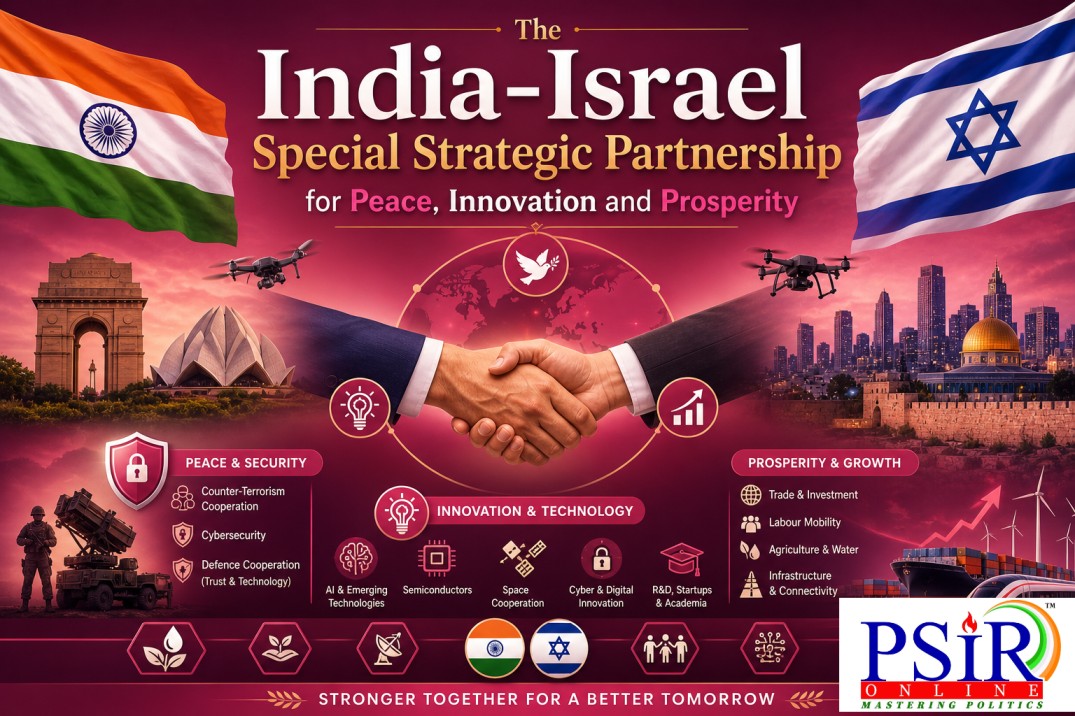
On 26 February 2026, during Prime Minister Narendra Modi’s state visit to Israel (25–26 February), India and Israel formally elevated their bilateral relationship to a “Special Strategic Partnership for Peace, Innovation and Prosperity.”
This upgrade, announced in the official Joint Statement issued by India’s Ministry of External Affairs (MEA), represents a significant milestone in one of the world’s most dynamic bilateral relationships. It builds on nearly three decades of diplomatic ties and nearly a decade of strategic partnership since 2017, reflecting deeper trust, shared strategic interests, and a forward-looking vision driven by technology, security, and economic complementarity.
The phrase itself is telling. “Special” denotes an elevated tier beyond the standard strategic partnership established in 2017 during Modi’s landmark first visit as Indian Prime Minister. “For Peace, Innovation and Prosperity” encapsulates the three pillars: security and counter-terrorism (peace), cutting-edge collaboration in emerging technologies (innovation), and mutually beneficial economic and people-to-people ties (prosperity).
As the Joint Statement notes, Prime Minister Modi and Israeli Prime Minister Benjamin Netanyahu “agreed and decided to elevate the Strategic Partnership to a new level,” recognizing “immense progress” since the 2017 and 2018 reciprocal visits.
HISTORICAL CONTEXT AND EVOLUTION
India and Israel established full diplomatic relations in 1992. For decades, cooperation remained discreet, particularly in defence and intelligence, due to India’s traditional balancing act in West Asia. Modi’s 2017 visit broke new ground as the first by an Indian Prime Minister to Israel.
It formalized a “Strategic Partnership,” launching frameworks like the Strategic Partnership in Water and Agriculture with a dedicated Joint Working Group, the India-Israel Industrial R&D and Innovation Fund (I4F) with $20 million contributions each, enhanced space cooperation between ISRO and the Israel Space Agency (ISA), and strengthened defence and cyber ties.
By 2026, bilateral trade had grown substantially, defence cooperation had deepened (including systems like Barak-8 and Heron UAVs), and technology ties expanded into agriculture (over 30 Centres of Excellence training millions of Indian farmers) and innovation. The 2026 upgrade during Modi’s second visit institutionalizes this momentum at a higher level. It comes amid global shifts: rising technological competition, supply-chain resilience needs, and regional security challenges. The visit yielded 27 outcomes, including 16 MoUs, covering AI, cybersecurity, semiconductors, quantum computing, labour mobility (up to 50,000 Indian workers over five years), and advances toward a Free Trade Agreement (FTA).
PILLARS OF THE SPECIAL STRATEGIC PARTNERSHIP
1. Peace and Security
The partnership explicitly addresses “peace” through a strong stance on terrorism. The Joint Statement condemns terrorism unequivocally, referencing specific incidents like the 7 October 2023 attack on Israel and attacks on Indian targets. Both nations commit to enhanced counter-terrorism cooperation, intelligence sharing, and support for regional peace initiatives, including aspects of the Gaza peace plan. Defence ties form the backbone: a 2025 MoU laid groundwork for joint development, production, and technology transfer. The 2026 roadmap envisions deeper collaboration in missiles, drones, air defence, and emerging domains like AI-enabled systems. This aligns with India’s quest for self-reliance (Atmanirbhar Bharat) and Israel’s need for reliable partners.
Cybersecurity receives special attention with the planned India-Israel Centre of Excellence in India, focusing on capacity building, AI-driven research, “Security by Design,” and joint exercises. A multi-year strategic program and financial-cyber resilience partnership add layers of protection against hybrid threats.
2. Innovation and Emerging Technologies
Innovation is the standout feature of the “Special” upgrade. A new Critical and Emerging Technologies (CET) Initiative, led by the two National Security Advisors, will synergize strengths in AI, semiconductors, quantum computing, biotechnology, and more. An MoU on AI cooperation was signed, alongside efforts to link talent ecosystems.
The I4F and Joint Research Calls have been strengthened (contributions raised to $1.5 million each side). The Joint Commission on Science and Technology moves to Ministerial level. New mechanisms include a Horizon Scanning/Strategic Foresight tool using AI and data analytics to anticipate global trends, plus an India-Israel Academic Cooperation Forum (I2I) for university collaboration. Space ties deepen with joint ventures, while agriculture innovation continues via the new India-Israel Innovation Centre for Agriculture (IINCA) and fisheries/aquaculture centres.
These initiatives leverage India’s vast talent pool, market scale, and manufacturing base with Israel’s R&D prowess and startup ecosystem—often called the “Startup Nation.” Together, they aim to drive technological transformation supporting India’s Viksit Bharat 2047 vision.
3. Prosperity and Economic Ties
Economic cooperation targets prosperity through trade, investment, and mobility. FTA negotiations advanced rapidly, with the first round completed and the next scheduled soon. A Bilateral Investment Agreement (signed earlier) and UPI linkage with Israel’s payment systems will ease business. Direct flights and infrastructure collaboration (including potential roles in India-Middle East-Europe Corridor or IMEC) are prioritized.
Labour mobility stands out: protocols for Indian workers in multiple sectors, supported by a Joint Coordination Committee, address Israel’s labour shortages while providing opportunities for skilled Indians. Cultural, educational (e.g., MoUs with Nalanda and Hebrew Universities, AI in education), and tourism exchanges further people-to-people bonds.
HOW THE “SPECIAL STRATEGIC PARTNERSHIP” (2026) DIFFERS FROM THE EARLIER “STRATEGIC PARTNERSHIP” (2017)
The 2017 upgrade (during Modi’s historic first standalone visit as Indian PM) marked the foundational shift after 25 years of diplomatic relations. It “raised the bilateral relationship to that of a strategic partnership” and focused on structured cooperation in core sectors.
The 2026 upgrade explicitly calls it a “new level” and builds directly on the 2017/2018 foundations (Modi’s 2017 visit + Netanyahu’s 2018 visit to India), noting “immense progress” made since then. It shifts from foundational frameworks to deeper institutionalisation, frontier technology integration, tangible outcomes, and a broader vision explicitly linking peace, innovation, and prosperity.
Here is a side-by-side comparison based on the two official joint statements:
|
Aspect |
2017 Strategic Partnership (July 2017 Joint Statement) |
2026 Special Strategic Partnership (Feb 2026 Joint Statement) |
|
Nature of Upgrade |
First-ever Indian PM visit; raised ties to “strategic partnership”; established baseline structured cooperation. |
Explicitly “elevate the Strategic Partnership to a new level”; adds “Special” + “for Peace, Innovation & Prosperity”. |
|
Core Focus |
Development, technology, innovation, defence/security, water & agriculture. |
Same foundation + heavy emphasis on frontier/emerging technologies, institutional mechanisms across G2G/B2B/P2P, and explicit “peace” dimension (terrorism condemnation, support for Gaza peace plan). |
|
Key New Mechanisms |
- Strategic Partnership in Water & Agriculture + Joint Working Group (JWG). - India-Israel Industrial R&D & Innovation Fund (I4F) launched ($20M each side). - Joint Committee on S&T. - Framework for cyber security cooperation. |
- Critical & Emerging Technologies Initiative led by National Security Advisors. - India-Israel Centre of Excellence in Cybersecurity (LoI signed). - Horizon Scanning/Strategic Foresight Mechanism (Declaration of Intent). - Joint Commission on S&T elevated to Ministerial level. - India-Israel Academic Cooperation Forum (I2I Forum). - India-Israel Innovation Centre for Agriculture (IINCA) + more Joint Centres of Excellence. |
|
R&D & Innovation Funding |
I4F established; joint research calls at baseline level. |
I4F strengthened; India-Israel Joint Research Calls (IIJRC) contribution increased to $1.5 million each side; more scientist exchanges & facility access. |
|
Defence & Security |
Joint development, technology transfer under “Make in India”; enhanced cyber & homeland security. |
Builds on 2025 Defence MoU; new vision and roadmap for future cooperation; joint production & tech transfer emphasis. |
|
Trade & Economy |
CEO Forum tasked; negotiations on investment protection agreement started. |
Bilateral Investment Agreement signed (2025); FTA negotiations advanced (ToR signed, first round done, next in May 2026); UPI linkage with Israeli system; target for early FTA. |
|
People-to-People & Labour |
Facilitation of Indian caregivers; tourism & cultural ties. |
Protocol for up to 50,000 additional Indian workers over 5 years (new sectors: commerce, manufacturing, etc.); Joint Coordination Committee (JCC) for frequent meetings. |
|
Other Notable Additions |
Space (ISA-ISRO MoUs); higher education/research. |
AI-specific MoU; quantum, semiconductors, biotech; financial-cyber resilience partnership; direct air connectivity expansion; 20 agricultural research fellowships. |
STRATEGIC AND GEOPOLITICAL SIGNIFICANCE
For India, the partnership diversifies partnerships beyond traditional alignments, bolstering defence modernisation, tech self-reliance, and food/water security. It fits India’s multi-alignment strategy—strong ties with Israel alongside engagement with Arab nations and the US-led I2U2 grouping.
For Israel, it provides a major market, co-development partner, and diplomatic support amid regional volatility. The “Special” label signals the highest bilateral commitment, potentially paving the way for more joint ventures and supply-chain integration.
Globally, this partnership exemplifies “middle-power” collaboration in a fragmented world: democracies leveraging innovation against common challenges like terrorism, climate change, and tech disruption. It contributes to global public goods—sustainable agriculture tech for developing nations, cybersecurity standards, and resilient supply chains.
CHALLENGES AND OUTLOOK
Challenges remain. Regional conflicts, including the Israel-Hamas war and broader West Asian tensions, test diplomatic balancing. India maintains engagement with Palestine and Iran while deepening Israel ties—a nuanced approach rooted in its interests. Economic hurdles like tariff barriers and regulatory alignment for FTA need resolution. Intellectual property, data governance, and equitable benefit-sharing in joint R&D will require careful management.
Looking ahead, the partnership’s success depends on implementation. Regular high-level meetings, NSA-led CET initiatives, Ministerial S&T commissions, and frequent JCCs provide structure. Annual I2I Forums and expanded cultural programs will sustain momentum. With bilateral trade potential in tens of billions and defence deals already significant, the trajectory points upward.
In conclusion, the Special Strategic Partnership for Peace, Innovation and Prosperity marks a mature phase in India-Israel relations. It transcends transactional ties, forging a comprehensive strategic convergence suited to 21st-century realities. By harnessing innovation for security and growth, both nations position themselves as key players in a multipolar world.
As Modi and Netanyahu noted, this elevation symbolizes the aspirations of their peoples for a resilient, prosperous future. The coming years will test and likely validate this ambitious vision through concrete deliverables in technology, trade, and stability.
PRACTICE QUESTIONS FOR GS 2 MAINS
1. The elevation of India–Israel ties to a “Special Strategic Partnership” reflects changing contours of India’s West Asia policy. Examine the strategic significance of this development.
2. India’s engagement with Israel demonstrates a shift from ideological diplomacy to interest-based multi-alignment. Critically analyse in the context of recent bilateral developments.
3. Emerging technologies are becoming central to modern diplomacy. Discuss with reference to India–Israel cooperation in AI, cybersecurity, and semiconductors.
4. Labour mobility agreements and Free Trade Agreements (FTAs) are key pillars of contemporary bilateral relations. Evaluate their role in strengthening India–Israel economic ties.
PRACTICE QUESTIONS FOR PSIR OPTIONAL
1. “India–Israel relations illustrate the evolution from realism-driven covert engagement to overt strategic partnership.” Analyse using theoretical perspectives of International Relations.
2. Discuss how the India–Israel Special Strategic Partnership reflects the concept of ‘middle power cooperation’ in a multipolar world order.
3. Examine the role of technology diplomacy in India–Israel relations with reference to Critical and Emerging Technologies (CET) initiatives.
4. India’s engagement with Israel, alongside its ties with Palestine and Iran, highlights the practice of strategic autonomy. Critically evaluate.