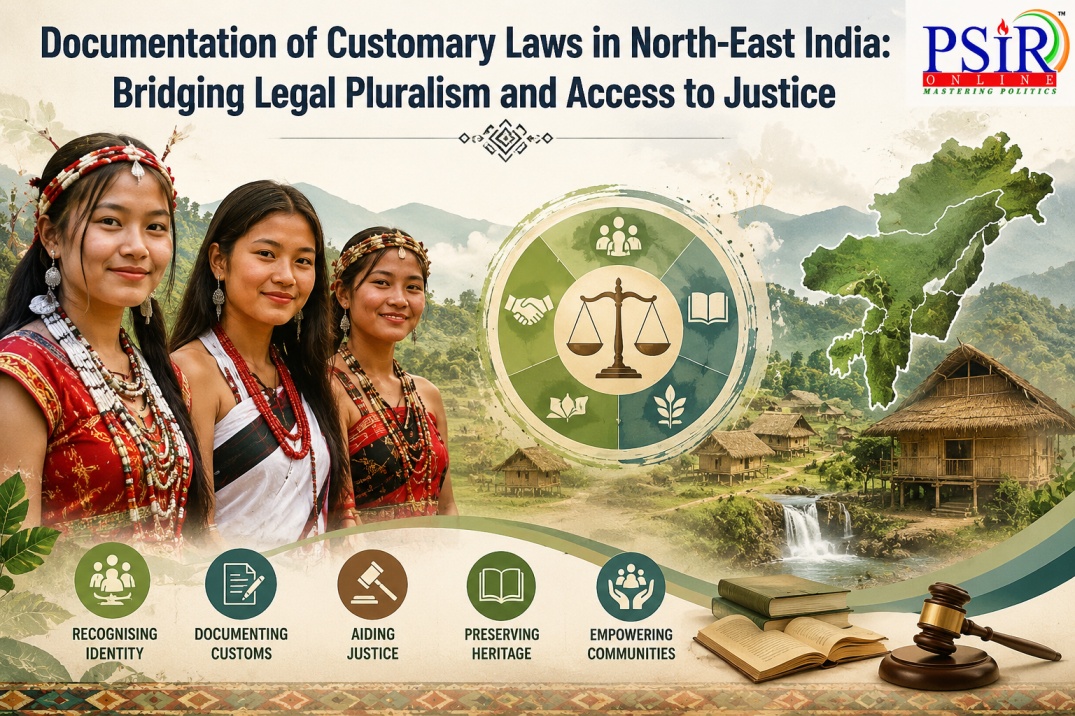
India’s constitutional vision of justice accommodates diversity through legal pluralism, particularly in tribal regions where customary laws govern everyday life. In this context, the “Documentation of Customary Laws of the North Eastern Region, India (2023–2026)” project, implemented by the Law Research Institute (LRI), Gauhati High Court under the Department of Justice, represents a significant step toward integrating indigenous legal traditions within the formal justice system.
BACKGROUND AND OBJECTIVES
The project (2023–2026) aims to systematically document, digitize, and preserve the customary laws of tribal communities across North-East India. It focuses on key domains such as marriage, inheritance, land rights, dispute resolution, and traditional governance institutions.
The initiative gained operational momentum through the recruitment of dedicated research teams in 2023, followed by field-level documentation. Its outputs include multiple e-books released in phases, including ten publications in March 2026 and three additional works in May 2026 covering communities like the Hrangkhol, Biate, and Hajong.
The project aligns with constitutional protections under Articles 371A–371G and the Sixth Schedule, which recognize tribal autonomy and customary practices.
KEY OUTPUTS AND PROGRESS (2023–2026)
The project has produced tangible documentation deliverables in collaboration with the Department of Justice:
· March 2026 Launch of Ten E-Books: Ten e-books documenting customary laws of tribal communities from the North-Eastern region were officially launched during the Regional Workshop on the Tele-Law Programme under the DISHA Scheme in Chennai. These were developed in direct collaboration with LRI, Gauhati High Court.
· 13 May 2026 Launch of Three E-Books: Union Minister of State for Law and Justice Shri Arjun Ram Meghwal launched three e-books (digital publications) documenting the customary laws and cultural traditions of the Hrangkhol, Biate, and Hajong communities of Assam & Meghalaya. These were developed with the Law Research Institute of the Gauhati High Court. The publications specifically cover their customary legal practices and aim to preserve indigenous legal traditions while enabling wider public and judicial access to community-based justice knowledge.
These e-books form part of the project’s core deliverables under the 2023-2026 initiative. No comprehensive public final report or exhaustive list of all tribes covered across the full set is available as of now (project is still within its timeline).
SIGNIFICANCE FOR SOCIAL JUSTICE
The project advances social justice in multiple ways:
· Recognition of Indigenous Identity: By documenting customary practices, it affirms cultural dignity and protects intangible heritage.
· Bridging Legal Gaps: Many tribal communities rely on unwritten norms; documentation reduces ambiguity and arbitrariness in interpretation.
· Enhancing Access to Justice: Digitized and standardized records can assist courts, legal aid services, and administrators in delivering context-sensitive justice.
· Strengthening Legal Pluralism: It harmonizes customary systems with formal law, avoiding forced homogenization.
· Gender and Vulnerable Group Visibility: Documentation may expose discriminatory practices, enabling reform within communities and through constitutional scrutiny.
Example: In inheritance disputes in tribal areas, courts often struggle due to lack of written norms. A documented corpus can provide authoritative reference, reducing delays and inconsistent rulings.
PRACTICAL USES BY COURTS AND GOVERNANCE INSTITUTIONS
The project has immediate and long-term utility for judicial and administrative functioning:
· Judicial Reference Material: Courts can rely on documented customary laws while adjudicating disputes under Article 13 and personal law frameworks.
· Evidence Standardization: Codified customs can be treated as credible evidence, reducing dependence on oral testimony.
· Policy Formulation: Governments can design welfare schemes and land policies aligned with tribal practices.
· Training and Capacity Building: Judicial officers and bureaucrats can be sensitized to regional legal cultures.
Example: In land disputes in Sixth Schedule areas, district councils and courts can use these documents to ensure decisions respect traditional land tenure systems rather than imposing general property laws.
KEY CHALLENGES
Despite its promise, the project faces several structural and operational challenges:
· Dynamic Nature of Customs: Customary laws are evolving and context-specific; documentation risks freezing them into rigid forms.
· Diversity and Fragmentation: Hundreds of tribes with intra-community variations make comprehensive coverage difficult.
· Legitimacy Concerns: Questions may arise about who defines “authentic” customs—elders, councils, or researchers.
· Gender Justice Tensions: Some customary practices may conflict with constitutional values like equality under Articles 14 and 15.
· Limited Awareness and Accessibility: Digital outputs may not reach remote communities lacking connectivity.
· Institutional Integration: Courts may hesitate to rely on such documentation without clear legal status or precedential value.
WAY FORWARD
To maximize impact and ensure alignment with social justice goals, the following steps are essential:
· Participatory Documentation: Involve tribal councils, women’s groups, and community stakeholders to ensure legitimacy and inclusivity.
· Periodic Revision Mechanism: Treat documentation as a living repository, updated regularly to reflect evolving practices.
· Legal Recognition Framework: Develop guidelines for admissibility and use of documented customs in courts.
· Harmonization with Fundamental Rights: Establish review mechanisms to reconcile customary practices with constitutional morality.
· Capacity Building: Train judges, lawyers, and administrators in interpreting customary law within the constitutional framework.
· Local Language Dissemination: Translate materials into regional languages and ensure offline accessibility.
· Integration with Digital Justice Platforms: Link documentation with e-Courts, Tele-Law, and legal aid systems for wider reach.
CONCLUSION
The LRI-led project marks a transformative step toward embedding India’s plural legal traditions within a modern justice framework. By documenting customary laws, it not only preserves cultural heritage but also enhances access to justice in underserved regions. However, its long-term success depends on balancing tradition with constitutional values, ensuring that legal pluralism strengthens rather than fragments the pursuit of justice.
PRACTICE QUESTIONS FOR GS 2 MAINS
1. “Legal pluralism strengthens democratic inclusion but may also generate tensions with constitutional morality.” Critically examine in the context of customary law documentation initiatives in North-East India. (15 Marks)
2. Discuss how the documentation and digitization of customary laws can improve access to justice in tribal regions of India. Also examine the associated challenges. (15 Marks)
3. “The recognition of customary laws is essential for protecting indigenous identity, but codification may risk freezing dynamic traditions.” Analyse. (10 Marks)
4. Evaluate the role of constitutional provisions such as the Sixth Schedule and Articles 371A–371G in balancing tribal autonomy with the broader framework of Indian constitutional governance. (20 Marks)