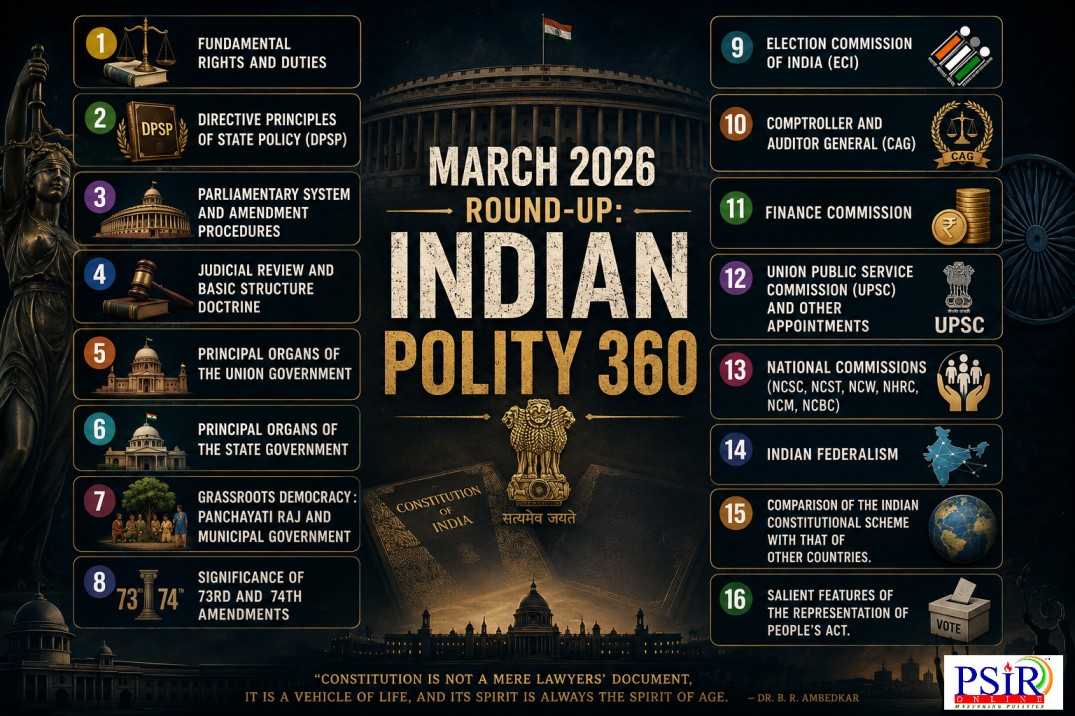
[NOTE: THE CURRENT AFFAIRS FOR THE MONTH OF APRIL HAS BEEN ORGANISED AS PER THE TOPICS MENTIONED IN PSIR AND GS 2 (MAINS) SYLLABUS. FEW TOPICS MIGHT LOOK REPETITIVE AS IT OVERLAPS UNDER MANY SUB-HEADINGS. BUT THE INFORMATION INSIDE THOSE TOPICS WILL BE DIFFERENT AND WILL PERTAIN TO THE MAIN HEADING CONCERNED. HENCE STUDENTS ARE REQUESTED TO READ EACH AND EVERY LINE OF THE SECTION TO GET COMPLETE UNDERSTANDING]
1. FUNDAMENTAL RIGHTS AND DUTIES
Several Supreme Court judgments in March 2026 actively engaged Fundamental Rights (Part III), especially Articles 14 (equality), 19 (freedoms), and 21 (life and personal liberty/dignity). No changes occurred to Fundamental Duties (Part IVA, Article 51A).
· Hamsaanandini Nanduri v. Union of India (17 March 2026): The Court struck down/re-read Section 60(4) of the Code on Social Security, 2020. The provision limited maternity benefits for adoptive mothers to children under 3 months. It violated Articles 14 and 21 by creating irrational classification. The Court extended 12 weeks’ benefits to all adoptive mothers, emphasizing motherhood as a process beyond biology and linking to dignity and equality.
· Harish Rana v. Union of India (around 11 March 2026): The Court permitted passive euthanasia (withdrawal of life support, including artificial nutrition/hydration) for a patient in persistent vegetative state. It reaffirmed the “right to die with dignity” as part of Article 21, building on the 2018 Common Cause judgment.
· Chinthada Anand v. State of Andhra Pradesh (24 March 2026): The Court upheld that conversion from Hinduism, Sikhism, or Buddhism to another religion results in loss of Scheduled Caste status under the 1950 Presidential Order. This engages equality (Article 14) and reservations (Articles 15/16), tying benefits to specific religious communities while preserving Article 25 religious freedom.
Transgender Persons (Protection of Rights) Amendment Bill, 2026 (introduced 13 March; passed Lok Sabha 24 March, Rajya Sabha 25 March; assented ~30 March): This legislation narrows the definition of “transgender,” removes self-perceived gender identity (reversing aspects of the 2014 NALSA judgment), introduces medical certification and District Magistrate scrutiny, and adds penalties for “alluring/coercing” transgender identity. Critics and experts argue it potentially violates Articles 14, 19(1)(a), and 21 (dignity, expression, privacy, equality). It is expected to face judicial review challenges.
2. DIRECTIVE PRINCIPLES OF STATE POLICY (DPSP)
No direct amendments or new policy programmes targeted DPSP (Part IV). However, judgments like the maternity benefits case indirectly advanced DPSP goals (e.g., Article 42 on just and humane work conditions, Article 39 on equal pay and maternity relief) through Fundamental Rights enforcement. The SC status judgment touched social justice themes aligned with DPSP and Preamble objectives.
3. PARLIAMENTARY SYSTEM AND AMENDMENT PROCEDURES
No changes to the parliamentary system or Article 368 amendment procedures in March 2026. A Private Member’s Constitution (Amendment) Bill introduced in Rajya Sabha on 13 March proposed a new Article 21B for free access to knowledge via public libraries (linking to education and Article 21), but it did not progress significantly. The major Constitution (131st Amendment) Bill on delimitation and women’s reservation was introduced and defeated in April 2026.
4. JUDICIAL REVIEW AND BASIC STRUCTURE DOCTRINE
NCERT textbook controversy (spilling into March): The Court’s earlier suo moto order on a chapter criticizing judicial corruption led to withdrawal of the book. This sparked expert commentary on judicial independence, contempt powers vs. free speech (Article 19), and transparency—indirectly touching rule of law (a Basic Structure element).
5. PRINCIPAL ORGANS OF THE UNION GOVERNMENT
Executive In March 2026, the Union Executive (President, Prime Minister, and Council of Ministers) continued normal functioning during the Budget Session of Parliament. Key activities included the passage of the Finance Bill 2026 (passed by Lok Sabha on 25 March with 32 government amendments) and other appropriation bills. The session saw debates on economic stabilisation and fiscal measures. No major controversies on executive overreach were reported, though routine coordination with Parliament occurred.
Legislature The Budget Session resumed on 9 March 2026 after a recess. Both Houses were active: Lok Sabha passed the Finance Bill 2026, Appropriation Bill 2026, and several other bills. Key legislations introduced/passed included the Transgender Persons (Protection of Rights) Amendment Bill 2026 (introduced 13 March, passed Lok Sabha 24 March, Rajya Sabha 25 March). Debates included a resolution for removal of Speaker Om Birla (discussed in Lok Sabha on 10 March). The session highlighted standard legislative scrutiny with some opposition protests and adjournments.
Supreme Court The Supreme Court exercised active judicial review. Key March 2026 developments:
· Harish Rana v. Union of India (11 March): Permitted passive euthanasia (withdrawal of life support) for a patient in persistent vegetative state, reaffirming right to die with dignity.
· Hamsaanandini Nanduri v. Union of India (17 March): Extended maternity benefits to adoptive mothers without age restriction of the child, striking down restrictive provisions.
· Nine-judge Constitution Bench (19 March) reserved judgment on the definition of “industry” under Industrial Disputes Act (hearing arguments from states and unions).
· Continued supervision of West Bengal electoral roll revision (Special Intensive Revision), directing appellate mechanisms and High Court involvement. These reflect the Court’s role in checking executive/legislative actions and interpreting constitutional provisions.
6. PRINCIPAL ORGANS OF THE STATE GOVERNMENT
Executive Governor reshuffles occurred in early March 2026 under the President’s orders: R.N. Ravi appointed Governor of West Bengal (effective 12 March), Kavinder Gupta as Governor of Himachal Pradesh (10 March), and additional charges/transfers in states like Tamil Nadu, Telangana, Bihar, and Maharashtra. These appointments align with the constitutional role of Governors as nominal heads of state executives. No major reported conflicts with Chief Ministers in March itself.
Legislature State legislatures functioned as per normal schedules. No widespread reports of major disruptions or new constitutional amendments in March. Tensions between elected governments and Governors (e.g., over bill assent) were noted in broader commentary but not as acute flashpoints specifically in March 2026. The focus remained on routine legislative business ahead of upcoming state polls.
High Courts High Courts delivered various rulings, many on state executive actions:
· Several benches addressed reservation, protest rights, quasi-judicial powers, and police mediation (e.g., Orissa HC on voluntary settlements, MP HC on mechanical exercise of powers, Kerala HC on excise checks).
· J&K and Ladakh HC ruled that Vaishno Devi Shrine Board is not “State” under Article 12 due to lack of government control. These demonstrate High Courts’ supervisory role over state executive and administrative actions.
7. GRASSROOTS DEMOCRACY : PANCHAYATI RAJ AND MUNICIPAL GOVERNMENT
· Rajasthan Panchayati Raj (Amendment) Bill, 2026 (passed by Rajasthan Assembly on 10 March 2026): The state scrapped the three-decade-old two-child norm that disqualified candidates with more than two children from contesting Panchayat elections. The Rajasthan Municipalities (Amendment) Bill, 2026 was passed the next day (11 March), extending the same relaxation to municipal/urban local body elections. This aims to align with changing social realities and democratic principles while removing population control-linked disqualifications.
· Say No to Proxy Sarpanch Campaign (8–18 March 2026): The Ministry of Panchayati Raj launched a nationwide campaign to curb proxy representation (especially male relatives acting on behalf of elected women Sarpanches). It emphasised genuine empowerment of women representatives in Gram Panchayats.
· Supreme Court Judgment (10 March 2026): In a case arising from Panchayat no-confidence motions, the Court set aside a High Court order and issued directions on procedural aspects, protecting the democratic functioning and rights of elected Panchayat representatives.
· Himachal Pradesh High Court (31 March 2026): Delivered a detailed judgment on Gram Panchayat reorganisation, delimitation, and election procedures. It addressed multiple petitions challenging bifurcation/creation of Panchayats and directed timely completion of related exercises.
· Ongoing Initiatives: Ministry of Panchayati Raj continued People’s Plan Campaign (Sabki Yojana Sabka Vikas) and eGramSwaraj integration with PFMS for digital planning, accounting, and fund transparency at Gram Panchayat level. High adoption rates of GPDPs were reported as of mid-March 2026.
8. SIGNIFICANCE OF 73RD AND 74TH AMENDMENTS
No new constitutional amendments or major expert observations specifically revisiting the core significance of the 73rd (Panchayati Raj) and 74th (Municipalities) Amendments occurred in March 2026. However, state-level actions and central campaigns reinforced their objectives of democratic decentralisation, women’s participation (one-third reservation), regular elections, and devolution of powers/functions/finances.
· The Rajasthan amendments and proxy Sarpanch campaign directly operationalised the spirit of the 73rd Amendment by promoting inclusive and genuine grassroots leadership.
· Parliamentary questions and Ministry reports in March highlighted devolution indices, women’s representation in PRIs, and digital empowerment tools under the Rashtriya Gram Swaraj Abhiyan (RGSA), underscoring the enduring relevance of the two amendments in strengthening local self-governance.
· These developments illustrated continued efforts to translate the constitutional mandate of the 73rd and 74th Amendments into effective ground-level democracy, particularly in empowering marginalised groups and ensuring accountable local institutions.
9. ELECTION COMMISSION OF INDIA (ECI)
· Supreme Court Hearings (March 2026): The Supreme Court continued hearings on challenges to the Chief Election Commissioner and Other Election Commissioners (Appointment, Conditions of Service and Term of Office) Act, 2023. The Court questioned the executive dominance in the selection panel (PM + LoP + Union Minister) and raised concerns over neutrality and independence of the ECI. Petitions highlighted potential violation of Article 324 and basic structure principles regarding free and fair elections.
· West Bengal Electoral Matters: In Mostari Banu v. Election Commission of India (10 March 2026), the Supreme Court dealt with petitions related to electoral roll revision and directed that judicial officers’ orders would not be subject to appeal before executive authorities, reinforcing ECI’s quasi-judicial functions.
· Assembly Elections Preparations: ECI announced schedules and deployed over 25 lakh officials for Assembly elections in multiple states (Assam, Kerala, Tamil Nadu, West Bengal, etc.). Madras High Court (17 March) dismissed challenges to tender conditions for live webcasting of polls, limiting judicial review in ECI’s administrative processes.
10. COMPTROLLER AND AUDITOR GENERAL (CAG)
· Audit Reports Tabled (March 2026): Several CAG reports were presented, including compliance audits on Union Government (Civil & Commercial) and State-specific reports (e.g., Gujarat GST deviations of ₹1,234 crore unverifiable records). Reports flagged systemic lapses in financial accountability.
· Policy Initiative (9 March 2026): CAG proposed the Risk-Controls Maturity Scorecard (RCMS) for universities and institutions — shifting from post-facto audits to proactive risk management and real-time monitoring.
· Other Activities: National Conference on Local Governance (2 March) and reopening of Expression of Willingness for CA firms for FY 2026-27 audits.
11. FINANCE COMMISSION
· No major new developments or sittings specifically in March 2026. The Sixteenth Finance Commission’s report (for 2026-31 period) had already been tabled earlier in February 2026, with government acceptance of key recommendations (e.g., 41% vertical devolution). Implementation and follow-up discussions continued in March.
12. UNION PUBLIC SERVICE COMMISSION (UPSC) AND OTHER APPOINTMENTS
· Routine appointments to constitutional posts continued via President’s orders. No major controversies or judgments specifically on UPSC functioning reported in March 2026. Governor/Lt. Governor reshuffles (e.g., R.N. Ravi as Governor of West Bengal effective 12 March) highlighted appointments under Articles 153/239.
13. NATIONAL COMMISSIONS (NCSC, NCST, NCW, NHRC, NCM, NCBC)
· National Human Rights Commission (NHRC): Launched its Online Short-Term Internship Programme for March 2026 (9–20 March), selecting 71 students. This underscores NHRC’s capacity-building and promotional functions under the Protection of Human Rights Act.
· Limited specific reports on NCSC, NCST, NCW, NCM, or NCBC activities in March 2026. These bodies continued routine functions related to safeguards, inquiries, and recommendations.
14. INDIAN FEDERALISM
Governor-related Centre-State Tensions: Governor reshuffles occurred in March 2026 (e.g., R.N. Ravi moved to West Bengal effective 12 March). These moves, along with ongoing disputes in non-BJP ruled states (Tamil Nadu, West Bengal, Kerala, Karnataka), sparked expert commentary on the Governor’s role as a central agent versus constitutional head. Critics highlighted integrationist tendencies and erosion of federal autonomy, with states viewing frequent interventions (bill assent delays, speech controversies) as undermining cooperative federalism.
Inter-State Water Disputes: Continued tensions over rivers like Cauvery, Krishna, Pennaiyar, and Mahanadi. The Supreme Court and tribunals handled implementation issues. No new major tribunal constituted in March 2026, but expert analyses noted persistent federal friction due to water stress and delays in award implementation.
Expert Observations: Articles and papers in March 2026 (e.g., published around 10 March) examined “coercive federalism,” politicisation of Governors, and challenges to Article 356/200 provisions. Regional aspirations in southern and opposition-ruled states were highlighted amid debates on delimitation and fiscal devolution. No new constitutional amendments altered federal provisions.
Separation of Powers between various organs
· Supreme Court Observations: Judgments and hearings in March 2026 reinforced separation of powers as part of the Basic Structure. Cases addressed judicial independence versus legislative/executive overreach (e.g., IT Rules fact-check units, industry definition on a 9-judge bench). A Kerala High Court judgment (31 March) explicitly invoked the doctrine in a case involving state powers.
· Expert Commentary: Discussions on institutional integrity, especially regarding executive influence on appointments and judicial review limits, appeared in legal analyses throughout the month.
Dispute Redressal Mechanisms and Institutions
· Supreme Court Interventions: Active role in federal disputes, including West Bengal electoral roll revision (directing judicial officers for appeals) and Panchayat-related no-confidence motions (10 March judgment modifying procedures). The Court continued scrutiny of ECI appointment processes under Article 324.
· Other Mechanisms: Routine functioning of inter-state tribunals and quasi-judicial bodies. Chief Justice of India emphasised credible dispute resolution systems (including arbitration) for economic growth in a March address. No major new legislation on dispute redressal was introduced in March 2026.
15. COMPARISON OF THE INDIAN CONSTITUTIONAL SCHEME WITH THAT OF OTHER COUNTRIES.
No new constitutional amendments or Supreme Court judgments in March 2026 directly addressed or altered comparative constitutional analysis. However, expert observations continued through academic and institutional platforms. The Supreme Court Observer’s South Asian Constitutional Law series published three new articles in March 2026 analysing “rule by law” via supermajority in the Maldives, Taliban-led authoritarian constitutionalism in Afghanistan, and delayed judicial checks on emergency powers in Sri Lanka — drawing implicit comparisons with India’s Basic Structure doctrine, judicial review, and separation of powers.
16. SALIENT FEATURES OF THE REPRESENTATION OF PEOPLE’S ACT.
The Representation of the People Act, 1950 and 1951 remained the core statutory framework for electoral rolls, candidate qualifications/disqualifications, and conduct of elections. Key March 2026 developments focused on judicial interpretation and enforcement:
· Shri Balaji v. Election Commission of India (9 March 2026): The Supreme Court examined Section 11 of the RPA 1951, clarifying the Election Commission’s discretionary powers regarding disqualification of candidates and maintenance of electoral rolls. The Court held that ECI must exercise this power narrowly and in accordance with statutory rules, reinforcing the Act’s emphasis on free and fair elections.
· Special Intensive Revision (SIR) of Electoral Rolls: Extensive Supreme Court hearings and directions (10 March and 24 March 2026) on the SIR exercise in West Bengal and other states under Section 21 of the RPA 1950. The Court directed appellate mechanisms involving judicial officers, underscoring the Act’s provisions for periodic revision and the ECI’s quasi-judicial role.
· Election Laws and Policy Tracker (March 2026 edition): Highlighted Supreme Court observations on whether a fresh poll is required in two-candidate contests where the returned candidate is later disqualified, along with proposals for digital service of election petition documents under the RPA framework. No amendments to the Act itself were introduced or passed in March 2026.
17. PRESSURE GROUPS AND FORMAL/INFORMAL ASSOCIATIONS AND THEIR ROLE IN THE POLITY.
Pressure groups and civil society associations remained active in policy advocacy, litigation, and public mobilisation. No new legislation regulating their functioning was enacted in March 2026.
· Trade unions and labour associations: Actively participated as pressure groups in the Supreme Court’s nine-judge Constitution Bench hearings (17–19 March 2026) on the definition of “industry” under the Industrial Disputes Act. Their arguments influenced the reserved judgment, demonstrating the continued role of formal associations in constitutional interpretation and labour policy.
· Civil society coalitions: Informal and formal associations (including human rights groups) continued advocacy on issues such as electoral roll revisions and transgender rights amendments, using petitions, press conferences, and engagement with constitutional bodies.