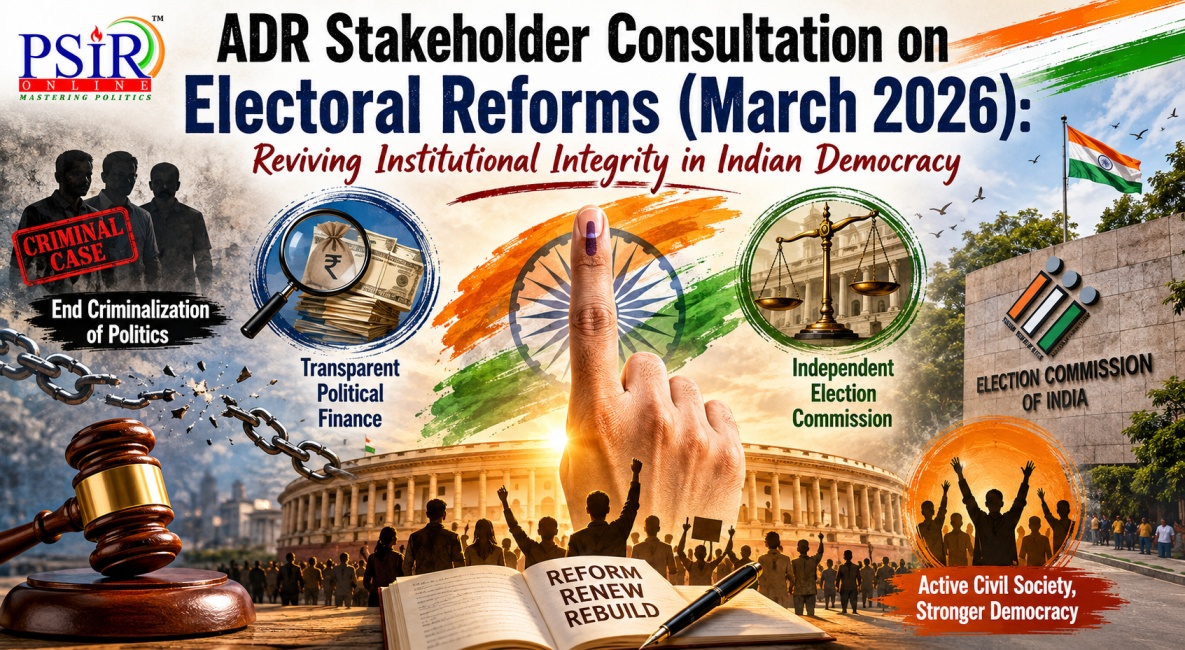
The Association for Democratic Reforms (ADR) and National Election Watch (NEW) convened a high-level stakeholder discussion on March 10, 2026, at the India International Centre, New Delhi. Bringing together former Chief Election Commissioners, Members of Parliament, academics, and civil society leaders, the consultation aimed to deliberate on pressing challenges facing India’s electoral democracy and to propose actionable reforms. The event is significant in the context of growing concerns over electoral integrity, transparency in political finance, and institutional independence.
CRIMINALIZATION OF POLITICS: A PERSISTENT DEMOCRATIC DEFICIT
One of the central themes of the discussion was the continuing criminalization of politics. ADR’s long-standing data highlights that a substantial proportion of elected representatives face criminal charges, including serious offences. This trend raises critical concerns:
· It undermines the rule of law and public trust in democratic institutions.
· It distorts electoral competition, as candidates with financial and coercive power gain an advantage.
· It weakens legislative functioning, affecting policy outcomes.
Participants emphasized the need for:
· Fast-track courts for cases involving elected representatives.
· Stricter disqualification norms beyond conviction, possibly upon framing of charges for serious offences.
· Greater voter awareness through mandatory disclosure of candidates’ criminal records.
This debate aligns with Supreme Court judgments such as Public Interest Foundation v. Union of India (2019), which called for transparency but stopped short of disqualification upon charges.
POLITICAL FINANCE AFTER ELECTORAL BONDS: THE TRANSPARENCY QUESTION
The discussion critically examined the post-Electoral Bonds scenario. Following judicial scrutiny and public debate, the opacity associated with anonymous political donations has become a central issue.
Key concerns raised:
· Electoral Bonds weakened transparency by allowing anonymous corporate funding.
· They created asymmetry, benefiting ruling parties disproportionately.
· The scheme diluted accountability mechanisms under the Representation of the People Act and Income Tax laws.
Proposed reforms included:
· Full disclosure of political donations above a low threshold.
· Strengthening the Election Commission’s auditing powers.
· Introducing state funding of elections in a limited or hybrid form.
This issue is crucial for PSIR students as it connects to debates on “level playing field” and the role of money power in elections, a recurring theme in Indian political analysis.
APPOINTMENT OF ELECTION COMMISSIONERS: INSTITUTIONAL INDEPENDENCE AT STAKE
Another major concern was the appointment process of Election Commissioners. The credibility of the Election Commission of India (ECI), a cornerstone of India’s democratic architecture under Article 324, depends significantly on perceived independence.
Recent developments, including the shift from a judicially mandated collegium-like system (as suggested in Anoop Baranwal v. Union of India, 2023) to a legislatively defined appointment committee, have triggered debate.
Participants argued:
· The current system risks executive dominance in appointments.
· There is a need for a more balanced, bipartisan selection committee including judicial representation.
· Transparent criteria and consultation processes should be institutionalized.
This discussion reflects broader concerns about the autonomy of constitutional bodies and the principle of checks and balances.
ROLE OF CIVIL SOCIETY: ADR AS A DEMOCRATIC WATCHDOG
The consultation underscores the proactive role played by civil society organizations like ADR in strengthening democratic accountability. Over the years, ADR has:
· Filed landmark PILs leading to mandatory disclosure of candidate information.
· Produced data-driven reports on elections, political funding, and legislative performance.
· Acted as a bridge between citizens, academia, and policymakers.
The March 2026 consultation aimed to consolidate expert opinion into concrete policy recommendations for submission to government authorities and parliamentary committees.
BROADER IMPLICATIONS FOR INDIAN DEMOCRACY
The themes discussed in the ADR consultation reflect deeper structural challenges in Indian democracy:
· The tension between electoral competitiveness and ethical politics.
· The increasing role of money power and opaque funding channels.
· Concerns over institutional autonomy and executive influence.
This event illustrates the dynamic interaction between law, institutions, and civil society in shaping democratic outcomes. It also provides contemporary relevance to theoretical concepts such as procedural democracy, substantive accountability, and institutional legitimacy.
CONCLUSION
The ADR stakeholder discussion of March 2026 represents an important moment in the ongoing discourse on electoral reforms in India. By foregrounding issues such as criminalization, political finance transparency, and institutional independence, it reinforces the need for sustained reforms to preserve the integrity of India’s democratic framework. The effectiveness of these efforts will ultimately depend on political will, judicial oversight, and continued vigilance by civil society.
PRACTICE QUESTIONS FOR PSIR OPTIONAL
1. “The criminalization of politics represents not merely a legal problem but a deeper crisis of democratic legitimacy in India.” Critically examine in the light of recent debates on electoral reforms and ADR’s interventions.
2. Discuss the constitutional and political implications of the appointment process of Election Commissioners in India. Does the present framework adequately safeguard institutional autonomy under Article 324?
3. “Transparency in political finance is essential for ensuring a level playing field in electoral democracy.” Analyse this statement in the context of the Electoral Bonds controversy and subsequent reform debates in India.
4. Examine the role of civil society organizations such as the Association for Democratic Reforms (ADR) in deepening democratic accountability in India. To what extent can civil society act as an effective counterbalance to institutional and political opacity?