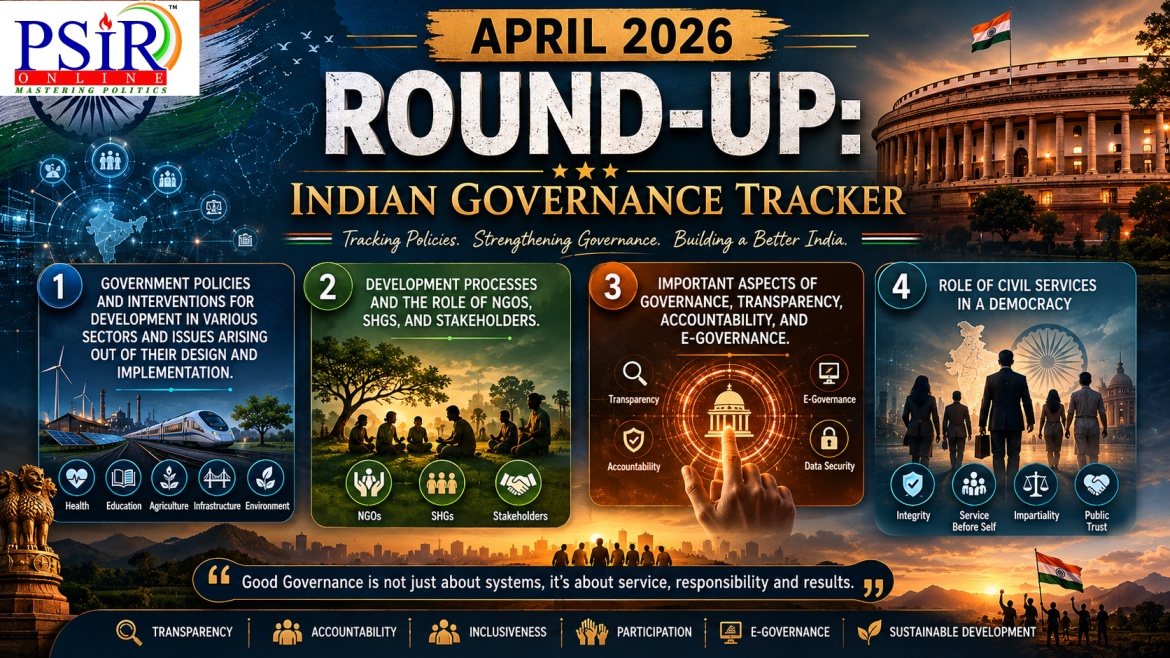
[NOTE: THE CURRENT AFFAIRS FOR THE MONTH OF APRIL HAS BEEN ORGANISED AS PER THE TOPICS MENTIONED IN GS 2 (MAINS) SYLLABUS. FEW TOPICS MIGHT LOOK REPETITIVE AS IT OVERLAPS UNDER MANY SUB-HEADINGS. BUT THE INFORMATION INSIDE THOSE TOPICS WILL BE DIFFERENT AND WILL PERTAIN TO THE MAIN HEADING CONCERNED. HENCE STUDENTS ARE REQUESTED TO READ EACH AND EVERY LINE OF THE SECTION TO GET COMPLETE UNDERSTANDING]
1. GOVERNMENT POLICIES AND INTERVENTIONS FOR DEVELOPMENT IN VARIOUS SECTORS AND ISSUES ARISING OUT OF THEIR DESIGN AND IMPLEMENTATION.
The month of April 2026 was highly eventful for Indian governance, marked by the conclusion of an extended Budget Session of Parliament on April 18, 2026. Significant legislative activity, institutional reforms, and administrative overhauls were introduced at both the Central and State/UT levels.
A. Central Legislative Reforms & Passed Bills
During the conclusion of the Budget Session, several key bills targeting administrative efficiency, reducing compliance burdens, and restructuring governance frameworks were passed:
· The Central Armed Police Forces (General Administration) Bill, 2026: Passed to overhaul, streamline, and standardize administrative, disciplinary, and promotional frameworks across all CAPFs, bringing greater uniformity and institutional transparency to internal security governance.
· The Transgender Persons (Protection of Rights) Amendment Bill, 2026: Passed to refine and strengthen administrative mechanisms, certification processes, and welfare delivery systems for transgender citizens.
The Delimitation & Constitutional Amendment Debate
On April 16, 2026, the Government introduced a legislative package consisting of:
1. The Constitution (131st Amendment) Bill, 2026
2. The Delimitation Bill, 2026
3. The Union Territories Laws (Amendment) Bill, 2026
Note: These highly anticipated bills sought to adjust the size of the Lok Sabha and permit delimitation based on the 2011 census to establish population-proportionate seats across states, alongside defining the framework for women's reservation. However, during the extended session, the Lok Sabha voted down the Constitutional Amendment Bill, making it a critical talking point for federal governance and regional representation.
B. Executive Policies & Regulatory Frameworks
· Notification of Online Gaming Rules: The Ministry notified comprehensive regulatory frameworks for the digital sector. It establishes the structural composition of the Online Gaming Authority, lays down clear criteria for defining "online money games," and mandates a streamlined governance process for platform registration and grievance redressal.
· SEZ Domestic Policy Reform: Effective April 1, 2026, the Central Board of Indirect Taxes and Customs (CBIC) relaxed governance guidelines for Special Economic Zones. Manufacturing units meeting a 20% value-addition threshold are now permitted to sell goods into the Domestic Tariff Area (DTA) at concessional customs duty rates, aimed at optimizing domestic supply chains.
C. Major Central Governance Initiatives
Sādhana Saptah 2026 (April 2–8, 2026): Launched by the Capacity Building Commission (CBC), the Department of Personnel and Training (DoPT), and Karmayogi Bharat, this was one of India's largest collaborative civil services training initiatives.
· Acronym: Strengthening Adaptive Development and Humane Aptitude for National Advancement.
· Scale: It united over 100 Central Ministries/Departments, 36 States/UTs, and 250+ Civil Services Training Institutions.
· The Three Sutras: It operated on Technology (leveraging AI, Digital Public Infrastructure, and automation for citizen-centric delivery), Tradition (incorporating ethics from Indian philosophy and local governance models), and Tangible Outcomes (requiring every department to commit to measurable governance goals for FY 2026–27).
· Karmayogi Kshamata Connect: A sub-program launched during the week specifically targeting the digital and operational upskilling of frontline public functionaries.
D. State and Union Territory Level Initiatives
· Delhi’s "Permitted Until Prohibited" Governance Shift: In mid-April to May 2026, the Delhi administration fast-tracked the Omnibus Ease of Doing Business Bill, 2026. This represents a radical structural shift in regional governance—moving away from rigid, pre-approval regulatory hurdles to an agile, ex-post compliance model. Concurrently, Delhi progressed from "Achievers" to "Exemplar" status in the Logistics Ease Across Different States (LEADS) framework.
· State-Level Integration with Mission Karmayogi: In tandem with the Central Sādhana Saptah, multiple state secretariats modified their internal human resource governance in April 2026, shifting state civil service training from a traditional, rule-based approach to an analytical, role-based competency model.
E. Prime Ministerial Policy Programs & National Context
During the month of April 2026, Prime Minister Narendra Modi addressed key gatherings on national platforms, focusing heavily on institutional design, inclusivity, and data architecture as foundational pillars for Viksit Bharat 2047.
Nari Shakti Vandan Sammelan (April 13, 2026)
· Context: Addressing a national gathering of policymakers, scientists, and social workers ahead of the special parliamentary debate on the implementation of the Nari Shakti Vandan Adhiniyam (Women's Reservation).
· Key Observations: The Prime Minister emphasized a paradigm shift from "women's development" to "women-led development." He noted that governance interventions must move away from viewing women purely as welfare beneficiaries (the old scheme-delivery model). Instead, the design of new programs must view them as active executive leaders in decision-making processes—stretching from grass-roots Panchayats to the Parliament.
· Implementation Issue Identified: Experts post-speech noted that while legislative reservation is an effective top-down design, its implementation faces structural blocks unless accompanied by capacity-building programs to counter proxy governance (the Sarpanch Pati phenomenon) in local bodies.
Vision for Data-Driven Governance (End of April 2026)
· Context: Shared during the National Deliberative Summit on "Harmonizing Administrative Data for Governance" organized by MoSPI.
· Key Vision: The PM highlighted the need for an open, positive attitude toward administrative data, noting that under modern socio-economic frameworks, data is officially recognized as an economic asset.
· Implementation Observations by Experts: Government secretaries and capacity-building experts observed that the primary roadblock to AI-ready digital public infrastructure is the presence of departmental data silos. The consensus plan emphasized that old schemes must be re-engineered with common identifiers, Application Programming Interfaces (APIs), and standard metadata guidelines to eliminate interoperability gaps between Central and State ministries.
F. Presidential Address on Infrastructure Governance (April 20, 2026)
President Droupadi Murmu addressed probationary civil servants from the Indian Railways and the Central Engineering Service (Roads) at Rashtrapati Bhavan.
· Observations on Infrastructure Design: The President evaluated the massive, multi-trillion-rupee expansions of highways, expressways, and economic corridors under the central capital expenditure framework. She observed that infrastructure governance must look "beyond engineering design and policy execution."
· The Inclusivity & Sustainability Directive: She emphasized that structural policies face implementation failures if they treat logistics purely as a mechanical process. Policy design must ensure that robust engineering explicitly blends with a "citizen-centric, sustainable, and inclusive approach where no one is left behind." Reduced logistics costs must directly translate into localized growth opportunities for rural and economically isolated populations.
G. Important Judicial Pronouncements on Governance (April 2026)
The Indian Judiciary delivered crucial judgments directly addressing governance interventions, citizen rights under Article 21, and institutional integrity.
Commuter and Road Safety as part of Article 21
· The Judgment: In a key ruling compiled in late April 2026, the Supreme Court of India officially expanded the horizons of the Right to Life. It recognized commuter safety and robust road maintenance as a fundamental right under Article 21 of the Constitution.
· Governance Impact & Design Issue: This ruling places a mandatory constitutional obligation on executive bodies (like the NHAI, State PWDs, and municipal corporations). Legal experts observe that public policy designs for transport infrastructure can no longer prioritize rapid construction speed or cost-cutting over structural audit protocols and public safety metrics.
Administrative Accountability and the "Rat-Eaten" Defense
· The Case: Aruna Kumari v. Economic Offences Unit (2026)
· The Supreme Court’s Observation: The Supreme Court encountered a bizarre administrative defense where state anti-corruption officials or accused parties claimed that missing bribe cash or critical case files had been "destroyed/eaten by rats."
· The Governance Verdict: A Division Bench heavily penalized this excuse, stating such explanations "do not inspire any confidence." The court used the opportunity to emphasize that the lack of digitized, secure, and temper-proof evidence lockers in administrative and policing wings reflects a systemic implementation loophole in public anti-corruption governance.
Right to Slum Rehabilitation vs. Eviction
· The Context: Parallel rulings from Constitutional Courts (such as the Delhi High Court) handled urban development interventions.
· The Observation: The court observed that while municipal bodies can legally evict illegal encroachments for public infrastructure projects, the government cannot leave displaced citizens without basic public utilities like schools, public transport, and drinking water. The implementation of urban relocation policies cannot be rejected strictly on formalistic grounds (like the absence of a name on a specific voter list), reinforcing that social welfare delivery must out-prioritize rigid bureaucratic paperwork.
2. DEVELOPMENT PROCESSES AND THE ROLE OF NGOS, SHGS, AND STAKEHOLDERS.
In April 2026, activities related to development processes emphasized citizen-centric governance, last-mile delivery, grassroots institutions (Panchayats), data-driven policymaking with stakeholder involvement, and regulatory oversight of NGOs via foreign funding rules. SHGs continued to be highlighted as key vehicles for women’s empowerment and rural development, though no major new central legislations or policy launches specifically targeting NGOs/SHGs were introduced that month.
A. Key High-Level Observations and Speeches (April 2026)
Vice President Shri C. P. Radhakrishnan:
o On April 15 (72nd Founders’ Day of Indian Institute of Public Administration - IIPA, New Delhi): Delivered the 5th Dr. Rajendra Prasad Memorial Lecture on “AI for Good Governance.” He called for harnessing AI as a force for just, inclusive, and compassionate governance, urging all stakeholders (government, civil society, academia) to collaborate for transparent, faster, and people-centric administration aligned with Viksit Bharat 2047.
o On April 21 (Civil Services Day, Vigyan Bhawan, New Delhi; theme: “Viksit Bharat: Citizen-Centric Governance and Development at the Last Mile”): Delivered the keynote address. Emphasized strengthening last-mile delivery, inclusive development, and the role of civil servants in partnering with local institutions and communities for equitable growth. He highlighted citizen participation and grassroots empowerment.
Prime Minister Narendra Modi:
Greetings and messages on Civil Services Day (April 21) and National Panchayati Raj Day (April 24) reinforced citizen-centric and Panchayat-led development. No specific new observations on NGOs/SHGs were prominently reported in April speeches, though broader emphasis on inclusive, women-led, and community-driven development continued.
During high-level planning sessions on data-driven governance at the close of April 2026, Prime Minister Narendra Modi spoke extensively on reshaping the execution of government schemes.
· The Observation: The PM reiterated that to achieve Viksit Bharat, administrative data must be treated directly as an economic asset.
· The Reform Matrix: He called on ministries to tear down departmental silos. Experts analyzing the speech noted that future policy design for welfare programs will require shared database links between government ministries, SHGs, and local urban bodies to ensure that targeting errors (wrongful inclusion/exclusion) are systematically eliminated using interoperable metadata frameworks.
President of India
In a mid-April address to administrative and engineering services probationers, the President highlighted that development policy models must look beyond top-down capital expenditure.
· The Observation: She emphasized that structural interventions in public infrastructure and rural housing fail if they treat community stakeholders as passive beneficiaries.
· The Directive: Policy designs must actively integrate grass-roots feedback to ensure a sustainable and inclusive approach, emphasizing that local communities and civil groups must feel a sense of ownership over public assets.
B. New Legislations / Amendments / Policy Programmes (April 2026)
SHGs and Rural Development: Scaling Up to "SHE-Marts"
Following the Union Budget allocations, the Ministry of Rural Development aggressively rolled out new implementation guidelines under the Deendayal Antyodaya Yojana-National Rural Livelihoods Mission (DAY-NRLM) in April 2026, focusing on the goal to create 6 crore Lakhpati Didis.
· The New "SHE-Mart" Policy Framework
· The Policy Program: The government formalized the operational framework for SHE-Marts (Self-Help Entrepreneurs Marts). These are community-owned retail outlets established in every district to serve as dedicated marketing platforms for products manufactured by women SHGs.
· Technological Integration: To ensure real-time economic tracking, the rollout utilized the LokOS app and the Digital Aajeevika Register to map the income levels of over 10 crore mobilized women across 90.90 lakh SHGs.
C. Other Notable Events and Stakeholder Focus
· National Panchayati Raj Day (April 24, 2026): Theme — “Sashakt Panchayat, Sarvangeen Vikas” (Empowered Panchayats, Holistic Development). Celebrated with focus on grassroots democracy, inclusive development, and collaboration among Panchayats, SHGs, NGOs, and local stakeholders for holistic village-level progress.
· MoSPI National Deliberative Summit on “Harmonizing Administrative Data for Governance” (April 29-30, Bhubaneswar): Involved states/UTs and various stakeholders (including experts, academia, and civil society representatives) to improve data interoperability for better policymaking and service delivery. This supports evidence-based development processes with multi-stakeholder input.
Expert/General Observations: Discussions around this period (including in governance forums) continued to stress the complementary role of NGOs and SHGs in bridging government efforts with community needs, while calling for better accountability, digital integration, and reduced regulatory burdens alongside transparency (e.g., via trust-based reforms like Jan Vishwas). SHGs were repeatedly praised as backbones of women’s economic empowerment and last-mile implementation.
3. IMPORTANT ASPECTS OF GOVERNANCE, TRANSPARENCY, ACCOUNTABILITY, AND E-GOVERNANCE.
In April 2026, India’s governance framework saw critical updates emphasizing transparency, bureaucratic accountability, and technological sovereignty. The conclusion of the extended Budget Session of Parliament on April 18, 2026, alongside National Civil Services Day on April 21, 2026, served as major focal points for policy evaluation and high-level directives from top dignitaries.
A. High Dignitary Addresses & Policy Programs
Prime Minister’s Address on National Civil Services Day (April 21, 2026)
· The Theme: "Viksit Bharat: Citizen Centric Governance and Development at the Last Mile."
· Core Focus on E-Governance: Speaking to civil servants, Prime Minister Narendra Modi stressed that e-governance must transcend basic digital delivery and evolve into an interoperable metadata framework. He noted that administrative data must be formally managed as a national economic asset, calling for the complete dismantling of departmental data silos across ministries.
· Accountability & Recognition: The Prime Minister’s Awards for Excellence in Public Administration 2026 were conferred. The selection criteria focused on systemic innovation, performance-bound public service, and the use of digital public infrastructure (DPI) to eliminate intermediary leakages, reinforcing a culture of outcome-based bureaucratic accountability.
Executive Briefings on Technological Sovereignty (Late April 2026)
· Context: Administrative assessments released via the Technology Development Board (TDB) under the Department of Science and Technology.
· The Quantum & AI Mandate: Government leadership highlighted that Quantum and AI sovereignty will define India’s next-generation governance architecture.
· Security & Trusted Governance: Top scientific advisors presented the “Quantum-Safe Ecosystem in India” status report, cautioning that emerging quantum computing capabilities pose an existential threat to existing cryptographic systems used in banking, telecom, and e-governance databases. The executive directive mandated an immediate phased transition toward post-quantum cryptography (PQC) and quantum-key distribution to secure national strategic infrastructure.
B. Important Judicial Pronouncements on Corporate Governance & Accountability
The Supreme Court of India and appellate tribunals delivered watershed observations in April 2026, targetting institutional transparency and checking corporate maneuvering.
The Supremacy of Substance Over Form in Corporate Fraud
· The Case & Judgment: Civil Appeal No. 4298/2026 (Decided by the Supreme Court on April 13, 2026).
· The Ruling: The Apex Court dismissed a complex appeal involving the fraudulent transfer of millions of corporate shares via contested Power of Attorney documents, upholding previous findings of the National Company Law Appellate Tribunal (NCLAT).
· Governance Observation: The Supreme Court explicitly ruled that corporate litigation cannot be weaponized as a shield against criminal accountability. The Court observed that technical, formalistic interpretations of legal instruments will not be allowed to override the fundamental principles of corporate transparency, shareholder protection, and financial integrity. Experts noted this signals a rapid, fast-track judicial temperament aimed at shortening corporate resolution timelines.
Systemic Accountability: Checking Administrative Excuses
· Context: Parallel rulings from the Apex Court heavily criticized structural implementation loopholes within enforcement directorates. The Court rejected superficial administrative explanations—such as evidence or cash being compromised by sub-optimal storage infrastructure—reiterating that the absence of tamper-proof, digitized ledger systems in public institutions constitutes a direct breach of public accountability.
C. Legislative Reforms & Regulatory Governance
Operationalization of Online Gaming Rules
· The Framework: In April 2026, the Ministry notified comprehensive operational rules establishing the Online Gaming Authority.
· Transparency Measures: The rules explicitly outline the criteria to distinguish genuine gaming from "online money games," mandating real-time registration, financial traceability, and automated grievance redressal systems.
The National Data Governance Framework Policy (NDGFP) Overhaul
In mid-April 2026, the Ministry of Electronics and Information Technology (MeitY) issued fresh, updated operational guidelines for the India Data Management Office (IDMO) to sharpen the execution of the NDGFP.
· The Governance Shift: The updated policy mandates that all non-personal and anonymized datasets generated by central public-funded systems must be systematically cataloged into a unified Unified Data Sharing Platform (UDSP).
· Transparency & Accountability: To prevent data monopolies, the policy creates a standardized framework for startups and Indian researchers to request access to government-held metadata.
· Implementation Issue: Data privacy experts and civil society groups pointed out that while the policy accelerates e-governance innovation, the automated anonymization protocols lack uniform, hardware-level verification across state-level servers, raising concerns over potential re-identification vulnerabilities.
Launch of "Project Digi-Audit" by the CAG
On April 12, 2026, the Comptroller and Auditor General (CAG) of India rolled out the pilot phase of Project Digi-Audit, an advanced e-governance tool designed to transition public audit mechanisms from post-facto investigations to real-time oversight.
· System Design: The platform integrates directly with the Public Financial Management System (PFMS) and uses predictive analytics to flag transactional irregularities, artificial splitting of contracts, and delayed vendor payments across central ministries.
· Accountability Impact: By embedding continuous digital tracking into the expenditure pipeline, this project shifts bureaucratic accountability from annual retrospective accounting to active, concurrent compliance.
4. ROLE OF CIVIL SERVICES IN A DEMOCRACY
The discourse around the Role of Civil Services in a Democracy gained significant momentum in April 2026. Anchored by the 18th Civil Services Day on April 21, 2026, held at Vigyan Bhawan, New Delhi, senior leaders, policy experts, and judicial pronouncements offered a fresh, modern critique of bureaucratic duty.
To ensure zero duplication with earlier discussions on data interoperability and digital public infrastructure, the following highlights focus strictly on institutional integrity, systemic shifts in state-level recruitment, and the political neutrality of the civil services.
A. High Dignitary Mandates on Civil Services Day (April 21, 2026)
The 2026 celebration operated under the central theme: “Holistic Development — Saturation of Government Schemes.” This theme fundamentally alters the traditional bureaucratic definition of "target achievement" to an absolute standard of welfare coverage.
Vice-Presidential Keynote on Neutrality and "Nari Shakti"
Vice-President C. P. Radhakrishnan delivered the keynote address, focusing on the changing democratic matrix within which civil servants must function.
· The Power-Responsibility Equation: Recalling Sardar Vallabhbhai Patel’s iconic 1947 Metcalfe House address labeling the administration the "steel frame," the Vice-President reminded officers that in a mature democracy, “with great power comes great responsibility.” He emphasized that the true measure of bureaucratic success is not the accumulation of executive authority, but a steadfast dedication to moral and intellectual honesty.
· A Call for State Recruitment Reforms: In a major policy observation, the Vice-President urged State governments to aggressively reform their independent recruitment policies. He noted that localized, non-transparent recruitment pipelines create uneven capacity and weaken administrative uniformity across the states, directly disrupting the delivery of federal welfare architectures.
· Rising Inclusivity: He lauded the shifting mindsets reflected in the growing presence of women in the higher civil services, noting that Nari Shakti in administration brings varied, empathetic expertise to grassroots problem-solving.
Prime Minister's Directive on Nation Building
In a national address, Prime Minister Narendra Modi re-emphasized that the primary role of civil servants today is to serve as the chief anchors of "good governance and nation building." He remarked that from grassroots execution to complex policymaking, the civil service must explicitly couple functional excellence with compassion and innovation. He highlighted that a civil servant's role is not just to execute a rule book, but to actively uplift citizen lives by upholding the highest standards of impartial duty.
B. Expert Observations on Policy Saturation (Design vs. Reality)
Public administration experts analyzing the 2026 Civil Services Day theme pointed out critical design shifts required from the bureaucracy to transition from partial implementation to complete "saturation":
· From Outlay to Absolute Coverage: Experts observed that traditional civil service training prioritized the utilization of financial outlays. The new saturation paradigm mandates an administrative shift where a district collector is directly accountable for ensuring 100% inclusion of every eligible beneficiary.
· The Problem of the Last Mile: Academic critics writing in public policy journals highlighted that "saturation" is hardest at the tail-end due to geographical, systemic, or sociological isolation. They argued that unless civil servants are granted greater localized flexibility to bypass rigid bureaucratic checkboxes when encountering genuine citizens without standard documentation, the last 5% of vulnerable populations will remain underserved.
C. Key Judicial Observations on Merit and Civil Service Allotments
The judiciary stepped in to reinforce accountability and meritocracy in civil services governance, with a major emphasis on transparency in cadre allocation rules.
The Separation of Screening and Final Merit
· The Legal Precedent: In landmark rulings adjudicated in early 2026 (Union of India v. G. Kiran & Ors.), the Supreme Court meticulously evaluated the intersection of relaxed standards and meritocracy in All India Services (such as the Indian Forest Service and IAS).
· The Governance Verdict: The Apex Court clarified that if a reserved-category candidate avails of an initial relaxation or lower cut-off strictly for a preliminary screening test but goes on to surpass general standard thresholds in the Main Examination and Personality Test, the initial relaxation cannot be used to penalize them during final merit-based cadre allocations.
· Impact on the Steel Frame: Legal scholars noted this judgment safeguards the principle of substantive equality within public administration, assuring that civil services selection and placement rules remain transparent, legally predictable, and strictly aligned with overall performance.