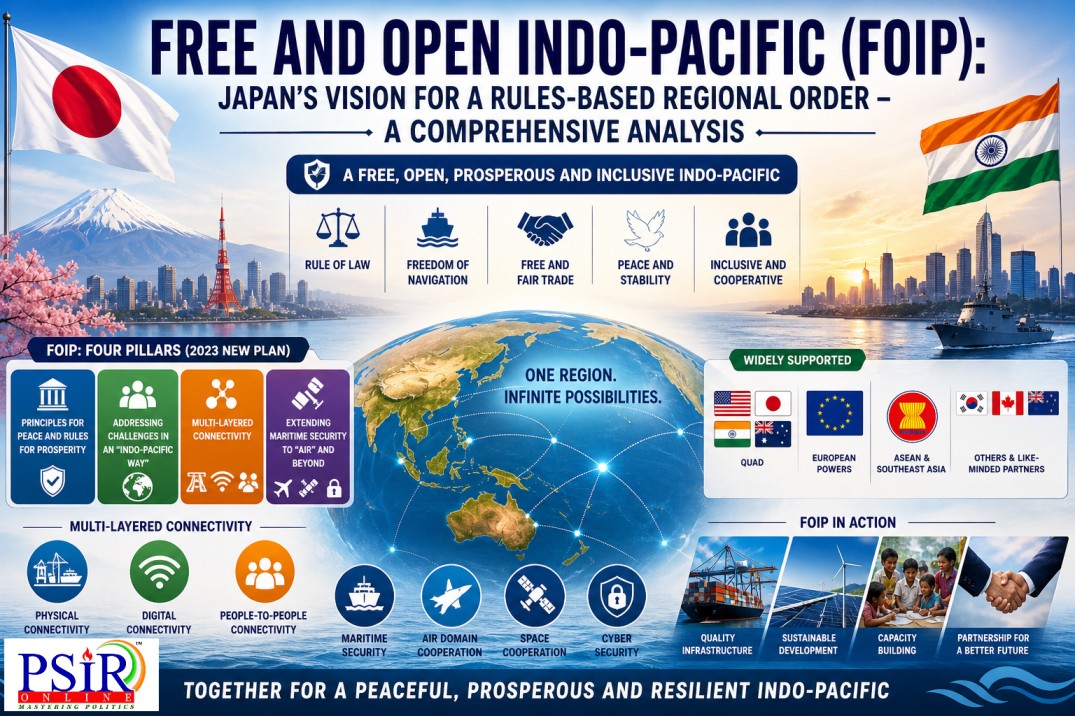
The phrase “Free and Open Indo-Pacific” (FOIP) encapsulates Japan’s long-term diplomatic and strategic vision for the vast Indo-Pacific region, spanning the Indian and Pacific Oceans and linking Asia, Africa, and beyond. First formally articulated by then-Prime Minister Shinzo Abe in a 2016 speech in Nairobi, Kenya (with intellectual roots tracing back to his 2007 address to the Indian Parliament), FOIP envisions a region that is secure, prosperous, and governed by international law rather than coercion or unilateral dominance.
At its core, FOIP promotes:
· Freedom of navigation and overflight.
· Free and fair trade.
· The rule of law in dispute resolution.
· Peaceful settlement of conflicts.
· Opposition to unilateral changes to the status quo (particularly in the East and South China Seas).
· “Quality” infrastructure and transparent connectivity projects as alternatives to opaque, debt-driven initiatives.
Japan frames FOIP not as an exclusive bloc or military alliance but as an inclusive, open vision that welcomes any country sharing its principles. It has evolved from a “strategy” (2016–2018) to a “concept”/“vision” and, most recently (2023 onward), a “New Plan” under Prime Minister Fumio Kishida, emphasizing practical cooperation.
The Indo-Pacific itself is not merely geographic; it represents half the world’s population, a major share of global GDP, and critical sea lanes carrying over half of global trade. FOIP positions this mega-region as a zone of shared prosperity where no single power dominates through military or economic coercion.
HISTORICAL EVOLUTION AND KEY PILLARS
FOIP builds on Abe’s “Confluence of the Two Seas” idea (2007), linking the Pacific and Indian Oceans as “seas of freedom and prosperity.” It gained momentum amid China’s assertive maritime claims, Belt and Road Initiative (BRI) expansion, and concerns over supply-chain vulnerabilities.
Original three pillars (2016):
· Promotion and establishment of the rule of law, freedom of navigation, and free trade.
· Pursuit of economic prosperity through improved connectivity (ports, roads, digital infrastructure).
· Commitment to peace and stability via capacity-building and security cooperation.
2023 New Plan (announced by Kishida in New Delhi) introduced four pillars for contemporary challenges:
1. Principles for peace and rules for prosperity (rule of law, democratic values, anti-coercion).
2. Addressing challenges in an “Indo-Pacific way” (region-specific, inclusive solutions).
3. Multi-layered connectivity (physical, digital, people-to-people).
4. Extending maritime security efforts to the “air” domain and beyond (space, cyber).

By 2026, marking its 10th anniversary, FOIP has shifted emphasis toward resilient supply chains, critical minerals, semiconductors, and hybrid threats, reflecting post-COVID and geopolitical realities.
COUNTRIES THAT ENDORSE OR ACTIVELY SUPPORT FOIP
FOIP’s strength lies in its flexibility; dozens of nations have aligned with or adopted compatible strategies. Key endorsers include:
Quadrilateral Security Dialogue (Quad) partners: United States (adopted FOIP in 2019, renamed Indo-Pacific Command), Australia (2017 Foreign Policy White Paper), and India (Modi’s 2018 Shangri-La speech on a “free, open, and inclusive Indo-Pacific”). The Quad serves as a practical implementation vehicle for maritime domain awareness, supply-chain resilience, and joint exercises.
European powers: France (2018/2021 Indo-Pacific strategy, territories in the region), Germany (2020 guidelines), United Kingdom (Integrated Review), Netherlands, and EU as a whole emphasize rule-of-law and sustainable connectivity. The 2021 Japan-EU Summit explicitly endorsed a “free and open Indo-Pacific” based on democratic values.
ASEAN and Southeast Asia: ASEAN’s 2019 Outlook on the Indo-Pacific (AOIP) overlaps significantly with FOIP in promoting inclusivity, ASEAN centrality, and rules-based order. Vietnam, Philippines, and Indonesia have deepened practical cooperation (e.g., Philippines-Japan Reciprocal Access Agreement 2024/2025). Indonesia’s own Indo-Pacific Cooperation Concept (2018) aligns closely.
Pacific Island nations: Fiji’s 2023 “Ocean of Peace” declaration (endorsed 2025) shares FOIP principles; Palau, others benefit from Japanese capacity-building in coast guards and resilience projects.
Others: South Korea (2022 strategy, though subject to domestic shifts), Canada (2022 Indo-Pacific Strategy), New Zealand, and even some African and Middle Eastern states through connectivity initiatives. G7 and NATO have referenced FOIP-aligned goals.
India and Japan have elevated ties to a “Special Strategic and Global Partnership,” co-leading in the Quad, Indo-Pacific Oceans Initiative (IPOI), and Supply Chain Resilience Initiative.
COUNTRIES THAT REJECT, OPPOSE, OR REMAIN CAUTIOUS TOWARD FOIP
While framed as inclusive, FOIP faces explicit and implicit pushback:
China: Views FOIP as a thinly veiled containment strategy targeting its rise, BRI projects, and claims in the South/East China Seas. Beijing criticizes it as creating “exclusive small circles,” undermining ASEAN centrality, and risking regional division. Official rhetoric labels it confrontational and incompatible with “win-win” cooperation, though China occasionally engages on selective economic issues.
Russia: Echoes China’s critique, describing FOIP/Quad as “closed and exclusive” structures that target third parties and destabilize the Asia-Pacific.
Some ASEAN members: Indonesia, Malaysia, and others stress “inclusivity” and fear being forced to choose sides. They prioritize ASEAN-led mechanisms to avoid alienating their largest trading partner (China) while hedging against coercion. Concerns include FOIP’s perceived U.S./Japan-centric security focus potentially eroding ASEAN centrality.
Hedging states: Many smaller economies maintain deep trade ties with China and avoid overt endorsement to prevent economic retaliation (e.g., coercion via trade or gray-zone tactics). South Korea has shown ambivalence due to economic interdependence.
Overall, opposition stems less from ideological rejection of “free and open” principles and more from geopolitical calculations and fear of great-power rivalry.
INDIA–JAPAN PARTNERSHIP AS THE CORNERSTONE OF FOIP IMPLEMENTATION
India and Japan exemplify FOIP in action. Their bilateral relationship has matured into a comprehensive strategic partnership covering defense (Malabar, MILAN exercises, intelligence-sharing), infrastructure (Andaman-Nicobar connectivity, port development), and economic security (semiconductors, critical minerals, resilient supply chains).
Both nations explicitly endorse a “free, open, and inclusive Indo-Pacific.” Japan sees India as an “indispensable partner”; India integrates FOIP with its Act East Policy and SAGAR (Security and Growth for All in the Region) vision. Joint projects emphasize transparent, high-quality infrastructure as a counter to non-transparent debt traps.
Focus of the New Delhi Conference (March 24, 2026)
The International Conference on “India–Japan Cooperation in the Indo-Pacific: Enhancing Security and Stability,” hosted by India Foundation, marked FOIP’s 10th anniversary. It highlighted the “New Golden Chapter” in bilateral ties, as noted by Japanese Ambassador Ono Keiichi. Discussions centered on:
· Strategic depth via Quad and IPOI.
· Maritime domain awareness and anti-coercion measures.
· Resilient supply chains and critical technology diversification.
· Capacity-building in Southeast Asia for port security and law enforcement.
The event underscored shared democratic values and collaborative responses to regional challenges.
ADVANTAGES AND DISADVANTAGES OF JAPAN’S FREE AND OPEN INDO‑PACIFIC (FOIP) VISION
Key Advantages of FOIP
1. Rules‑based stability and order
a. Deters unilateralism, coercion, and grey‑zone tactics by reinforcing the United Nations Convention on the Law of the Sea (UNCLOS) and commitments to peaceful dispute settlement.
b. Provides a normative anchor that discourages attempts to alter the status quo by force, especially in maritime domains such as the South China Sea and East China Sea.
2. Economic resilience and secure supply chains
a. Encourages diversified, resilient supply chains across critical sectors (semiconductors, rare earths, energy, pharmaceuticals), reducing dependence on any one actor—including China.
b. Promotes high‑quality, transparent, and sustainable infrastructure finance through standards like the G7 Principles for Infrastructure Investment, countering “debt‑traps” and opaque financing models.
3. Inclusive multilateralism and connectivity
a. Acts as a flexible, non‑exclusive framework that enables participation from Indo‑Pacific, Indo‑Mediterranean, and Africa‑linked economies (e.g., India, ASEAN, EU, Middle East partners) without formal alliance burdens.
b. Enhances physical and digital connectivity across Asia–Africa–Europe corridors, supporting development‑linked integration rather than narrow military blocs.
4. Enhanced security interoperability
a. Strengthens maritime security through joint exercises, capacity‑building in coastal‑state navies and coastguards, and shared maritime domain awareness (e.g., QUAD‑linked initiatives).
b. Improves regional disaster response and humanitarian‑assistance coordination via interoperable standards and pre‑positioned assets.
5. Normative and values‑based appeal
a. Articulates democratic governance, human rights, rule of law, and good governance as public goods, reinforcing legitimacy among like‑minded democracies.
b. Provides a counter‑narrative to autocratic models of influence, framing openness and transparency as core development principles.
6. Japan’s soft‑power and development leadership
a. Positions Tokyo as a trusted, high‑quality development partner through concessional ODA, clean technology, and climate‑resilient infrastructure.
b. Leverages Japanese expertise in green growth, digital infrastructure, and disaster‑resilient projects to build long‑term trust and dependency.
7. Complementarity with regional architecture
a. Designed to support ASEAN centrality and initiatives such as the Indo‑Pacific Oceans Initiative (IPOI) and ASEAN Outlook on the Indo‑Pacific, rather than replace them.
b. Encourages regional‑led solutions while adding advanced‑technology and finance support from external partners.
Disadvantages, Criticisms, and Limitations of FOIP
1. Perceived anti‑China bias and security dilemma
a. Often viewed by Beijing and some non‑aligned states as an implicit containment strategy, which risks hardening China’s assertiveness and triggering counter‑initiatives such as the Belt and Road Initiative (BRI)‑plus models.
b. Encourages regional states to “choose sides,” increasing strategic fragmentation and reducing room for neutral or balancing diplomacy.
2. Implementation vagueness and lack of binding mechanisms
a. Emphasis on flexibility and voluntary participation can dilute concrete, enforceable commitments, leading to inconsistent project‑level follow‑through.
b. Absence of supranational enforcement or dispute‑settlement bodies makes it difficult to ensure compliance with promised transparency and environmental standards.
3. Economic trade‑offs and decoupling costs
a. Encourages partial economic decoupling from China, which may raise input and transport costs for countries deeply integrated into China‑centric manufacturing networks.
b. Smaller and middle powers may face trade losses, reduced FDI, or retaliatory measures if they openly align with FOIP‑linked initiatives.
4. ASEAN centrality vs. great‑power minilateralism
a. As the US‑Japan‑India‑Australia “Quad” and other minilateral bodies gain prominence, ASEAN‑led institutions may be sidelined in decision‑making, even if FOIP explicitly pays lip‑service to ASEAN centrality.
b. Regional states complain that “FOIP‑plus” formats are driven by great‑power agendas rather than inclusive regional consensus.
5. Resource and commitment gaps among partners
a. Smaller Indo‑Pacific states often lack the administrative capacity, technical expertise, or financing to fully absorb complex FOIP‑linked projects, leading to uneven implementation.
b. Japan and its partners face domestic budgetary limits, political cycles, and competing priorities that constrain long‑term financial and logistical commitments.
6. Hypocrisy and selective application of norms
a. Critics argue that FOIP states sometimes engage with non‑democratic or rights‑problematic partners when strategic interests demand (e.g., security or energy cooperation), undermining the normative consistency of the framework.
b. Emphasis on “rules‑based order” can be weaponised rhetorically, with powerful actors invoking rules selectively when they suit their interests.
7. Competitive framing with BRI and other regional initiatives
a. FOIP is often presented as the “norm‑based alternative” to China’s BRI, but this competitive optics can foster zero‑sum thinking instead of pragmatic cooperation.
b. Some developing countries see both frameworks as competing great‑power projects, and may prefer hedging or “pick‑and‑choose” strategies rather than full alignment.
8. Limited inclusion of non‑democratic or non‑aligned actors
a. Strong emphasis on democratic values and “like‑minded” partners can alienate important regional players that are not fully democratic or prefer strategic autonomy.
b. Vulnerability exists that FOIP‑aligned projects may be perceived as aligning with Western‑centric security agendas, triggering resistance in politically sensitive contexts.
CAN FOIP BE REALIZED? TIMELINE, FEASIBILITY, AND OBSTACLES
Full realization of an entirely “free and open” Indo-Pacific is a long-term, incremental process rather than a near-term outcome.
Short-term (next 5–10 years): Partial successes in connectivity projects, supply-chain diversification, and maritime cooperation are realistic. The Quad, bilateral pacts (e.g., Japan-Philippines), and ASEAN+ engagements provide momentum. The 2026 conference signals continued political will.
Medium- to long-term: A genuinely rules-based order depends on sustained multilateral pressure, economic alternatives to BRI, and China’s willingness to moderate behavior. Geopolitical shocks (e.g., Taiwan contingency, South China Sea escalation) could accelerate or derail progress.
Major obstacles:
· China’s economic and military leverage: Massive BRI footprint, gray-zone tactics, and ability to punish critics economically.
· Hedging by regional states: Economic dependence on China discourages full alignment.
· Great-power rivalry: U.S.-China competition overshadows cooperative aspects.
· Diverse regional interests: Sovereignty disputes, development gaps, and non-traditional security threats (climate, piracy) complicate unified action.
· Internal challenges: Japan’s demographic/economic constraints; domestic politics in Quad nations; lack of a comprehensive FOIP funding blueprint.
· Global distractions: Conflicts elsewhere (Ukraine, Middle East) divert attention and resources.
What ultimately stops full realization is not conceptual weakness but structural power realities: China’s rise has altered the regional balance, forcing FOIP into a competitive rather than purely cooperative framework. Success hinges on demonstrating tangible benefits (prosperity without dependency) while avoiding outright confrontation.
FOIP’S ENDURING RELEVANCE
Ten years on, FOIP remains Japan’s (and partners’) guiding framework for navigating 21st-century geopolitics. Its adaptability has enabled widespread adoption, but its ambitions face formidable headwinds.
For India and Japan, deepening cooperation offers a model of pragmatic, values-driven partnership. Whether FOIP evolves into a truly transformative regional order or remains an aspirational counterweight will depend on sustained diplomacy, economic innovation, and the collective will of like-minded nations.
In an era of strategic competition, FOIP’s emphasis on openness, rules, and connectivity provides a constructive alternative—provided it can deliver concrete results without alienating the very region it seeks to stabilize.
PRACTICE QUESTIONS FOR GS 2 MAINS
1. “The Free and Open Indo-Pacific (FOIP) vision reflects the shift towards a rules-based regional order in Asia.” Examine its significance for India’s foreign policy.
2. Discuss how the 2023 FOIP New Plan addresses contemporary challenges in the Indo-Pacific region with special reference to connectivity and security.
3. “FOIP is both an opportunity and a strategic dilemma for ASEAN countries.” Analyse.
4. Evaluate the role of the India–Japan partnership in strengthening a free, open, and inclusive Indo-Pacific region.
PRACTICE QUESTIONS FOR PSIR OPTIONAL
1. Critically examine Japan’s Free and Open Indo-Pacific (FOIP) as a strategic response to the changing balance of power in Asia.
2. “FOIP represents a normative order based on democratic values but faces structural geopolitical constraints.” Discuss.
3. Analyse the evolution of FOIP from a “strategy” to a “vision” and evaluate its effectiveness in shaping regional order.
4. Examine the convergence and divergence between FOIP and China’s Belt and Road Initiative (BRI) in the Indo-Pacific.